Tenancy Act
Gujarat Rent Bill 2026 Explained: What Changes for Landlords, Tenants and PG Owners

Written by
Ishika Pannu
Read Time
11 min read
Posted on
November 17, 2026
Overview
Overview
Gujarat Rent Bill 2026 Explained: What Changes for Landlords, Tenants and PG Owners
A three-month deposit ceiling, written agreements and faster rent disputes: September headlines made the Gujarat Rent Bill 2026 sound like an immediate reset for every rental property. But Assembly passage does not, by itself, bring those obligations into force. Later developments matter before you change a contract, demand a refund or approach a new authority.
This guide separates the Bill’s proposed changes from steps landlords, tenants and PG operators can take today. It covers agreements, deposits, eviction, essential services and the proposed dispute system, with a particular caution for PG businesses: the nature of your arrangement determines coverage. Research checked on 17 November 2026; the discussion below concerns proposals, not a confirmed operational rollout.
Has Gujarat replaced its 1947 rent law yet?
The Assembly passed the Bill on 11 September 2026. However, the government put it on hold in October after lawyers challenged the proposed transfer of rent disputes to revenue and municipal officers. The Times of India’s October report records that development, which changes how readers should interpret earlier coverage.
The published Bill’s opening clause requires a government notification appointing the commencement date. This review did not verify a later assent or commencement notification. Do not treat a September headline saying “Bombay Rents Act replaced” as sufficient evidence that the replacement now governs your tenancy.
The reason behind the proposed replacement
The government presented reform as a move from the 1947 rent-control framework towards clearer contracts and specialised dispute resolution. Its stated objectives included improving transparency and addressing limitations in the older law, as DeshGujarat’s Assembly report explains.
For an owner, the practical attraction is a documented route to rent recovery and possession. For a tenant, it is clearer limits on deposits and landlord conduct. Those objectives explain the proposal; they do not establish that its new remedies are available today. Existing cases and older tenancies need individual review rather than an assumption that every agreement must immediately restart.
Written agreements and registration serve different purposes
The Bill proposes written tenancy agreements and joint reporting to a Rent Authority within two months of the agreement. It also provides a separate-submission fallback and a tenancy identification number. This would make keeping the contract and filing record important for both parties. The reported agreement provisions describe the proposed process; they do not establish that a public filing portal is currently operational.
An agreement should identify the parties, premises, term, rent, deposit, escalation, repairs, utilities and exit conditions. PG operators should also explain room or bed allocation, meals and other services. WhatsApp discussions can support the record, but they should not carry important terms that the final document leaves unclear.
Does a Rent Authority ID make an agreement registered?
Do not assume that it does. Reporting tenancy information, paying stamp duty, signing a document and completing legal registration perform different functions. The Registration Act’s Section 17 includes compulsory registration for specified leases, including terms exceeding one year, subject to applicable provisions.
Check Gujarat’s requirements for the actual instrument and complete the authorised process where required. An e-signature or proposed tenancy ID should not substitute for that assessment. RentOk’s guide to e-stamping and agreement formalities explains why these steps need separate attention.

The proposed three-month deposit cap and refund deadline
The Bill proposes a security deposit limit of three months’ rent for covered residential and commercial tenancies. It also proposes refund within one month of taking back vacant possession, after adjusting the tenant’s legitimate liabilities. The Assembly coverage of the deposit provisions supports those terms; they remain subject to the Bill’s status and eventual applicable text.
Consider this illustration for a covered tenancy if that framework takes effect:
| Deposit calculation | Illustrative amount |
|---|---|
| Monthly rent | ₹15,000 |
| Maximum deposit at three months’ rent | ₹45,000 |
| Supported, permissible outstanding dues | ₹2,500 |
| Balance after those deductions | ₹42,500 |
The refund clock would connect to vacant possession, not merely the day a tenant sends a move-out message. Record the handover date, returned keys, final meter readings and any disputed charge. Do not treat every repair or cleaning demand as automatically deductible.
Landlords should plan for refunds rather than assume deposits are available business income. Tenants should request an itemised settlement. RentOk’s guide to handling security deposits fairly explains the value of clear deduction policies and condition records.
Would the Gujarat Rent Bill cover every PG?
Coverage needs a case-specific check. The Bill addresses residential and commercial rental premises, but that does not settle every hostel, boarding, licence or service-based accommodation arrangement. The contract’s substance, the premises and statutory exclusions matter more than the label “PG”.
For example, a building owner may lease an entire property to a PG operator, while the operator separately offers beds and meals to residents. These are two different legal relationships. A rule relevant to the building lease should not automatically determine every resident’s deposit or exit rights.
The Bill includes exclusions for specified government premises, employment-linked housing and certain religious, charitable, Waqf and trust properties, with an opt-in mechanism for excluded premises, as IANS’s coverage explains. This Gujarat legal analysis identifies uncertainty around leave-and-licence coverage. Obtain advice on your actual documents before announcing that all PG deposits face an operative three-month ceiling.
For operators, review the building lease’s authority to run the PG, the resident agreement and the service schedule together. Keep food, utilities and accommodation charges identifiable. Clear paperwork helps explain the arrangement without pretending that renaming rent as a service fee determines its legal treatment.
Rent Authority, Rent Court and Rent Tribunal
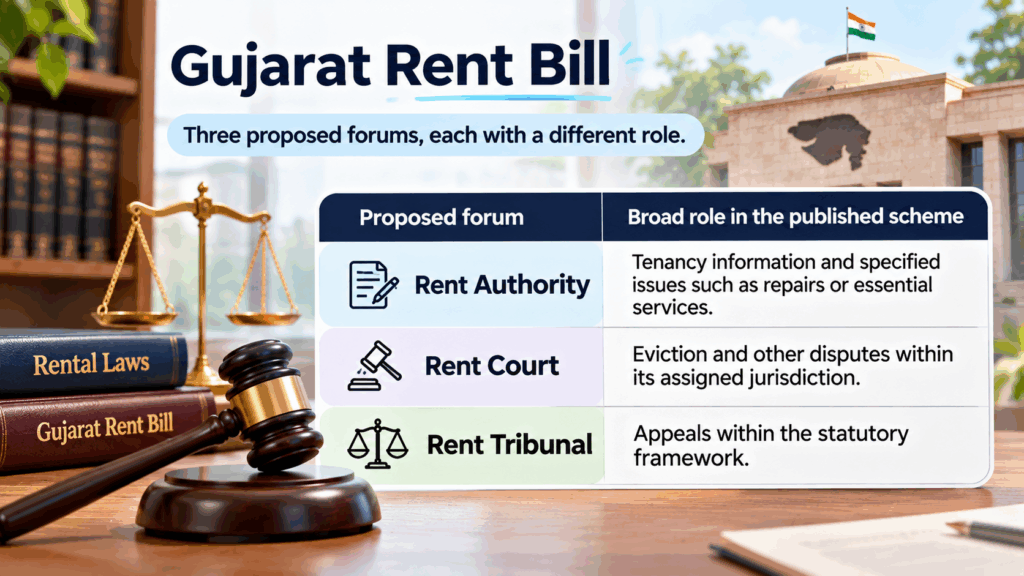
The proposal creates three named forums with different roles. They are not simply three counters that every complaint must visit in order. The correct starting point depends on the relief someone seeks and the final law’s allocation of powers.
| Proposed forum | Broad role in the published scheme |
|---|---|
| Rent Authority | Tenancy information and specified issues such as repairs or essential services |
| Rent Court | Eviction and other disputes within its assigned jurisdiction |
| Rent Tribunal | Appeals within the statutory framework |
The original structure placed executive officers in the Authority and Rent Court roles, with a District Judge or Additional District Judge heading the Tribunal. That allocation helped trigger the opposition. Reporting on the Bill’s dispute system should therefore be read alongside the later hold, rather than as a directory of functioning new offices.
The often-mentioned 60-day timeline is not a guarantee that every disagreement, appeal and enforcement step will finish within two months. Different proceedings carry different proposed timelines. Today, ask a Gujarat lawyer which existing forum has jurisdiction before filing, and organise the agreement, payment history, notices and exact remedy you want.
When could a landlord seek eviction?
The Bill proposes specific eviction grounds and a formal process. Reported grounds include rent default, unauthorised parting with possession, continued misuse and unauthorised structural changes, alongside specified rebuilding and other situations. A landlord’s wish to end a tenancy does not itself authorise physical removal.
The arrears provision is more precise than “miss two months and leave”. The published scheme links two consecutive months’ arrears to a demand notice and a further opportunity to clear the dues. It also proposes double monthly rent for unauthorised occupation after expiry or termination. The Gujarat legal review of these provisions sets out those conditions.
Landlords should document the breach, use the applicable notice process and seek the appropriate order. Tenants should check the notice, reconcile payments and respond within the actual deadline. Neither side should calculate penalties or change possession based only on a headline about the Bill.
RentOk’s explanation of digital rent agreements and their evidence highlights why an authentic executed copy and signing history matter. Preserve amendments and renewal records too; an old draft may not describe the terms that currently govern the stay.
Essential services, entry and necessary repairs
The Bill proposes a bar on landlords withholding water, electricity and gas, as Gujarat Samachar’s passage report explains. Its remedial scheme includes interim restoration and compensation of up to two months’ rent in specified circumstances. Compensation would require the relevant decision; a tenant should not simply deduct that amount independently. The authors’ legal analysis discusses these remedies.
A rent dispute still needs a lawful recovery process. If an owner cuts supply today, document the interruption, request restoration in writing and seek urgent advice on the remedies currently available. Distinguish deliberate interference from a supplier’s outage or disconnection; the cause affects the response.
Privacy, repairs and disaster-related relief
Reported entry safeguards require 24 hours’ written notice and ordinarily limit visits to sunrise–sunset, with emergency exceptions. Schedule inspections and repairs clearly rather than treating ownership as unrestricted access to an occupied room.
The Bill also proposes a repair-cost deduction mechanism, with a half-month’s-rent deduction limit, when the landlord fails to meet the relevant repair obligation. Do not treat this as permission for any renovation or an immediate rent reduction. Confirm the notice, procedure and deduction conditions before acting. The authors’ legal commentary on the proposals discusses this provision.
For disasters that make premises uninhabitable, the proposal includes rent relief linked to that condition. Preserve photographs, inspection findings and correspondence. A disagreement about maintenance alone does not establish disaster-related uninhabitability or permission to stop paying rent.
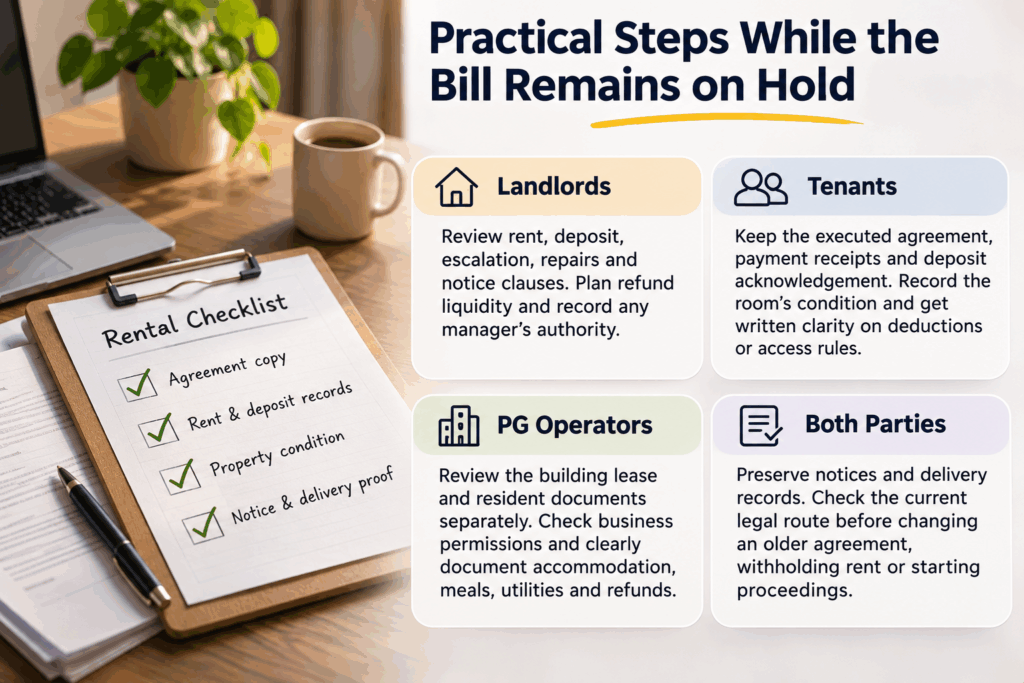
Practical steps while the Bill remains on hold
Use this period to improve your records and identify gaps. Avoid paying an intermediary for a supposed mandatory new registration without confirming the official requirement, portal and commencement position. Keep a copy of the notification you rely on, including its date and scope.
- Landlords: Review the rent, deposit, escalation, repair responsibilities and notice clauses. Plan refund liquidity and document any manager’s authority to act for you.
- Tenants: Obtain the executed agreement, payment receipts and deposit acknowledgement. Record the room’s condition and request written clarification of unclear deductions or access rules.
- PG operators: Review the building lease and resident documents separately. Check permissions for the business and explain accommodation, meals, utilities and refunds consistently.
- Both parties: Preserve notices and delivery records. Check the current legal route before changing an older agreement, withholding rent or starting proceedings.
RentOk’s rental handover documentation guide explains the practical records worth collecting. For a multi-resident property, its guide to tracking PG security deposits helps structure the payment and settlement history. Use those operational practices alongside Gujarat-specific advice, rather than as substitutes for the law.
How RentOk helps organise agreements and tenancy records
A change in rent law creates practical work: checking the right parties, finding the current agreement and explaining payments or deductions. RentOk connects agreement workflows with resident records, helping operators organise that information before a renewal, refund discussion or legal review.
- Prepare and review agreements: Enter resident details and review the agreement before signing. Check the property, financial terms and responsibilities against the arrangement everyone accepted.
- Include the relevant signers: The multi-party workflow supports co-owners, co-tenants, witnesses and parent or guardian details for under-18 residents. Confirm each person’s authority and legal role before execution.
- Track signing and retrieve the PDF: Agreement Parties shows signing status, and the completed agreement becomes available from the resident’s profile. Aadhaar e-Sign is available with property-level enablement; confirm the options your account supports.
- Keep payment evidence accessible: The payment page provides dues details and a Receipts tab where tenants can view and save receipts. Keep the completed-payment reference with the relevant receipt for reconciliation.
RentOk’s published agreement and payment workflow documents these capabilities. Agreement creation and e-signing do not establish government registration or Rent Authority filing. Confirm the applicable Gujarat formalities and complete the authorised process separately where required.
Conclusion
The Gujarat Rent Bill 2026 proposes significant changes to agreements, deposits, eviction and dispute resolution. Its October hold makes commencement the first check before anyone relies on those proposals. Landlords, tenants and PG operators can still act now by clarifying their contracts and maintaining complete payment, condition and notice records.
Create your rent agreement on RentOk, review the terms and signers, and complete any required registration through Gujarat’s authorised process. Keep the registration record and any future Rent Authority acknowledgement alongside the executed agreement.
Frequently Asked Questions
Find answers to common questions about this topic
About the Author
Ishika Pannu
Ishika Pannu brings you the latest insights and easy-to-apply strategies in property management—helping you simplify renting and grow with RentOk.