
Legal
How to File a Rental Dispute Complaint in India (Step-by-Step Guide)

Written by
Ishika Pannu
Read Time
15 min read
Posted on
September 6, 2026
Overview
Overview
How to File a Rental Dispute Complaint in India (Step-by-Step Guide)
Rental disputes rarely begin as legal disputes. They often start with manageable issues. A tenant may question a security deposit deduction. A landlord may claim that rent is overdue. A repair may remain unresolved. One party may also want to end the tenancy early.
The situation becomes complicated when conversations remain informal and neither side has a clear record of what was agreed. A payment may have been made but not properly recorded. A notice may have been communicated verbally. A maintenance request may have been raised several times without a formal trail. By the time either party considers filing a complaint, the original disagreement may already involve multiple issues.
Knowing how to file a rental dispute complaint in India involves more than finding the right authority. First, understand the nature of the dispute and review your tenancy agreement. Then, organise your evidence and identify the legal remedy that applies to your situation.
There is another important point tenants should know. India does not have one identical rental-dispute procedure that applies to every property. Tenancy matters are largely governed by applicable state laws, while the Model Tenancy Act, 2021 provides a model framework that states and Union Territories may adopt or modify. RentOk’s recent guide on tenant rights under the Model Tenancy Act explains why checking the law applicable to your particular property is important before relying on the model framework.
What Counts as a Rental Dispute?
A rental dispute can arise from almost any part of the landlord-tenant relationship. However, identifying the exact issue is important because different disputes can involve different remedies and legal procedures.
For example, a disagreement over a security deposit is fundamentally different from a dispute over possession of the property. Similarly, an unresolved maintenance complaint may require a different approach from a disagreement about unpaid rent.
Some of the more common rental disputes include:
- Security deposit disputes: These often arise when a tenant believes deductions are excessive, unexplained, or unrelated to actual dues or damage. The original deposit amount, tenancy agreement, move-out records, and communication about deductions can become important evidence.
- Rent and payment disputes: A landlord may claim that rent remains unpaid, while the tenant may have transaction records showing otherwise. Disagreements can also involve late charges, utility payments, or other amounts mentioned in the agreement.
- Maintenance and essential-service disputes: Problems involving repairs, water, electricity, sanitation, or other necessary services can become serious when requests remain unresolved or responsibilities between the parties are unclear.
- Notice and eviction disputes: A disagreement may develop over whether sufficient notice was given, whether the tenancy was validly terminated, or whether either party followed the applicable agreement and law.
- Agreement-related disputes: Lock-in periods, rent increases, renewal terms, early termination, and other contractual conditions can all become sources of conflict when the written terms are unclear or interpreted differently.
The first objective should therefore be to define the dispute precisely. Instead of saying, “My landlord is treating me unfairly,” identify the actual issue: What happened? When did it happen? What does the agreement say? What outcome are you seeking?
That clarity becomes particularly valuable if the matter eventually moves beyond direct communication.
Try to Resolve the Dispute Before Going Legal
Not every rental disagreement needs to begin with a formal complaint.
In many situations, the first useful step is a clear written conversation between the tenant and landlord. This gives both parties an opportunity to understand the disagreement and correct a genuine misunderstanding before the matter becomes more expensive and time-consuming.
Suppose a tenant has received only part of their security deposit after moving out. Before escalating, they could request a written explanation of each deduction and compare it with the terms of the agreement. If the landlord provides an explanation supported by records, the matter may be resolved without further action. If the explanation does not match the agreement, the tenant now has a clearer basis for responding.
A professional attempt at negotiation should generally include:
- A clear description of the problem: Mention the relevant date, payment, notice, repair, deduction, or contractual term instead of making broad accusations about the landlord or tenant.
- The evidence supporting your position: Refer to the agreement, payment records, photographs, receipts, messages, or notices that directly relate to the dispute.
- A specific resolution: State exactly what you want to happen, such as payment of a disputed amount, clarification of deductions, completion of a repair, or correction of a payment record.
- A reasonable opportunity to respond: Give the other party sufficient time to consider the issue, unless the circumstances require urgent action.
This approach is not about being overly formal. It is about creating clarity.
RentOk’s article on handling rental disputes without going to court follows a similar principle: documentation and early resolution can prevent disagreements from unnecessarily turning into formal legal conflicts.
Before Filing a Complaint, Get Your Documents in Order
If negotiation does not work, documentation becomes even more important.
A rental dispute is ultimately about establishing facts. Who paid what? What did the agreement say? When was notice given? Was the complaint raised earlier? What response was received? Were deductions explained?
The stronger your records, the easier it becomes to answer these questions.
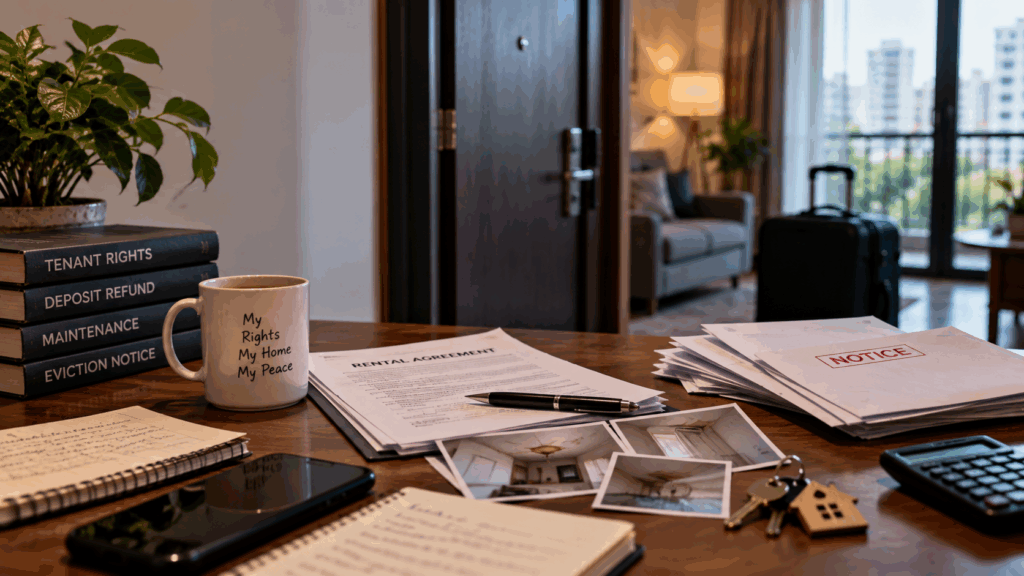
Ideally, keep a complete tenancy file containing:
- The signed rental agreement: Preserve the original agreement and any renewals, amendments, addendums, or written changes made during the tenancy.
- Payment records: Keep rent receipts, bank statements, UPI transaction records, deposit payments, utility payments, and other relevant financial evidence.
- Communication records: Save important emails, messages, written notices, maintenance complaints, and responses, particularly where they concern payments, termination, repairs, or deposit settlement.
- Property-condition records: Photographs and videos from move-in and move-out can be useful when a dispute involves damage, cleanliness, furnishings, appliances, or maintenance.
- Notice and settlement documents: Keep copies of notices received and sent, as well as any final statement showing deductions, pending dues, or settlement amounts.
The objective is not to turn every tenancy into a legal file. Good documentation simply ensures that an important event does not depend on someone’s memory months later.
RentOk has also covered real tenant disputes where payment records, notices, and documented agreements helped clarify disagreements before they became larger legal matters. Its RentOk Legal Cases article provides useful examples of how documentation can change the way a rental dispute is handled.
When Should You Send a Legal Notice?
When informal communication has failed, a legal notice may become the appropriate next step, particularly where there is a significant financial or contractual dispute.
A legal notice is more than an angry message written in formal language. It should establish the facts, identify the issue, explain the basis of the claim, and clearly state what resolution is being sought.
There is no single legal-notice format that works for every rental dispute in India. The contents depend on the agreement, applicable state law, nature of the dispute, and remedy being pursued.
A properly prepared notice may address:
- The tenancy: Identify the parties, property, agreement, tenancy period, and other relevant background.
- The dispute: Explain what happened in chronological order, including relevant payments, notices, communications, or incidents.
- The contractual or legal basis: Identify the relevant agreement terms or applicable legal provisions rather than making unsupported legal accusations.
- The requested resolution: Clearly state what action you expect the other party to take and within what period, where appropriate.
- Further action: Explain the intended next step if the matter is not resolved, but only in a manner consistent with the applicable legal process.
For significant disputes, particularly those involving eviction, substantial money, or contested possession, getting the notice reviewed by a qualified lawyer is a sensible step. A poorly drafted notice can sometimes create additional confusion instead of resolving the original issue.
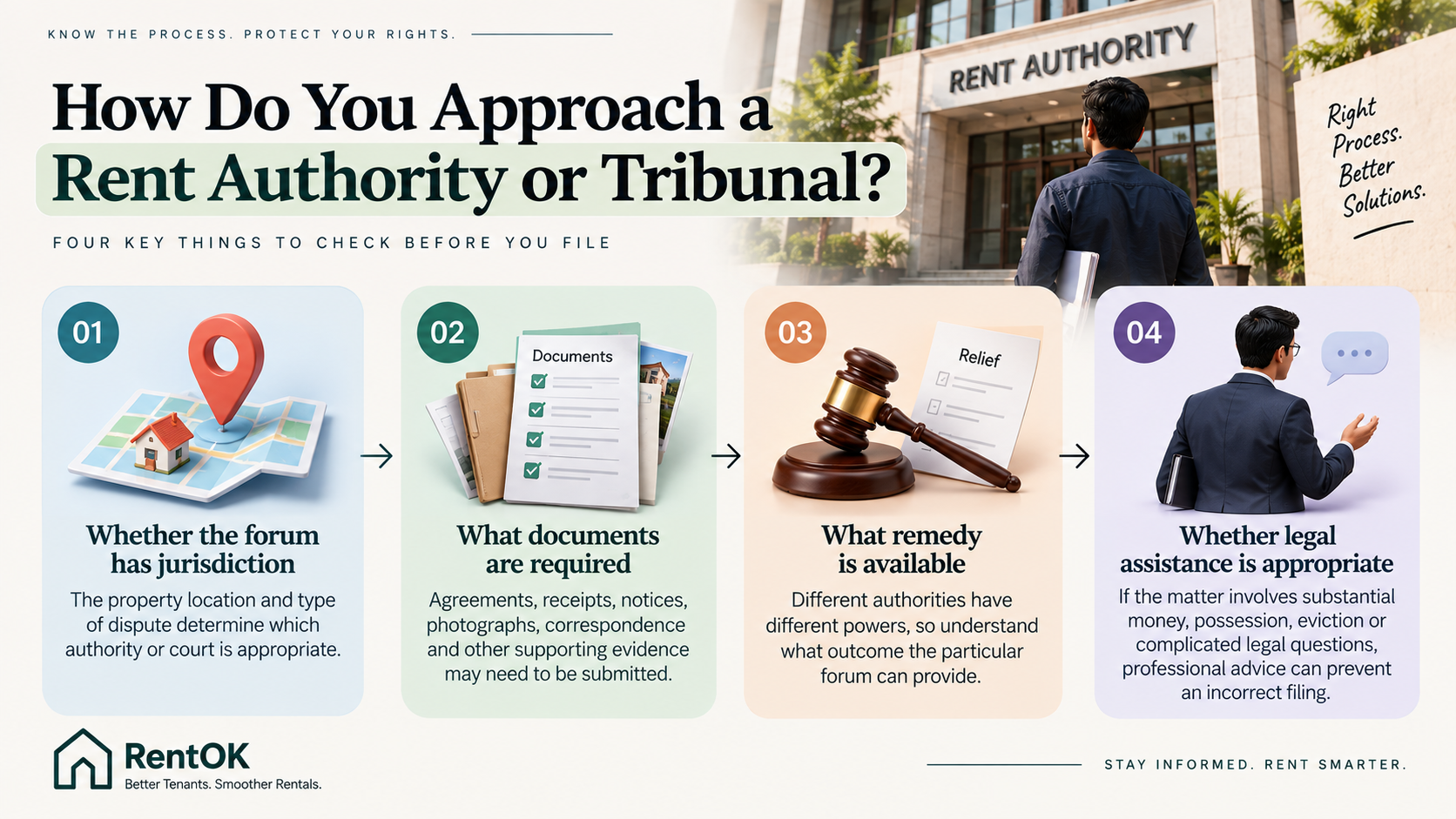
How Do You Approach a Rent Authority or Tribunal?
This is one area where tenants should avoid assuming that the same procedure applies throughout India.
The Model Tenancy Act, 2021 proposes a structured tenancy dispute-resolution system involving a Rent Authority, Rent Court, and Rent Tribunal. Its objective is to create a specialised framework for rental disputes. However, it is a model framework, and its applicability depends on adoption and the laws in force in the relevant state or Union Territory.
Therefore, before filing anything, determine which authority actually has jurisdiction over your tenancy.
The process may involve identifying the correct forum, preparing the required application or complaint, submitting supporting documents, paying any applicable filing fee, and responding to further procedural requirements.
Before proceeding, verify:
- Whether the forum has jurisdiction: The property location and type of dispute can determine which authority or court is appropriate.
- What documents are required: Agreements, receipts, notices, photographs, correspondence, and other supporting evidence may need to be submitted.
- What remedy is available: Different authorities have different powers, so understand what outcome the particular forum can provide.
- Whether legal assistance is appropriate: If the matter involves substantial money, possession, eviction, or complicated legal questions, professional advice can prevent an incorrect filing.
The important principle is simple: do not file first and figure out jurisdiction later. Choosing the wrong forum can delay the resolution of an already stressful dispute.
Can You File a Rental Dispute in a Consumer Forum?
Consumer law can sometimes apply to disputes involving accommodation and services. However, it is not a universal solution for landlord-tenant disagreements.
The Consumer Protection Act, 2019 covers complaints involving deficiency in services and unfair trade practices. Whether a rental arrangement falls under the Act depends on the facts and the relationship between the parties.
This distinction can become especially important in PG and co-living arrangements. A resident may be paying for accommodation alongside services such as housekeeping, food, maintenance, or other facilities. However, the presence of additional services does not automatically determine the correct legal forum.
Before approaching a consumer commission, consider:
- What exactly are you complaining about? Separate a service-related issue from a pure tenancy or possession dispute.
- What documents support your claim? Agreements, invoices, payment records, communication, and service-related evidence may all be relevant.
- Does the forum have jurisdiction? Confirm that the consumer framework applies to the particular relationship and dispute.
- Would another legal remedy be more appropriate? Tenancy law, contractual remedies, civil proceedings, or another specialised mechanism may be relevant depending on the circumstances.
When the legal position is uncertain, professional legal advice is preferable to filing multiple complaints simply because several forums appear available.
How Long Does Rental Dispute Resolution Take?
There is no single timeline for rent dispute resolution in India.
The time required can depend on the state, applicable law, forum, nature of the dispute, complexity of the evidence, response from the other party, and whether the matter is settled before formal proceedings continue.
A straightforward payment or deposit disagreement may be resolved through communication and documentation relatively quickly. A contested possession or eviction matter can be considerably more complicated.
It is useful to think about the process in stages:
First comes resolution. Both parties get an opportunity to discuss the problem and reach an agreement.
Then comes formal escalation. A written complaint or legal notice can establish the dispute more clearly if informal communication has failed.
After that comes the appropriate forum. If the issue remains unresolved, the tenant may need to approach the authority, tribunal, court, or other mechanism that has jurisdiction.
Finally comes the proceeding itself. Depending on the matter, this can involve submissions, responses, evidence, hearings, and a final order or settlement.
This is also why delaying documentation can be a costly mistake. If you wait until a dispute becomes serious to reconstruct months of payments and conversations, important evidence may be difficult to locate.
For disputes involving unpaid rent and possession, RentOk’s guide on how to legally evict a non-paying tenant in India is another useful internal resource because it explains why rent recovery and recovery of possession are not necessarily the same legal question.
What If the Dispute Is About Eviction?
Eviction and possession disputes require particular care. Neither landlord nor tenant should assume that an argument automatically changes their legal rights.
A landlord’s ownership does not mean every demand to vacate can be enforced immediately. The applicable agreement and law must still be considered. Likewise, a tenant cannot assume that indefinite occupation prevents the landlord from seeking possession through the proper legal process.
Several factors may matter in these disputes. These include the tenancy agreement, state law, notice requirements, and the reason for termination. Payment history and other circumstances of the tenancy may also be relevant.
Written records are especially important in possession disputes. Tenants should preserve notices and communications. Landlords should maintain records of rent, defaults, notices, and other relevant events.
RentOk’s recent article on how to legally evict a non-paying tenant also emphasises the importance of reviewing the agreement and applicable law before moving toward formal action.
The safest approach is not to treat eviction as an informal argument. When possession is genuinely contested, both parties should follow the applicable legal process.
Keep Your Complaint Factual and Well-Organised
A rental dispute complaint should not read like a collection of every frustration you have experienced during the tenancy.
The strongest complaints usually establish a straightforward timeline. Start with the tenancy and the terms that matter. Explain what happened next, what communication took place, what attempts were made to resolve the issue, and what remains unresolved.
For example, if the dispute concerns a security deposit, focus on the deposit paid, relevant agreement terms, move-out condition, deductions communicated by the landlord, and the amount you believe remains payable.
If the dispute concerns maintenance, explain when the problem was reported, how it was communicated, what response was received, and why the matter remains unresolved.
This makes the complaint easier for another person to understand and allows the supporting evidence to connect directly with each claim.
Avoid exaggeration where a precise fact will do more work. Saying “I paid ₹20,000 on 5 August and have the transaction record” is much more useful than simply saying “I always paid everything on time.”
A good rental dispute complaint is not necessarily the longest one. It is the one where the facts, documents, agreement terms, and requested resolution fit together clearly.

How RentOk Helps Property Managers Handle Rental Disputes Better
For rental businesses, preventing disputes often starts long before a complaint is filed. When tenant information, payment records, agreements, deposits, complaints, and communication are scattered across spreadsheets, paper registers, WhatsApp conversations, and individual devices, establishing a clear history becomes difficult.
RentOk helps property managers and landlords bring important rental operations into one structured system. Tenant information, payment tracking, occupancy records, complaints, agreements, deposits, and communication can be managed with greater visibility instead of being maintained through disconnected manual records.
This matters because organised records can reduce the ambiguity that often turns ordinary rental disagreements into larger conflicts. RentOk’s own legal case examples show how payment logs, digital notices, agreement records, and documented communication have been used to clarify disputes involving deposits, rent payments, fines, eviction, and verbal-agreement confusion.
RentOk does not replace a lawyer, court, Rent Authority, tribunal, or other legal forum. What it does is help rental businesses create a more consistent operational record, making everyday tenant management more transparent and giving property managers better visibility when an issue needs to be investigated.
Conclusion
A rental dispute complaint in India should not be the first reaction to every disagreement. In many cases, the better approach is to understand the issue, review the agreement, organise the evidence, communicate clearly, and give both parties an opportunity to resolve the matter before escalating.
If formal action becomes necessary, the correct route depends on the nature of the dispute and the law applicable to the property. A Rent Authority or tribunal may be relevant in jurisdictions where the applicable tenancy framework provides for it. A consumer forum may be appropriate for certain service-related disputes, while other matters may require a different legal remedy. There is no universal process that can safely be applied to every landlord-tenant disagreement.
The most important protection is therefore preparation. Keep your rental agreement, payment records, notices, communication, and property-condition evidence organised from the beginning. When a dispute does arise, you will be in a much stronger position to explain what happened and determine what needs to happen next.
Frequently Asked Questions
Find answers to common questions about this topic
About the Author
Ishika Pannu
Ishika Pannu brings you the latest insights and easy-to-apply strategies in property management—helping you simplify renting and grow with RentOk.
You may also like these
Related Articles

1 min read
The Satya Niketan PG Collapse: What It Means for Safety in Delhi PG’s
Written by
Posted on
Ishika Pannu
Sep 7, 2026
1 min read
What to Do If Your Landlord Refuses to Return Your Security Deposit
Written by
Posted on
Ishika Pannu
Sep 5, 2026
1 min read
Why Landlords Cannot Legally Refuse Unmarried Tenants in India
Written by
Posted on
Ishika Pannu
Sep 5, 2026
1 min read
How to Get Your Security Deposit Back When Vacating a Rental Property
Written by
Posted on
Ishika Pannu
Sep 5, 2026
1 min read
What Is Tenant Police Verification and Why Is It Mandatory in India?
Written by
Posted on
Ishika Pannu
Sep 4, 2026
1 min read
How to Read a Rent Agreement Before Signing: What to Watch Out For
Written by
Posted on
Ishika Pannu
Sep 4, 2026
1 min read
What Are Your Rights as a Tenant Under the Model Tenancy Act?
Written by
Posted on
Ishika Pannu
Sep 3, 2026

1 min read
How to Get FSSAI Licence for Your Hostel Mess or Canteen
Written by
Posted on
Ishika Pannu
Sep 3, 2026
1 min read
How to Use Digital Signatures on Rent Agreements Legally in India
Written by
Posted on
Ishika Pannu
Sep 1, 2026
1 min read
How to Get Society Permission Before Renting Out Your Flat
Written by
Posted on
Ishika Pannu
Aug 31, 2026
Stay ahead in property management with expert insights
Join thousands of property managers receiving exclusive tips delivered straight to your inbox.
Browse posts by category
Case Study
Cost of Living
Growth
Legal
Market Trends
News
Pg owner app
Property Management
Property Tax
Tech
RentOk
The easiest way to rent and manage your PGs and hostels.
Get the app


Contact us
hello@eazyapp.tech
HQ Office
COGROW, BASEMENT F-12/8A
BESIDE HOUSE OF STYLE SALON, SECTOR 28, DLF PHASE 1
GURUGRAM, HARYANA - 122002
South India Office
LUMIODESK COWORKING, 2ND FLOOR, 40, 14TH MAIN RD
BESIDE MC DONALD, 7TH SECTOR, HSR LAYOUT
BENGALURU, KARNATAKA - 560102
©️ 2026 EazyApp Tech Pvt Ltd. All rights reserved


