
Legal
What is E-Stamping for Rent Agreements and Is It Legally Valid?

Written by
Ishika Pannu
Read Time
15 min read
Posted on
August 30, 2026
Overview
Overview
What is E-Stamping for Rent Agreements and Is It Legally Valid?
Rent agreements have traditionally involved a familiar process: decide the rent, prepare the document, purchase stamp paper, sign the agreement, and keep a physical copy for future reference. But as rental operations become increasingly digital, the way these agreements are created and documented is changing as well.
One of the biggest changes is the growing use of e-stamping for rent agreements. Instead of relying entirely on physical stamp paper, e-stamping allows stamp duty to be paid and recorded electronically through the applicable system. For landlords managing one property, this can make documentation more convenient. For PG, hostel, and co-living operators handling dozens or hundreds of agreements, the benefits can extend much further.
However, e-stamping also creates an important legal question: is an e-stamped rent agreement actually valid?
The answer is yes. An e-stamped agreement can be legally valid when it is properly stamped and executed. It must also comply with the applicable legal requirements. However, e-stamping should not be confused with registration. Registration requirements can vary by state. They may also depend on the nature and duration of the agreement.
This distinction is important for rental businesses. Using a digital process does not remove the need to follow the applicable legal requirements.
If you want to understand the broader documentation requirements before creating a rental agreement, RentOk’s Rent Agreement Checklist: 15 Things Every Owner Should Include is a useful starting point.
What Is E-Stamping?
E-stamping is an electronic method of paying and recording stamp duty on eligible documents. Instead of using traditional physical stamp paper, the transaction is recorded electronically. An e-stamp certificate or equivalent electronic record is then generated through the authorised system.
The key point is that e-stamping changes how stamp duty is documented. It does not change the purpose of stamp duty.
Stamp duty is a government levy imposed on certain legal instruments, including rental and lease-related documents. In India, the applicable stamp-duty framework is largely determined at the state level. This means there is no single e-stamping process or stamp-duty amount for every rent agreement in the country.
For a landlord managing one property, the process may be relatively straightforward. For a PG or co-living operator managing properties across several states, it requires more attention. This is because the applicable rules and procedures can differ between states.
This is also why using a fixed “e-stamp rent agreement price” can be risky. The applicable amount depends on the relevant state rules and the terms of the agreement.

How Does E-Stamping Work for a Rent Agreement?
The exact procedure depends on the state and the authorised system through which stamp duty is collected. Some states provide dedicated online facilities, while others use designated collection centres, banks, vendors, or government-linked systems.
The overall process generally follows a few common stages.
First, the parties need to prepare the agreement and determine the applicable stamp duty. The amount may depend on factors such as rent, tenure, deposit, premium, advance, and the nature of the agreement, depending on the relevant state law.
Once the applicable amount has been determined, the stamp duty is paid through the authorised channel. An electronic stamp certificate or corresponding record is then generated, which can be associated with the agreement.
The agreement itself still needs to be properly executed by the parties. Depending on the arrangement and applicable law, there may also be additional requirements such as registration, identity verification, witnesses, or other formalities.
This is where many people misunderstand e-stamping. The e-stamp is not the entire rent agreement. It is part of the agreement’s legal and documentation process.
For example, Delhi has an established e-stamping framework through its Revenue Department, while other states operate their own systems and procedures.
Is an E-Stamped Rent Agreement Legally Valid?
An e-stamped rent agreement can be legally valid, provided the agreement has been properly prepared, the required stamp duty has been paid, and all other applicable formalities have been completed.
The electronic format of the stamp does not, by itself, make the agreement less valid than an agreement using physical stamp paper. What matters is whether the document complies with the applicable law.
However, there is an important distinction that landlords should remember:
Stamping and registration are two different things.
Stamp duty relates to the duty payable on the instrument. Registration, where required, is a separate legal process through the appropriate registration authority.
The Registration Act, 1908 provides compulsory registration requirements for certain leases, including leases from year to year or for terms exceeding one year, while shorter leases fall into a different category under the central law. State-specific legislation can impose additional requirements, which means the popular assumption that “an 11-month agreement never needs registration” is not universally reliable.
This distinction is especially important for professional rental businesses. An agreement should not be considered legally complete simply because it has been e-stamped.
The operator should instead verify three things:
- Whether the applicable stamp duty has been paid correctly, based on the state and terms of the agreement rather than a generic figure copied from another property.
- Whether the agreement has been properly executed, including the required signatures, identification, witnesses, or other formalities applicable to the transaction.
- Whether registration is required, based on the agreement’s duration, nature, property location, and the relevant state-specific rules.
That approach is far more reliable than treating e-stamping as a shortcut around the broader rental documentation process.
E-Stamping vs Physical Stamp Paper: What Is the Difference?
The fundamental purpose remains the same: the applicable stamp duty needs to be paid on the instrument. The difference lies primarily in how the payment and documentation are handled.
Physical stamp paper requires the parties to obtain the appropriate paper through the permitted channels and use it as part of the agreement process. E-stamping, on the other hand, creates an electronic record through an authorised system.
For modern property managers, this can make a meaningful operational difference. Physical documentation can become difficult to organise when agreements are being created frequently, particularly when tenants move in and out throughout the year.
E-stamping can offer advantages such as:
- Better digital record-keeping, because the relevant certificate and agreement information can be stored electronically rather than depending entirely on physical files.
- Improved traceability, since electronic stamping systems generally provide transaction or certificate details that can be checked through the applicable verification mechanism.
- Greater operational convenience, particularly for rental businesses that need to prepare agreements regularly across multiple properties.
- Reduced dependence on physical paperwork, which becomes increasingly valuable when agreement volumes increase and documents need to be accessed quickly.
However, these benefits do not eliminate the need to understand the legal process behind the document.
Is E-Stamping Available Across India?
E-stamping has expanded significantly, but it should not be treated as one uniform nationwide process.
Stamp duty is largely governed by state-level laws, and states can differ in how they calculate stamp duty, how e-stamping is made available, which authorities or vendors are authorised, and what additional formalities apply.
For example, RentOk’s recent guide on What Stamp Duty Applies to Your Rent Agreement? explains why the amount cannot simply be assumed to be the same across Delhi, Maharashtra, Karnataka, Tamil Nadu, Uttar Pradesh, or other rental markets.
The difference is not limited to the amount of money payable. The underlying calculation can also vary.
One state may consider rent and tenure in a particular way, while another may have specific provisions for leave-and-licence arrangements or the treatment of deposits and advances.
For a property operator, therefore, the safest approach is to maintain a state-specific compliance workflow rather than assuming that one agreement process can be copied across every property.
This becomes even more important when properties operate across different locations and tenant profiles. A structured approach to How to Create a Legally Valid Rent Agreement in India can help operators ensure that the agreement itself is properly prepared before moving into the stamping and execution stage.
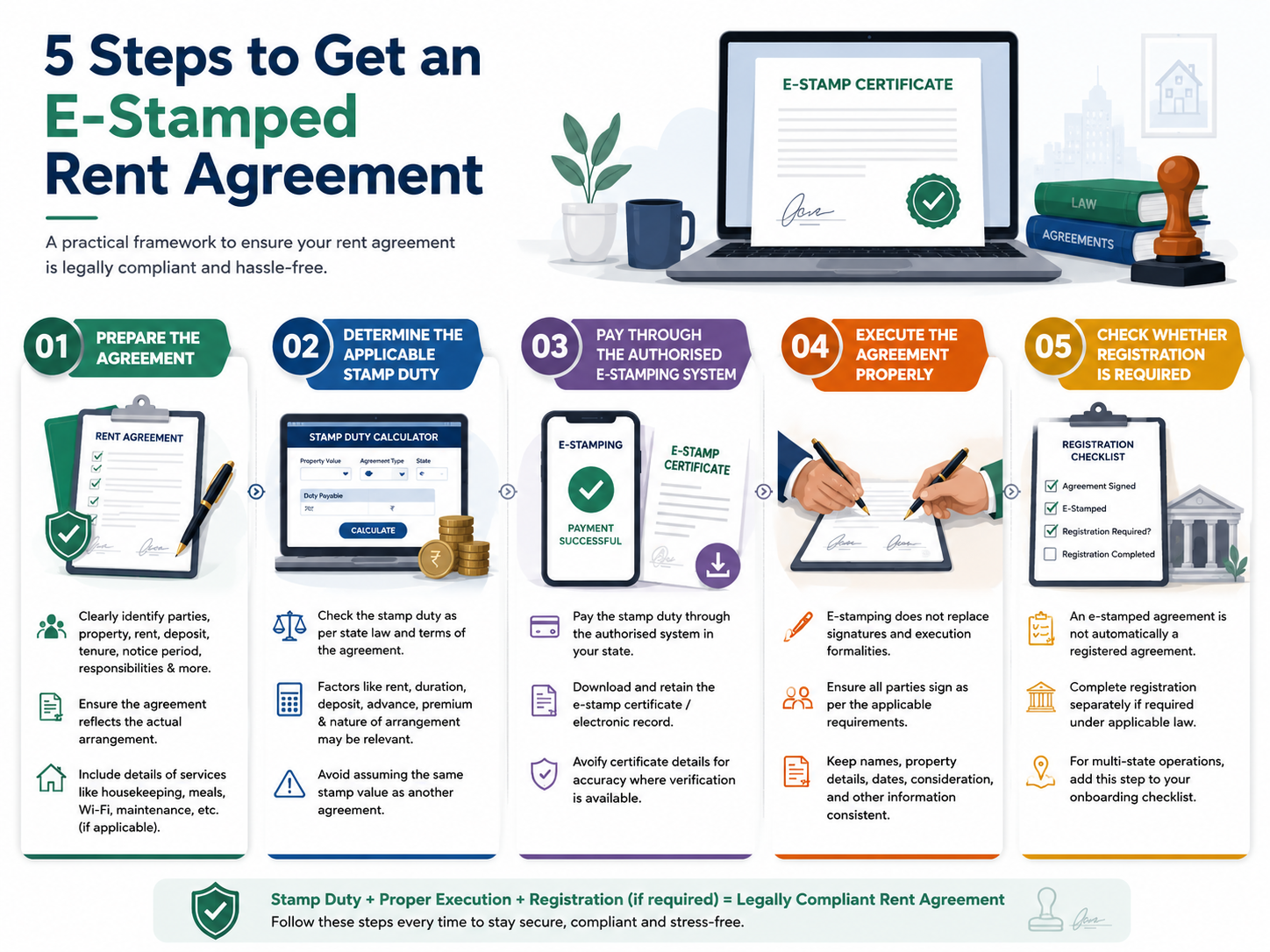
What Steps Are Involved in Getting an E-Stamped Rent Agreement?
While the exact procedure varies, the following framework provides a practical way to approach the process.
1. Prepare the Agreement
Start by preparing the actual rent, lease, tenancy, or leave-and-licence agreement according to the nature of the arrangement. The document should clearly identify the parties, property, rent, deposit, tenure, notice period, responsibilities, and other relevant terms.
The agreement should reflect the actual arrangement rather than relying blindly on an old template.
This is particularly important for PG and co-living businesses where the occupant may also receive services such as housekeeping, meals, Wi-Fi, maintenance, or access to shared facilities. Those arrangements should be documented clearly rather than left entirely to verbal communication.
2. Determine the Applicable Stamp Duty
The next step is determining how much stamp duty is actually applicable.
This should be based on the relevant state law and the terms of the agreement. Rent, duration, deposit, advance, premium, and the nature of the arrangement may all be relevant depending on the jurisdiction.
Avoid assuming that an agreement needs the same stamp value simply because another tenant in the same building used that amount.
3. Pay Through the Authorised E-Stamping System
Once the applicable duty has been determined, it can be paid through the authorised mechanism available in that state.
The resulting certificate or electronic record should be retained along with the agreement.
Where the relevant system provides verification facilities, the certificate details should also be checked for accuracy.
4. Execute the Agreement Properly
The agreement still needs to be executed by the parties in accordance with the applicable requirements.
E-stamping does not replace signatures or other execution formalities. The parties should ensure that the names, property details, dates, consideration, and other information are consistent throughout the documentation.
5. Check Whether Registration Is Required
This is the step that should never be skipped.
An e-stamped agreement is not automatically a registered agreement. If the agreement falls within a category requiring registration under the applicable law, registration needs to be completed separately.
For businesses operating in multiple states, this should ideally be built into the onboarding checklist rather than handled only when someone remembers to check it.
What About the Popular “11-Month Agreement” Rule?
The 11-month rent agreement has become so common in India that it is often treated as a legal rule in itself.
It is not.
An 11-month agreement is a commonly used rental structure, but the duration alone does not answer every question about stamp duty and registration.
Under the central Registration Act, leases not exceeding one year are generally listed as optionally registrable, while certain longer leases require registration. However, state-specific tenancy laws can create additional requirements. RentOk’s Why Your Rent Agreement Must Be Registered – And How to Do It explains this distinction in greater detail and highlights why the assumption that every 11-month agreement is automatically exempt from registration can be misleading.
The practical takeaway is simple: do not use “11 months” as a substitute for checking the applicable law.
For landlords and property managers, this becomes even more important when managing agreements in different cities. The same agreement duration can still be subject to different state-level requirements.
Common E-Stamping Mistakes Landlords Should Avoid
Most problems with rental documentation do not happen because property owners deliberately ignore the law. They happen because processes become repetitive and operators start relying on assumptions.
A few mistakes are particularly common.
- Using the same stamp-duty amount everywhere: Stamp duty can vary by state and by the terms of the agreement, so copying the amount from another property can result in incorrect stamping.
- Confusing stamping with registration: Paying stamp duty, whether electronically or through physical stamp paper, does not automatically mean that a document has been registered where registration is required.
- Treating e-stamping as the complete agreement process: The agreement still needs proper drafting, execution, documentation, and any other applicable formalities.
- Relying on outdated templates: Rental laws, state procedures, and digital systems can change, so agreements should be reviewed periodically rather than reused indefinitely without checking.
- Failing to maintain a central record: When agreements, stamp certificates, payment records, and tenant documents are stored across different locations, it becomes much harder to verify compliance later.
The last point becomes particularly important as the number of tenants increases. A landlord handling five agreements may remember where each document is stored. A property manager handling several hundred agreements cannot rely on memory or individual WhatsApp conversations.
That is where rental documentation starts becoming an operational system rather than a paperwork task.
E-Stamping for PG and Co-Living Businesses
For PGs, hostels, and co-living businesses, the importance of e-stamping goes beyond simply making agreements easier to create.
These businesses often have a continuous tenant lifecycle. One tenant moves out, another moves in, an agreement is renewed, a room changes occupancy, and new documentation needs to be completed. When this happens across multiple properties, agreement management can quickly become difficult to control manually.
A structured digital process can help operators keep track of agreement-related information alongside other tenant records.
For example, an operator may need to know whether:
- the agreement has been created and executed before move-in,
- the relevant stamp-duty process has been completed,
- the agreement is approaching renewal,
- the tenant’s occupancy period has changed,
- a notice period has been initiated, or
- the relevant documentation can be retrieved quickly if a dispute arises.
This is why digital agreement management is increasingly connected to broader property management rather than being treated as an isolated legal task.
If you want to explore this shift further, RentOk’s PG Rental Agreement Format discusses why agreement management becomes increasingly difficult as tenant volumes grow and how digital workflows can reduce dependence on physical paperwork.
What Records Should Property Managers Keep?
An e-stamped agreement is only useful if the supporting documentation can actually be retrieved when needed.
Property managers should maintain an organised record of the executed agreement, relevant stamp-duty or e-stamp details, tenant identification and onboarding information, payment records, and any other documentation required under the applicable process.
For larger rental operations, this record should ideally be connected to the tenant’s overall profile rather than stored as an isolated PDF in a folder.
That makes it easier to answer practical questions later:
Which agreement does this tenant currently have? When does it expire? What were the agreed terms? Has it been renewed? Can the signed copy be retrieved immediately?
These questions may seem simple when managing one property. At scale, they become critical operational requirements.

How RentOk Helps With Digital Rental Agreements
RentOk helps rental businesses move agreement management away from scattered paperwork and into a more structured digital property-management workflow.
For PG, hostel, and co-living operators, the value is not simply in creating an agreement electronically. The larger benefit comes from connecting agreement-related documentation with the rest of the tenant lifecycle.
RentOk can help operators organise key rental workflows around:
- Digital tenant onboarding, so important tenant information can be captured systematically rather than through disconnected conversations and manual entries.
- Digital agreement management, making it easier to maintain and access rental documentation as occupancy changes.
- Tenant and property records, allowing agreement information to remain connected to the relevant person and property instead of becoming an isolated file.
- Payment and occupancy visibility, helping operators manage the commercial and operational information that sits alongside the agreement.
- Move-in, renewal, and move-out workflows, so important tenancy milestones are easier to track as properties scale.
This becomes particularly useful for businesses managing frequent tenant turnover. Instead of treating every new agreement as a separate administrative task, operators can build a repeatable process around onboarding, documentation, occupancy, payments, and exits.
For a growing rental business, that structure can make the difference between simply having digital documents and actually having a digital rental operation.
Conclusion
E-stamping has made the process of paying and documenting stamp duty more convenient, but it should not be mistaken for a replacement for the broader legal requirements surrounding a rent agreement.
An e-stamped rent agreement can be legally valid when it has been correctly prepared, appropriately stamped, properly executed, and registered wherever registration is required. The exact requirements depend on the state, the nature of the rental arrangement, and the applicable law.
For landlords, the most important lesson is to move away from assumptions such as “all rent agreements use the same stamp value” or “an 11-month agreement never needs registration.” Rental documentation needs to be handled according to the actual agreement and the rules applicable to the property.
For PG and co-living operators, there is an additional operational consideration. As the number of tenants increases, agreements need to be managed as part of a structured tenant lifecycle rather than as individual pieces of paperwork.
Create Digital Agreements with RentOk and bring greater structure to your rental documentation and tenant management workflow.
Frequently Asked Questions
Find answers to common questions about this topic
About the Author
Ishika Pannu
Ishika Pannu brings you the latest insights and easy-to-apply strategies in property management—helping you simplify renting and grow with RentOk.
You may also like these
Related Articles

1 min read
How to Get Society Permission Before Renting Out Your Flat
Written by
Posted on
Ishika Pannu
Aug 31, 2026

1 min read
How to Legally Evict a Non-Paying Tenant in India
Written by
Posted on
Ishika Pannu
Aug 24, 2026

1 min read
What Stamp Duty Applies to Your Rent Agreement?
Written by
Posted on
Ishika Pannu
Aug 22, 2026

1 min read
How to Handle a Rental Dispute Without Going to Court
Written by
Posted on
Ishika Pannu
Aug 22, 2026

1 min read
How to Do Tenant Police Verification Online: A State-by-State Guide
Written by
Posted on
Ishika Pannu
Aug 21, 2026
1 min read
What is TDS on Rent Under Section 194-IB – Guide for Landlords
Written by
Posted on
Shivanshi Dheer
Aug 21, 2026

1 min read
How to Create a Legally Valid Rent Agreement in India
Written by
Posted on
Ishika Pannu
Aug 18, 2026

1 min read
How to Write a Formal Eviction Notice for a PG Tenant in India
Written by
Posted on
Ishika Pannu
Aug 11, 2026

1 min read
The PG Owner’s Guide to Tenant Background Verification in 2026
Written by
Posted on
Ishika Pannu
Aug 6, 2026

1 min read
How to Recover Rent from a Tenant Who Has Already Vacated
Written by
Posted on
Ishika Pannu
Aug 5, 2026
Stay ahead in property management with expert insights
Join thousands of property managers receiving exclusive tips delivered straight to your inbox.
Browse posts by category
Case Study
Cost of Living
Growth
Legal
Market Trends
News
Pg owner app
Property Management
Property Tax
Tech
RentOk
The easiest way to rent and manage your PGs and hostels.
Get the app


Contact us
hello@eazyapp.tech
HQ Office
COGROW, BASEMENT F-12/8A
BESIDE HOUSE OF STYLE SALON, SECTOR 28, DLF PHASE 1
GURUGRAM, HARYANA - 122002
South India Office
LUMIODESK COWORKING, 2ND FLOOR, 40, 14TH MAIN RD
BESIDE MC DONALD, 7TH SECTOR, HSR LAYOUT
BENGALURU, KARNATAKA - 560102
©️ 2026 EazyApp Tech Pvt Ltd. All rights reserved


