
Tenant Rights
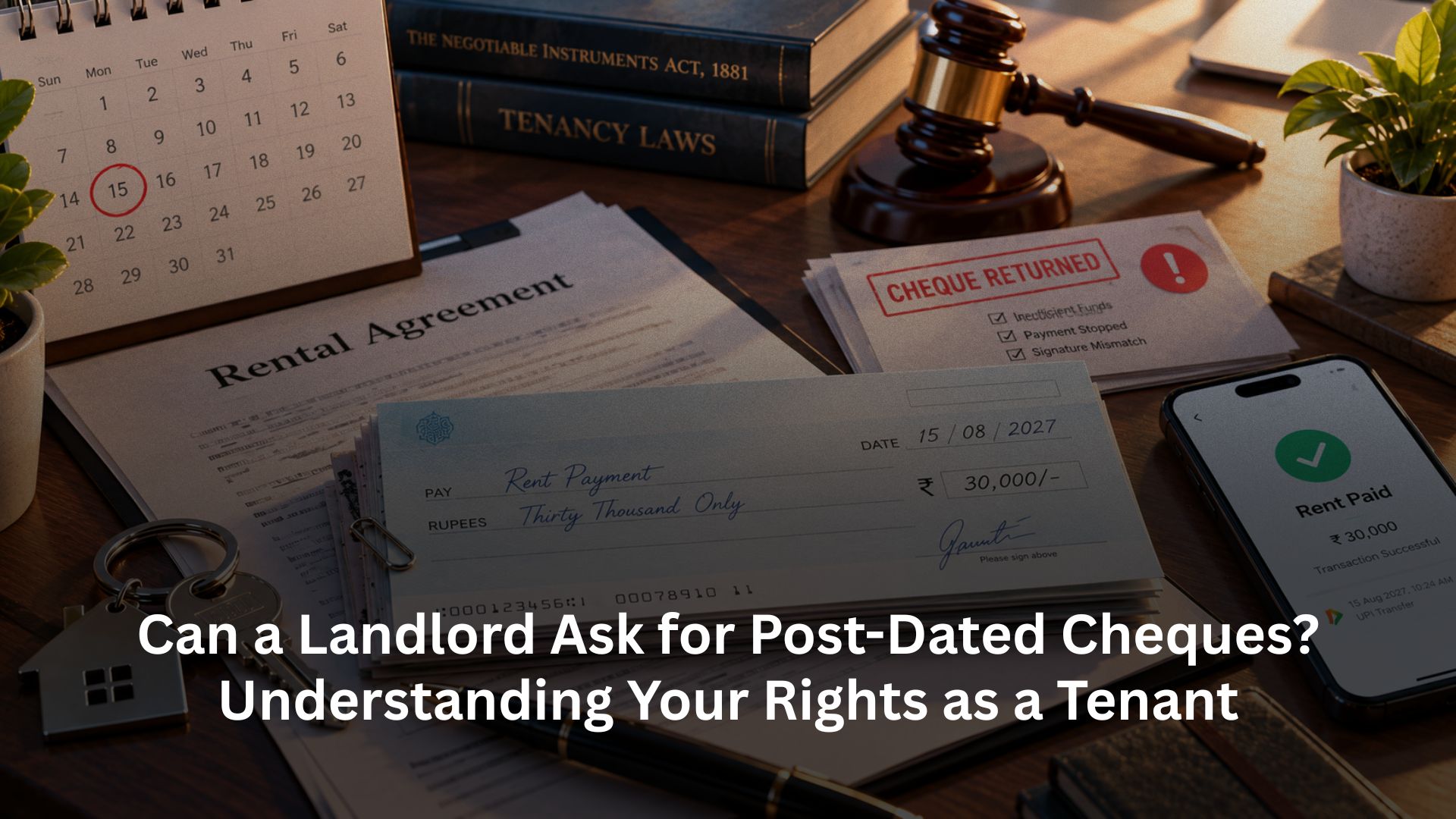
Can a Landlord Ask for Post-Dated Cheques? Understanding Your Rights as a Tenant

Written by
Ishika Pannu
Read Time
12 min read
Posted on
October 13, 2026
Overview
Overview
Can a Landlord Ask for Post-Dated Cheques? Understanding Your Rights as a Tenant
Moving into a rented flat or PG often comes with a familiar request. Pay the security deposit, sign the rental agreement, and provide post-dated cheques for future rent. Many tenants accept this as standard practice without checking whether it is legally required.
But post-dated cheques are more than a formality. If a cheque is dishonoured, it may lead to legal consequences. This can happen even when a tenant believes the cheque was issued only as security. Understanding the rules beforehand can help tenants make informed decisions and avoid unnecessary disputes.
Why Landlords Ask for Post-Dated Cheques
For landlords, post-dated cheques (PDCs) offer a convenient way to plan rent collection. They can collect cheques in advance and present them on the agreed dates. This reduces the need to contact every tenant at the beginning of each month.
PDCs can also provide a sense of financial security. Landlords may have dealt with late rent payments, missed deadlines, or tenants who left without clearing their dues. Collecting cheques in advance may seem like a practical safeguard.
However, a cheque is not the same as money already received. It must still be presented and honoured by the bank. If it is returned unpaid, the landlord may need to follow up with the tenant or consider legal remedies.
For tenants, the distinction is important. A landlord’s preference for PDCs does not automatically make them a legal requirement for every tenancy. The payment method generally depends on the agreement between both parties and the applicable law.

The Legal Position on Post-Dated Cheques in India
Indian tenancy law does not impose a general requirement for every tenant to provide post-dated cheques. At the same time, landlords and tenants can generally agree to use them as a payment method.
A landlord may propose PDCs as part of the rental arrangement. A prospective tenant can discuss alternatives before signing the agreement. Whether the tenancy proceeds depends on the negotiations, contractual terms, and applicable law.
The Model Tenancy Act, 2021, provides a framework for regulating tenancy arrangements. It includes provisions concerning security deposits, with limits of two months’ rent for residential premises and six months’ rent for non-residential premises. However, it does not establish a general requirement to pay rent through PDCs.
The Act is a model framework for states and union territories to adopt. It does not automatically apply as a uniform tenancy law across India. Tenants should therefore check the applicable state rules and their rental agreement before agreeing to payment conditions.
A negotiated requirement is different from a legal rule that applies to every tenant. Understanding this distinction can help tenants discuss payment terms before committing to a tenancy.
For more practical guidance on rental operations, explore RentOk’s property management blogs.
How the Negotiable Instruments Act Applies
Although tenancy law does not generally mandate PDCs, issuing a cheque can create legal obligations. The Negotiable Instruments Act, 1881, governs cheque-related matters, including certain cases of dishonour.
Under Sections 5 and 6, a post-dated cheque is treated as a bill of exchange until its date arrives. It can then be presented as a cheque, subject to the applicable rules.
Two Supreme Court judgments help explain the legal position.
- Goa Plast (P) Ltd. v. Chico Ursula D’Souza (2004): This judgment supports the principle that a post-dated cheque issued towards a legally enforceable debt may attract Section 138 when the statutory conditions are met.
- Sampelly Satyanarayana Rao v. Indian Renewable Energy Development Agency Ltd. (2016): The Court clarified that calling a cheque a security cheque does not automatically prevent Section 138 from applying. The underlying liability and circumstances of presentation matter.
This distinction is important for tenants. A cheque issued as security may still have legal consequences if the payment obligation becomes due. The other requirements of Section 138 must also be satisfied.
However, the existence of a cheque does not automatically prove that every amount demanded by a landlord is legally payable. The underlying agreement and facts of the transaction also matter.
Tenants Can Negotiate Alternative Payment Methods
Tenants who are uncomfortable providing several post-dated cheques can discuss other payment methods before signing the agreement. There is no universal legal requirement to use PDCs for every tenancy.
However, a landlord may decline a proposed arrangement, subject to applicable law. This makes it important to discuss payment terms before committing to the tenancy.
Some common alternatives include:
- Monthly UPI payments: Tenants can transfer rent through UPI and retain the transaction reference. Payments still need to be made on time unless a recurring arrangement is authorised.
- NEFT or bank transfers: Direct bank transfers create an electronic record. They can work well for regular rent payments when both parties agree on the process.
- Standing instructions or recurring payments: Depending on the bank or payment provider, tenants may be able to authorise recurring payments instead of issuing physical cheques.
- Cash payments with receipts: Where lawful and mutually agreed, cash payments should be supported by a dated receipt. It should mention the amount and rental period.
Each option has its limitations. Monthly transfers require regular action unless automated. Recurring mandates also need proper authorisation and may fail.
The goal is to agree on a rent payment method that is convenient, traceable, and clear to both parties. Tenants should also retain proof of every payment, regardless of the method used.
For a practical overview of digital payment methods, read How to Collect Rent Online from Tenants in India.
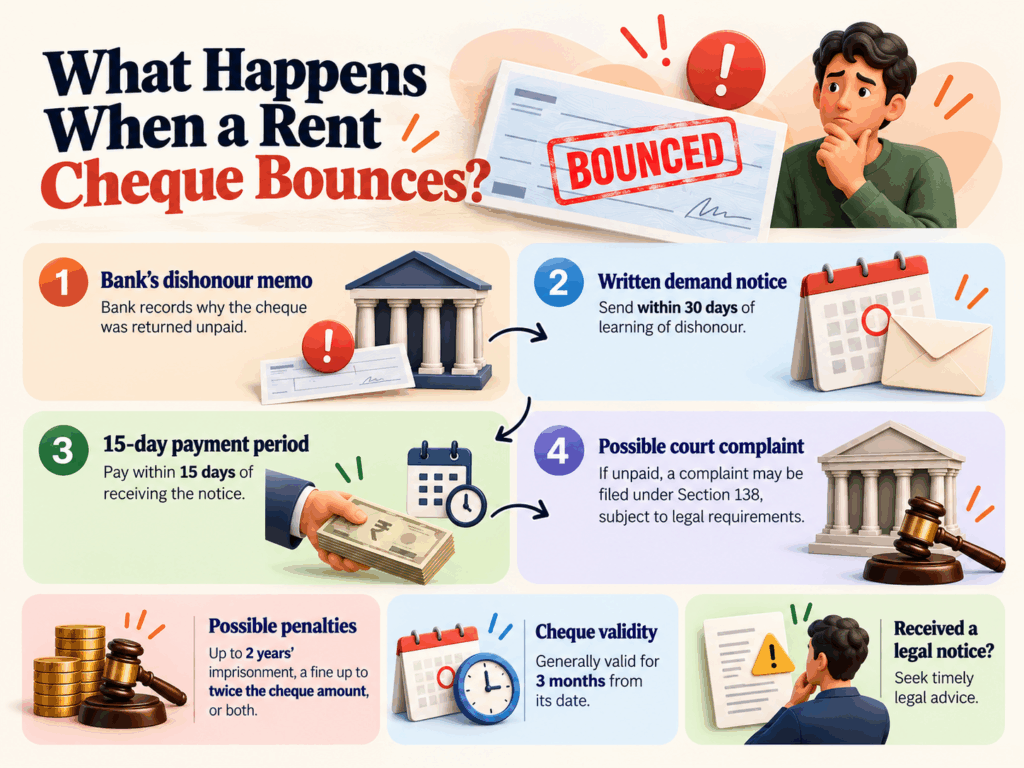
What Happens When a Rent Cheque Bounces?
A cheque can be dishonoured for several reasons. These may include insufficient funds or certain account-related issues. However, not every bounced cheque automatically leads to criminal liability.
Section 138 of the Negotiable Instruments Act may apply when its legal requirements are satisfied. These include the existence of a legally enforceable debt or liability and compliance with the prescribed procedure.
When Section 138 applies, the process generally involves the following stages:
- Bank’s dishonour memo: The bank informs the payee that the cheque has been returned unpaid. The memo records the reason for dishonour.
- Written demand notice: The payee generally must send a demand notice within 30 days of receiving information about the dishonour from the bank.
- Fifteen-day payment period: The drawer has 15 days from receiving the notice to pay the cheque amount demanded.
- Possible court complaint: If payment is not made within the prescribed period, the payee may file a complaint, subject to the Act’s conditions. The complaint generally must be filed within one month after the cause of action arises. A court may condone a delay for sufficient cause.
A conviction under Section 138 can result in imprisonment for up to two years, a fine of up to twice the cheque amount, or both. These are maximum statutory penalties, not automatic outcomes in every dispute.
Cheques are generally valid for three months from their date under current banking requirements. They cannot be presented indefinitely.
If a tenant receives a legal notice about a bounced cheque, ignoring it can make the situation more difficult. Seeking timely legal advice is a safer approach. Tenants should not assume that describing a cheque as security will automatically protect them from legal action.
Risks to Consider Before Issuing PDCs
Providing several cheques in advance may seem convenient. However, the arrangement needs attention throughout the tenancy. Problems can arise when circumstances change but the cheques remain with the landlord.
Tenants should consider a few important risks before handing them over.
- Future payment obligations: Keep track of every cheque’s date, amount, and purpose. Make sure you understand the payment obligation it represents.
- Early termination disputes: Unused cheques may remain with the landlord when a tenant moves out early. Whether further rent is payable depends on the agreement, applicable law, and circumstances.
- Disagreements over presentation: A dispute may arise if a cheque is presented before the agreed date or after the payment arrangement changes. Written records can help clarify what both parties agreed.
- Unclear payment purpose: Without documentation, the parties may disagree about whether a cheque covered rent, outstanding dues, or another obligation.
These risks do not mean every landlord will misuse a cheque. They highlight why tenants should understand the arrangement before issuing one.
Clear documentation is particularly important when a tenant pays through another method or ends the tenancy before all the cheques are used. It can help establish what was agreed and whether any payment remains due.
Precautions to Take When Providing Post-Dated Cheques
If you decide to provide PDCs, a few precautions can help prevent misunderstandings. Keep the records organised from the beginning rather than waiting for a dispute.
- Cheque records: Note each cheque number, date, amount, and intended rental period. Ask the landlord to acknowledge receipt in writing.
- Documented purpose: The rental agreement or a separate acknowledgement should specify which months the cheques cover. It should also explain how unused cheques will be handled when the tenancy ends.
- Proof of payment: Save bank statements, digital payment confirmations, receipts, and relevant messages. If a cheque is replaced by another payment method, document the change and clarify what happens to the original cheque.
- Written communication: If the tenancy ends or the payment arrangement changes, inform the landlord in writing. Request the return or documented cancellation of unused cheques. Keep evidence of the request and response.
- A stop-payment instruction may be appropriate in certain situations. However, it does not automatically remove an underlying legally enforceable debt. Tenants should seek legal advice before relying on it to resolve a dispute.
For an alternative to repeated manual payments, read RentOk AutoPay & e-NACH for Automatic Rent Collection.
Resolving Disputes Over Unused Cheques
Disagreements can arise when a tenancy ends or the parties dispute outstanding rent. The first step is to establish what was agreed, what was paid, and which obligations remain.
Start by reviewing the rental agreement, payment history, and written communication. Make a list of the cheques issued and the rental periods they cover. Then identify whether any amount remains outstanding.
If a cheque is no longer required, request its return. You can also ask for written confirmation that it will not be presented.
If the landlord refuses to return unused cheques, threatens to misuse them, or presents one in circumstances that appear inconsistent with the agreement, retain the relevant evidence. Seek advice from a qualified legal professional about the available options.
Payment records are equally important. Tenants who paid through UPI or bank transfer should retain proof and identify the rental period covered by each transaction. This helps distinguish outstanding rent from amounts already paid.
For landlords, maintaining accurate records can also reduce confusion. How to Track Rent Collection Performance explains how payment tracking and dues reports can support a more organised collection process.

How RentOk Helps
Rent collection involves more than receiving money. Property owners must also send reminders, follow up on dues, track transactions, and maintain tenant-wise records. RentOk brings these activities together in one property management platform.
With RentOk, property owners can simplify several parts of the collection process:
- Automated rent collection: RentOk AutoPay supports recurring payments after tenants authorise a mandate. This reduces the need to initiate every payment manually.
- Payment reminders: Automated reminders through WhatsApp, SMS, and notifications help tenants stay informed about upcoming and pending dues.
- Dues tracking: Tenant-wise records and dues reports help owners see who has paid and where follow-up is needed.
- Financial reporting: Transaction updates, tenant ledgers, and financial reports help reduce dependence on scattered spreadsheets and manual reconciliation.
These features can be useful for PGs, hostels, and co-living businesses managing multiple tenants. They help owners organise collections as their operations grow.
Digital payments do not guarantee that every payment will succeed. They also cannot eliminate every legal dispute. However, better tracking and clearer records can reduce repetitive administrative work and improve visibility into rent collection.
Property owners can also explore How Property Management Software Helps You Collect Rent on Time to understand how reminders, payment tracking, and digital records support the collection process.
Conclusion
Post-dated cheques are common in India’s rental market, but they are not a universal legal requirement. Landlords and tenants can discuss payment methods, subject to applicable law and the terms of their agreement.
Once a cheque is issued, it may carry legal consequences if dishonoured and the requirements of Section 138 are met. Tenants should understand the agreement, document every cheque, and retain proof of rent payments. They should also address unused cheques promptly when a tenancy ends.
Digital payments and authorised recurring arrangements can offer a practical alternative. The right process should be convenient for both parties and maintain clear payment records.
Explore RentOk AutoPay for a more organised approach to recurring rent collection. Reduce manual follow-ups, improve payment visibility, and keep tenant-wise records in one place.
Disclaimer: This article is for general educational purposes and does not constitute legal advice. Tenancy rules and cheque-dishonour proceedings depend on the facts and applicable law. Consult a qualified legal professional about a specific dispute.
Frequently Asked Questions
Find answers to common questions about this topic
About the Author
Ishika Pannu
Ishika Pannu brings you the latest insights and easy-to-apply strategies in property management—helping you simplify renting and grow with RentOk.
You may also like these
Related Articles
1 min read
Is There a Penalty for Breaking My Rental Agreement Early?
Written by
Posted on
Ishika Pannu
Oct 12, 2026
1 min read
Can My Landlord Evict Me Without Notice?
Written by
Posted on
Ishika Pannu
Oct 5, 2026
1 min read
Can My Landlord Restrict Guests or Visitors in My Rented Home?
Written by
Posted on
Ishika Pannu
Oct 3, 2026
1 min read
What Counts as Normal Wear and Tear vs Damage I’ll Be Charged For?
Written by
Posted on
Ishika Pannu
Oct 2, 2026

1 min read
Notice Period for Vacating a Rented Flat in India
Written by
Posted on
Ishika Pannu
Oct 1, 2026
Stay ahead in property management with expert insights
Join thousands of property managers receiving exclusive tips delivered straight to your inbox.
Browse posts by category
Case Study
Cost of Living
Growth
Legal
Market Trends
News
Pg owner app
Property Management
Property Tax
Tech
RentOk
The easiest way to rent and manage your PGs and hostels.
Grievance Officer
Get the app


Contact us
hello@eazyapp.tech
HQ Office
COGROW, BASEMENT F-12/8A
BESIDE HOUSE OF STYLE SALON, SECTOR 28, DLF PHASE 1
GURUGRAM, HARYANA - 122002
South India Office
LUMIODESK COWORKING, 2ND FLOOR, 40, 14TH MAIN RD
BESIDE MC DONALD, 7TH SECTOR, HSR LAYOUT
BENGALURU, KARNATAKA - 560102
©️ 2026 EazyApp Tech Pvt Ltd. All rights reserved


