
Cost of Living
How to Split Rent and Bills Fairly With Flatmates


Written by
Ishika Pannu
Read Time
11 min read
Posted on
November 27, 2026
Overview
Overview
How to Split Rent and Bills Fairly With Flatmates
Three flatmates can pay the same rent and still receive very different value. One gets the largest bedroom and a private bathroom; another takes the small room beside the kitchen. Add different AC habits, shared groceries and an upcoming move-out, and an equal split can start to feel unfair.
The fairest way to split rent is to agree on a formula before choosing rooms. Use equal shares for similar spaces, adjust for meaningful differences and divide bills according to access or usage. Write down the arrangement, including deposits and exits, so nobody has to renegotiate the household budget every month.
When does splitting rent equally make sense?
An equal split works well when bedrooms offer similar space, privacy and facilities, and everyone accepts the trade-offs. For a ₹30,000 flat shared by three people, that means ₹10,000 each. Equal payment becomes harder to justify when one person receives substantially more private space or exclusive amenities.
Discuss room preferences before anyone claims the best bedroom. Someone may value a quiet room more than a balcony, while another needs a desk. RentOk’s guide to finding a compatible flatmate highlights the importance of discussing household expenses and living expectations before moving in.
An income-based split is another voluntary option, especially for partners or close friends. Divide the agreed cost in proportion to take-home income if everyone wants that arrangement. A higher salary does not automatically mean someone owes more; discuss affordability and revisit the agreement when incomes change.
A room-size formula that includes shared space
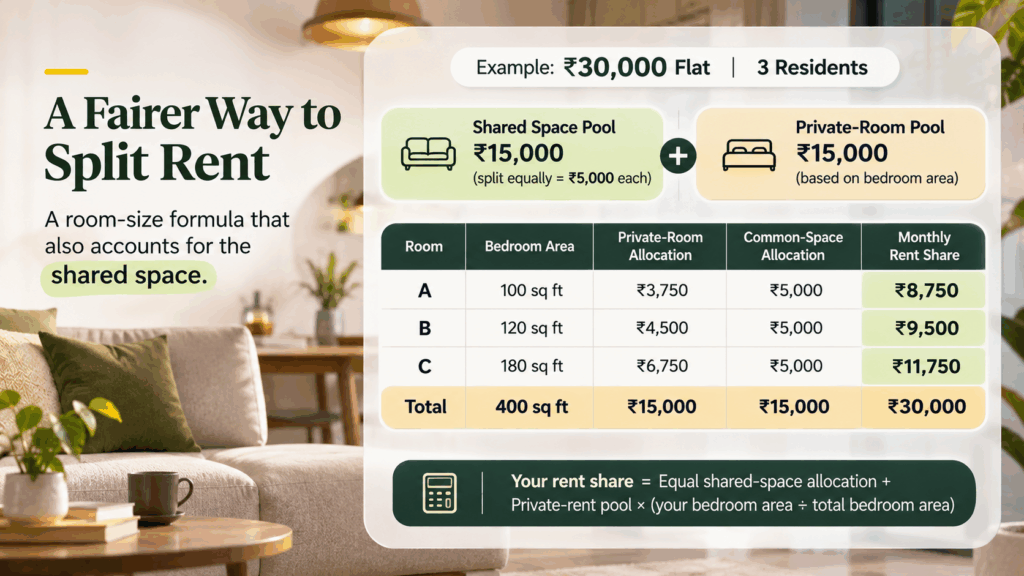
Charging only by bedroom area overlooks the living room, kitchen and other facilities everyone uses. A practical alternative divides rent into two portions: an equal common-space share and a private-room share weighted by area. The proportion itself is negotiable, not a prescribed rule.
For an illustrative ₹30,000 flat with three residents, allocate ₹15,000 equally for shared space: ₹5,000 each. Allocate the remaining ₹15,000 according to bedrooms measuring 100, 120 and 180 sq ft, totalling 400 sq ft.
| Room | Bedroom area | Private-room allocation | Common-space allocation | Monthly rent share |
|---|---|---|---|---|
| A | 100 sq ft | ₹3,750 | ₹5,000 | ₹8,750 |
| B | 120 sq ft | ₹4,500 | ₹5,000 | ₹9,500 |
| C | 180 sq ft | ₹6,750 | ₹5,000 | ₹11,750 |
| Total | 400 sq ft | ₹15,000 | ₹15,000 | ₹30,000 |
The formula is your rent share = equal shared-space allocation + private-rent pool × your bedroom area ÷ total bedroom area. Use consistent measurements and decide how you will treat private bathrooms, balconies and awkward layouts.
If two people share a bedroom, do not automatically divide everything by the number of rooms. Allocate shared facilities by people, then agree how the occupants divide that room’s private allocation. A rent split calculator can provide a starting point, but everyone should approve the assumptions and final amounts.
Pricing an attached bathroom, balcony or AC fairly
Room size does not capture every advantage. An attached bathroom offers privacy, a usable balcony provides exclusive space, and dedicated parking benefits the person who uses it. Agree on a modest premium for features people actually value, rather than copying an unsupported market rate.
Continue the example above. Suppose Room C’s occupant agrees to pay ₹1,500 extra for an attached bathroom, with the other two residents receiving ₹750 reductions each. The revised shares become ₹8,000, ₹8,750 and ₹13,250, still totalling ₹30,000.
Keep these distinctions clear:
- Exclusive versus shared: Charge a private-balcony premium only if the room’s occupant controls that space. A shared terrace belongs in the shared-facility discussion.
- Availability versus consumption: An AC-equipped room may command an agreed room premium, while electricity depends on use. Explain both charges so nobody confuses appliance access with prepaid power.
- One advantage, one adjustment: If your area measurement already includes a feature, avoid charging again for the same benefit without discussing why.
For feature points instead of rupee premiums, agree on the weights before allocating rooms. Keep the calculation visible and ensure every share adds back to the landlord’s rent.
Splitting electricity, Wi-Fi and household help
Use equal shares for genuinely shared fixed services, such as one Wi-Fi plan or routine cleaning. Follow the rental terms for maintenance, and agree separately on additional services that only some residents request. RentOk’s guide to rent inclusions and extra charges helps distinguish the advertised rent from the full monthly commitment.
For electricity, start with the actual current bill. Equal sharing can work for similar usage; a room AC or another heavy appliance may justify an agreed adjustment. Prefer reliable meter information where available, and record the allocation method before the bill arrives.
A bill split that reconciles to the invoice
Assume the three-person household has a ₹6,000 electricity bill. Everyone accepts that ₹1,800 of that bill relates to Room C’s AC use. Divide the remaining ₹4,200 equally: ₹1,400 each. Room C therefore pays ₹3,200 for electricity; Rooms A and B pay ₹1,400 each.
| Monthly household bill | Total | Room A | Room B | Room C |
|---|---|---|---|---|
| Wi-Fi | ₹1,200 | ₹400 | ₹400 | ₹400 |
| Cleaning help | ₹2,400 | ₹800 | ₹800 | ₹800 |
| Electricity | ₹6,000 | ₹1,400 | ₹1,400 | ₹3,200 |
| Shared cleaning supplies | ₹900 | ₹300 | ₹300 | ₹300 |
| Total bills | ₹10,500 | ₹2,900 | ₹2,900 | ₹4,700 |
These are illustrative allocations, not tariff quotations. The ₹1,800 AC amount sits inside the ₹6,000 bill; adding it on top would double-count consumption. Account for credits and fixed charges consistently, and keep old arrears or penalties identifiable.
Including the revised rent, the monthly totals become ₹10,900, ₹11,650 and ₹17,950. RentOk’s PG-versus-flat cost comparison explains why affordability depends on the complete household budget, not rent alone.
Sharing the deposit and recording contributions
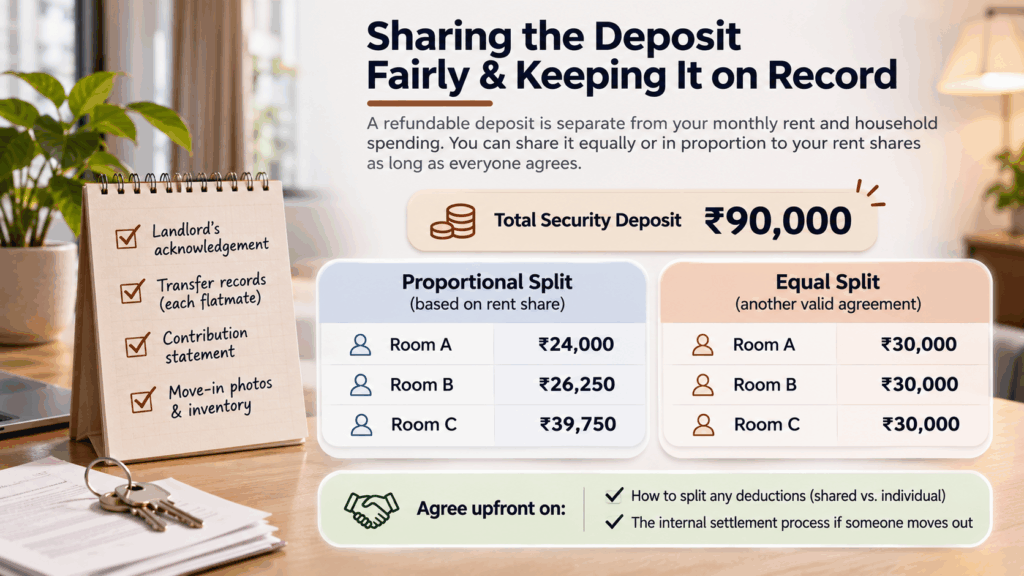
A refundable deposit requires cash upfront, but it is separate from monthly rent and household spending. Flatmates can contribute equally or in proportion to their rent shares, provided everyone agrees and the records identify who paid what.
For a ₹90,000 deposit using the revised ₹30,000 rent split, proportional contributions would be ₹24,000 for Room A, ₹26,250 for Room B and ₹39,750 for Room C. Equal contributions of ₹30,000 each are another possible agreement; rent weighting does not automatically determine the deposit split.
Keep the landlord’s acknowledgement, individual transfer records and a contribution statement. Photograph the premises and inventory at move-in, and identify how you will allocate shared deductions versus damage attributable to a particular person.
RentOk’s security-deposit refund guide explains why payment records and property condition matter. Agree on the internal settlement process without promising that the landlord will release part of the deposit whenever one flatmate leaves.
Guests, travel and groceries need separate rules
Rent, access to shared services and actual consumption follow different patterns. Set these household rules before a disagreement arises, then change them prospectively when everyone accepts the revision.
- Frequent guests: Agree when overnight stays become frequent enough to discuss a contribution. Set a household threshold and method, while checking the property’s visitor rules; no universal number of guest nights determines fairness.
- Extended travel: Keeping your room reserved normally means continuing your agreed rent contribution. Discuss variable food or consumption adjustments in advance, while recognising that Wi-Fi and cleaning commitments may continue.
- Groceries: Share staples only among people who use them. Keep personal snacks, supplements and different diets separate rather than expecting everyone to subsidise the same shopping basket.
- Household supplies: Split genuinely shared items such as dish soap and cleaning products. Decide who buys replacements and whether purchases come from a small shared pool.
For a cook or meal arrangement, agree whether the charge follows participating residents, meals or a fixed service commitment. Someone leaving for a week does not necessarily reduce the amount you owe the service provider.
Move-outs and jointly owned purchases
Check notice, replacement and landlord-approval requirements before someone leaves. Record the departing resident’s final rent share, outstanding bills, deposit contribution and possession handover date. An internal arrangement between friends does not automatically update the landlord’s agreement.
RentOk’s rent-agreement review guide covers the financial and exit terms worth checking. Decide how you will handle a vacant room instead of assuming the remaining residents can instantly cover it.
Agreeing on a furniture buyout
For a shared appliance, record the purchase price, ownership shares and a buyout method. One illustrative approach values a ₹12,000 washing machine over an agreed 60-month life. After 24 months, its remaining planning value is ₹7,200.
If three flatmates originally owned equal shares, the departing person’s share would be ₹2,400 under that method. The two remaining owners could pay ₹1,200 each. This is a negotiated household valuation, not a statutory depreciation rate; condition, repairs and resale value may justify a different agreed amount.
A monthly routine that prevents reimbursement chasing
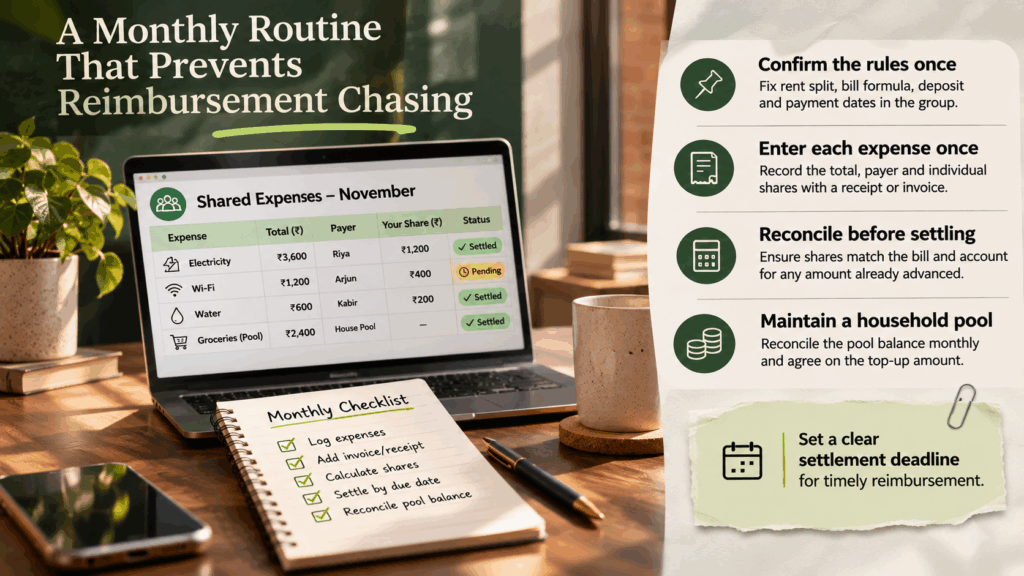
Choose one shared tracker: a spreadsheet, a suitable expense app or a simple group-chat summary. Record the bill period, total, payer, individual shares and settlement status, with a receipt or invoice reference. Pick a settlement deadline so the person paying upfront knows when reimbursement will arrive.
Keep the process consistent:
- Confirm the rules once: Pin the rent allocation, bill formula, deposit contributions and payment dates in the flat group. Give new residents the same information before they commit.
- Enter each expense once: Mark whether the household pool or an individual paid it. A reimbursement is settlement of that expense, not another shared purchase.
- Reconcile before settling: Check that shares equal the invoice and account for money someone already advanced. Keep landlord payments distinct from flatmate reimbursements.
If you maintain a fixed household pool, reconcile its balance monthly and agree on the top-up. A small reserve should stay visible rather than quietly becoming one resident’s money.
How RentOk helps apply agreed bill splits
At a participating property, RentOk supports the property team’s billing and payment records. Flatmates should agree their allocation first, then confirm which charges and account arrangements the manager can support.
- Apply equal or individual charges: RentOk’s Add Dues workflow lets the property team select tenants or rooms and choose individual amounts or Divide Equally. Apply the shares you agreed; this does not automatically decide a fair room premium.
- Keep payment evidence accessible: RentOk’s payment page provides bills and receipts. Retain those records alongside the separate tracker showing reimbursements between flatmates.
- Document the people sharing the flat: Its published multi-party agreement workflow supports co-tenants signing one agreement. Confirm availability and review every signer’s role before completion.
The published co-tenant release keeps dues and payments with the primary tenant and describes separate rent and deposit splits as planned. Confirm newer availability with RentOk; do not assume that adding co-signers creates automatic household expense splitting.
Conclusion
A fair rent split reflects the space and benefits each person receives, while a fair bill split reflects the service or consumption involved. Agree on the method before move-in, test it with actual rupee amounts and check that every allocation reconciles to the full rent or invoice.
Give deposits, absences, guests and move-outs the same attention as the monthly calculation. A written reference and one settlement routine can prevent repeated arguments without tracking every small personal purchase. Split bills easily with RentOk through your property team’s supported dues workflow, while maintaining a separate tracker for any reimbursements between flatmates.
Frequently Asked Questions
Find answers to common questions about this topic
About the Author
Ishika Pannu
Ishika Pannu brings you the latest insights and easy-to-apply strategies in property management—helping you simplify renting and grow with RentOk.
You may also like these
Related Articles

1 min read
Cost of Living in Bangalore for Freshers and Students
Written by
Posted on
Ishika Pannu
Nov 14, 2026

1 min read
Cost of Living in Pune for Freshers and Students
Written by
Posted on
Ishika Pannu
Nov 10, 2026

1 min read
PG vs Flat-Sharing for Your First Job: Real Monthly Costs Compared
Written by
Posted on
Ishika Pannu
Oct 27, 2026

1 min read
Renting vs. Buying a House in India in 2026: Which Makes More Financial Sense?
Written by
Posted on
Ishika Pannu
Oct 9, 2026

1 min read
Rent vs Commute in Gurgaon: How Much Is Convenience Worth?
Written by
Posted on
Ishika Pannu
Oct 9, 2026

1 min read
Bengaluru’s Salary-Rent Gap: Why Are Rents Rising Faster Than Salaries?
Written by
Posted on
Ishika Pannu
Oct 6, 2026
1 min read
GST on PG Rent: What Tenants Pay
Written by
Posted on
Ishika Pannu
Sep 13, 2026

1 min read
When and Why Did Rent in Gurgaon Get So Expensive?
Written by
Posted on
Shivanshi Dheer
Dec 24, 2025

1 min read
What is the Cost of Renovating a PG/Hostel for Setup?
Written by
Posted on
Shivanshi Dheer
Sep 10, 2025

1 min read
Rent Trends in 2025: Delhi vs Bangalore vs Hyderabad
Written by
Posted on
Shivanshi Dheer
Aug 1, 2025
Stay ahead in property management with expert insights
Join thousands of property managers receiving exclusive tips delivered straight to your inbox.
Browse posts by category
Case Study
Cost of Living
Growth
Legal
Market Trends
News
Pg owner app
Property Management
Property Tax
Tech
RentOk
The easiest way to rent and manage your PGs and hostels.
Grievance Officer
Get the app


Contact us
hello@eazyapp.tech
HQ Office
COGROW, BASEMENT F-12/8A
BESIDE HOUSE OF STYLE SALON, SECTOR 28, DLF PHASE 1
GURUGRAM, HARYANA - 122002
South India Office
LUMIODESK COWORKING, 2ND FLOOR, 40, 14TH MAIN RD
BESIDE MC DONALD, 7TH SECTOR, HSR LAYOUT
BENGALURU, KARNATAKA - 560102
©️ 2026 EazyApp Tech Pvt Ltd. All rights reserved


