Growth
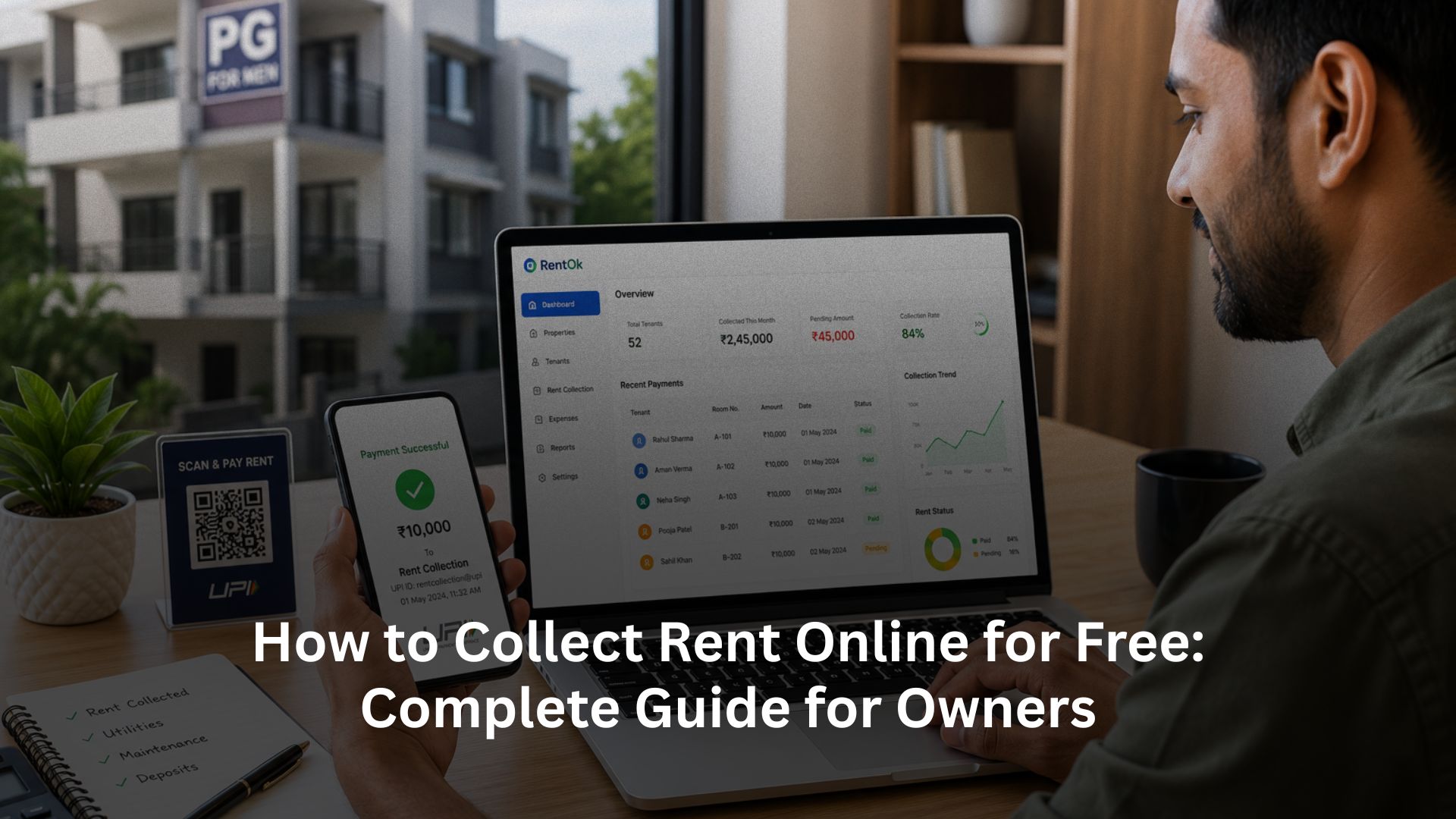
How to Collect Rent Online for Free: Complete Guide for Owners

Written by
Ishika Pannu
Read Time
12 min read
Posted on
June 5, 2026
Overview
Overview
How to Collect Rent Online for Free: A Step-by-Step Guide for Owners
Collecting rent is one of the most important responsibilities in any rental business. Whether you manage a small apartment building, a PG, a hostel, or multiple rental properties, your ability to collect rent consistently has a direct impact on cash flow, operations, and long-term profitability.
Yet, many landlords still rely on a mix of cash payments, bank transfers, WhatsApp screenshots, handwritten registers, and spreadsheets to manage collections. While these methods may work when occupancy is low, they quickly become difficult to manage as the number of tenants grows.
The challenge is not collecting money itself. Most tenants eventually pay. The real challenge is maintaining visibility. Property owners need to know who has paid, who still has pending dues, whether utility charges have been included, and how much revenue has actually been collected during the month. Without a structured process, finding these answers often requires unnecessary manual work.
This is exactly why online rent collection has become increasingly popular among landlords and PG operators across India. Modern payment systems make collections faster, records more organized, and operations easier to manage. The best part is that getting started does not require expensive software. With a few free tools and the right workflow, landlords can significantly improve rent collection without increasing costs.
Why Cash Rent Collection Creates More Problems Than Most Owners Realize
Cash collection often feels simple because the transaction is completed immediately. The tenant pays, the landlord receives the money, and everything appears settled. However, the operational challenges usually begin after the payment is collected.
Unlike digital payments, cash does not automatically generate records. Someone needs to manually update registers, verify balances, maintain payment histories, and reconcile collections at the end of the month. As occupancy increases, these tasks become increasingly difficult to manage.
Many landlords eventually find themselves dealing with issues such as:
- Payment records being updated several hours or days after collection, creating confusion around actual outstanding balances and monthly collections.
- Utility charges, rent payments, and security deposits being tracked separately, making it difficult to understand a tenant’s complete financial status.
- Staff members forgetting to update records consistently, resulting in discrepancies between collected amounts and recorded amounts.
- Historical transactions becoming difficult to verify because information is scattered across registers, notebooks, spreadsheets, and chat conversations.
The problem becomes even more noticeable in PGs and co-living spaces where tenant movement is frequent. New move-ins, move-outs, utility adjustments, and deposit settlements all create additional financial activity that must be tracked accurately.
Individually, these issues may seem manageable. However, when they occur repeatedly across dozens of tenants every month, they create a significant administrative burden. Instead of focusing on occupancy growth and tenant satisfaction, property owners spend valuable time searching for information that should already be organized.

Why More Landlords Are Moving to Online Rent Collection
The shift toward online rent collection is not happening simply because digital payments are convenient. It is happening because digital systems provide operational visibility that manual methods struggle to offer.
When rent is collected online, every transaction automatically generates a record. That record remains searchable, accessible, and easy to verify whenever questions arise. Instead of relying on memory, screenshots, or handwritten notes, landlords gain access to a structured transaction history.
This creates several advantages for rental businesses:
- Payment histories remain organized, making it easier to verify collections and resolve disputes when tenants raise questions.
- Collection records can be accessed remotely without requiring physical access to registers or office files.
- Monthly reporting becomes faster because payment information is already available in digital form.
- Tenants can complete payments from anywhere, reducing delays caused by physical collection dependencies.
Another important factor is tenant behavior. Today’s tenants are already comfortable using digital payment systems for shopping, transportation, food delivery, subscriptions, and utility bills. Paying rent online feels natural because it fits into habits they already follow daily.
As rental operations become more structured, online rent collection is increasingly viewed as a standard business practice rather than a technology upgrade.
Setting Up UPI and QR-Based Rent Collection
One of the biggest misconceptions among property owners is that digital rent collection requires complex systems or expensive software. In reality, most landlords can start collecting rent online using tools they already have access to.
The objective is not simply to accept digital payments. The objective is to create a process that remains organized, scalable, and easy to manage as occupancy grows.
Create a Dedicated Collection Account
One of the simplest improvements landlords can make is separating rental income from personal finances.
Many owners collect rent into their primary bank account because it feels convenient initially. Over time, however, this creates visibility challenges. Rent collections, maintenance expenses, utility payments, and personal transactions all appear together, making financial tracking more difficult than necessary.
A dedicated rent collection account helps create clearer visibility into:
- Monthly rental income without unrelated transactions affecting reporting accuracy.
- Outstanding dues that require follow-up before they become larger collection issues.
- Utility-related collections and adjustments that need separate tracking.
- Security deposit transactions and settlement activities throughout the tenant lifecycle.
This may seem like a small operational change, but it creates a much stronger foundation for organized financial management.
Set Up UPI-Based Payments
UPI has become one of the easiest and most widely accepted payment methods in India. Most tenants already use UPI daily, which makes adoption extremely straightforward.
However, setting up a UPI ID is only the first step. The real goal is ensuring that payments remain easy to identify and track later.
Many landlords encounter tracking difficulties because tenants submit payments without providing useful references. When multiple transactions arrive within a short period, identifying individual payments becomes unnecessarily time-consuming.
A simple solution is asking tenants to include:
- Their room or apartment number in payment remarks to simplify transaction identification.
- Their full name when occupancy involves multiple residents sharing accommodation.
- The month for which the payment is being made, reducing future confusion.
- Notes regarding utility charges whenever rent and electricity payments are combined.
These small practices dramatically improve visibility and reduce reconciliation effort later.
Generate a QR Code for Faster Collections
QR-based rent collection has become increasingly popular because it removes unnecessary friction from the payment process.
Instead of manually entering account details or UPI IDs, tenants can simply scan a code and complete the payment within seconds. The process is faster, more convenient, and less prone to errors.
Some practical benefits of QR-based collection include:
- Faster transactions because tenants can pay immediately without entering account information manually.
- Reduced payment mistakes caused by incorrect account numbers or typing errors.
- Easier onboarding since payment instructions become visual and straightforward.
- Better tenant experience because the payment process feels simple and familiar.
While QR codes may seem like a small operational improvement, they often contribute to smoother rent collection and fewer payment-related issues overall.
Why Reconciliation Becomes Difficult as Occupancy Grows
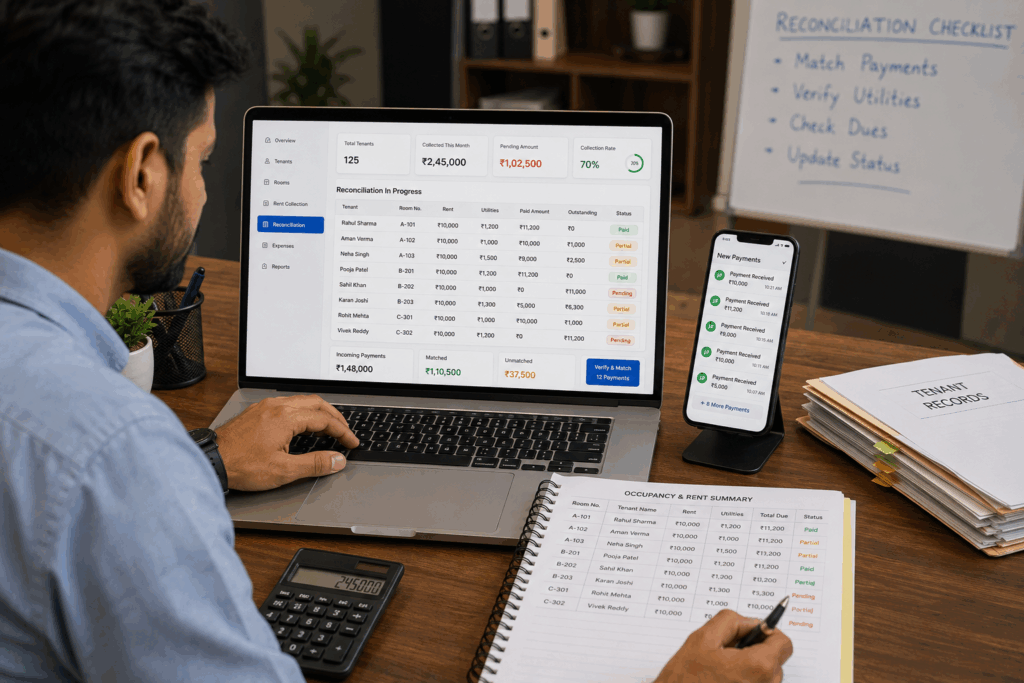
Many landlords assume that once rent collection becomes digital, the problem is solved. In reality, collecting rent online is only half the process. The bigger challenge is reconciliation.
Reconciliation simply means matching incoming payments with the correct tenants, dues, utility charges, deposits, and payment records. For a property with ten tenants, this may not seem complicated. But for a PG with fifty, one hundred, or even more residents, the process can quickly become time-consuming if records are not organized properly.
Consider what happens during the first week of every month. Payments start arriving throughout the day. Some tenants pay rent only. Others include electricity charges. A few may clear previous dues along with the current month’s rent. Without a structured system, management still ends up spending hours identifying transactions and updating records.
This usually happens because:
- Multiple tenants make payments around the same time, making it difficult to identify who paid if references are missing.
- Rent, electricity charges, and deposits are often combined into a single transaction, requiring additional verification.
- Partial payments create confusion around actual outstanding balances and collection status.
- Payment records remain spread across bank statements, spreadsheets, WhatsApp chats, and manual notes.
The challenge is not receiving the payment. The challenge is ensuring every transaction is accurately linked to the right tenant and reflected in the correct records.
As occupancy grows, this administrative workload increases rapidly. Many operators eventually discover that they spend more time verifying payments than collecting them.
Automating Reconciliation: The Missing Piece Most Owners Ignore
One of the biggest advantages of digital rent collection is the ability to automate repetitive administrative work. While many landlords focus on online payments, fewer focus on what happens after the payment is received.
This is where automation becomes valuable.
Automation helps connect incoming transactions directly with tenant records, reducing the need for constant manual verification. Instead of comparing bank statements against spreadsheets every month, operators gain access to organized payment histories that are easier to manage.
Some of the biggest benefits include:
- Payment records remain updated consistently, reducing dependency on manual entries and minimizing human error.
- Outstanding balances become easier to identify because transactions are linked directly to tenant accounts.
- Collection reports can be generated quickly without requiring hours of spreadsheet work.
- Historical payment information remains organized and accessible whenever disputes or questions arise.
More importantly, automation creates operational consistency. The process no longer depends entirely on one staff member remembering to update records correctly.
For growing rental businesses, this consistency becomes extremely valuable because it allows management to focus on occupancy, tenant satisfaction, and property growth instead of repetitive administrative tasks.
Best Free Tools for Small Property Owners
The good news is that landlords do not need expensive software to start collecting rent online. Several free tools can help improve collection visibility and organization immediately.
The goal is not to find the perfect system on day one. The goal is to move away from fragmented processes and create a more structured workflow over time.
UPI Apps
UPI applications remain the easiest starting point for digital rent collection because they are already familiar to most tenants.
They provide several advantages:
- Instant payment transfers directly into the landlord’s account without requiring complex banking processes.
- Transaction histories that help verify collections and review previous payments when needed.
- QR code generation that simplifies the payment experience for tenants.
- Real-time notifications that improve visibility into incoming collections.
For smaller properties, UPI apps may be sufficient during the initial stages of digital adoption.
Google Sheets
Google Sheets remains one of the most popular tools among independent landlords because it provides flexibility without additional costs.
Property owners commonly use it to track:
- Tenant information and room allocation details.
- Monthly rent obligations and due dates.
- Payment status and outstanding balances.
- Utility charges and additional collections.
While the process still requires manual updates, it provides significantly better organization than traditional registers.
WhatsApp for Tenant Communication
WhatsApp has become an important communication tool for many rental businesses because tenants already use it daily.
It can be useful for:
- Sending rent reminders before due dates.
- Sharing payment instructions and QR codes.
- Confirming payment receipts and updates.
- Communicating utility charges and operational announcements.
However, WhatsApp works best when used alongside a structured tracking system rather than serving as the primary source of payment records.
Property Management Apps
As occupancy grows, dedicated property management software becomes increasingly valuable because it combines multiple operational workflows into a single platform.
These systems typically help centralize:
- Tenant records and occupancy information.
- Rent collection tracking and payment visibility.
- Complaint management and maintenance coordination.
- Reporting, reminders, and operational workflows.
For landlords managing larger properties, centralized systems often reduce administrative effort significantly.
Common Mistakes Owners Make When Collecting Rent Online
Moving rent collection online can improve operations dramatically, but only when the process is implemented correctly. Many landlords continue experiencing problems because they focus on payment methods rather than workflow design.
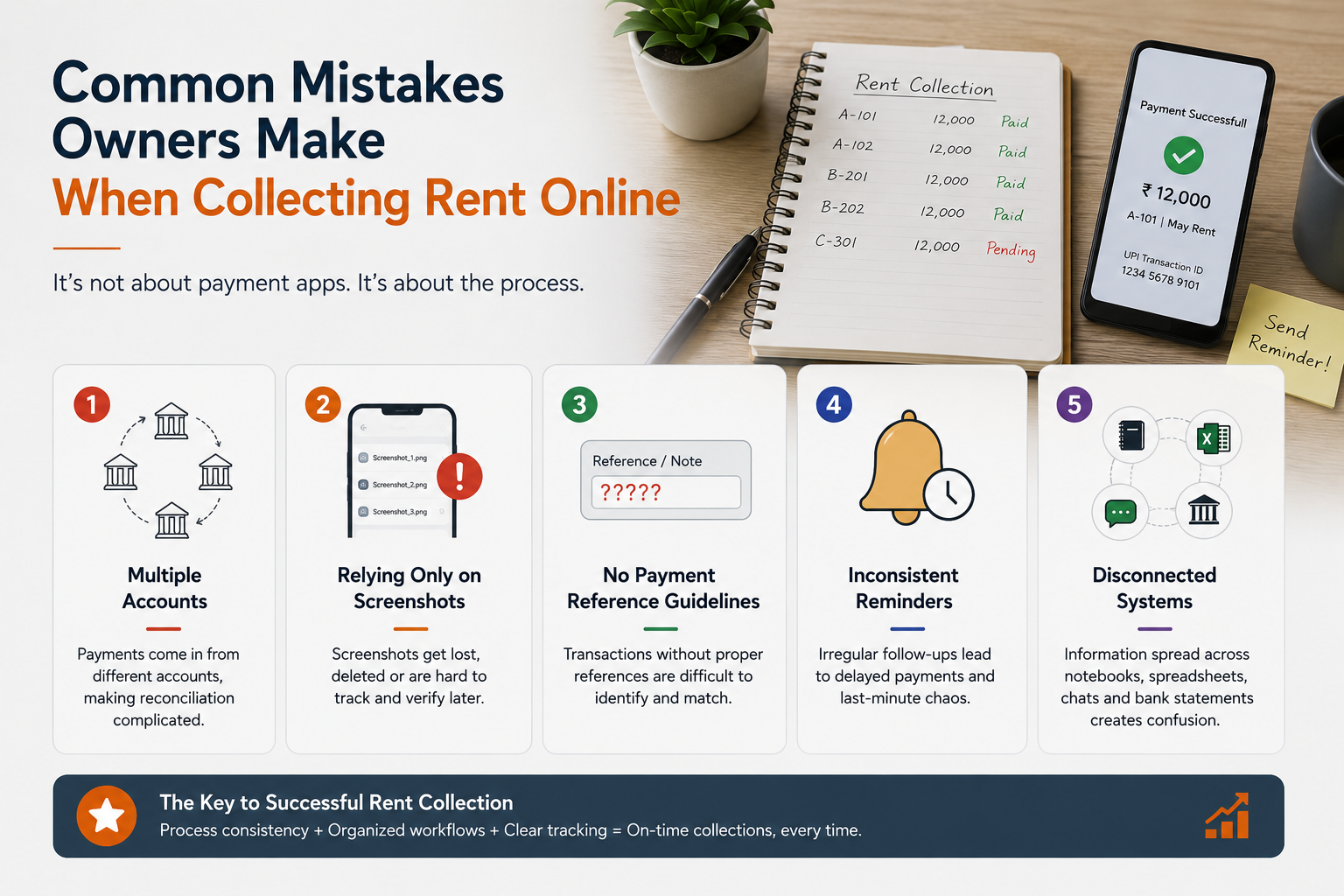
Some of the most common mistakes include:
- Accepting payments through multiple unrelated accounts, making reconciliation unnecessarily complicated and difficult to manage.
- Depending entirely on screenshots instead of maintaining organized payment records that can be reviewed later.
- Failing to establish payment reference guidelines, resulting in transactions that are difficult to identify.
- Sending reminders inconsistently, which often contributes to avoidable payment delays.
- Managing information across multiple disconnected systems, including notebooks, spreadsheets, chats, and bank statements.
The strongest operators understand that successful rent collection depends on process consistency. Digital payments are helpful, but they deliver the most value when combined with organized workflows and clear tracking systems.
How RentOk Helps Simplify Rent Collection
As occupancy grows, managing collections through UPI apps, spreadsheets, WhatsApp chats, and manual records eventually becomes difficult. Information starts getting fragmented, payment tracking consumes more time, and operational visibility becomes harder to maintain.
RentOk helps landlords and property managers centralize rent collection by bringing together tenant records, payment tracking, occupancy management, automated reminders, and reporting within a single platform. Instead of manually comparing transactions across multiple systems, operators gain access to organized records that are easier to track, review, and manage.
This helps improve collection consistency, reduce administrative workload, and create a more structured rental operation. As properties continue scaling, centralized visibility becomes increasingly important because it allows owners to spend less time tracking information and more time improving the tenant experience.
Conclusion
Online rent collection is no longer just a convenience feature. It has become one of the simplest ways for landlords to improve visibility, reduce manual work, and create a more organized rental business.
The strongest collection systems are not necessarily the most expensive. They are the ones that make payments easy to complete, easy to track, and easy to reconcile. By combining UPI payments, QR codes, structured processes, and basic automation, even small property owners can significantly improve the way rent is managed.
As rental operations continue becoming more professional and technology-driven, organized rent collection will increasingly become a competitive advantage rather than an operational upgrade. If you’re looking to streamline rent collection, improve payment visibility, and build a more efficient rental management system, explore RentOk and discover how centralized property management can simplify your daily operations.
About the Author
Ishika Pannu
Ishika Pannu brings you the latest insights and easy-to-apply strategies in property management—helping you simplify renting and grow with RentOk.