Growth
How to Track PG Expenses Digitally and Stop Caretaker Theft

Written by
Ishika Pannu
Read Time
11 min read
Posted on
June 4, 2026
Overview
Overview
How to Track PG Expenses Digitally and Stop Caretaker Theft
Running a profitable PG is not just about filling rooms. Most operators focus heavily on occupancy, tenant retention, and rent collection because these are the numbers they see every day. However, many properties that appear successful on the surface struggle to achieve the profits owners expect. The reason is often hidden in an area that receives far less attention: expense management.
Unlike vacant rooms, expense leakages do not announce themselves. They develop quietly. A slightly inflated grocery bill, an unnecessary maintenance expense, a cash payment without documentation, or repeated purchases of the same supplies can all seem harmless in isolation. The problem is that these transactions occur repeatedly throughout the month. By the time an owner realizes spending has increased, the money has already left the business.
This challenge becomes even more significant when owners are not physically present at the property every day. Most PGs rely on caretakers and on-site staff to handle daily operations, coordinate vendors, purchase supplies, and manage minor repairs. This delegation is essential for smooth operations, but it also creates a dependency on manual reporting. When visibility is limited, owners are forced to trust that expenses are reasonable without having a reliable way to verify them.
The objective is not to monitor every rupee obsessively. The objective is to build a system where spending remains visible, accountable, and easy to review. That visibility is often the difference between a PG that simply survives and a PG that consistently generates strong profits.
Why Expense Leakages Usually Go Unnoticed
Most financial leakages inside a PG do not happen because of one large incident. They happen because small inefficiencies become part of everyday operations.
A property owner would immediately notice if ₹50,000 disappeared from the business account. However, an extra ₹200 spent on supplies today, another ₹300 added to a repair bill next week, and a few undocumented cash purchases throughout the month rarely attract the same attention. Yet collectively, these small transactions can add up to thousands of rupees in unnecessary spending.
Some common patterns that lead to hidden leakages include:
- Routine purchases becoming automatic rather than monitored, which means owners often know that money was spent but not whether the expense was actually necessary.
- Different staff members purchasing items from different vendors without standardized pricing, creating inconsistencies that gradually increase costs.
- Cash transactions being treated as minor expenses, even though they are often the hardest to verify during financial reviews.
The challenge is that these situations do not feel urgent. They rarely create immediate operational problems. Instead, they slowly reduce profitability until owners begin wondering why the business is not performing as expected despite healthy occupancy levels.
Daily Consumables: The Biggest Blind Spot in Most PGs
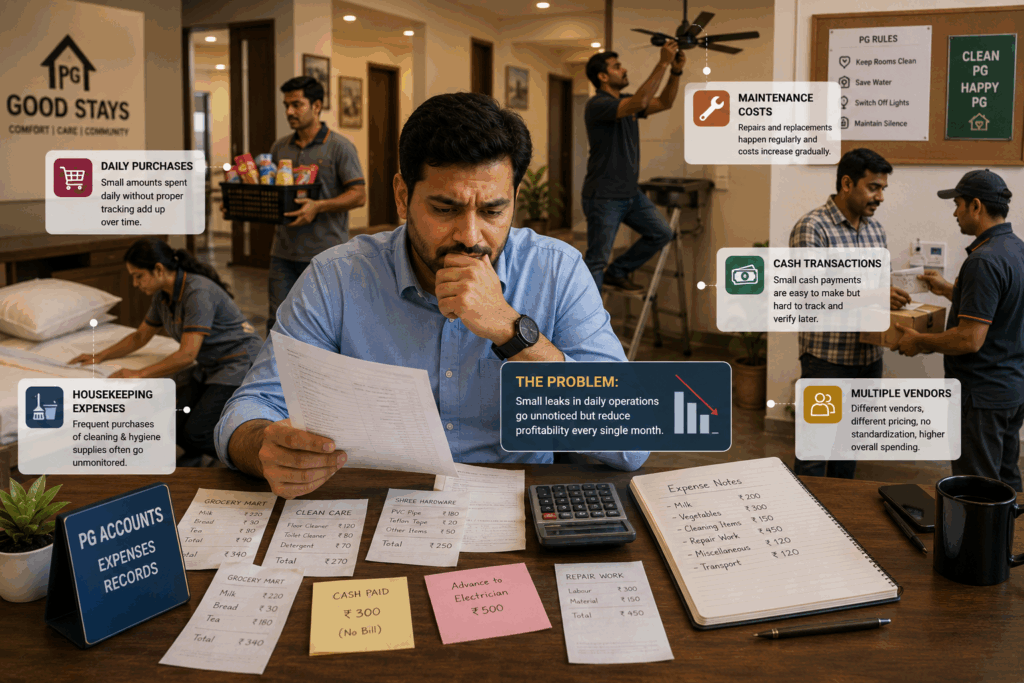
If there is one category where spending quietly increases without attracting attention, it is daily consumables.
Milk, groceries, tea supplies, packaged water, and kitchen essentials are purchased so frequently that they become part of the background operations of the property. Owners focus on ensuring these items are available because they directly affect tenant experience. As a result, spending patterns often receive less scrutiny than they should.
Over time, this creates several challenges:
- Milk and grocery expenses may increase gradually without any corresponding increase in occupancy, making it difficult to understand whether higher spending is actually justified.
- The same products may be purchased from different vendors at different prices, leading to avoidable cost variations that remain hidden inside routine transactions.
- Bills are not always collected consistently, which means monthly reviews often depend on memory rather than documented records.
What makes consumables particularly difficult to manage is their frequency. A single grocery purchase rarely matters. Hundreds of grocery purchases over the course of a year matter a great deal.
This is why successful operators track trends rather than individual transactions. They want to know whether spending is aligned with occupancy, whether vendor pricing is consistent, and whether costs are increasing for legitimate operational reasons.
Housekeeping Expenses Can Quietly Affect Margins
Cleanliness is one of the most important aspects of any PG operation. A clean property improves tenant satisfaction, strengthens retention, and contributes to a better overall reputation. Because of this, owners rarely question spending on housekeeping supplies.
However, operational necessity should not eliminate financial visibility.
Cleaning materials, disinfectants, toiletries, garbage bags, and maintenance supplies are recurring expenses that continue throughout the year. While each purchase may seem reasonable, the cumulative cost can become significant if spending is not monitored properly.
Common challenges include:
- Supplies being replenished before existing inventory is fully utilized, resulting in unnecessary stock accumulation and higher operational costs.
- Housekeeping expenses increasing steadily over time without a clear explanation, making it difficult to determine whether spending is being driven by occupancy or inefficiency.
- Limited visibility into actual consumption levels, which prevents owners from identifying waste or over-purchasing.
The goal is not to reduce service quality. In fact, cutting corners on cleanliness usually creates larger problems. The goal is to ensure that spending remains aligned with actual operational requirements rather than assumptions.
Maintenance Costs Are Harder to Audit Than Most Owners Think
Maintenance is one of the most unpredictable expense categories inside a PG. Unlike groceries or housekeeping supplies, repair costs vary depending on urgency, vendor availability, and the nature of the issue itself.
This unpredictability makes maintenance expenses difficult to benchmark and therefore harder to control.
When a repair needs immediate attention, the priority is usually solving the problem quickly rather than evaluating multiple options. While this approach is understandable, it can create opportunities for overspending if there is no structured review process.
Some common maintenance-related challenges include:
- Emergency repairs receiving immediate approval because operational continuity is more important than cost evaluation at that moment.
- Recurring issues being repaired multiple times without addressing the root cause, resulting in repeated spending on the same problem.
- Vendor invoices being accepted without supporting photographs, work records, or detailed explanations of the completed repair.
Maintenance will always be a necessary expense. The question is whether owners have enough visibility to determine if they are receiving value for the money being spent.
Why Manual Expense Tracking Eventually Breaks Down
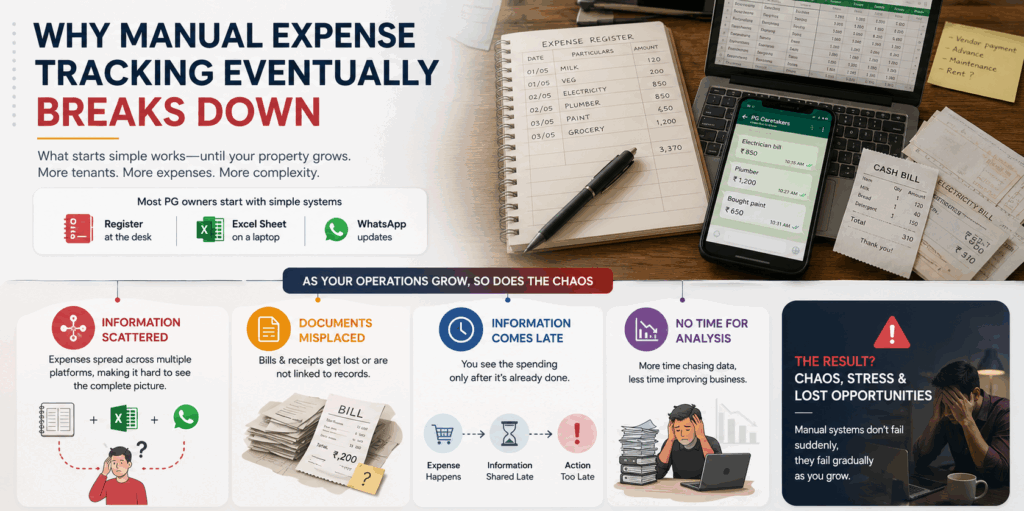
Most PG owners begin with simple systems. A register at the reception desk, an Excel sheet on a laptop, or a WhatsApp group where caretakers send expense updates often feels sufficient during the early stages of the business. When occupancy is low and transactions are limited, these methods can work reasonably well.
The problem begins when operations become more complex.
As tenant numbers increase, so do vendor interactions, maintenance requests, utility expenses, and day-to-day purchases. Suddenly, information starts flowing through multiple channels at once. Some expenses are recorded in registers, some are shared through WhatsApp, and others are remembered only when someone asks about them later.
This creates several operational challenges:
- Expense records become scattered across different platforms, making it difficult for owners to build a complete picture of monthly spending without manually combining information from multiple sources.
- Supporting documents such as bills and receipts often get misplaced because they are stored physically rather than linked directly to the corresponding expense entry.
- Management receives information after spending has already occurred, which means opportunities to question, approve, or optimize expenses have already passed.
The biggest issue is not that manual systems fail immediately. It is that they fail gradually. As the property grows, owners spend more time chasing information and less time analyzing it.
What Changes When Expenses Are Tracked Digitally?
The biggest advantage of digital expense tracking is not automation. It is visibility.
Instead of relying on memory, registers, or fragmented communication channels, every expense enters a centralized system that can be reviewed in real time. Owners no longer need to wait until month-end to understand where money is being spent.
This shift changes the way decisions are made.
When spending becomes visible, patterns become visible too. Management can identify which categories are increasing, which vendors are becoming more expensive, and which operational areas require closer attention.
Digital tracking also creates consistency because every expense follows the same process. Whether it is a grocery purchase, a maintenance bill, or a housekeeping expense, the information is recorded in a standardized format.
Some immediate benefits include:
- A complete history of expenses that can be reviewed at any time, making it easier to compare spending patterns across weeks, months, or occupancy cycles.
- Greater accountability because staff members know that purchases, bills, and approvals are being documented rather than communicated informally.
- Faster decision-making because owners no longer need to spend hours gathering information before understanding what is happening inside the property.
The goal is not to create more administrative work. The goal is to replace uncertainty with visibility.
Approving Bills From Your Phone Improves Control Without Slowing Operations
Many owners assume that tighter financial controls will make operations slower. In practice, the opposite is usually true.
The reason is simple. Most operational delays happen because information is unclear, not because approvals take too long.
When expense requests are submitted digitally, owners can review them from anywhere. Whether they are managing multiple properties, traveling, or handling another business, they remain connected to day-to-day operations without needing to be physically present.
A structured approval process allows management to see:
- Why the expense is required, helping owners understand the operational context rather than simply seeing a final bill amount.
- Who submitted the request and which vendor is involved, creating a clear record of responsibility and accountability.
- Whether supporting documents, photographs, or quotations have been attached, making it easier to evaluate spending decisions objectively.
This level of visibility helps reduce unnecessary expenses while ensuring that genuine operational requirements are addressed quickly.
More importantly, it creates a culture where spending decisions are reviewed rather than assumed.
Why Monthly Profit Analysis Matters More Than Monthly Revenue
Many PG operators know exactly how much rent they collected last month. Far fewer know how much profit they actually generated.
This distinction is important because revenue alone does not determine business performance. A property may collect more rent than ever before while simultaneously becoming less profitable due to rising operational costs.
Without structured expense tracking, owners often underestimate how much money is leaving the business.
A strong monthly review should help answer questions such as:
- Which expense categories increased significantly compared to previous months, and were those increases supported by operational requirements or occupancy growth?
- Which vendors represent the largest share of spending, and are those relationships still delivering value compared to available alternatives?
- How much profit is generated per occupied room after accounting for maintenance, staffing, utilities, consumables, and other recurring expenses?
These insights transform expense management from a bookkeeping activity into a strategic business tool.
When owners understand where money is going, they gain the ability to make better decisions regarding pricing, expansion, staffing, and operational planning.
The Most Profitable PGs Usually Have the Best Systems
Interestingly, the highest-performing PGs are not always the ones charging the highest rents. In many cases, they are simply the ones with stronger operational visibility.
These businesses understand exactly where money is coming from and where it is going. They know which expenses deserve attention, which vendors provide the best value, and which operational areas require improvement.
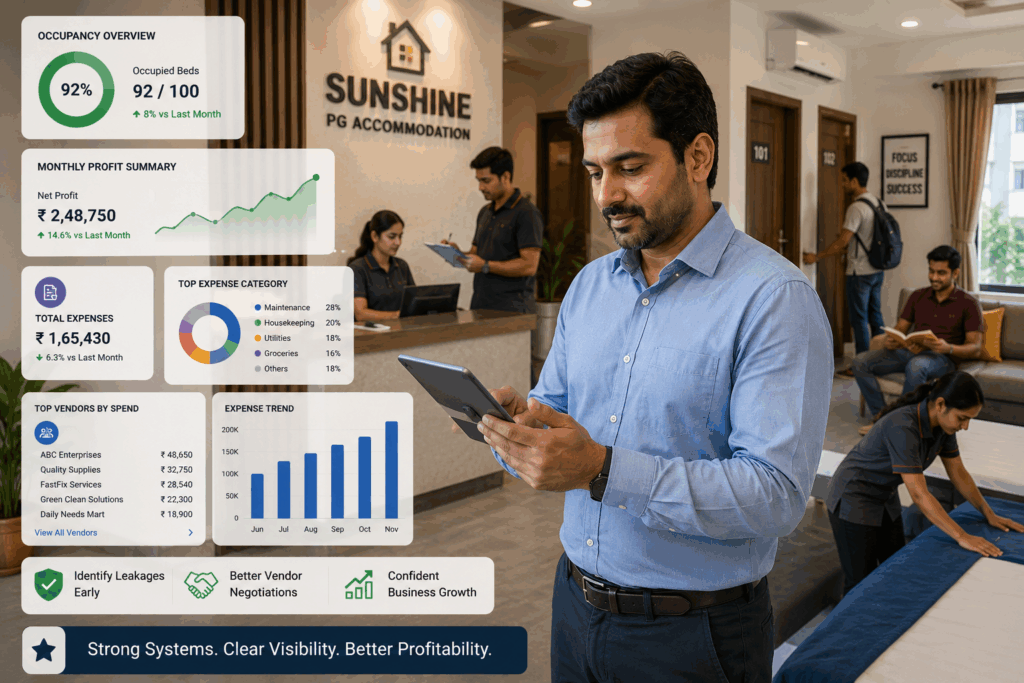
Because of this visibility, they can:
- Identify financial leakages before they become major problems, allowing management to take corrective action while the impact is still manageable.
- Improve vendor negotiations using historical spending data rather than relying on assumptions or incomplete information.
- Scale operations more confidently because financial decisions are supported by accurate records and measurable trends.
The result is not just better profitability. It is greater operational control across the entire business.
How RentOk Helps Owners Manage Expenses More Effectively
As a PG grows, managing expenses through registers, spreadsheets, WhatsApp messages, and verbal updates becomes increasingly difficult. Information gets scattered, approvals become inconsistent, and owners spend more time gathering data than analyzing it.
RentOk helps operators centralize expense management by bringing together bill tracking, expense recording, approval workflows, vendor visibility, and financial reporting into a single platform. Instead of waiting until month-end to understand spending patterns, owners gain real-time visibility into daily expenses and can review supporting documents directly from their phones.
This helps create stronger financial discipline across the business by improving accountability, reducing operational leakages, and providing a clearer understanding of how money moves through the property. More importantly, it gives owners the visibility they need to make informed decisions rather than relying on assumptions.
Conclusion
Most PG owners focus heavily on occupancy because vacant rooms are easy to notice. Expense leakages are different. They develop quietly through routine operational transactions that seem insignificant individually but become costly when repeated over time.
The strongest rental businesses are not simply the ones that generate the most revenue. They are the ones that maintain the highest level of operational visibility. When expenses are tracked properly, approved consistently, and reviewed regularly, owners gain greater control over profitability, vendor management, and long-term growth.
If you want to reduce cash leakages, improve financial visibility, and build a more efficient PG operation, explore RentOk and discover how digital expense management can help you run a more profitable and better-controlled rental business.
About the Author
Ishika Pannu
Ishika Pannu brings you the latest insights and easy-to-apply strategies in property management—helping you simplify renting and grow with RentOk.