Growth
How to Start a PG in Bangalore: Areas, Costs, Licences and Profit


Written by
Ishika Pannu
Read Time
14 min read
Posted on
November 3, 2026
Overview
Overview
How to Start a PG in Bangalore: Areas, Costs, Licences and Profit
A profitable Bangalore PG starts with three numbers: the beds you can legally operate, the rent residents will actually pay and the monthly cost of keeping the property running. A building with space for 30 cots may support fewer approved residents. A busy locality may attract enquiries while its lease cost leaves little money after salaries and meals.
If you are researching how to start a PG in Bangalore, establish that fit before paying a building advance. This guide compares the main neighbourhoods, provides illustrative budgets for 10, 20 and 50 beds, explains the licence and verification checks, and tests a 20-bed operation at different occupancy levels. The financial figures are planning assumptions, not contractor quotations or guaranteed returns.
Bangalore’s PG demand starts with its employment corridors
Bengaluru combines office employment, education and regular relocation demand. JLL’s October 2026 office-market release reports that the city led India’s office gross leasing during January–September 2026, with a 28% share. That supports its importance as an employment market; office leasing does not directly measure occupied PG beds.
Calling Bangalore India’s biggest PG market would require a comparable national PG dataset, so treat that claim cautiously. Your decision needs evidence from the particular catchment: nearby employers or colleges, competing room types, realistic resident budgets and actual vacancies.
Visit competing PGs, check advertised availability and test the commute at the times your intended residents travel. A property near a campus on a map may sit on the wrong side of a difficult junction. Strong city-wide demand cannot rescue an unsuitable building or an expensive lease.
Which Bangalore areas suit your intended residents?
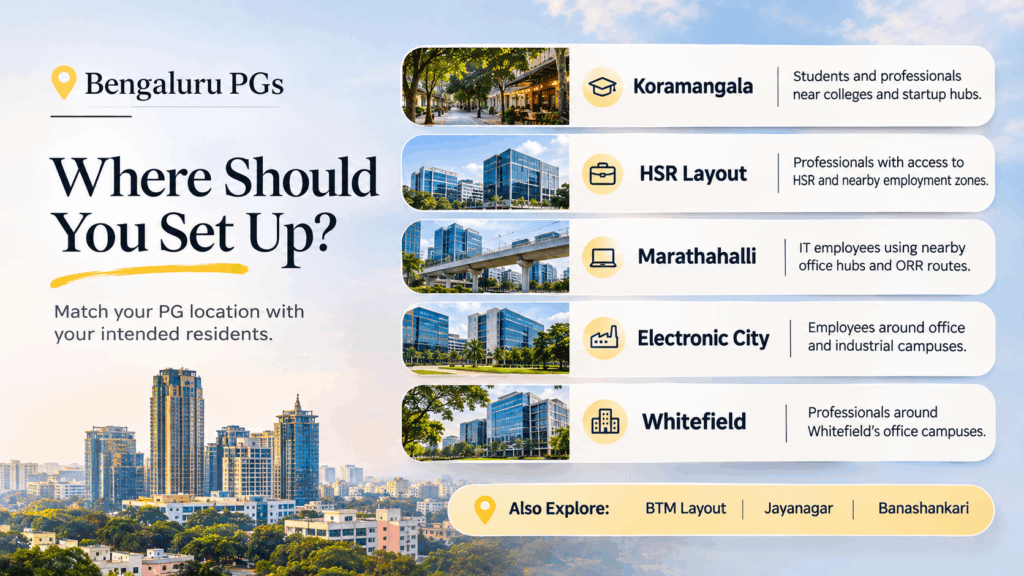
Choose the resident profile first, then shortlist streets and buildings. The following are catchments to investigate, rather than a ranking that guarantees occupancy.
| Area | Potential resident catchment | Check before leasing |
|---|---|---|
| Koramangala | Students and professionals around colleges and startup offices | The relevant block, institution entrance and achievable price after competition |
| HSR Layout | Professionals seeking access to HSR and nearby employment corridors | Sector-level location, last-mile travel and the lease premium |
| Marathahalli | Employees using nearby technology-office and ORR-side routes | Exact office gate, road crossings, noise and peak-hour access |
| Electronic City | Employees around its office and industrial campuses | Phase 1 versus Phase 2, campus entrance and transport after shifts |
| Whitefield | Professionals around Whitefield’s office campuses | The specific campus, nearby transport and practical walking or last-mile access |
Also assess BTM Layout, Jayanagar and Banashankari for student and professional demand. Indiranagar, MG Road and central Bengaluru may suit higher-budget residents, but a higher advertised room price does not establish a better margin. Check both accommodation demand and building costs locally.
Shortlist a few comparable properties rather than signing for the most recognisable address. Speak to prospective residents about food, shift timings, privacy and budget; those answers determine whether you should offer economical sharing, larger twin rooms or a smaller number of private rooms.
The investment plan for 10, 20 and 50 beds
Keep setup expenditure, refundable lease deposit and working capital in separate buckets. A deposit ties up cash but is not automatically a permanent setup cost. Working capital supports operations while beds fill and collections settle; it should not disappear into furnishing purchases.
Illustrative opening budgets
The table assumes a leased building that already supports the intended use, ₹25,000 furnishing and appliance allocation per bed, limited refurbishment and three months of full-capacity operating cash. It excludes buying land or a building, major structural work and borrowing costs. All amounts below are ₹ lakh.
| Funding item | 10 beds | 20 beds | 50 beds |
|---|---|---|---|
| Refundable building deposit | 3.00 | 5.00 | 10.00 |
| Furniture and appliance allocation | 2.50 | 5.00 | 12.50 |
| Refurbishment, safety and utility work | 1.50 | 2.00 | 4.00 |
| Pre-opening administration and marketing | 0.50 | 0.50 | 1.00 |
| Setup contingency | 0.50 | 0.75 | 1.75 |
| Setup subtotal, excluding deposit and reserve | 5.00 | 8.25 | 19.25 |
| Three-month operating reserve | 3.90 | 6.00 | 12.90 |
| Total opening cash requirement | 11.90 | 19.25 | 42.15 |
The reserves assume monthly fixed costs of ₹1 lakh, ₹1.4 lakh and ₹2.8 lakh respectively, plus ₹3,000 per occupied bed at full capacity. They are stress-planning allowances, not measured Bangalore averages. Test a longer reserve period if approvals, fit-out or occupancy take longer.
What changes the quotation?
Price beds, mattresses, lockable wardrobes, study furniture, geysers, washing machines and internet equipment separately. The per-bed allowance spreads shared equipment across capacity; it does not mean each bed requires its own appliances. Add AC only where residents will pay enough to support its installation and running costs.
A ₹50,000–₹2 lakh refurbishment allowance may be inadequate if the building needs bathrooms, rewiring, water storage, fire work or access changes. Obtain itemised quotations after a technical inspection. Likewise, a ₹12–₹15 lakh lease advance is a possible negotiated demand, not a city-wide requirement.
For 25–40 beds, ₹20–₹50 lakh can serve as an initial screening envelope, not a reliable quotation. The correct numerical conversion is ₹20,00,000–₹50,00,000. Premium fit-outs or extensive remedial work can exceed it.
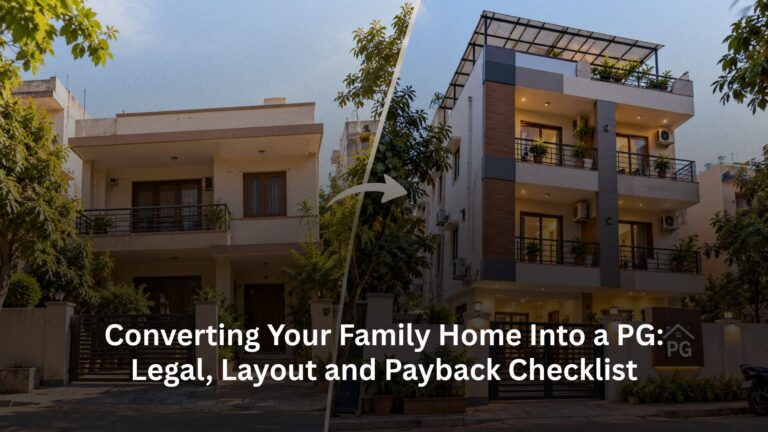
An owned property removes the lease deposit but still has an opportunity cost. Compare the PG’s additional return with ordinary letting and the value of your time. RentOK’s family-home conversion guide explains why layout, legal capacity and the rental alternative belong in the same decision.
Licences and building readiness come before admissions
Establish the lawful capacity and trade-licence route
For a PG licence in Bangalore, start with the official GBA services and identify the city corporation handling the address. Check the current application, inspection and renewal requirements. A trade licence does not cure an unauthorised floor or make an otherwise impermissible use lawful.
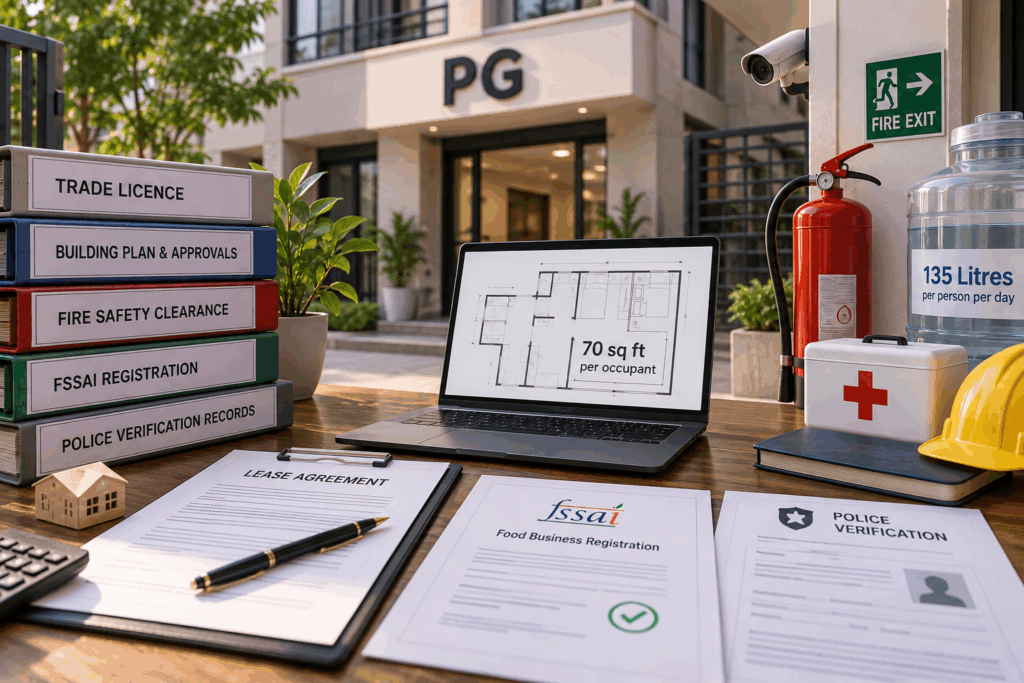
The High Court’s 10 September 2026 order requires examination of sanctioned plans, permitted use and capacity. It refers to the 70 sq ft per occupant licensing benchmark and prohibits turning unapproved circulation or utility spaces into bedrooms. Confirm the accepted area calculation before choosing bed capacity.
If you lease, secure written permission for the actual PG operation, resident accommodation, food service and alterations. Complete applicable stamping and registration, and allocate responsibility for approvals and repairs. Owner consent cannot replace statutory permission. RentOK’s Bengaluru PG rules guide connects the licence with these premises checks.
Budget for working safety systems
The earlier licensing conditions reproduced in the February 2026 court record include CCTV at entries, exits and corridors with 90-day footage storage, water availability of 135 litres per person per day, hygienic washrooms, fire clearance and continuous security coverage. The water figure concerns total availability, not drinking-water consumption alone.
Arrange competent fire-safety review, clear exits, maintained extinguishers, safe electrical installations and appropriate LPG storage. Check which fire clearance applies to the building; buying extinguishers alone does not complete the process. Keep cameras out of private rooms and washrooms.
Plan security shifts and relief rather than expecting one employee to work continuously. Include verified staff, first aid, emergency contacts, cleaning and segregated waste arrangements in the operating budget. Technology supports these safeguards but cannot replace every physical requirement.
Food approval and police records need separate attention
If you prepare or supply meals, select the correct FSSAI registration or licence through FoSCoS. Its April 2026 eligibility document includes boarding houses serving food. Confirm the applicable Kind of Business and approval rather than using an outdated turnover threshold or assuming a universal food-licence fee.
Maintain resident identity, address, emergency-contact and stay records. Ask the jurisdictional police station for the applicable tenant/PG intimation or verification procedure and retain its acknowledgement. An Aadhaar copy alone does not complete it. The Karnataka Police online-services list includes several verification services but does not list a dedicated tenant-verification service; do not promise residents a fully online process without confirming it locally.
Complete applicable staff verification separately. Before opening, also check business registration, employment obligations, property-tax treatment and utility categories for the premises.
Rent by area: compare like-for-like room packages
Use current asking prices as a comparison sample, not proof of an area’s median or your future collections. These advertised monthly starting prices were checked on 3 November 2026; sharing options, inclusions, offers and availability vary.
| Area | Examples from inspected operator listings | What the figures establish |
|---|---|---|
| Koramangala | Stanza Living listings showed starts around ₹9,999–₹22,699 | A wide spread across shared-room properties, not one standard rate |
| HSR Layout | Sivani Living showed ₹12,099 and ₹13,099; Stanza’s HSR listings showed ₹13,899–₹17,299 | Different operators and packages can occupy different price points |
| Marathahalli | Local Stanza listings showed ₹7,499 and ₹8,799 starts | Entry prices may correspond to higher sharing; nearby-area results need filtering |
| Electronic City Phase 1 | Stanza listings showed ₹8,499 and ₹9,999 starts | Phase-specific listings are more useful than a city-wide average |
| Whitefield | Stanza listings showed ₹6,999–₹12,599 starts | Prices span different properties and occupancy options |
Can you use one rate for every sharing type?
No. Build separate comparisons for triple sharing, twin sharing, private rooms and AC rooms. A property card offering multiple room types does not establish the price of each type; request an actual quotation. Studios also differ from a bed in a shared PG.
Record meals, electricity, water, Wi-Fi, housekeeping, deposits, minimum stay and notice terms alongside the price. Avoid pricing a food-inclusive room against an accommodation-only offer. Set the model’s average realised rate after discounts and room mix, then test whether residents will pay it.
Monthly costs and cash collection shape the margin
Separate fixed costs such as the building lease, core payroll, internet and routine overheads from occupancy-linked costs such as ingredients, consumables and usage-linked utilities. Include cook, cleaner, security and management coverage rather than leaving unpaid owner work invisible.
A claimed ₹2,500–₹6,000 cost per bed means little without its denominator and inclusions. Does it exclude the building lease, payroll or empty beds? In the 20-bed example below, full-capacity operating cost is ₹2 lakh: ₹10,000 per available bed, even though the variable cost is only ₹3,000 per resident.
Track meals and water costs, repairs, software, insurance, marketing, brokerage and compliance spending. Maintain a replacement reserve and keep refundable tenant deposits separate from earned income. RentOK’s rental expense-tracking guide explains the value of property-wise spending records.
Occupied beds also need to produce collected payments. Use written due dates, receipts and follow-up routines; rent-collection performance should distinguish billed income, bank receipts and outstanding dues.
For GST, CBIC’s accommodation clarification explains the exemption for accommodation valued at ₹20,000 or less per person per month when supplied for a minimum continuous 90 days. Have a tax adviser review shorter stays, food/service bundles, registration obligations and the building lease separately; this exemption does not settle every transaction.
Break-even occupancy and payback are different tests
A 20-bed operating model
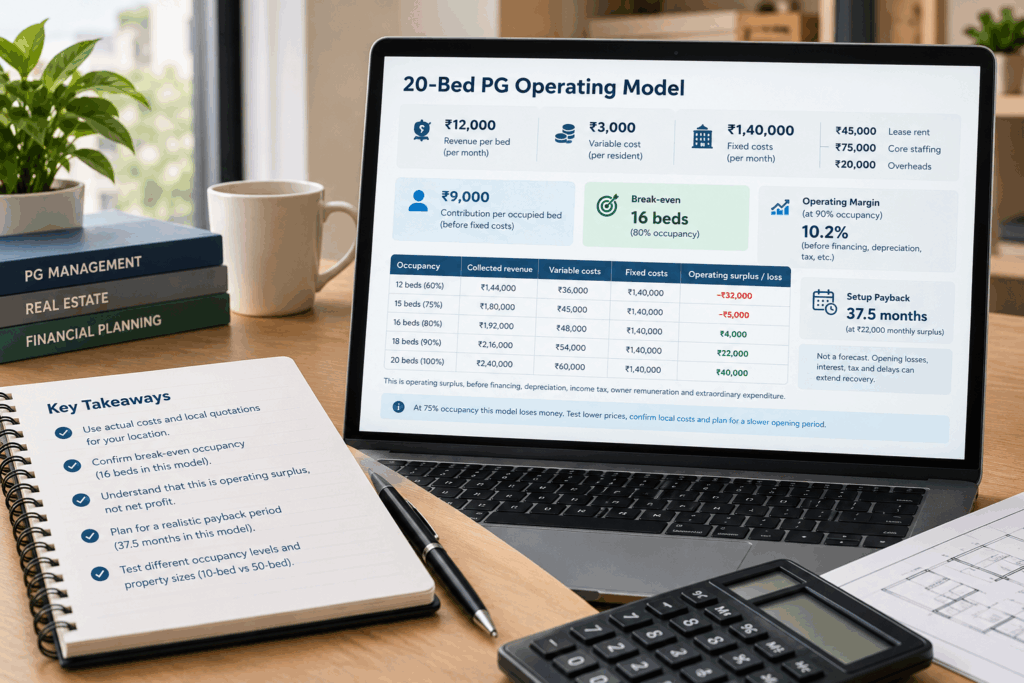
Assume ₹12,000 monthly realised revenue per occupied bed, ₹3,000 variable cost per resident and ₹1,40,000 fixed monthly operating costs. The fixed-cost assumption includes ₹45,000 lease rent, ₹75,000 core staffing and ₹20,000 base overheads. Replace these figures with a staffing roster and local quotations that cover the actual requirements.
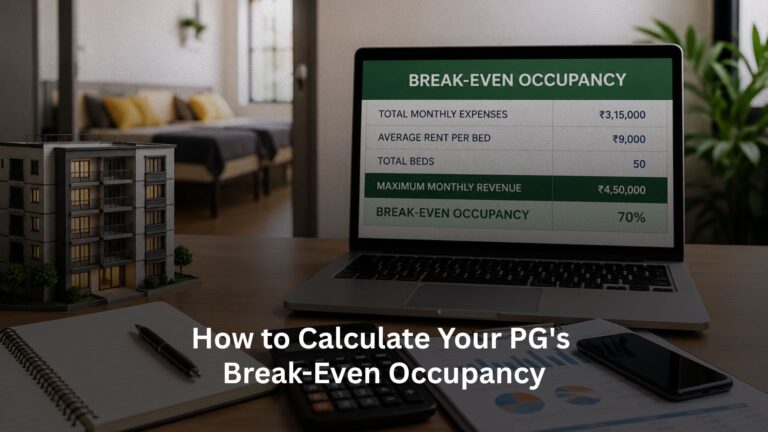
Each occupied bed contributes ₹9,000 before fixed costs. Break-even is ₹1,40,000 ÷ ₹9,000 = 15.56 beds, so you need 16 occupied beds, or 80% occupancy, to reach a non-negative monthly operating result with whole beds. RentOK’s break-even occupancy guide provides further context; use the contribution approach when costs vary with resident count.
| Occupancy | Collected revenue | Variable costs | Fixed costs | Operating surplus or loss |
|---|---|---|---|---|
| 12 beds: 60% | ₹1,44,000 | ₹36,000 | ₹1,40,000 | −₹32,000 |
| 15 beds: 75% | ₹1,80,000 | ₹45,000 | ₹1,40,000 | −₹5,000 |
| 16 beds: 80% | ₹1,92,000 | ₹48,000 | ₹1,40,000 | ₹4,000 |
| 18 beds: 90% | ₹2,16,000 | ₹54,000 | ₹1,40,000 | ₹22,000 |
| 20 beds: 100% | ₹2,40,000 | ₹60,000 | ₹1,40,000 | ₹40,000 |
This is operating surplus, before financing, depreciation, income tax, owner remuneration and extraordinary expenditure. It is not guaranteed net profit. At 90% occupancy, the operating margin is about 10.2%, before those exclusions.
How long would the setup take to recover?
Using the ₹8.25 lakh setup subtotal, a constant ₹22,000 monthly operating surplus gives a simple screening payback of 37.5 months. That is not a forecast: opening losses, replacements, interest, tax and payment delays extend recovery. The refundable ₹5 lakh building deposit remains tied-up capital, while the ₹6 lakh reserve may partly fund early losses or remain cash.
At 75% occupancy this model loses money, so the suggested 60%–75% break-even range is not a safe assumption. If fixed costs rise to ₹1.6 lakh, you need 18 beds, or 90% occupancy. Negotiate the building lease and test lower prices before committing.
A 10-bed leased operation can struggle to spread security and staffing costs; an owned or appropriately shared-cost arrangement may change the result. A 50-bed property can spread some fixed costs, but requires more capital and management. Approve the investment only after testing lawful capacity, conservative collections and a slower opening period.
How RentOK helps you run a Bangalore PG
The opening budget depends on accurate bed inventory, successful move-ins and money actually collected. RentOK connects these operating records so you can compare the forecast with daily activity rather than discovering a gap at month-end.
- Set up the real room and bed inventory: Record sharing types, facilities, rent and vacant or occupied status. Block beds that you cannot sell, and keep allocations within the independently approved capacity.
- Follow enquiries through to admission: Assign leads, schedule visits and track their status. This helps distinguish a weak enquiry pipeline from visits that fail to convert, so you can investigate the right problem.
- Organise joining and resident records: Use digital joining, document review and tenant-ledger workflows to connect residents with their rooms and agreed charges. Complete the separate police procedure and retain official acknowledgements where required.
- Keep dues and collections visible: RentOK supports recurring dues, reminders, payment histories and receipts. Review overdue amounts alongside occupancy; a filled bed should not conceal an unpaid balance.
- Compare actual costs with the plan: Use property-wise money reports for income, expenses and profit views. Recheck food costs, lease commitments and staffing when the recorded result differs from your model.
RentOK supports management; it does not issue licences, approve occupancy, replace physical safety arrangements or guarantee bookings and profit. Establish a compliant, financially workable property first, then use reliable records to run it consistently.
Conclusion
Starting a PG business in Bangalore works best when the location, legal capacity and financial model support one another. Choose a specific resident catchment, confirm the premises and approvals, obtain detailed quotations and price rooms against comparable local offers. Separate refundable deposits from setup spending, and protect enough working capital for a slower start.
Before signing the lease, calculate how many paying residents the business needs and what happens below that level. Once the property passes those checks, run your Bangalore PG on RentOK to keep bed availability, resident records, collections and expenses connected from the first move-in.
Frequently Asked Questions
Find answers to common questions about this topic
About the Author
Ishika Pannu
Ishika Pannu brings you the latest insights and easy-to-apply strategies in property management—helping you simplify renting and grow with RentOk.