Growth
Converting Your Family Home Into a PG: Legal, Layout and Payback Checklist

Written by
Ishika Pannu
Read Time
14 min read
Posted on
October 29, 2026
Overview
Overview
Converting Your Family Home Into a PG: Legal, Layout and Payback Checklist
A spare floor can look like the beginning of a rental business: add beds, advertise near a college or office hub, and start collecting monthly payments. But a family home serves one household. A PG must support several residents with different schedules, shared facilities, clear agreements and someone responsible when the water stops or a resident needs help at night.
Before you convert a house into a PG, test three things together: legal permission, usable capacity and financial return. More beds do not automatically mean a better investment, and the income will rarely feel passive unless you budget for management. This guide covers the five practical factors behind the decision, legal requirements, security, resident screening, facilities and staffing, and costs, then shows how to calculate payback without assuming every bed stays full.
Is it legal to turn your family home into a PG?
It may be, but ownership does not automatically authorise PG use. Ask the municipal corporation, development authority or estate office how it classifies your proposed operation. A small owner-occupied PG and a separately operated hostel may face different conditions.
Check the sanctioned building plan, permitted use, occupancy documents and title or lease conditions. Depending on the jurisdiction, you may need PG registration, trade permission, change-of-use approval or alterations to the sanctioned plan. Do not assume every city requires the same commercial-conversion certificate. The Chandigarh Administration’s PG notices, for example, separately list residential-area PG orders, rules and registration documents.
For a PG in an independent house, also resolve co-owner consent, shared access and lender or insurance conditions where relevant. If your family will stay, identify private rooms and shared areas before planning admissions.
Inside a society or apartment complex, examine the registered bye-laws and applicable law. Establish whether you need an NOC, another approval or prior intimation, and keep the response in writing. Society permission requirements vary; an informal assurance from a committee member cannot settle every issue.
Spend on a feasibility assessment before spending on furniture. A property-use restriction can undermine the entire project, even if the rooms look ready.
How many beds can the house really support?
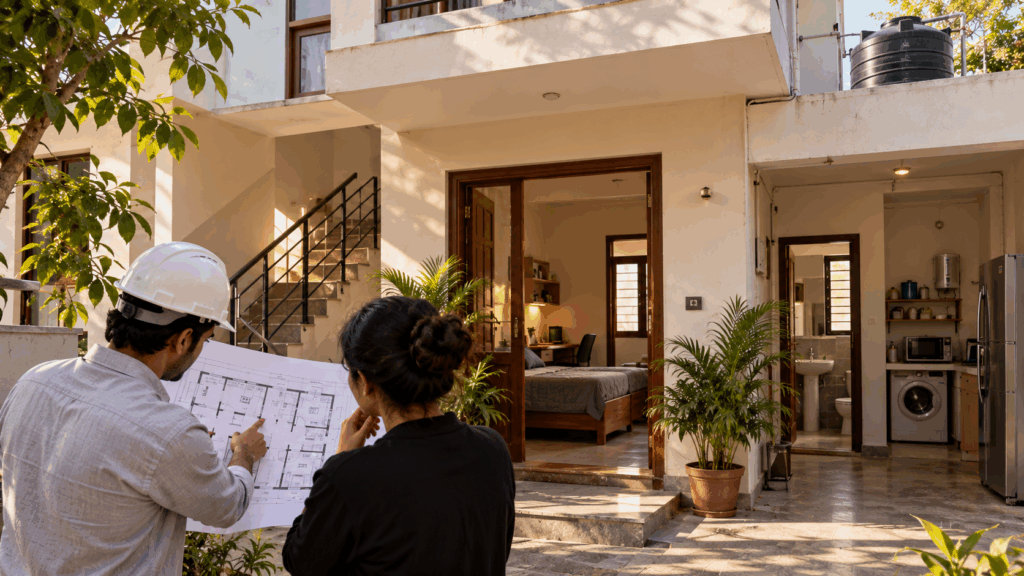
Start with a measured layout, not the number of mattresses a room can hold. Ask an architect to check permitted occupancy, ventilation, circulation, bathroom access, fire escape and the effect of proposed alterations. Exclude areas that cannot lawfully serve as sleeping rooms.
An illustrative six-bedroom house might support 12 residents in double-sharing rooms, but only if the individual rooms, services and local conditions permit it. A large total floor area cannot compensate for cramped bedrooms, an unsuitable staircase or inadequate sanitation.
Bedrooms, bathrooms and family privacy
Keep the route from each bed to the door usable. Include room for wardrobe doors, luggage, study space and cleaning. If you divide a large hall, use professionally designed partitions that preserve daylight, ventilation, fire performance and access; neither gypsum nor timber automatically makes a division suitable. Curtains cannot create a compliant bedroom.
As a comfort target, consider roughly one bathroom for three residents, and examine peak-hour queues carefully if four share one. This is a planning preference, not a nationwide statutory ratio. Local requirements may be stricter. Splitting an existing bathroom or installing a prefabricated unit still needs workable drainage, ventilation, waterproofing and any required approval.
Utilities and common areas set another capacity limit
Provide lockable personal storage, accessible sockets and room-wise sub-metering where suitable. Have a qualified electrician assess the sanctioned load, wiring, earthing and simultaneous use of geysers, appliances and ACs. Explain meter readings and the lawful billing basis in the agreement.
Reserve space for a pantry, drinking-water purifier, refrigerator, microwave, laundry and Wi-Fi coverage. Size backup power to essential loads rather than buying a generator by label alone. Check siting, ventilation, noise and permissions.
For illustration, a planning assumption of 150–200 litres per resident per day produces 1,800–2,400 litres for 12 residents before other demand. Confirm the applicable water norms and actual use; this is neither a universal requirement nor a tank-size prescription. Have an engineer check storage loads, supply reliability and drainage.
Renovation costs, room by room
Your house to PG conversion cost depends on the building’s existing condition and the approved scope. A home needing only furniture differs substantially from one requiring new bathrooms, rewiring or structural work. Obtain itemised local quotations that identify quantities, labour, taxes, exclusions and completion milestones.
The following illustrative ₹8.40 lakh setup budget assumes an existing six-bedroom house, 12 beds, no major structural alteration and a shared pantry rather than an operator-run meal service. These are planning allocations, not market rates or contractor quotations.
| Area or work package | Assumed scope | Budget allocation |
|---|---|---|
| Six bedrooms | Beds, mattresses, lockable storage and study furniture for 12 residents | ₹2,40,000 |
| Bathrooms and plumbing | Refurbish existing facilities and provide one additional bathroom, subject to feasibility | ₹1,80,000 |
| Electrical and water systems | Wiring corrections, metering, essential-load backup and water-system work | ₹1,00,000 |
| Pantry and laundry | Refrigerator, purifier, microwave, washing machine and basic fittings | ₹75,000 |
| Safety and access | Initial allowance for assessed fire, alarm, entry-security and CCTV work | ₹55,000 |
| Painting and minor finishes | Repairs, painting and finishing | ₹60,000 |
| Professional and application costs | Provisional design, legal and approval-related allowance | ₹40,000 |
| Contingency | Allowance for unforeseen work | ₹90,000 |
| Total setup outlay | Illustrative conversion budget | ₹8,40,000 |
Separate the renovation bill from launch cash
The table cannot establish the cost of a required fire system or statutory fee. Replace every provisional allowance with the assessed requirement; add major structural repairs, sewage upgrades or other excluded work if necessary. Do not cut safety work to preserve the original total.
Keep working capital outside the renovation budget. An additional illustrative ₹1.20 lakh reserve brings initial funding to ₹9.60 lakh, before any separate refundable utility deposits or financing costs. The reserve supports early vacancies and unexpected bills; it is not automatically an expense on day one. Tenant security deposits remain refundable liabilities, not free renovation funding.
Licences, safety clearances and tariff changes
There is no single document that makes every Indian PG legal. Create an approval register showing the authority, requirement, application status, conditions and renewal date. Use the wider PG business setup checklist to organise the process, then confirm the rules with your own authorities.
- Municipal and building permissions: Identify the applicable PG, lodging, trade or health-trade category. Check change of use and approval for alterations before work starts.
- Fire clearance: Confirm whether the building requires an NOC or Fire Safety Certificate. Height, occupancy, use and configuration matter; “only 10–12 guests” is not a universal exemption. The Delhi Fire Service FAQ illustrates how building categories determine coverage. Plan clear escape routes, appropriate extinguishers, detection and maintenance regardless.
- Food registration or licensing: If you prepare or serve meals, check the current FoSCoS category. FSSAI expressly includes boarding houses serving food; registration versus licensing depends on current eligibility. Assess outsourced meal arrangements too.
- Employment and local registrations: Check the applicable Shops and Establishments framework and staff obligations. Employing a cook is not the sole test for coverage; state law and the establishment’s category matter.
Ask the municipality and utility providers to confirm property-tax classification, electricity and water tariffs, sanctioned load and connection deposits. PG use may change these costs, but do not assume every charge automatically becomes commercial. Check insurance cover and ask your accountant about income tax and GST separately.
Security, screening and the first resident agreement
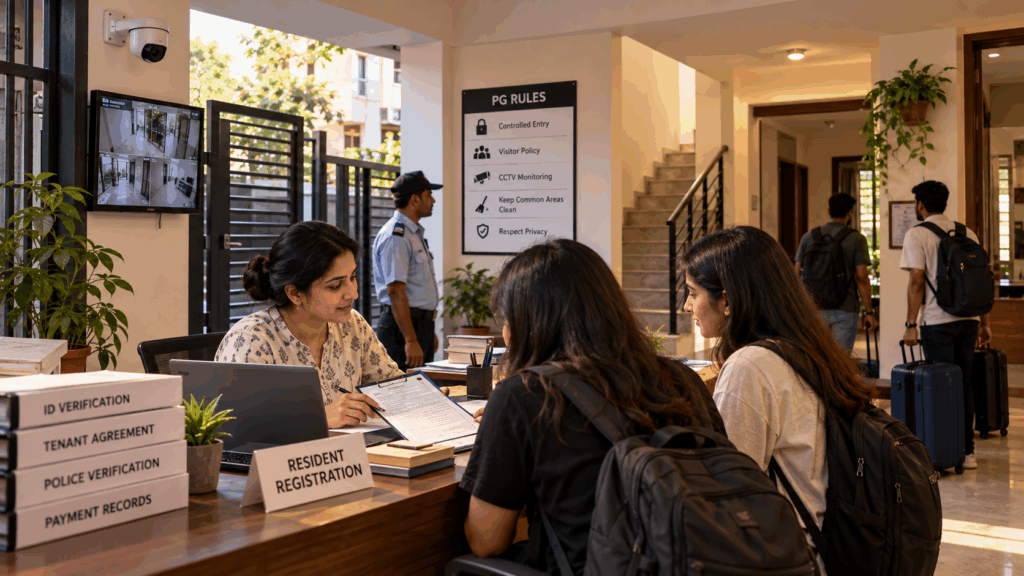
A converted home needs a clear operating routine, whether it houses students or working professionals. Security should protect every resident, with controlled entry, functioning locks, well-lit access, a visitor process and an identified person who handles emergencies. Budget for the staffing and shifts that your service promise and local rules require.
Use CCTV for appropriate access and common areas while protecting private spaces. Plan camera coverage, access to recordings, retention and maintenance; cameras alone cannot replace responsible supervision. Keep bedrooms, bathrooms and changing areas private.
Before move-in, verify identity, contact details and relevant references through a consistent process. Follow the current local police procedure where required, and retain the acknowledgement. For example, Delhi Police provides a tenant-verification form. Collecting an Aadhaar image does not by itself complete that process.
Request only necessary documents, explain their purpose and restrict access. RentOK’s tenant background-verification guide explains why identity checks, police submissions and references serve different purposes. Avoid circulating residents’ documents through personal chats.
Use a suitable written occupancy agreement covering the allotted bed, rent, utilities, meals if offered, deposit, notice, refund terms, visitors and maintenance. Include any agreed rent-review schedule and complete applicable stamping or registration. Record inventory, existing damage and payment receipts before handing over keys. Test the shared water and laundry facilities with staff, and explain their use during the resident’s orientation.
How long will the conversion take to pay back?
Payback depends on collected revenue, not advertised capacity. Compare nearby PGs with similar rooms, food arrangements and facilities, then test a realistic achievable rate. City-wise PG prices provide context, but current neighbourhood quotations should drive your forecast.
An illustrative 12-bed operating budget
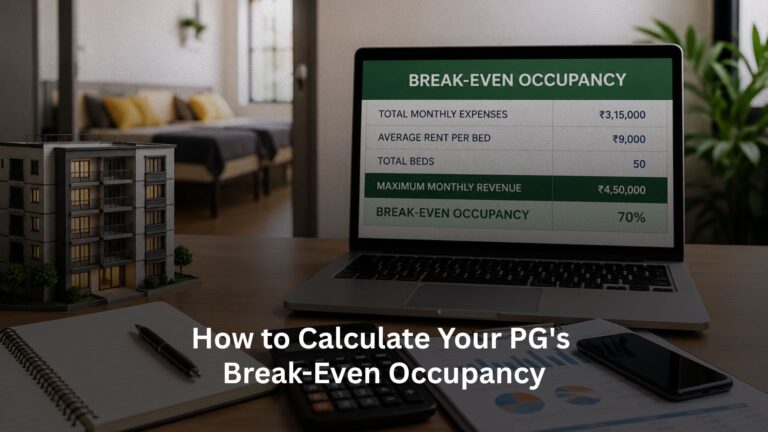
Assume 12 available beds, a ₹10,000 monthly charge without meals, and 85% collected occupancy averaged over the period. That percentage represents paid bed-months, not a literal fraction of a resident. Monthly receipts average 12 × ₹10,000 × 85% = ₹1,02,000.
| Monthly operating provision | Illustrative amount |
|---|---|
| Housekeeping and caretaker support | ₹20,000 |
| Electricity and water | ₹12,000 |
| Cleaning, laundry supplies and consumables | ₹6,000 |
| Internet and software | ₹2,000 |
| Repairs, replacement reserve and insurance provision | ₹5,000 |
| Marketing, listing and tenant-turnover costs | ₹3,000 |
| Owner-management allowance | ₹14,000 |
| Total monthly operating provision | ₹62,000 |
| Monthly operating cash surplus | ₹40,000 |
These assumptions require local validation, including whether staffing meets applicable requirements. This model includes no meal service, property purchase cost or loan payment, and the surplus is before income tax. Provisioning for repairs and management makes the estimate more useful than treating every rupee after electricity as profit. The owner allowance and reserves are planning provisions, not claims of tax deductibility.
Simple payback and the normal-rent alternative
Simple setup payback = setup outlay ÷ monthly operating cash surplus. Here, ₹8,40,000 ÷ ₹40,000 gives 21 months after steady operations begin. Slower admissions, bad debts, major repairs, financing and tax can extend the actual recovery period. A reserve that remains unspent should not automatically enter the numerator as a consumed setup cost.
Now assume the house could otherwise earn ₹25,000 net monthly from an ordinary tenancy, on a comparable basis. The PG produces only ₹15,000 additional monthly surplus. Incremental payback becomes ₹8,40,000 ÷ ₹15,000 = 56 months. This asks whether the extra investment and responsibility improve on your available alternative.
Occupancy can change the answer quickly
| Collected occupancy | Monthly receipts | Surplus after ₹62,000 provision | Simple setup payback |
|---|---|---|---|
| 60% | ₹72,000 | ₹10,000 | 84 months |
| 75% | ₹90,000 | ₹28,000 | 30 months |
| 85% | ₹1,02,000 | ₹40,000 | 21 months |
This sensitivity holds costs constant to isolate occupancy; actual bills and staffing may change. At 60%, the PG’s ₹10,000 surplus also falls below the assumed ₹25,000 tenancy alternative. Keep monthly financial reports so you can compare real collections and costs with the forecast.
Use the accompanying PG Conversion Payback Calculator to change the setup outlay, beds, rate, occupancy, operating costs and alternative net rent. It calculates both simple and incremental payback; it does not assess legal capacity or promise a return.
Mistakes that make a first PG harder to run
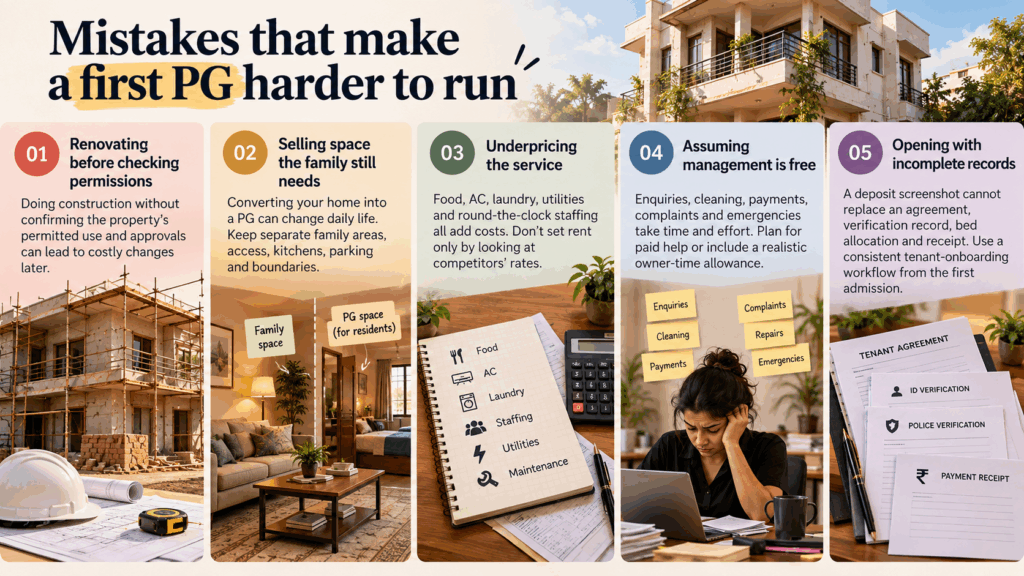
The most expensive mistake often happens before launch: owners buy beds for a capacity that the building cannot legally or comfortably support. Other problems appear only once residents begin sharing bathrooms, paying utility bills and requesting repairs.
- Renovating before checking permissions: Resolve permitted use and approval conditions first. Retrofitting completed work can cost more than revising a drawing.
- Selling space the family still needs: Agree on separate access, private areas, kitchens, parking and household boundaries. A family home rental business changes everyday life as well as income.
- Underpricing the service: Food, AC, laundry and round-the-clock staffing need their own cost assessment. Do not copy a competitor’s headline rate without comparing inclusions.
- Assuming management is free: Assign responsibility for enquiries, cleaning, payments, complaints and emergencies. Include paid help or a realistic owner-time allowance in the forecast.
- Opening with incomplete records: A deposit screenshot cannot replace an agreement, verification record, bed allocation and receipt. Use a consistent tenant-onboarding workflow from the first admission.
Before advertising a firm move-in date, close the essential checks: lawful use, completed safety work, usable utilities, documented terms, staffing and launch cash. If the project works only at full occupancy or by omitting necessary costs, revise the model before committing further money.
How RentOK helps you onboard your first PG tenants
Once the house is ready and the required permissions are in place, the next challenge is turning enquiries into organised move-ins. RentOK connects room information, resident records and payment tracking so your new PG starts with a repeatable process.
- Set up the actual room inventory: Record sharing types, rents, facilities and bed availability. Allocate or block beds so admissions follow your approved operating capacity rather than an informal list.
- Organise tenant details and documents: Use digital joining and KYC workflows to review submitted information and keep resident records together. Complete the applicable police procedure and retain its acknowledgement separately where required.
- Prepare agreements and payment records: Use RentOK’s agreement workflows, tenant ledgers and payment histories to keep agreed terms connected with the resident. Check the correct document, stamping and registration requirements for your arrangement.
- Track the business after launch: Review dues, collections, expenses and profit-loss reports against the conversion forecast. Actual records help you spot whether vacancies or running costs are delaying recovery.
RentOK supports these operating tasks; it does not approve building use, certify layouts or guarantee occupancy. Start with a legally ready property, then use the platform to keep the first admission and every subsequent move-in organised.
Conclusion
The strongest reason to convert a house into a PG is a workable combination of permission, resident comfort and additional income. Establish the lawful capacity first, price the necessary infrastructure and staffing, and test the numbers against both lower occupancy and a normal tenancy. A larger rent collection alone cannot show whether the conversion rewards your investment and time.
When those checks support the decision, prepare the operating process before you hand over the first key. Clear agreements, documented payments and accurate room records help your family home become a manageable accommodation business. Onboard your first tenants on RentOK and build consistent records from the first move-in.
Frequently Asked Questions
Find answers to common questions about this topic
About the Author
Ishika Pannu
Ishika Pannu brings you the latest insights and easy-to-apply strategies in property management—helping you simplify renting and grow with RentOk.