Growth
Stop Chasing Tenants with Automated Rent Reminders

Written by
Ishika Pannu
Read Time
9 min read
Posted on
June 4, 2026
Overview
Overview
Stop Chasing Tenants with Automated Rent Reminders
Rent collection is one of the most repetitive tasks in property management, yet it is often handled in the most manual way possible. Every month, landlords and property managers find themselves sending WhatsApp messages, making reminder calls, checking payment screenshots, and following up with tenants who have not paid yet. While this approach may work for a small property, it becomes increasingly difficult as occupancy grows.
The real problem is not that tenants refuse to pay. In most cases, delayed payments happen because there is no structured reminder system in place. Some tenants genuinely forget, others postpone payments until they receive a reminder, and a few simply delay because there is no urgency attached to the due date. When reminders depend entirely on manual follow-ups, collection performance becomes inconsistent and management teams end up spending hours every month on work that could easily be automated.
This is why many modern PGs, co-living spaces, and rental properties are moving towards automated WhatsApp rent reminders. Instead of chasing tenants individually, they are building systems that automatically communicate payment information, send due date reminders, and improve collection discipline without increasing workload.
Why Manual Calling Becomes an Operational Problem
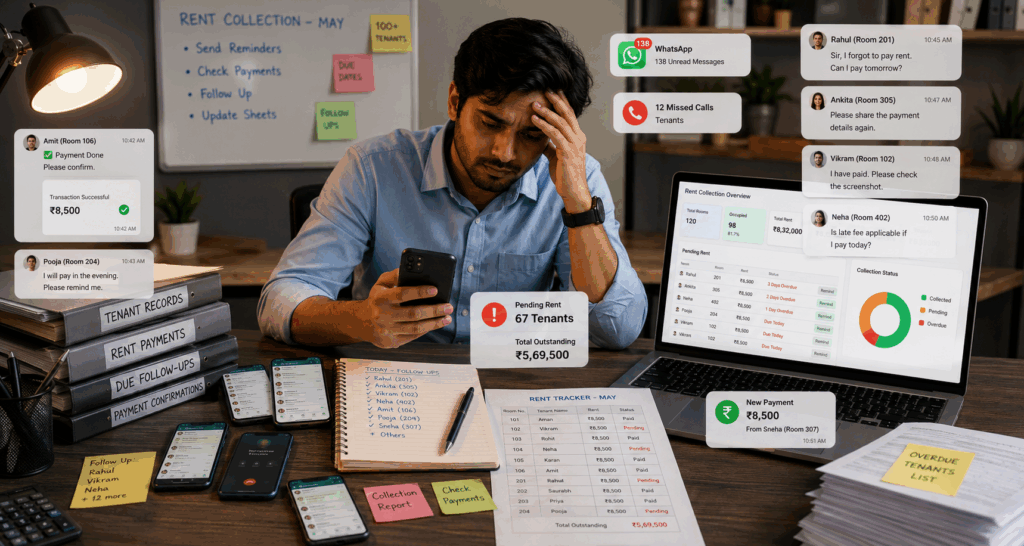
Most landlords think manual rent collection is only a time-management issue. However, the impact goes much deeper than that. As tenant numbers increase, reminder management starts affecting multiple areas of property operations.
A property with ten tenants may only require a handful of reminders every month. But a property with 100 tenants operates very differently. Managers are suddenly tracking payment confirmations across dozens of chats, responding to repetitive payment-related questions, and trying to remember which tenants still need follow-ups.
Over time, this creates a chain of operational challenges that affect both collections and overall efficiency.
Some of the most common issues include:
- Property managers spending several hours every month sending repetitive messages that could easily be automated through structured workflows.
- Payment confirmations becoming scattered across WhatsApp chats, making reconciliation slower and increasing the chances of errors.
- Collection timelines becoming inconsistent because reminder schedules depend on staff availability rather than predefined processes.
- Tenant communication feeling unorganized as some residents receive multiple reminders while others receive none at all.
The biggest issue is that manual systems rarely scale well. They may work when occupancy is low, but they quickly become difficult to manage once a property starts growing.
Why Tenants Often Need Reminders in the First Place
One of the biggest misconceptions in rental management is that delayed payments are always caused by irresponsible tenants. While that may occasionally be true, most delays happen for far more ordinary reasons.
People already receive dozens of notifications every day. Banks send reminders for EMIs, credit card companies send due-date alerts, utility providers send payment notifications, and subscription services remind customers before renewals. Modern payment systems are built around visibility because they understand that reminders influence behavior.
Rent payments work in exactly the same way.
A tenant may fully intend to pay rent on time, but if the due date arrives during a busy work week, the payment can easily get pushed to the next day and then forgotten entirely. Once that happens across multiple tenants, collections begin slowing down.
Properties that maintain stronger payment discipline usually create visibility before the due date arrives. Instead of waiting until payments become overdue, they communicate early and consistently.
This approach offers several advantages:
- Tenants have enough time to plan payments instead of reacting to last-minute reminders.
- Collection cycles become shorter because residents are already aware of upcoming dues.
- Management spends less time chasing payments because reminders are sent proactively.
- Payment behavior gradually improves as tenants become accustomed to a structured process.
The objective is not to send more reminders. The objective is to send the right reminders at the right time.
Why WhatsApp Has Become the Preferred Channel
Communication channels play a surprisingly important role in rent collection. A reminder is only effective if the tenant actually sees it.
While SMS remains useful for urgent notifications and email works well for documentation, WhatsApp has become the preferred communication platform for many rental businesses because it aligns naturally with tenant behavior. Most residents already use the platform daily, which means reminder visibility is significantly higher compared to many other channels.
For property managers, this creates several operational benefits.
A WhatsApp rent reminder can include:
- The pending rent amount along with the due date, reducing confusion and unnecessary clarification requests.
- Payment links or account details that allow tenants to complete transactions immediately.
- Late fee information that helps residents understand payment timelines before penalties apply.
- Instant payment confirmations that reassure tenants once transactions are completed successfully.
Unlike phone calls, WhatsApp messages also create a communication trail. Both management and tenants can refer back to previous messages whenever needed, reducing misunderstandings and improving transparency.
How to Set Up Automated Rent Reminders
One reason some landlords hesitate to automate reminders is the assumption that the setup process will be complicated. In reality, most reminder systems follow a fairly straightforward structure.
The first step is organizing tenant information. Automation only works well when records are accurate and accessible. This means maintaining clear visibility into tenant names, contact details, rent amounts, payment schedules, and due dates.
Once this information is available digitally, reminder workflows can be configured to run automatically.
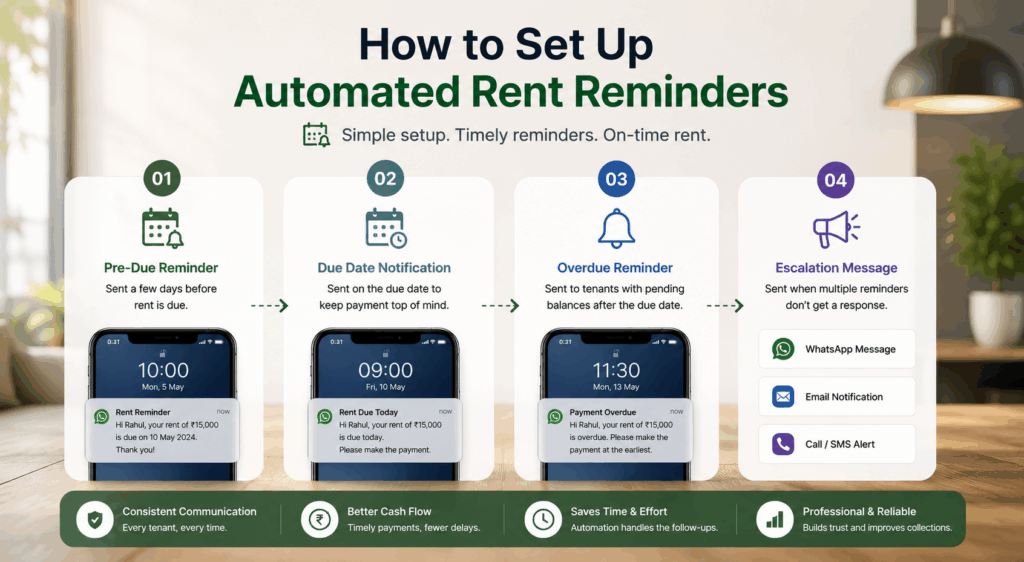
A typical reminder setup includes:
- A pre-due reminder sent a few days before rent becomes payable so tenants can plan their payments.
- A due-date notification that ensures the payment remains visible on the actual collection date.
- An overdue reminder sent only to tenants who still have pending balances after the due date passes.
- Escalation messages for cases where multiple reminders fail to generate a response.
The advantage of automation is consistency. Every tenant receives communication according to the same schedule, regardless of occupancy size or staff availability.
Why Timing Matters More Than Frequency
Many landlords assume that sending more reminders automatically leads to better collections. In practice, reminder timing matters far more than reminder volume.
When tenants receive excessive messages, communication starts feeling intrusive. Over time, they may begin ignoring notifications altogether. On the other hand, sending reminders too late reduces their effectiveness because the payment delay has already begun.
Successful operators focus on creating a balanced communication schedule.
A well-timed reminder system typically achieves the following:
- It creates awareness before the due date instead of reacting after payments become overdue.
- It keeps communication professional rather than making tenants feel pressured unnecessarily.
- It reduces reminder fatigue by limiting messages to meaningful collection milestones.
- It maintains visibility throughout the collection cycle without overwhelming residents.
The goal is to create predictable communication patterns rather than constant follow-up.
Managing Late Fees Without Creating Conflict
Late fees are often one of the most sensitive aspects of rent collection. Interestingly, disputes usually arise not because tenants disagree with the fee itself, but because they were unaware of it until after the penalty was applied.
This is where automated communication becomes valuable.
Instead of informing tenants about penalties after the due date has passed, reminder systems can communicate payment expectations well in advance. This helps create transparency and reduces the chances of misunderstandings.
A good reminder workflow can communicate:
- The rent due date and payment timeline before any penalties become relevant.
- The late fee policy in a clear and consistent manner across all tenants.
- Outstanding balances and pending amounts that require attention.
- Available payment options that help tenants complete transactions quickly.
When expectations are communicated proactively, late fee conversations become significantly easier to manage.
How Automated Reminders Improve Cash Flow
Many property owners view rent reminders purely as a collection tool. In reality, they also play a major role in cash flow management.
Every delayed payment affects operational planning. Salaries, maintenance costs, utility bills, vendor payments, and property expenses continue regardless of whether rent has been collected. When collections become unpredictable, financial planning becomes more difficult.
This is why collection consistency matters so much.
Properties with structured reminder systems often experience:
- Faster collection cycles because tenants receive timely payment visibility.
- Improved financial forecasting due to better understanding of incoming revenue.
- Reduced dependence on last-minute follow-ups and emergency collection efforts.
- Stronger operational stability because cash inflows become more predictable.
Even small improvements in collection timing can create meaningful benefits over the course of a year.
When Should You Move Beyond Manual Reminders?
Most rental businesses reach a point where manual communication starts limiting efficiency. The challenge is recognizing when that point has arrived.
Some warning signs are easy to identify:
- Managers spend a significant amount of time every month sending reminders and tracking payments.
- Payment records are spread across spreadsheets, WhatsApp chats, and handwritten notes.
- Tenants frequently claim they never received reminders or payment information.
- Collection visibility becomes difficult as occupancy continues growing.
Once these issues begin appearing consistently, automation usually becomes a necessity rather than a convenience.
The objective is not to remove personal communication from property management. It is to eliminate repetitive administrative work that adds little value while consuming significant time.
How RentOk Helps Automate Rent Reminders
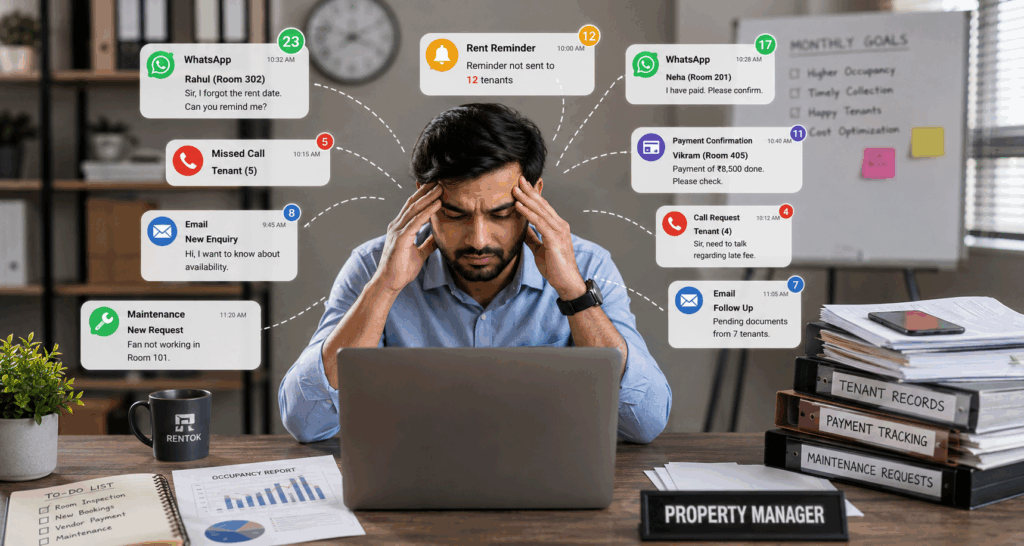
Managing rent reminders manually becomes increasingly difficult as occupancy grows. Payment confirmations get scattered across chats, follow-ups become repetitive, and collection visibility weakens over time. What begins as a manageable process often turns into a recurring operational burden that consumes valuable management bandwidth every month.
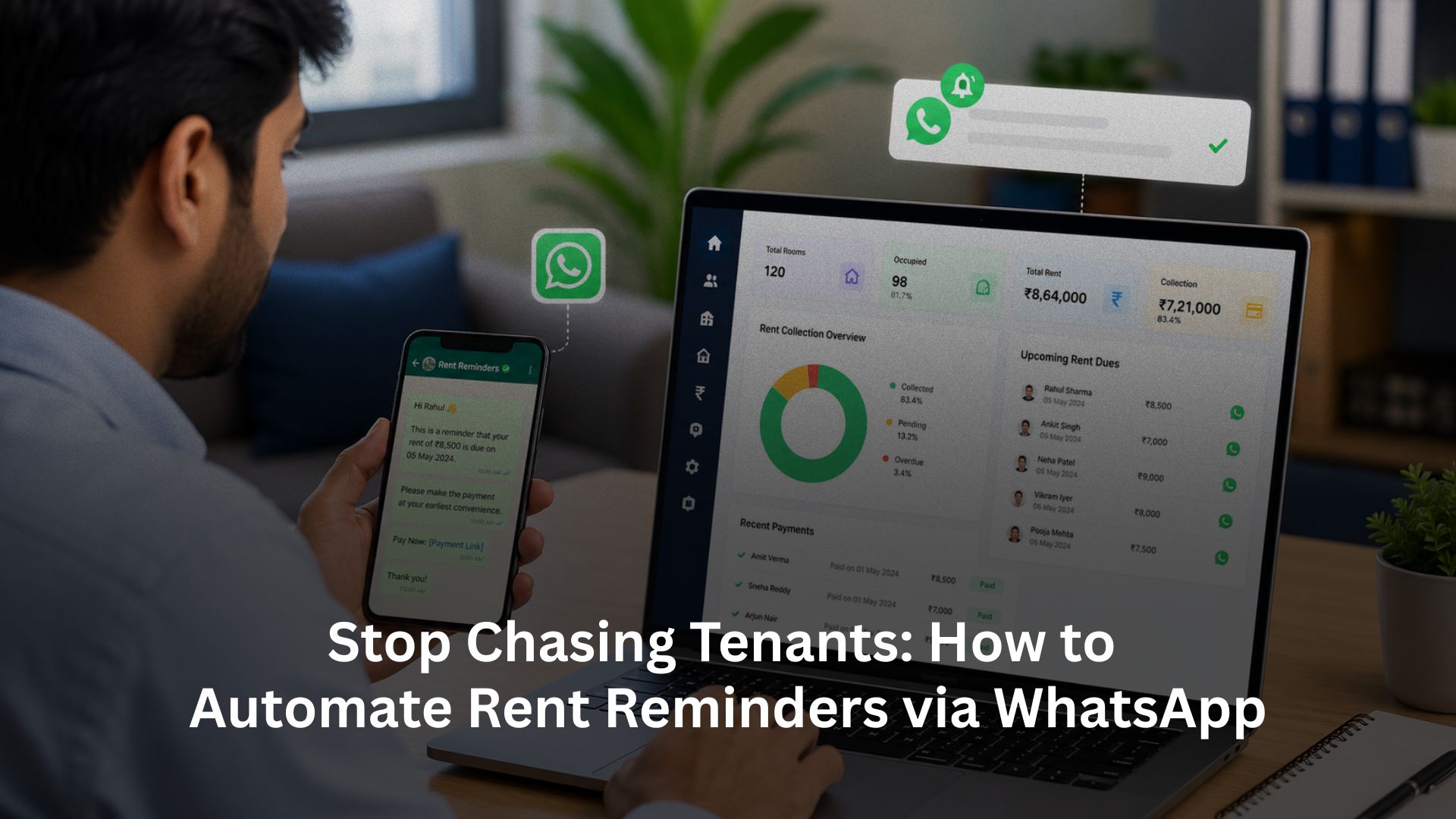
RentOk helps landlords, PG owners, and property managers streamline rent collection by centralizing tenant records, payment tracking, reminder workflows, and communication visibility within a single platform. Automated WhatsApp reminders ensure tenants receive timely payment notifications, while centralized tracking makes it easier to monitor pending dues and collection performance across the property.
By reducing manual follow-ups and improving visibility into payment status, RentOk allows operators to focus less on chasing rent and more on improving occupancy, tenant experience, and overall property operations.
Final Thoughts
The strongest rent collection systems are not necessarily the ones with the strictest policies or the most aggressive follow-up strategies. They are the ones that create consistency. When tenants receive timely reminders, understand payment expectations, and have easy access to payment information, collection performance improves naturally.
Manual reminder systems may work for smaller properties, but they become increasingly difficult to manage as occupancy grows. Automated WhatsApp reminders provide a practical way to improve communication, strengthen collection discipline, and reduce the operational workload associated with rent management.
If you’re looking to simplify rent collection, improve payment visibility, and create a more structured collection process, explore RentOk and discover how automated rent reminders can help your rental business operate more efficiently.
About the Author
Ishika Pannu
Ishika Pannu brings you the latest insights and easy-to-apply strategies in property management—helping you simplify renting and grow with RentOk.