Market Trends
AI Property Management Software vs Traditional Software

Written by
Ishika Pannu
Read Time
8 min read
Posted on
June 12, 2026
Overview
Overview
AI Property Management Software vs Traditional Software
The property management industry has never been short of technology. Over the last decade, landlords, property managers, PG operators, and co-living businesses have adopted software to simplify everything from rent collection and tenant onboarding to complaint tracking and occupancy management. What once required spreadsheets, phone calls, and physical records can now be managed from a centralized dashboard.
But a new shift is beginning to take shape.
Today, the conversation is no longer just about digitizing operations. It is about making operations smarter. As portfolios grow and operational complexity increases, many property managers are discovering that having access to data is not the same as being able to act on it effectively.
This is where AI powered property management apps are starting to change the game.
Unlike traditional property management software, which focuses on recording, organizing, and displaying information, AI systems are designed to analyze information, identify patterns, and assist with decision-making. The difference may sound technical, but its impact on day-to-day property operations can be significant.
For growing rental businesses, understanding this distinction is becoming increasingly important because the technology decisions made today will influence operational efficiency, scalability, and profitability for years to come.
How Traditional Property Management Software Works
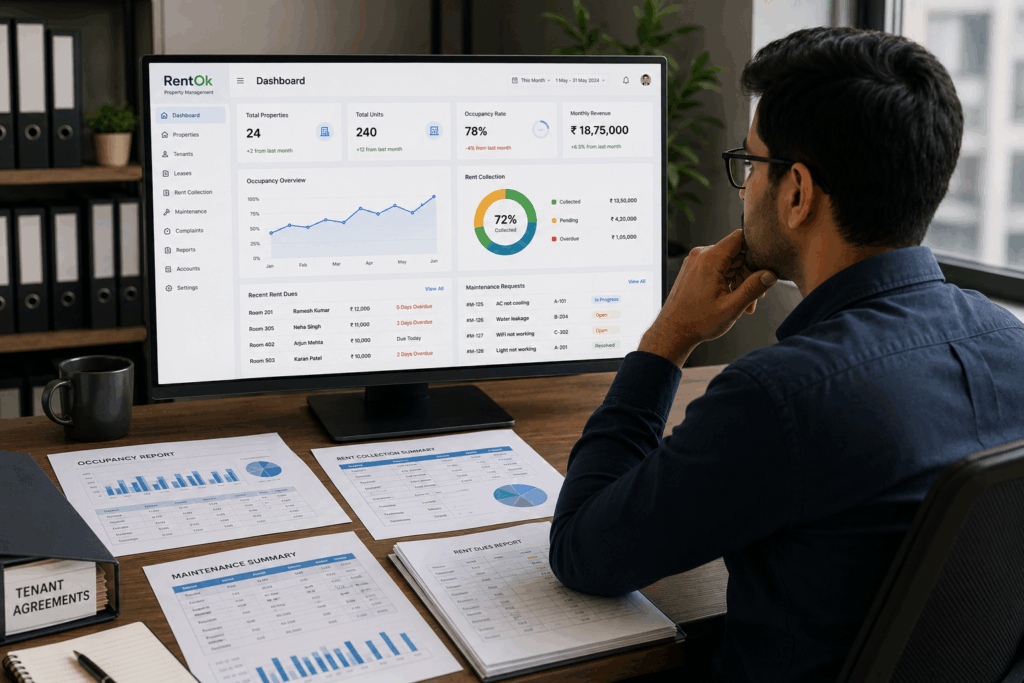
Traditional property management software was built to simplify administration. It replaces manual processes with structured workflows, helping operators centralize information and improve visibility across their properties.
Most platforms typically help manage:
- Tenant records and occupancy data, ensuring agreements, KYC documents, move-in details, and resident history remain organized and accessible.
- Rent collection and payment tracking, allowing managers to monitor due dates, pending payments, invoices, and transaction history from a single dashboard.
- Maintenance and complaint management, helping teams assign, track, and resolve operational issues more systematically.
- Financial reporting and performance monitoring, providing visibility into occupancy, revenue, expenses, and overall property performance.
For many businesses, these capabilities create immediate value. Administrative work decreases, information becomes easier to access, and operations become more organized.
However, traditional software primarily answers the question:
“What is happening?”
It may show declining occupancy, rising complaints, or delayed rent collections, but managers still need to investigate the cause and decide what action to take.
As portfolios grow, this manual interpretation process often becomes a bottleneck.
The Fundamental Difference Between Software and AI Systems
The biggest difference between traditional software and AI systems is not automation, it’s intelligence.
Traditional software follows predefined rules. It performs actions because someone configured those actions in advance.
AI systems go a step further. They analyze data, identify patterns, and generate insights that help operators make better decisions.
A simple comparison highlights the difference:
| Traditional Software | AI-Powered Software |
|---|---|
| Organizes operational data | Analyzes trends and patterns |
| Follows predefined rules | Learns from historical data |
| Displays reports and dashboards | Highlights actionable insights |
| Automates repetitive tasks | Supports decision-making |
| Primarily reactive | Increasingly proactive |
This becomes especially valuable as operations expand.
A manager overseeing 20 rooms can often review reports manually. A manager overseeing hundreds of tenants across multiple properties cannot realistically analyze every operational trend without assistance.
AI helps bridge that gap by surfacing the information that deserves attention first.
For example, AI-powered systems can help:
- Identify payment-risk patterns, allowing teams to intervene before delayed collections become recurring problems.
- Detect occupancy concerns early, helping managers respond before vacancy trends significantly affect revenue.
- Spot recurring maintenance issues, making it easier to address root causes instead of repeatedly solving the same complaints.
- Improve operational visibility, ensuring managers focus on priorities rather than spending hours searching through reports.
The goal is not to replace human decision-making. It is to help operators make better decisions faster.
Comparing Automation, Decision-Making, and Scalability
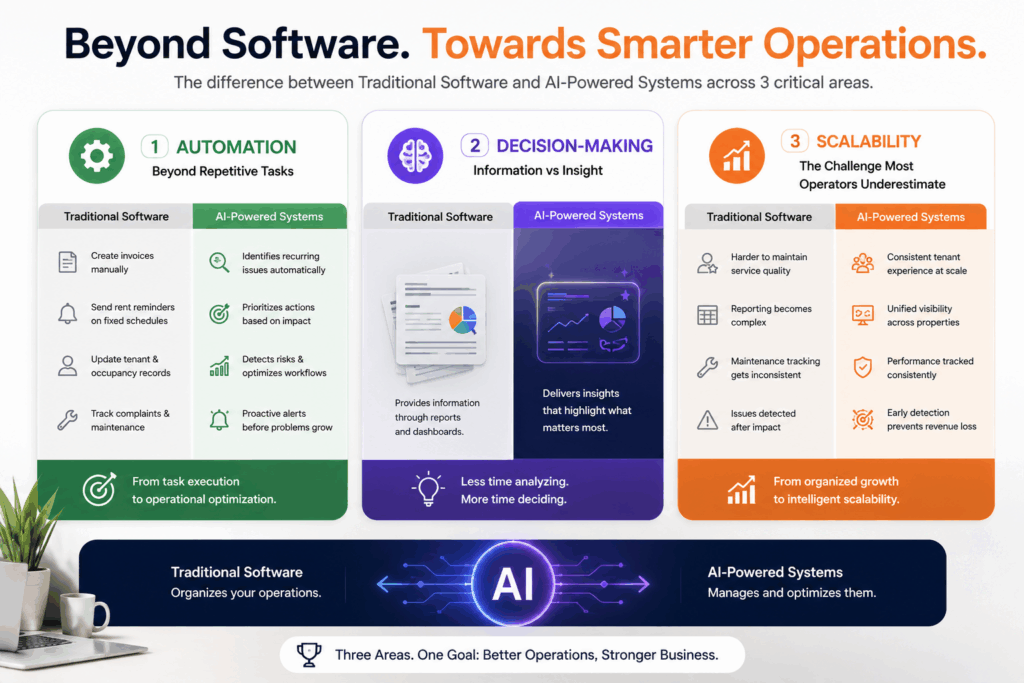
The gap between traditional software and AI-powered systems becomes much easier to understand when viewed through three areas that directly affect property operations: automation, decision-making, and scalability.
Automation: Beyond Repetitive Tasks
Traditional property management software has already transformed the way rental businesses automate routine work.
Tasks that once required manual effort can now happen automatically, including:
- Generating invoices and payment records without requiring staff to create them manually every month.
- Sending rent reminders based on predefined schedules that improve collection consistency and reduce administrative workload.
- Updating tenant records and occupancy information whenever move-ins, move-outs, or payment events occur.
- Tracking complaints and maintenance requests through standardized workflows that improve accountability.
These automations create significant efficiency gains, particularly for businesses transitioning away from spreadsheets and manual systems.
However, traditional automation remains rule-based. It executes tasks because someone previously defined what should happen.
AI-powered systems introduce a different layer of operational intelligence.
Instead of simply completing tasks, they can help optimize workflows by identifying areas where intervention is needed most.
For example:
- Rather than treating every complaint equally, AI can help identify recurring issues that may indicate larger operational problems.
- Instead of reviewing multiple reports separately, managers can receive prioritized insights based on business impact.
- Rather than reacting to occupancy declines after they occur, teams can monitor early warning signs and take corrective action sooner.
This shift moves automation from task execution toward operational optimization.
Decision-Making: Information vs Insight
One of the most overlooked challenges in property management is decision fatigue.
Every day, managers make decisions related to collections, maintenance, tenant communication, occupancy, staffing, vendor management, and operational priorities. As portfolios grow, the number of decisions grows with them.
Traditional software supports these decisions by providing information.
AI systems support these decisions by helping interpret information.
That distinction may seem subtle, but operationally it can be transformative.
Instead of spending hours reviewing dashboards and compiling reports, managers can focus on acting on insights that have already been surfaced for them.
The result is often faster response times, better resource allocation, and improved operational visibility across the portfolio.
Scalability: The Challenge Most Operators Underestimate
Many property businesses assume growth simply means managing more tenants. In reality, growth creates entirely new layers of complexity.
As occupancy expands across multiple properties, operators typically face challenges such as:
- Maintaining service quality while handling larger volumes of tenant communication.
- Tracking collections across multiple locations without creating reporting bottlenecks.
- Monitoring maintenance performance consistently across properties.
- Identifying operational issues before they begin affecting revenue or tenant satisfaction.
Traditional software helps organize this complexity.
AI helps manage it.
And as portfolios continue to grow, that distinction becomes increasingly important.
Which Solution Delivers Better ROI for Growing Properties?
For smaller portfolios, traditional property management software often delivers excellent returns. Centralized records, automated reminders, and digital workflows can significantly improve efficiency without requiring major investment.
However, growth changes the equation.
As operations become more complex, managers spend less time gathering information and more time trying to understand it. This is where AI-powered systems can create additional value.
Some of the biggest ROI drivers include:
- Improved collection performance through earlier identification of payment-risk patterns and follow-up opportunities.
- Better occupancy management by detecting performance issues before vacancies begin affecting revenue.
- Reduced operational inefficiencies through smarter prioritization of tasks and resources.
- Higher management productivity because teams spend less time analyzing reports manually.
For growing rental businesses, these benefits can translate directly into stronger profitability and better operational control.
What the Future of Property Management Technology Looks Like
Property management technology is moving beyond digitization and toward intelligence.
Operators increasingly expect systems that can do more than store information. They want platforms that help identify risks, improve visibility, and support decision-making.
Over the next few years, the industry is likely to see greater adoption of:
- Predictive analytics that identify occupancy, collection, and maintenance risks before they become major issues.
- AI-assisted communication tools that improve tenant engagement and response times.
- Smart workflow prioritization that helps teams focus on the tasks that matter most.
- Real-time operational monitoring that provides deeper visibility across properties and portfolios.
The future of property management will not simply be about collecting data. It will be about using data more intelligently.
How RentOk Helps Property Managers Stay Ahead
As rental businesses grow, operational visibility often becomes fragmented. Tenant records, payment tracking, occupancy management, and communication may end up spread across multiple systems, making coordination increasingly difficult.
RentOk helps solve this challenge by centralizing critical property management functions into one platform.
With features designed for tenant management, rent collection, occupancy tracking, and operational oversight, RentOk helps property managers reduce manual effort while maintaining better control over day-to-day operations.
By creating a stronger operational foundation, businesses can improve efficiency today while preparing for the more intelligent property management systems of tomorrow.
Conclusion
The discussion around AI property management software versus traditional software is not about replacing one system with another. It is about understanding how property management is evolving.
Traditional software brought structure and organization to the industry. AI is helping take the next step by turning operational data into actionable insights.
For smaller properties, traditional software may provide everything needed to run efficiently. But as portfolios grow, the ability to identify patterns, prioritize actions, and make faster decisions becomes increasingly valuable.
The future belongs to property management platforms that combine operational efficiency with intelligent decision support. For operators looking to scale without increasing complexity, building that foundation today can create a significant advantage tomorrow.
Explore RentOk to streamline property operations, improve visibility, and manage growing rental portfolios with greater efficiency.
About the Author
Ishika Pannu
Ishika Pannu brings you the latest insights and easy-to-apply strategies in property management—helping you simplify renting and grow with RentOk.