
Market Trends
How Long Does It Take for a Rental Property to Become Profitable in India?

Written by
Shivanshi Dheer
Read Time
14 min read
Posted on
July 18, 2026
Overview
Overview
If you own a rental flat, a PG, or a hostel, you have asked yourself this question at least once: when will this property actually start making money for me? You pay the EMI every month, you pay for repairs, and then you collect rent. But somehow, when you sit down and do the maths, you are not sure if you are really in profit or just breaking even.
This confusion is very common. Most people are not actually confused about their property. They are confused about what “profitable” even means. There is no single answer like “18 months” or “3 years” that applies to everyone. It depends on your city, your financing, your property type, and how well you manage it every day.
In this blog, we will go through this properly. We will cover what profitability means, how to calculate it, how location changes the answer, and what you can actually do to become profitable faster. No heavy words, no confusing formulas. Just simple, honest explanations.
Let’s get into it.
What Does It Mean for a Rental Property to Be Profitable?
A rental property becomes profitable when the money coming in from rent is more than the money going out in expenses. That sounds simple, but the tricky part is that “money going out” includes a lot more than people usually count.
When most landlords think about profit, they only think about rent minus EMI. But your real expenses also include property tax, maintenance charges, repairs, brokerage, insurance, and the months when the property is sitting empty with no tenant.
So the real formula looks like this:
Profit = Rent income – (EMI + property tax + maintenance + repairs + brokerage + vacancy loss)
If this number is positive every month, you are cash flow profitable. But there is a second, bigger question that most landlords forget to ask.
Cash Flow, Profit, and ROI Profit Are Not the Same Thing
This is the part that confuses almost every first-time landlord.
Cash flow profit is about the month-to-month picture. Does your rent cover your expenses right now, with something left over? This can happen quite fast, sometimes within the first year, if your property was ready to rent from day one.
ROI profit, or return on investment, is a bigger picture question. It looks at your total investment, meaning your down payment, registration cost, brokerage, and repair costs, and asks how long it takes to earn that full amount back through rent and property value growth combined.
These two numbers can be very different. You can be cash flow positive in month six, but it can still take you 7 to 10 years to earn back your full down payment and other upfront costs. Both are correct answers to “Is my property profitable?” They are just answering different questions.
How Long Does It Actually Take to Become Profitable?
Here is a simple table that most landlords find useful when they ask this question.
| What you are measuring | Typical time it takes |
|---|---|
| Rent covers your monthly expenses (cash flow positive) | 0 to 12 months after the property is tenanted |
| You earn back your full down payment and setup cost | 5 to 10 years |
| Your total return, including rent and property value growth, becomes strong (10 per cent or more per year) | Keeps growing every year, speeds up if the area appreciates well |
If someone tells you their property became “profitable in 6 months”, they almost always mean cash flow profitable, not that they got their full investment back. Keep this difference in mind whenever you read success stories online. It saves you from comparing your property unfairly with someone else’s.
Does Location Really Decide How Fast a Property Becomes Profitable?
Yes, and this is probably the single biggest factor. Two identical flats in two different cities can have completely different profitability timelines, simply because of where they are.
Location affects profitability in three ways.
First, it decides your rental yield. Rental yield means how much annual rent you get compared to the property price. A higher yield means faster cash flow profit. Areas close to IT parks, colleges, hospitals, and business hubs almost always get higher yields because tenant demand stays high all year round.
Second, it decides your vacancy risk. In a location with strong tenant demand, your property gets rented fast and stays rented. In a location with weak demand, you might lose two or three months of rent every time a tenant leaves, which quietly pushes your profitability timeline back every single year.
Third, it decides your property value growth. Locations near upcoming metro lines, new business parks, or expanding city limits tend to appreciate faster. This does not put cash in your pocket immediately, but it does shorten your ROI timeline if you eventually sell or take a loan against the property.
Which Indian Cities Give the Best Rental Returns Right Now?
Since location matters so much, here is what the current data looks like for 2026.
Bengaluru continues to lead as one of the strongest rental markets in India, mainly because of its IT industry. Areas like Whitefield, Electronic City, and Sarjapur Road see steady demand from working professionals, keeping yields in the 3 to 3.6 per cent range for standard flats.
Chennai has actually overtaken some of the bigger metros in recent data, with gross rental yields going above 4.8 per cent in early 2026, driven by the OMR IT corridor and steady tenant demand.
Hyderabad is a favourite among investors because property prices are still lower compared to Bengaluru and Mumbai, while rental yields stay strong, often between 4 and 5 per cent for 2 and 3 BHK flats near HITEC City and Gachibowli.
Pune benefits from both IT and manufacturing jobs, plus a large student population. Areas like Hinjewadi, Wakad, and Kharadi are seeing steady rental demand and stable yields.
Ahmedabad offers lower entry prices, which naturally support a better yield percentage, along with strong long-term appreciation thanks to GIFT City and improving infrastructure.
The pattern across all these cities is the same. Places with strong job hubs, colleges, or transit connectivity give both higher rent and lower vacancy, which is exactly what shortens your profitability timeline. If you are still deciding where to buy or how to price an existing property, this is worth studying properly instead of only looking at the property price.
What Other Factors Decide Your Profitability Timeline?
Location is the biggest factor, but not the only one. Here are the others that matter just as much.
How you financed the property – A property bought fully in cash can be cash flow positive almost immediately, since there is no EMI eating into your rent. A property bought with a large loan takes longer, because a big chunk of your early rent is simply going towards paying interest.
How much repair work it needed before renting – Every month your property sits empty for renovation is a month of pure expense with zero income. This single factor is usually the biggest reason one landlord becomes profitable within a year, while another takes three years on an almost identical property.
How often it stays vacant – No property stays rented 100 per cent of the time. But the difference between a well-managed property with 95 per cent occupancy and a poorly managed one with 80 per cent occupancy is huge over a few years. That gap alone can delay your profitability by a year or more.
What kind of tenant you rent to – A single family renting a whole flat gives you steady, predictable income, but it grows slowly. Renting room by room, like in a PG or hostel setup, usually brings in more total rent from the same property, but needs much tighter day to day management.
How well you track your numbers – This sounds small, but it genuinely changes how landlords behave. If you do not know your real monthly profit, you cannot fix what is going wrong. Many landlords assume they are doing fine simply because rent is coming in, without realising that repairs, brokerage, and vacant months have quietly eaten most of that profit.
Is a PG or hostel more profitable than renting out a full flat?
This is one of the most common questions Indian property owners ask, especially in cities with a large student or working professional population.
In a normal rental flat, you rent the whole unit to one family or one group of tenants. Your income depends on one rent cheque a month.
In a PG or hostel, you are renting bed by bed or room by room. This usually brings in higher total monthly income from the same physical space, because you are monetising every corner of the property rather than just the whole unit as one block.
However, this comes with more operational work. You are now dealing with multiple tenants, more move-ins and move-outs, food arrangements if you provide meals, and more day to day complaints like WiFi issues or water problems. A PG or hostel can become profitable faster on paper, but only if it is run properly, with good tenant retention and low vacancy across all rooms.
If you already run a PG or are thinking about starting one, it is worth reading a proper breakdown on what actually makes a hostel profitable in India, covered in detail in this guide on running a profitable hostel in India. It goes deeper into occupancy, pricing, and operations, which are the real levers behind hostel profitability, not just location.
If you are still deciding between a PG, a hostel, or a coliving setup for your property, this comparison is also useful: PG vs coliving vs hostel, what is the difference.
What Mistakes Delay Profitability the Most?
A lot of landlords unknowingly push their own profitability timeline back. Here are the common ones.
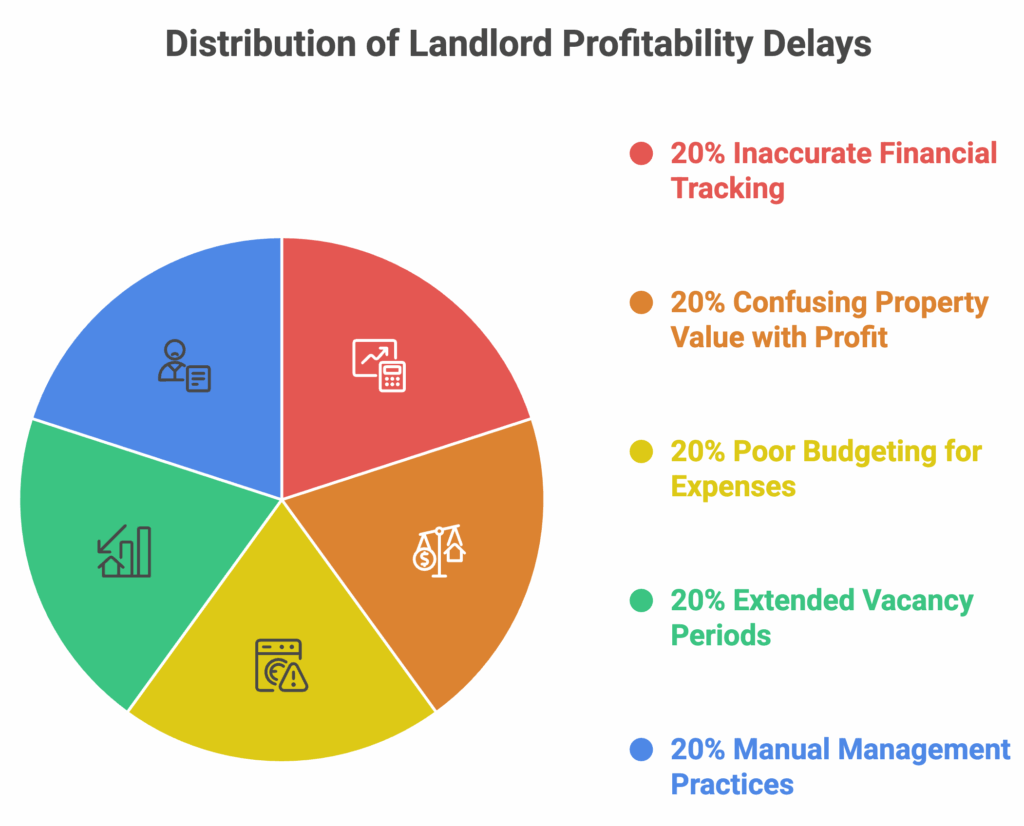
Only tracking rent in and EMI out. This ignores maintenance, repairs, brokerage, and vacant months, which gives a falsely positive picture of how the property is actually doing.
Confusing rising property value with actual profit. Your flat being worth more on paper does not put money in your bank account. That value only becomes real cash when you sell or take a loan against it.
Not budgeting properly for expenses. A large share of your rental income, often close to half of it over the long run, tends to go towards taxes, repairs, and maintenance. Landlords who do not plan for this end up surprised every time a big repair bill shows up.
Letting a property sit vacant too long between tenants. Even a small delay in finding the next tenant, say one extra month every year, adds up to a meaningful loss of income over five or ten years.
Managing everything manually. Registers, WhatsApp reminders, and Excel sheets work fine when you have one or two tenants. But once you have more tenants or more than one property, manual tracking causes missed rent, lost paperwork, and no real visibility into your actual numbers. This is explained well in RentOk vs Excel, what you are really losing every month.
How Can You Actually Speed Up Your Own Profitability Timeline?
You cannot control the overall property market or interest rates. But there is a lot you can control that directly affects how fast your property becomes profitable.
Price your rent correctly from the start. Pricing too high leads to long vacancies. Pricing too low means you are leaving money on the table every single month. If you run a PG, this guide on how much you should charge for a PG room is a good place to start.
Reduce the gap between tenants. The faster you fill a vacant room or flat, the less income you lose. Keeping your listing updated and responding quickly to enquiries matters more than most landlords realise.
Track every rupee, not just the rent. Knowing your real numbers, month by month, is what actually tells you when your property has crossed into genuine profit, instead of just guessing based on how your bank balance feels.
Avoid long vacancy gaps around predictable dips. In student heavy areas, vacancies often spike around festivals or semester breaks. If this applies to your property, it helps to plan for it in advance rather than reacting after rooms go empty. This is covered well in festival vacancies are not inevitable, a PG owner’s guide.
Keep your deposit and legal paperwork clean. Disputes over deposits are one of the most common and most avoidable sources of stress and delay for landlords. If you want to understand this better, this is explained in security deposits, the hidden cost of renting.
Use a system instead of managing everything in your head. This is the single biggest shift landlords make once they start managing more than a couple of tenants. A proper system automatically tracks rent, expenses, and vacancies, which means you always know your real profitability, not an estimate.
A Simple Before and After Example
Let’s say you buy a 2 BHK flat for 80 lakh rupees, with a 20 percent down payment, and rent it out for 22,000 rupees a month.
Without proper tracking, you collect rent every month, pay the EMI, and things feel fine. A geyser breaks and you spend 8,000 rupees on repairs, but you never write it down anywhere. Two years later, someone asks you what your actual return has been, and you honestly do not know, because you never separated your real expenses from your rent income.
With proper tracking, you know your EMI, taxes, maintenance, and vacancy cost down to the rupee. You can see clearly, every month, whether you are cash flow positive. When a repair comes up, it gets logged immediately instead of being forgotten. Five years in, you know exactly where you stand, because profitability was never a feeling, it was a number you were actually watching.
Same flat, same rent, but a completely different level of clarity. That clarity is what actually tells you when your property has turned the corner into real profit.
Conclusion
There is no single number that answers “when will my rental property become profitable.” It depends on whether you are asking about monthly cash flow or your full return on investment, which city and locality your property is in, how it was financed, and how tightly you manage it every month.
As a simple guide, cash flow profit can happen within the first year if your property is ready to rent and priced well. Earning back your full upfront investment usually takes 5 to 10 years. Both are real milestones, and understanding the difference will save you a lot of unnecessary stress while you wait for your property to “become profitable.”
If you are managing a rental flat, PG, or hostel and still tracking everything through registers, WhatsApp, and Excel sheets, that is usually the biggest reason profitability feels unclear in the first place. You can explore RentOk’s property management app to see how automated rent collection, expense tracking, and monthly reports can give you a real, accurate picture of where your property actually stands.
Frequently Asked Questions
Find answers to common questions about this topic
About the Author
Shivanshi Dheer
Shivanshi Dheer sharing actionable strategies and information on PG/hostel management to help simplify renting and scale with RentOk.
You may also like these
Related Articles
1 min read
How to Avoid MDR on Rent Payments: A Guide for PG Owners
Written by
Posted on
Shivanshi Dheer
Oct 6, 2026
1 min read
RentOk AutoPay & e-NACH for Automatic Rent Collection
Written by
Posted on
Shivanshi Dheer
Oct 6, 2026
1 min read
What’s Included in My Rent and What Am I Paying Extra For?
Written by
Posted on
Ishika Pannu
Sep 30, 2026

1 min read
Which Indian City Gives Landlords the Best Rental Yield Right Now?
Written by
Posted on
Ishika Pannu
Sep 28, 2026
1 min read
How Much Can My Landlord Legally Increase My Rent Each Year?
Written by
Posted on
Ishika Pannu
Sep 23, 2026

1 min read
India’s Rental Market Grows 16%: What Owners Should Know
Written by
Posted on
Ishika Pannu
Sep 22, 2026
1 min read
Why Landlords Check CIBIL Scores Before Renting
Written by
Posted on
Ishika Pannu
Sep 21, 2026
1 min read
Why Students Need Tenant Verification Done Before Moving Into a PG
Written by
Posted on
Ishika Pannu
Sep 14, 2026

1 min read
What to Do When Your Landlord Won’t Make Repairs
Written by
Posted on
Ishika Pannu
Sep 12, 2026

1 min read
Satya Niketan Building Collapse: What Happened in Detail?
Written by
Posted on
Shivanshi Dheer
Sep 9, 2026
Stay ahead in property management with expert insights
Join thousands of property managers receiving exclusive tips delivered straight to your inbox.
Browse posts by category
Case Study
Cost of Living
Growth
Legal
Market Trends
News
Pg owner app
Property Management
Property Tax
Tech
RentOk
The easiest way to rent and manage your PGs and hostels.
Grievance Officer
Get the app


Contact us
hello@eazyapp.tech
HQ Office
COGROW, BASEMENT F-12/8A
BESIDE HOUSE OF STYLE SALON, SECTOR 28, DLF PHASE 1
GURUGRAM, HARYANA - 122002
South India Office
LUMIODESK COWORKING, 2ND FLOOR, 40, 14TH MAIN RD
BESIDE MC DONALD, 7TH SECTOR, HSR LAYOUT
BENGALURU, KARNATAKA - 560102
©️ 2026 EazyApp Tech Pvt Ltd. All rights reserved


