
Market Trends
Why Occupancy Alone Doesn’t Explain Rental Success

Written by
Ishika Pannu
Read Time
17 min read
Posted on
August 7, 2026
Overview
Overview
Why Occupancy Alone Doesn’t Explain Rental Success
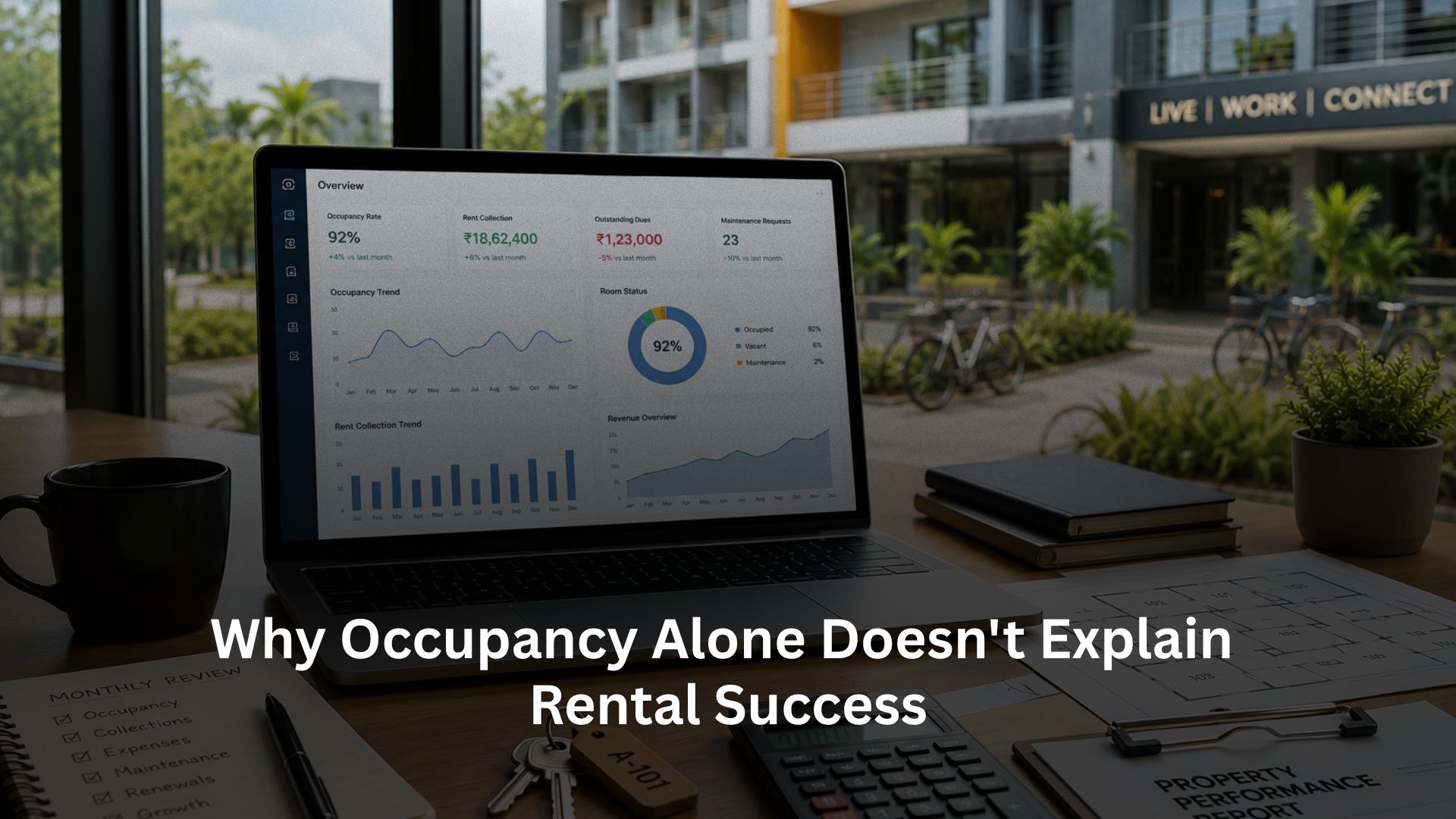
Most property owners associate a high occupancy rate with business success. After all, a fully occupied property appears to be doing everything right, rooms are filled, inquiries are converting, and revenue seems to be flowing consistently. At first glance, it feels like the ultimate measure of a healthy rental business.
However, experienced operators know that occupancy is only one piece of a much larger picture.
Imagine two PGs operating in the same city with almost identical occupancy rates. One property has every room occupied but constantly struggles with delayed rent payments, frequent maintenance complaints, and tenants moving out every few months. The other operates at slightly lower occupancy but enjoys higher rent collections, longer tenant stays, better online reviews, and a steady stream of referrals. Although both businesses report similar occupancy numbers, their financial performance and long-term growth look completely different.
This is why relying solely on occupancy can be misleading. It tells you how many rooms are filled, but it says very little about whether your rental business is actually becoming stronger, more profitable, or easier to operate.
Successful landlords and professional co-living operators are moving beyond occupancy rates and focusing on rental KPIs that provide a clearer picture of business performance. While occupancy matters, metrics like cash flow, tenant behaviour, and operational efficiency help drive sustainable growth. Our guide on How to Grow Your PG Business in 2026 explores the systems and strategies that support long-term success beyond simply filling rooms.
In this guide, we’ll explain why occupancy alone isn’t enough, the key rental KPIs to track, and how data-driven operators use them to improve profitability.
Why Occupancy Rate Is an Incomplete Measure of Success
Occupancy is often the first metric landlords check because it is simple, easy to calculate, and instantly understandable. If 95 out of 100 beds are occupied, the property reports a 95% occupancy rate. While that number certainly indicates demand, it doesn’t explain the quality of the business behind it.
Occupancy is what many business analysts call a lagging indicator. It tells you the result of previous decisions but rarely explains whether those decisions were financially or operationally sustainable.
Consider these two examples.
Property A
- Maintains a 98% occupancy rate throughout the year by offering aggressive discounts and flexible pricing. While almost every room is occupied, rent collections are inconsistent, maintenance requests continue piling up, and tenant turnover remains high because many residents leave after short stays.
Property B
- Operates at an 89% occupancy rate, but tenants stay significantly longer, renew their agreements more often, pay rent on time, and frequently recommend the property to friends. The operator spends less on acquiring new tenants while maintaining healthier profit margins.
Looking only at occupancy, Property A appears to be performing better.
Looking at the overall business, Property B is likely generating stronger cash flow, lower operational costs, higher customer satisfaction, and more sustainable growth.
This is why occupancy should never be viewed in isolation. It must be evaluated alongside the financial and operational indicators that reveal how efficiently the property is actually being managed.
Occupancy alone cannot answer questions like:
- Are tenants paying their rent on time, or are outstanding dues increasing every month? A property may look fully occupied, but delayed collections can quietly create serious cash flow issues that affect daily operations.
- Are residents renewing their stay or leaving after a short period? High occupancy achieved through constant new move-ins often hides high tenant churn, increasing marketing and onboarding costs.
- Is the property earning healthy revenue from each occupied room? Filling rooms by reducing prices may improve occupancy temporarily but can reduce overall profitability if pricing isn’t sustainable.
- Are operational expenses growing faster than rental income? Increasing maintenance costs, staffing expenses, or utility bills can gradually reduce profits even when occupancy remains consistently high.
- Is the property building a strong reputation? Online reviews, referrals, and tenant satisfaction often influence long-term occupancy far more than short-term promotional offers.
Professional operators understand that occupancy should be treated as one indicator within a larger performance framework rather than the ultimate measure of success.
If your goal is to improve occupancy sustainably rather than temporarily, our blog on The Psychology of Tenant Retention: What Makes Residents Stay Longer? explains why retaining existing tenants often contributes more to long-term business stability than continuously acquiring new ones.

The Metrics That Actually Drive Rental Growth
Rental businesses generate enormous amounts of data every month. Payments are collected, tenants move in and out, maintenance requests are resolved, leads are generated, and operational expenses fluctuate constantly.
The challenge isn’t collecting data.
It’s understanding which metrics actually influence business growth.
Successful operators don’t rely on a single number. Instead, they evaluate performance across four major areas: financial health, tenant experience, operational efficiency, and business growth. Together, these rental KPIs provide a far more accurate picture of how the business is performing.
Revenue and Financial Health
Revenue is the foundation of every rental business. A property may achieve high occupancy, but if collections remain inconsistent or profitability continues declining, long-term growth becomes difficult to sustain.
This is why successful operators regularly monitor financial KPIs that go beyond monthly rent received.
Some of the most important indicators include:
- Rent Collection Rate: This measures the percentage of rent successfully collected against the amount due. A property with excellent collection efficiency usually enjoys stronger cash flow and spends less time following up on pending payments.
- Outstanding Dues: Monitoring unpaid rent helps operators identify recurring payment patterns before they become major financial risks. Growing outstanding dues often indicate problems with payment discipline, communication, or documentation rather than occupancy.
- Revenue Per Available Bed: Instead of focusing only on occupied rooms, this metric evaluates how much revenue each available bed generates over a specific period. It provides better insight into pricing strategy and overall business performance.
- Average Revenue Per Tenant: This includes additional income from services such as food, laundry, parking, or premium amenities. Understanding total tenant value helps operators identify opportunities to improve profitability without relying solely on rent increases.
Financial metrics also become more meaningful when reviewed together. For example, increasing occupancy accompanied by declining revenue per bed may indicate excessive discounting, while stable occupancy combined with stronger collections often reflects healthier business performance.
If you’re working to improve payment tracking and collection efficiency, you may also find our guide on How to Recover Rent from a Tenant Who Has Already Vacated useful. It explains how better documentation and structured payment records contribute to stronger financial management long before recovery becomes necessary.
Tenant Experience and Retention
Growth doesn’t come only from acquiring new tenants. In many cases, it comes from giving existing residents enough reasons to stay.
Every tenant who renews their stay saves the business acquisition costs, reduces vacancy periods, and contributes to more predictable revenue. This makes tenant experience one of the strongest drivers of long-term rental growth.
Instead of measuring satisfaction through assumptions, successful operators monitor indicators such as:
- Tenant Retention Rate: A high retention rate usually reflects consistent service quality, transparent communication, and a positive living experience. Properties with stronger retention often spend significantly less on marketing and onboarding.
- Average Length of Stay: Understanding how long tenants typically remain helps operators identify whether short stays are becoming an operational trend or simply seasonal behaviour.
- Complaint Resolution Time: Resolving maintenance requests quickly isn’t just about customer service, it directly influences online reviews, referrals, and renewal decisions. Delayed resolutions often create dissatisfaction long before tenants decide to move out.
- Referral Rate: When existing tenants actively recommend a property, it usually indicates confidence in the overall experience rather than satisfaction with a single feature. Referral-driven occupancy also reduces customer acquisition costs while improving lead quality.
Tenant experience often becomes the strongest competitive advantage because it influences occupancy, reputation, and long-term profitability simultaneously.
Operational Efficiency: The KPIs That Keep Your Property Running Smoothly
Revenue and tenant satisfaction are essential, but they don’t tell the whole story. Behind every successful rental business is a set of operational processes that determine how efficiently the property functions on a daily basis. Even if occupancy remains stable, poor operations can gradually increase costs, reduce tenant satisfaction, and place unnecessary pressure on the management team.
This is where operational KPIs become valuable. They help property owners identify inefficiencies before they begin affecting revenue or resident experience.
Some of the most useful operational metrics include:
- Room Turnaround Time: This measures how quickly a room is cleaned, inspected, and made ready for the next tenant after move-out. Longer turnaround times mean vacant inventory remains unoccupied for extended periods, directly affecting revenue and occupancy planning.
- Maintenance Cost Per Room: Every property incurs maintenance expenses, but tracking the average cost per room helps identify recurring issues and budget more effectively. If maintenance costs continue rising without corresponding improvements in tenant satisfaction, it may indicate underlying operational inefficiencies.
- Move-in and Move-out Processing Time: Delays in documentation, room allocation, inventory verification, or security deposit settlements create unnecessary friction for both tenants and staff. Measuring these timelines helps streamline onboarding and exit workflows.
- Staff Productivity: As occupancy grows, managers often spend significant time on repetitive administrative work such as payment follow-ups, complaint coordination, and manual reporting. Tracking operational workload helps identify where automation can improve efficiency.
These metrics may not directly appear on financial statements, but they significantly influence the property’s ability to scale without increasing operational complexity.
Strong operational systems also create better tenant experiences. Faster room readiness, quicker maintenance responses, and smoother onboarding contribute to stronger reviews, better retention, and improved referrals over time.
If you’re looking to improve operational communication across your property, our blog on Best Communication Channels for Property Management explains how structured communication systems reduce coordination gaps while improving efficiency for both tenants and staff.
Business Growth Metrics Reveal Whether You’re Scaling Sustainably
Many rental businesses experience periods of rapid occupancy growth but struggle to maintain that momentum. New tenants continue moving in, yet profitability remains stagnant because operators aren’t measuring how efficiently those leads are being converted or retained.
Growth KPIs help answer a different question altogether.
Instead of asking, “How full is my property?”, they ask, “Is my business becoming stronger every month?”
Some of the most valuable growth indicators include:
- Lead-to-Move-in Conversion Rate: Generating inquiries is important, but converting them into confirmed move-ins is what ultimately drives occupancy. Tracking this metric helps evaluate the effectiveness of your sales process, follow-ups, and property presentation.
- Source of Leads: Understanding whether tenants come through referrals, listing platforms, brokers, social media, or direct enquiries helps operators invest their marketing budget more effectively instead of relying on assumptions.
- Occupancy Trend: A single month’s occupancy tells very little. Monitoring occupancy across several months reveals seasonal patterns, pricing opportunities, and long-term business stability.
- Marketing Cost Per Tenant: Acquiring new residents should become more efficient as the business grows. Measuring acquisition costs helps determine whether marketing investments are generating sustainable returns.
Growth metrics become even more powerful when analysed alongside retention and financial data. For example, increasing lead generation means little if tenant churn remains equally high.
This is exactly why successful operators view growth as a combination of occupancy, profitability, and tenant satisfaction rather than simply adding more bookings every month.
If you’re working on reducing acquisition costs while improving occupancy quality, our article on Building a Referral Program: Turn Your Tenants into Your Sales Team explores how referral-driven growth often delivers higher-quality tenants than traditional acquisition channels.

Why Looking at One KPI Often Leads to Poor Business Decisions
One of the biggest mistakes rental operators make is assuming that improving one number automatically improves the entire business.
In reality, focusing too heavily on a single KPI often creates unintended consequences elsewhere.
Take occupancy as an example.
A property owner notices occupancy dropping and immediately reduces rent by 20% to fill vacant rooms. Within a few weeks, occupancy improves dramatically.
On paper, the strategy appears successful.
However, a closer look tells a different story.
Lower pricing reduces monthly revenue, attracts more price-sensitive tenants, increases turnover, and leaves less budget for maintenance and staff. Within a few months, complaint volumes increase, online reviews decline, and tenant retention starts falling.
The occupancy rate improved.
The business became weaker.
Similar situations occur across rental operations:
- Improving occupancy by offering heavy discounts may fill rooms quickly, but lower revenue often affects profitability and limits future investments in maintenance or property improvements.
- Reducing maintenance expenses may appear to improve short-term financial performance, but unresolved issues gradually reduce tenant satisfaction and increase move-outs.
- Focusing only on new bookings while ignoring tenant retention forces operators into an expensive cycle of constantly replacing residents instead of building stable occupancy.
- Celebrating revenue growth without monitoring rent collections can create a misleading picture of financial health if outstanding dues continue increasing each month.
These examples illustrate why individual metrics should always be interpreted within the broader context of the business.
High-performing rental businesses rarely make decisions based on one number alone.
Instead, they analyse how different KPIs influence each other before introducing pricing changes, marketing campaigns, or operational improvements.
How Successful Rental Businesses Measure Performance
Rather than reviewing performance only when occupancy drops or complaints increase, successful operators establish a consistent reporting routine. Monthly performance reviews help identify trends early, allowing management teams to respond before small operational issues become larger business problems.
Instead of asking isolated questions, they evaluate multiple KPIs together to understand the overall health of the property.
| Instead of asking… | Successful operators ask… |
|---|---|
| Is occupancy high? | Is occupancy improving profitability? |
| Are rooms filled? | Are tenants renewing their stay? |
| Is revenue increasing? | How much rent is actually being collected? |
| Are complaints being closed? | How quickly are they being resolved? |
| Are leads increasing? | Which lead sources generate the highest-quality tenants? |
This approach transforms data from a reporting exercise into a decision-making tool.
Rather than reacting emotionally to temporary fluctuations, operators can identify long-term patterns and make more confident business decisions.
For a broader understanding of sustainable property operations, you may also enjoy our Complete Guide to Running a Profitable Hostel in India, where we explore how occupancy, operations, finances, and tenant experience work together to support long-term growth.
Turning KPIs Into Better Business Decisions
Collecting data has very little value unless it leads to action.
Every KPI should help answer one practical question:
What should we improve next?
For example:
- If occupancy begins declining, operators should analyse lead quality, pricing strategy, marketing performance, and tenant retention instead of immediately reducing rent.
- If rent collections become inconsistent, reviewing payment reminders, collection processes, and tenant communication often produces better results than increasing follow-up calls alone.
- If complaint volumes increase, management should investigate whether maintenance resources, staffing, or communication workflows require improvement before dissatisfaction begins affecting renewals.
- If referral rates start falling, it may indicate that tenant experience has weakened even if occupancy remains healthy, making it important to review service quality and operational consistency.
- If average length of stay decreases, operators should identify whether pricing, amenities, management practices, or competitor activity are influencing tenant decisions.
The most successful rental businesses don’t simply generate reports, they use those reports to prioritise improvements that strengthen the business over time.
Common Mistakes Operators Make While Measuring Rental Success
Every rental business tracks numbers in some form. The problem isn’t the lack of data, it’s focusing on the wrong data or interpreting it without context. Over time, these mistakes can lead to pricing decisions, operational changes, and marketing investments that look effective initially but weaken the business in the long run.
Experienced operators understand that business performance should be evaluated through multiple connected KPIs rather than a single headline number. Unfortunately, many landlords still rely on occupancy alone because it is the easiest metric to understand.
Some of the most common mistakes include:
- Treating occupancy as the ultimate measure of success. A property with every room occupied isn’t necessarily profitable. If collections remain inconsistent, maintenance costs continue rising, or tenants leave after short stays, high occupancy alone cannot compensate for these operational challenges.
- Ignoring profitability while chasing occupancy. Discounting rent to fill vacant rooms may improve occupancy temporarily, but it often reduces revenue per tenant and creates long-term pricing challenges that become difficult to reverse.
- Reviewing monthly reports in isolation. Looking at a single month’s data rarely reveals meaningful business trends. Comparing performance across several months provides better insight into seasonal demand, tenant behaviour, and operational improvements.
- Overlooking tenant retention metrics. Constantly acquiring new tenants while existing residents continue leaving creates unnecessary marketing expenses and operational pressure. Retention is often a stronger indicator of business health than occupancy alone.
- Failing to measure operational efficiency. Complaint resolution time, maintenance turnaround, and onboarding processes directly affect tenant experience. Ignoring these metrics can eventually reduce occupancy even if current numbers appear healthy.
The strongest operators don’t simply collect reports, they ask better questions. Instead of celebrating one good metric, they look for patterns that explain why the business is improving or declining.
If you’re evaluating ways to improve operational visibility across multiple properties, our article on Why You Need Property Management Software for Landlords explains how centralized reporting helps operators make faster, data-driven decisions.

How RentOk Helps You Measure Rental Performance Beyond Occupancy
As rental businesses grow, monitoring multiple KPIs manually becomes increasingly difficult. Occupancy reports may sit in one spreadsheet, payment records in another, complaint tracking happens through WhatsApp, and operational updates remain scattered across different systems. This fragmented approach makes it difficult to identify trends or make informed decisions based on accurate data.
RentOk helps landlords, PG owners, and co-living operators bring all these operational metrics together through one centralized property management platform. Instead of looking only at occupancy, operators can monitor collections, outstanding dues, expenses, tenant movements, complaint resolution, and overall business performance from a single dashboard.
This complete operational visibility allows management teams to identify issues early, compare property performance, improve reporting accuracy, and make decisions backed by real data rather than assumptions. As the business expands across multiple properties, these insights become increasingly valuable for improving efficiency, profitability, and long-term rental growth.
Whether you’re tracking occupancy trends, monitoring rent collections, reviewing operational reports, or analysing tenant performance, having all your business data connected in one place makes it much easier to understand what is actually driving growth.
Conclusion
Occupancy is an important rental metric, but it shouldn’t be the only one guiding your decisions. While it shows how many rooms are filled, it doesn’t reveal whether your business is truly profitable, efficient, or retaining quality tenants.
The most successful rental businesses track occupancy alongside financial performance, operational efficiency, tenant satisfaction, and growth metrics. This data-driven approach helps operators make better decisions, solve issues faster, and scale with confidence.
Want to track occupancy, collections, expenses, tenant performance, and other key rental KPIs from one place? Book a demo with RentOk to see how our Property Management Dashboard gives you complete visibility into your property’s performance and helps you make smarter business decisions.
Frequently Asked Questions
Find answers to common questions about this topic
About the Author
Ishika Pannu
Ishika Pannu brings you the latest insights and easy-to-apply strategies in property management—helping you simplify renting and grow with RentOk.
You may also like these
Related Articles

1 min read
Which City in India Has the Highest Rent?
Written by
Posted on
Ishika Pannu
Oct 12, 2026

1 min read
Renting vs. Buying a House in India in 2026: Which Makes More Financial Sense?
Written by
Posted on
Ishika Pannu
Oct 9, 2026

1 min read
Rent vs Commute in Gurgaon: How Much Is Convenience Worth?
Written by
Posted on
Ishika Pannu
Oct 9, 2026

1 min read
Delhi-NCR’s PG Boom: When Family Homes Turn into Hostels
Written by
Posted on
Ishika Pannu
Oct 8, 2026
1 min read
How to Avoid MDR on Rent Payments: A Guide for PG Owners
Written by
Posted on
Shivanshi Dheer
Oct 6, 2026

1 min read
RentOk AutoPay & e-NACH for Automatic Rent Collection
Written by
Posted on
Shivanshi Dheer
Oct 6, 2026
1 min read
What’s Included in My Rent and What Am I Paying Extra For?
Written by
Posted on
Ishika Pannu
Sep 30, 2026

1 min read
Which Indian City Gives Landlords the Best Rental Yield Right Now?
Written by
Posted on
Ishika Pannu
Sep 28, 2026
1 min read
How Much Can My Landlord Legally Increase My Rent Each Year?
Written by
Posted on
Ishika Pannu
Sep 23, 2026

1 min read
India’s Rental Market Grows 16%: What Owners Should Know
Written by
Posted on
Ishika Pannu
Sep 22, 2026
Stay ahead in property management with expert insights
Join thousands of property managers receiving exclusive tips delivered straight to your inbox.
Browse posts by category
Case Study
Cost of Living
Growth
Legal
Market Trends
News
Pg owner app
Property Management
Property Tax
Tech
RentOk
The easiest way to rent and manage your PGs and hostels.
Grievance Officer
Get the app


Contact us
hello@eazyapp.tech
HQ Office
COGROW, BASEMENT F-12/8A
BESIDE HOUSE OF STYLE SALON, SECTOR 28, DLF PHASE 1
GURUGRAM, HARYANA - 122002
South India Office
LUMIODESK COWORKING, 2ND FLOOR, 40, 14TH MAIN RD
BESIDE MC DONALD, 7TH SECTOR, HSR LAYOUT
BENGALURU, KARNATAKA - 560102
©️ 2026 EazyApp Tech Pvt Ltd. All rights reserved


