
Market Trends
How to Find the Best Hostel Management Software in India


Written by
Ishika Pannu
Read Time
6 min read
Posted on
March 19, 2026
Overview
Overview
How to Find the Best Hostel Management Software in India
Running a hostel in India is operationally intensive in ways that are not always obvious at the beginning.
It’s not just about filling beds. It’s about managing constant movement, new check-ins, scheduled move-outs, shared rooms, food consumption, staff coordination, and daily issue resolution. On the surface, everything may look under control. Rooms appear occupied, tenants are present, and operations seem stable.
But when you look closely, inefficiencies start to show.
Beds remain unutilised within “occupied” rooms. Bulk bookings create scattered allocations. Food planning doesn’t align with actual occupancy. Payments require constant follow-ups. And most importantly, decision-making becomes reactive instead of structured.
This is where most hostel operators hit a ceiling.
Not because of demand, but because their operational systems are not designed to handle scale.
Choosing the right hostel management software is not about upgrading your tools. It’s about fixing the way your hostel operates on a daily basis.
Why Most Hostel Software Decisions Go Wrong
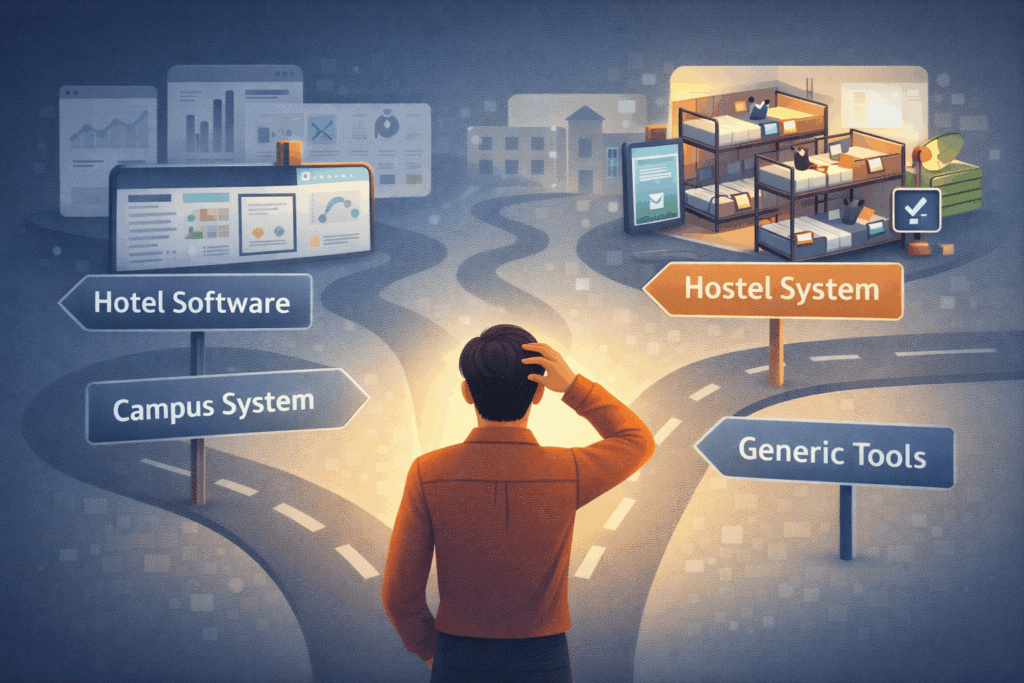
When hostel owners start looking for software, they usually focus on features.
Dashboards, booking systems, payment tracking, reports, on paper, most tools offer similar capabilities. But the real difference lies in how well these features align with hostel operations.
The mistake is choosing software that looks good, instead of software that actually works in your environment.
Most tools fall into one of these categories:
- Hotel-focused systems that prioritise rooms, not beds
- Institutional software designed for large campuses, not independent hostels
- Generic property tools that don’t handle operational complexity
As a result, operators end up with software that exists, but doesn’t reduce effort.
The real goal of hostel software should be simple:
Reduce manual decision-making and improve operational clarity.
Understanding Hostel Operations at a Practical Level
Before choosing any software, it’s important to understand what makes hostel management different.
Unlike hotels or standard rentals, hostels operate on:
- Shared accommodation
- Frequent tenant turnover
- Daily operational dependencies (especially food and housekeeping)
- Group-based occupancy patterns
This creates a system where everything is interconnected.
For example:
- A single move-out affects room allocation, food planning, and future bookings
- A bulk booking impacts multiple rooms simultaneously
- Even a few empty beds across rooms can significantly reduce revenue
This is why hostel operations require continuous visibility, not just periodic tracking.
Bed-Level Visibility: The Most Critical Factor
One of the most common and costly mistakes in hostel management is tracking occupancy at the room level instead of the bed level.
At a glance, a room with tenants appears “occupied.” But in reality, partially filled rooms often hide unused capacity.
For example, consider this:
- A 4-sharing room with 3 tenants
- A 3-sharing room with 2 tenants
Both rooms appear occupied. But together, they represent two empty beds, which could equal the revenue of an entire room.
When this pattern repeats across a property, the financial impact becomes significant.
A good hostel management system must:
- Track each bed individually
- Highlight partially filled rooms clearly
- Help prioritise filling existing vacancies before opening new rooms
Without this level of visibility, operators unknowingly operate below full capacity.

Managing Bulk Bookings Without Disrupting Occupancy
Bulk bookings are common in hostels—especially in student housing, internships, or corporate stays.
While they increase occupancy, they also introduce complexity.
Without proper systems:
- Tenants get distributed randomly across rooms
- Group members get separated
- Future availability becomes difficult to manage
Over time, this leads to fragmented occupancy—multiple rooms partially filled instead of fewer rooms fully occupied.
A well-designed system should allow you to:
- Allocate groups efficiently within rooms
- Maintain structured occupancy patterns
- Avoid unnecessary distribution of tenants
This ensures that bulk bookings improve occupancy instead of complicating it.
The Role of Food and Inventory in Hostel Efficiency
Food management is one of the most operationally sensitive areas in a hostel.
Unlike rent or occupancy, food is a daily variable. Consumption changes with:
- Occupancy levels
- Tenant preferences
- Seasonal patterns
Without proper tracking, most hostels rely on estimates.
This leads to:
- Over-purchasing and wastage
- Under-preparation and dissatisfaction
- Lack of clarity on actual costs
A strong hostel management system should connect food planning with occupancy data.
This allows operators to:
- Estimate consumption more accurately
- Track inventory usage in real time
- Reduce wastage while maintaining consistency
Food operations are not separate from hostel management, they are central to it.
Payment Tracking and Financial Clarity
Rent collection in hostels is more complex than it appears.
Unlike traditional rentals, hostels often deal with:
- Different payment cycles
- Security deposits
- Partial payments
- Late payments
When managed manually, this quickly becomes difficult to track.
Operators may face:
- Unclear payment status
- Delayed follow-ups
- Incomplete financial records
A structured system simplifies this by:
- Maintaining real-time payment records
- Automating reminders
- Providing clear visibility into pending and completed payments
This not only improves cash flow but also reduces the time spent on repetitive follow-ups.
Why Visibility Is More Important Than Automation
Many software platforms emphasise automation. While automation is useful, it only works when the underlying system is clear.
In hostel operations, visibility comes first.
You need to know:
- Current occupancy across rooms and beds
- Upcoming move-outs
- Available capacity for new bookings
- Operational gaps that need attention
Once this visibility is established, automation becomes effective.
Without it, automation simply speeds up incorrect decisions.
Evaluating Hostel Management Software: What Actually Matters
When comparing software options, instead of focusing on features, evaluate how the system fits your workflow.
Ask practical questions:
- Can I see real-time bed availability without confusion?
- Does this system simplify allocation decisions?
- Can my staff use this without constant training?
- Does it reduce manual tracking or just digitise it?
The goal is not to adopt software, it’s to improve how your hostel functions.
Common Gaps in Existing Software
Even after adopting software, many hostel operators continue facing issues.
This usually happens because the system does not align with real operations.
Common problems include:
- Lack of bed-level clarity
- Overly complex interfaces
- Delayed or inaccurate updates
- Features that exist but are not practical to use
When software adds friction instead of reducing it, adoption fails.
This is why simplicity and usability matter as much as functionality.
How RentOk Solves These Challenges
RentOk is designed with a clear understanding of how PGs and hostels operate in real-world conditions.
Instead of focusing on excessive features, it focuses on making operations visible, structured, and easy to manage.
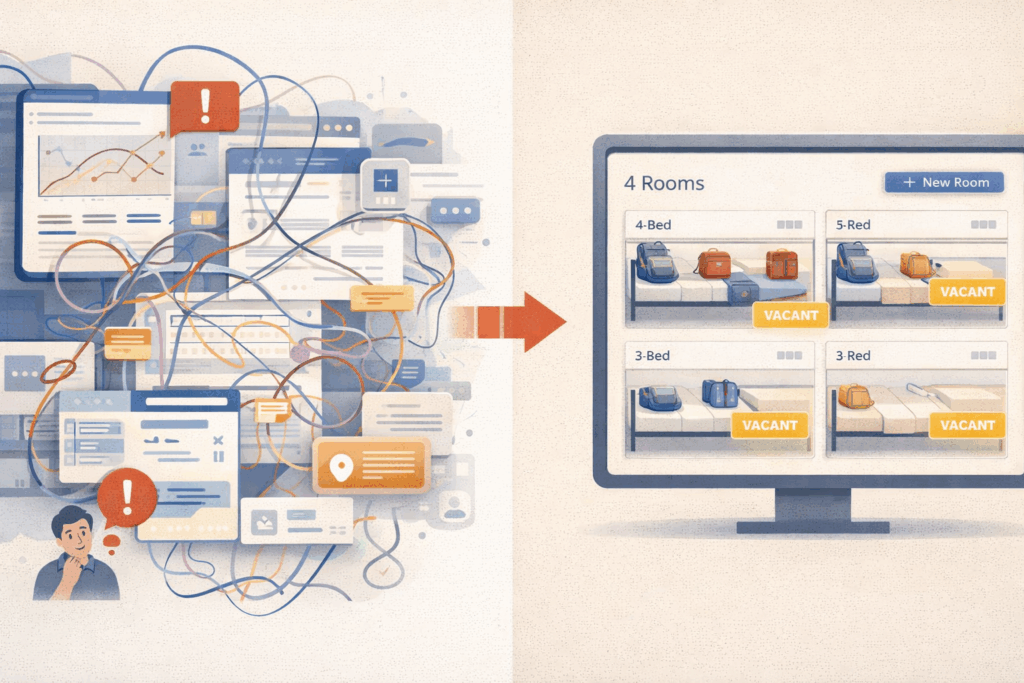
With RentOk, hostel operators can:
- Track room and bed occupancy in real time
- Identify partially filled rooms instantly
- Allocate tenants strategically to maximise occupancy
- Manage bookings, payments, and tenant records from a single platform
- Stay updated on move-ins, move-outs, and availability without manual tracking
What makes RentOk effective is its focus on clarity over complexity.
Operators don’t need to switch between multiple tools or maintain parallel records. Everything is accessible in one place, making decision-making faster and more accurate.
For growing hostels, this becomes especially important. Small inefficiencies, like a few empty beds or delayed allocations, can significantly impact revenue over time.
RentOk helps eliminate these gaps by giving operators complete visibility into their operations.
Final Thoughts
Finding the best hostel management software in India is not about choosing the most advanced platform, it’s about choosing the one that aligns with how your hostel actually operates.
Hostel management is dynamic. Occupancy changes frequently, operations are interconnected, and small inefficiencies can scale quickly.
The right system should simplify your work, not complicate it.
If your current setup still depends on manual tracking, scattered records, or constant follow-ups, it’s likely limiting your efficiency more than you realise. Moving to a structured system like RentOk can help you gain better visibility, reduce operational gaps, and manage your hostel more effectively, without adding unnecessary complexity.
Explore RentOk Now
About the Author
Ishika Pannu
Ishika Pannu brings you the latest insights and easy-to-apply strategies in property management—helping you simplify renting and grow with RentOk.