Market Trends
How to Invest in Property for Rental Income in India


Written by
Shivanshi Dheer
Read Time
19 min read
Posted on
August 20, 2026
Overview
Overview
How to Invest in Property for Rental Income in India: A Guide for Investors
Buying or investing in property for rental income sounds simple. You purchase a house or apartment, find a tenant, collect rent every month, and watch your investment grow. But anyone who has actually owned a rental property knows that the reality is more complicated. The right property can become a reliable source of income and long-term wealth, while the wrong property can leave your money locked into an expensive asset that spends months vacant, requires constant repairs, or earns far less rent than expected.
That is why investing in property for rental income should not begin with the question, “Which property should I buy?” It should begin with a much more important question: “What kind of rental business am I trying to build?”
Your answer will influence almost everything else, from the city and locality you choose to the type of property, expected rent, tenant profile, furnishing, financing, maintenance and even how you manage the property after finding a tenant.
This guide explains how to invest in property for rental income to make it work, how to calculate rental yield, what to look for before buying, where rental demand comes from, how to estimate expenses, what taxes to consider, and how to manage the property once it starts generating income.
What Does Investing in Property for Rental Income Mean?
Investing in property for rental income means purchasing a residential or commercial property with the intention of leasing it to tenants and generating recurring rental income. The property can potentially provide two types of returns: regular income from rent and capital appreciation if the property’s market value increases over time.
This distinction is important. Rental income is the cash flow you receive while you own the property. Capital appreciation is the increase in the property’s value when you eventually sell it. A property can appreciate significantly but generate relatively modest rent, or it can generate stronger rental income while seeing slower price appreciation. A good investment decision considers both rather than focusing only on the expected monthly rent.
Residential property in India generally produces relatively modest rental yields compared with some other asset classes, which means investors should not assume that a high property price automatically translates into high rental income. Current 2026 estimates for residential rental yields in major Indian markets commonly fall around the low-single digits, although actual returns vary considerably by location, property type, rent and purchase price.
Why Do People Invest in Property for Rental Income?
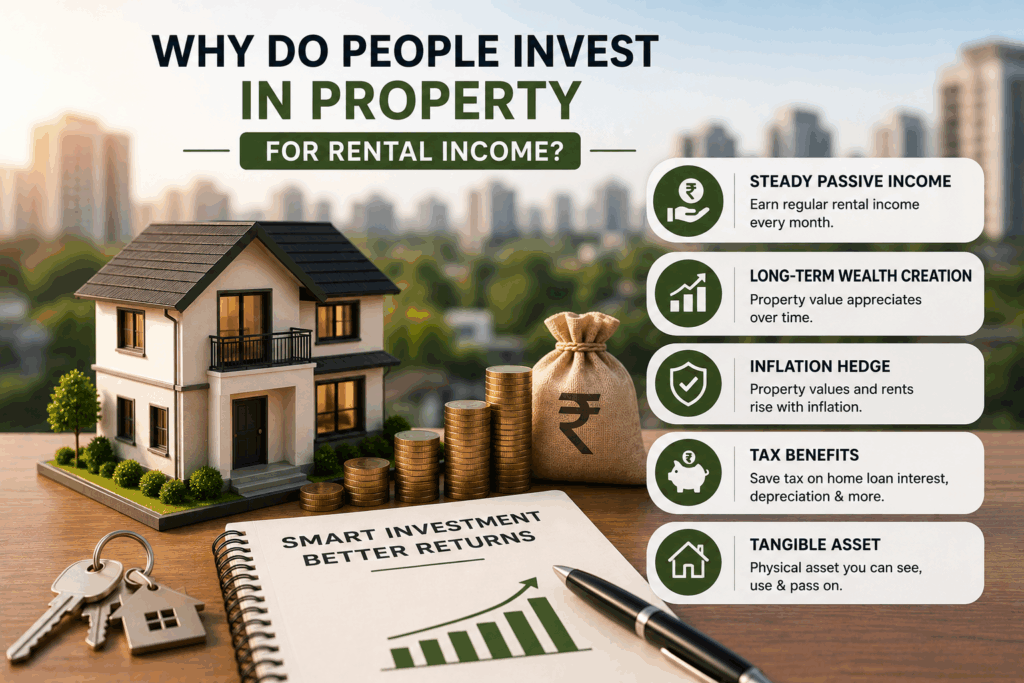
One of the biggest attractions of rental property is the combination of recurring income and ownership of a physical asset. Unlike an investment that exists only on a statement, a property is something you can see, use, lease, improve and eventually sell.
For many Indian investors, property also feels familiar. Real estate has traditionally been viewed as a long-term wealth-building asset, particularly when the property is located in an area experiencing population growth, infrastructure development and increasing employment opportunities.
Rental income can also help offset the cost of owning a property. If you have purchased a property using a home loan, the rent may contribute toward your monthly loan obligations, although investors should never assume that rent will automatically cover the entire EMI. Interest, maintenance, taxes, vacancy and other expenses need to be included in the calculation.
The real opportunity comes when you treat the property as an investment rather than simply buying a house and hoping that someone will rent it.
How Do You Choose the Right Property for Rental Income?
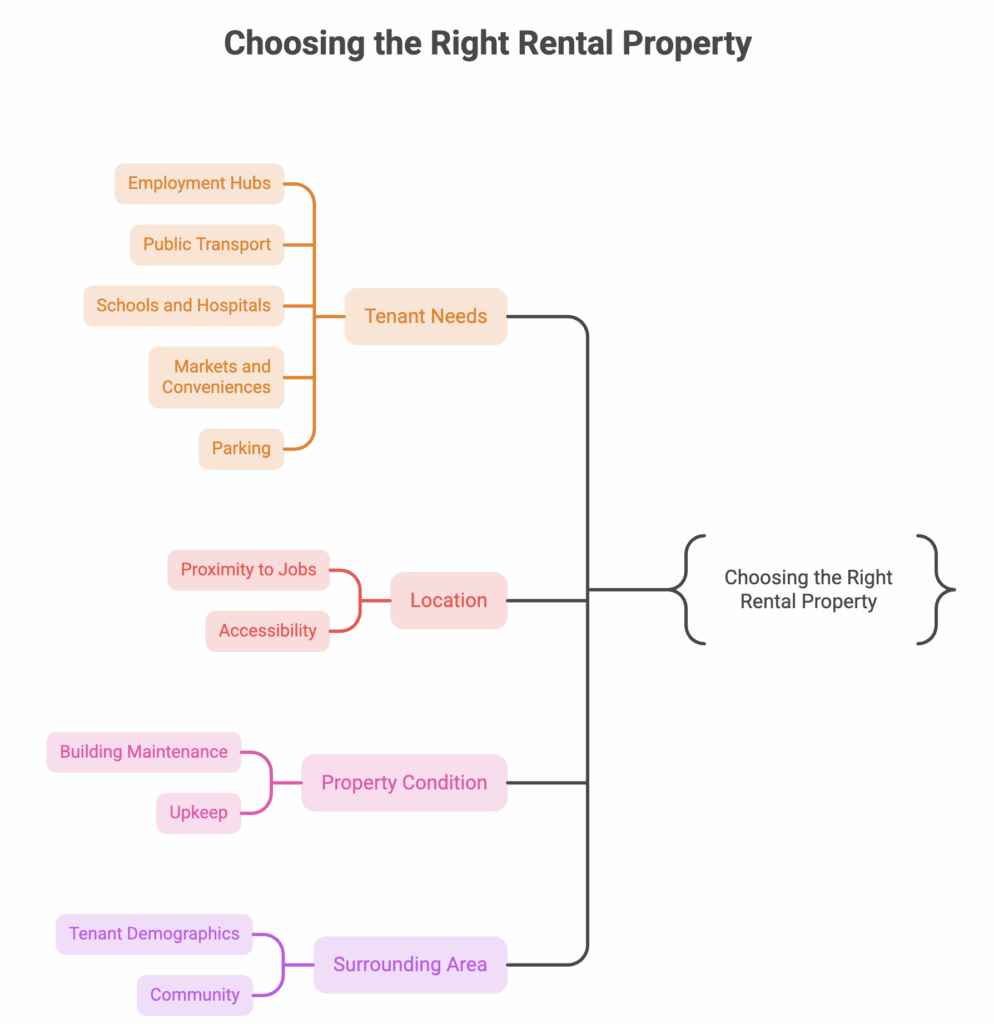
The first rule of rental property investment is simple: do not buy a property only because you personally like it.
A home that is perfect for your lifestyle may not be the property that tenants in that area actually want.
When buying for rental income, you need to think like a tenant. Is the property close to employment hubs? Is public transport accessible? Are schools, hospitals, markets and daily conveniences nearby? Is parking available? Is the building well maintained? What kind of tenants live in the surrounding properties?
The ideal rental property is usually one where there is a clear and sustainable reason for people to want to live there.
A beautiful apartment in an isolated location may struggle to attract tenants. A relatively ordinary apartment five minutes from a major employment hub may have stronger rental demand.
Location Matters More Than Luxury
One of the most common mistakes first-time property investors make is spending too much time comparing interiors and not enough time studying the location.
For rental income, location determines who your potential tenants are and how much they are willing to pay.
A property close to an IT corridor may attract working professionals. A property near a university may appeal to students. A home close to a hospital cluster may attract healthcare workers and families. A property near a major industrial area may attract employees working in that ecosystem.
The important thing is to identify the source of rental demand.
Instead of asking, “Is this a good area?”, ask, “Why would someone want to rent here?”
That question will lead you to much better investment decisions.
Which Type of Property Is Best for Rental Income?
There is no universally best property type for rental income. The right choice depends on the location and tenant profile.
A 1BHK or compact 2BHK may work well in an area dominated by young professionals. A larger 2BHK or 3BHK may be more suitable for families. Near universities and employment hubs, PGs, co-living spaces and managed accommodations may have a completely different demand profile.
Commercial property can sometimes offer higher rental yields than residential property, but it also comes with different risks, higher entry costs and potentially more complicated leasing arrangements. For a first-time investor, residential property is often easier to understand, but that does not automatically make it the better investment.
The important thing is to match the property with the tenant market rather than choosing based solely on size, amenities or appearance.
What Is Rental Yield?
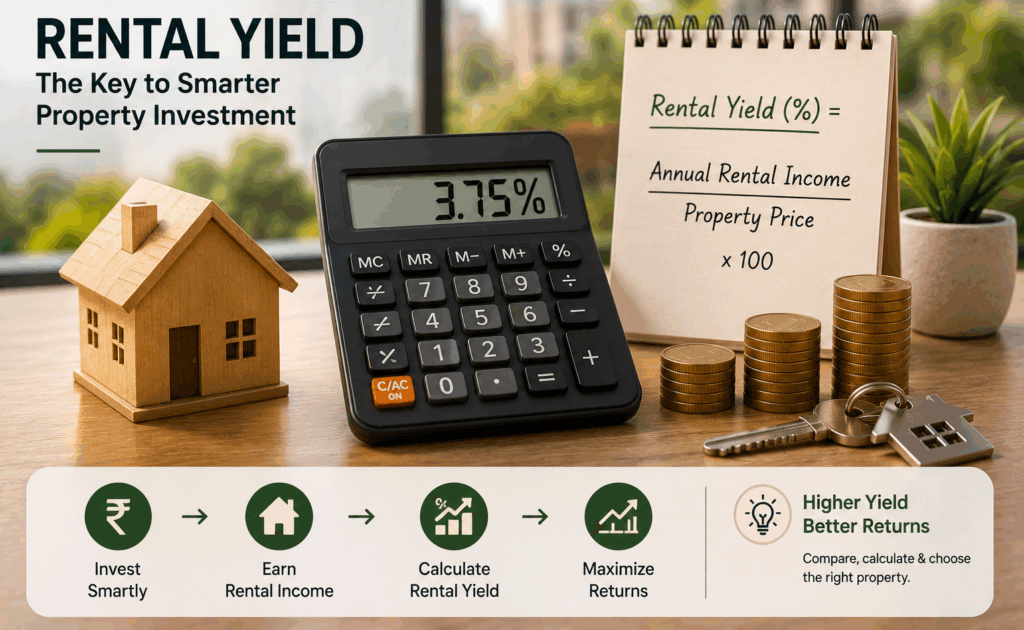
Rental yield is one of the most important numbers for anyone investing in property for rental income.
It tells you how much annual rent a property generates compared with its value or purchase price.
The basic formula for gross rental yield is:
Gross Rental Yield = (Annual Rental Income ÷ Property Value) × 100
For example, imagine you purchase a property for ₹80 lakh and rent it for ₹25,000 per month.
Your annual rental income would be ₹3 lakh.
Your gross rental yield would therefore be:
₹3,00,000 ÷ ₹80,00,000 × 100 = 3.75%
That number gives you a starting point, but it does not tell you what you actually keep.
Gross Rental Yield vs Net Rental Yield
This is where many property investment calculations go wrong.
Gross rental yield ignores the costs associated with owning and operating the property. A landlord may have to pay society maintenance, property tax, repairs, insurance, brokerage during tenant changes, furnishing expenses and other costs. The property may also remain vacant between tenants.
Net rental yield attempts to account for these expenses.
A simplified calculation is:
Net Rental Yield = (Annual Rent − Annual Property Expenses) ÷ Property Value × 100
For example, if your property generates ₹3 lakh in annual rent but you spend ₹60,000 on maintenance, repairs, taxes and vacancy-related costs, your actual rental income before other applicable taxes is closer to ₹2.4 lakh.
That distinction matters enormously when comparing two investment properties.
A property offering ₹30,000 rent is not necessarily better than one offering ₹25,000 if the first property has significantly higher maintenance, vacancy or operating costs.
How Much Should You Spend on a Rental Property?
There is no universal percentage of your income that should be spent on an investment property. Your budget should be determined by your available capital, loan eligibility, expected rental income, existing financial commitments and investment horizon.
More importantly, don’t calculate only the property’s advertised price.
Your total acquisition cost can include stamp duty, registration, brokerage, legal fees, furnishing, interiors, maintenance deposits and other transaction-related costs. RentOk’s own property-investment guidance similarly highlights the importance of accounting for costs beyond the agreement value when evaluating real estate returns.
A property that looks attractive at ₹80 lakh may require significantly more capital before it is actually ready to rent.
Should You Buy a Ready-to-Move Property or Under-Construction Property?
Both options have advantages, but they serve different investment strategies.
A ready-to-move property can start generating rental income relatively quickly because the property already exists and can potentially be occupied after the necessary preparation. You can also inspect the actual building, neighbourhood and amenities rather than relying entirely on plans and projections.
An under-construction property may offer different pricing and payment structures, but your money may remain tied up until completion. During that period, there is generally no rental income from the property.
If your primary objective is immediate rental cash flow, the timeline to possession should be an important part of your calculation.
How Do You Know Whether a Property Will Get Tenants?
Before purchasing, research the local rental market as if you were already a landlord.
Look at similar properties in the same building and nearby buildings. Check their asking rents, how long listings remain active, what furnishing is included and what tenant profiles they attract.
Speak to local brokers, property managers and residents. Visit the area at different times of day. Look at transport connectivity, traffic, parking and nearby commercial activity.
Most importantly, do not base your expected rent on the highest listing you find online.
Use a realistic range.
If similar apartments are actually renting for ₹25,000–₹28,000, building your investment calculation around ₹35,000 rent can make the property look much more profitable on paper than it will be in reality.
Should You Furnish a Rental Property?
Furnishing can directly influence both the rent you charge and the type of tenants you attract.
A fully furnished property may appeal to students, young professionals, corporate employees and people relocating to a new city. A semi-furnished property may work better for families or long-term tenants who want to bring their own belongings.
However, furnishing also increases your investment and creates additional maintenance responsibilities.
A smart investor should compare the additional rent generated by furnishing with the additional cost of furniture, appliances, repairs and replacements.
For example, spending ₹5 lakh on furniture does not automatically make sense just because it allows you to charge ₹5,000 more in monthly rent. You need to calculate how long it will take to recover that additional investment and whether the furnishing will increase occupancy or reduce vacancy.
How Does Vacancy Affect Rental Income?
A rental property does not earn money simply because it exists.
It earns money when it is occupied and the rent is actually collected.
If your property remains vacant for two months every year, your annual rental income is immediately reduced. Add repairs between tenants, brokerage and cleaning costs, and the difference can become substantial.
This is why occupancy rate is an important metric for rental property investors.
A slightly lower monthly rent with consistent occupancy can sometimes generate more annual income than a higher asking rent that causes the property to remain vacant for longer periods.
The objective should not always be maximum rent.
It should be maximum sustainable rental income.
What Expenses Should You Consider Before Investing?
Your rental-property calculation should include every recurring and occasional expense that affects your cash flow.
These may include society maintenance, property tax, repairs, insurance, furnishing, appliance replacement, brokerage, vacancy periods, legal documentation and property management costs.
If you have financed the property, loan interest and EMI obligations also need to be considered separately.
This is why investors should calculate cash flow, not just rental yield.
A property can have a reasonable rental yield and still create negative monthly cash flow if the loan repayment and operating expenses are too high.
How Does Home Loan Financing Change the Calculation?
A home loan allows investors to acquire property without paying the entire purchase price upfront. This can increase the potential return on the investor’s own capital if the property appreciates and generates income.
However, leverage also increases risk.
If the property remains vacant, you still have to service the loan. If interest rates or financing costs change, your monthly obligations may become more difficult to manage. A rental property should therefore be evaluated under realistic scenarios rather than assuming perfect occupancy and continuously rising rents.
Before purchasing, calculate what happens if the property is vacant for several months, rent grows more slowly than expected, or an expensive repair occurs.
If the investment only works under perfect conditions, it may not be a strong investment.

What Taxes Apply to Rental Income in India?
Rental income from a property is generally considered under the head Income from House Property, subject to the applicable tax rules. The Income Tax Department’s house-property computation includes annual value, municipal taxes, a standard deduction and interest on borrowed capital as relevant components.
A standard deduction of 30% of annual value is an important part of the house-property calculation under the applicable rules.
However, taxation can become more complicated depending on the property type, ownership structure, financing, other income, whether the property is let out or deemed let out, and the applicable tax regime.
Tax rules can also change, so investors should verify the current rules with a qualified tax professional before making an investment decision.
What Legal Checks Should You Do Before Buying?
Before investing, verify the property’s title, ownership, approvals, registration and applicable local requirements. If purchasing from a developer, investors should also verify relevant project registration and disclosures where applicable.
RERA was established to regulate and promote the real estate sector, improve transparency and protect the interests of real estate consumers.
You should also verify whether the property can legally be used for the type of rental arrangement you have in mind. This becomes particularly important if you are considering converting a conventional apartment into a PG, co-living setup or another managed accommodation model.
Never assume that because you own a property, every possible rental model is automatically permitted.
How Do You Find the Right Tenants?
Once the property is ready, the next challenge is finding the right tenant.
The objective should not simply be to fill the property as quickly as possible. A tenant who pays on time, follows property rules and takes care of the home can be more valuable over the long term than a tenant who agrees to a higher rent but creates frequent operational problems.
Tenant verification, clear rental agreements, documented move-in conditions and transparent communication are important parts of the process.
For furnished properties, documentation becomes even more important because there are more assets involved.
Why Property Management Matters After the Investment
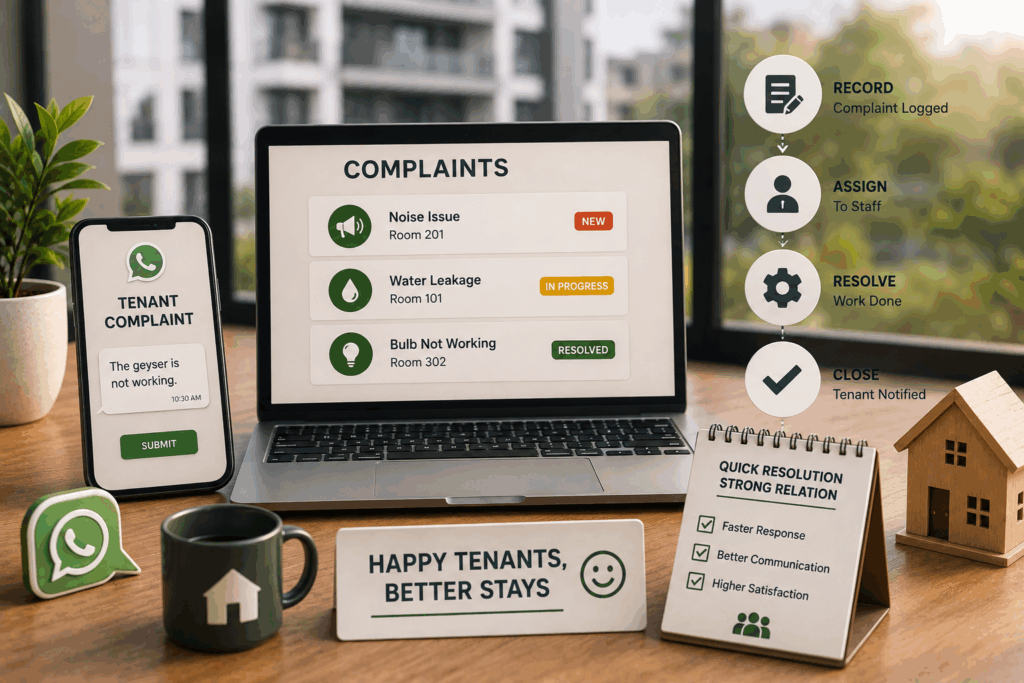
This is the part many property investors underestimate.
Buying a property is a one-time transaction. Managing it is an ongoing business.
Every month brings rent collection, payment follow-ups, maintenance requests, tenant complaints, utility calculations, inspections, repairs and eventually move-outs.
What looks like passive rental income can quickly become a collection of manual tasks if you are managing everything through WhatsApp messages, spreadsheets and notebooks. Property management software can bring these operations into one structured system.”
RentOk’s property-management tools are designed to bring these operations into one system, helping owners manage tenants, payments, property operations and day-to-day rental workflows digitally.
How RentOk Can Help You Manage a Rental Property
Once a property starts generating rental income, the focus shifts from buying the asset to protecting and operating the asset efficiently.
With RentOk, owners can manage important parts of their rental operations digitally instead of relying entirely on manual records. Rent collection, tenant information, complaints, operational tasks and property-level information can be organised in one system.
For owners managing furnished properties, this becomes even more useful when there are multiple physical assets inside the property. Furniture, appliances and other items can be tracked, assigned and monitored rather than being left to memory or scattered spreadsheets.
A structured management system can also make it easier to maintain records across multiple properties as an investor’s portfolio grows.
This matters because a rental property becomes more difficult to manage as the number of tenants, properties and transactions increases. The goal of technology is not simply to replace a spreadsheet. It is to give the owner a reliable operating system for the rental business.
How Can You Increase Rental Income From a Property?
Increasing rent is not the only way to improve rental returns.
You can potentially increase the property’s income by reducing vacancy, improving tenant retention, offering relevant paid services, furnishing strategically, improving the tenant experience and reducing operational leakage.
For example, if two similar properties exist in the same locality and one consistently remains occupied while the other experiences frequent vacancies, the difference in annual income can be substantial even if their advertised rents are identical.
This is why rental income should be viewed as a system rather than a single number.
Revenue = Rent × Occupancy − Operating Costs
Improving any of these variables can improve the investment’s actual performance.
What Are the Biggest Mistakes First-Time Rental Property Investors Make?
The first mistake is buying based on appreciation alone. A property may increase in value but still provide weak rental cash flow.
The second is overestimating rent. Investors often use the highest asking rent they can find instead of studying actual local demand.
The third is ignoring vacancy. A property that is vacant for several months every year can produce a much lower return than expected.
The fourth is forgetting operating costs. Maintenance, repairs, furnishing, taxes and brokerage can materially reduce net income.
The fifth is treating rental income as completely passive. Managing tenants and property operations requires time, systems and follow-up.
The sixth is buying too much property too soon. A large portfolio is not necessarily better if the investor cannot manage the associated debt and operations.
Is Property Investment Still Good for Rental Income in India?
It can be, but it should be approached as a long-term investment rather than a guaranteed passive-income strategy.
Residential rental yields in India can be relatively modest, so investors should evaluate rental income alongside capital appreciation, financing costs, taxes, vacancy and operating expenses. Current market data also shows that rental yields can vary substantially between cities and even between neighbourhoods within the same city.
The best investment is therefore not necessarily the property with the highest advertised rent.
It is the property where purchase price, rental demand, expected rent, occupancy, expenses, financing and long-term appreciation work together.
Frequently Asked Questions
Find answers to common questions about this topic
About the Author
Shivanshi Dheer
Shivanshi Dheer sharing actionable strategies and information on PG/hostel management to help simplify renting and scale with RentOk.