
Market Trends
What is the Model Tenancy Act and How Does It Protect Landlords?


Written by
Ishika Pannu
Read Time
13 min read
Posted on
August 19, 2026
Overview
Overview
What is the Model Tenancy Act and How Does It Protect Landlords?
India’s rental market has changed significantly over the last few years. More people are renting for work, education, relocation, and flexible living, while landlords and property operators are managing increasingly complex tenancy relationships. Yet, rental laws across the country have historically remained fragmented, with different states following different rules around rent, eviction, deposits, agreements, and dispute resolution.
This is where the Model Tenancy Act, 2021 (MTA) comes in.
Approved by the Union Cabinet in June 2021, the Model Tenancy Act was designed as a framework that states and Union Territories could adopt by introducing new tenancy legislation or modifying their existing laws. Its objective is not simply to protect tenants or landlords individually, but to create a more structured rental ecosystem with clearer responsibilities, formal agreements, and a faster mechanism for resolving disputes.
For landlords, this matters because a predictable rental system can reduce one of the biggest risks in property management: uncertainty. When rent terms, deposits, maintenance responsibilities, eviction conditions, and dispute mechanisms are clearly defined, landlords have a stronger operational framework for managing their properties.
However, there is one important point to understand before looking at the provisions: the Model Tenancy Act is not automatically applicable across India. Tenancy is a state subject, and each state or Union Territory must adopt or modify its own laws. The rules that apply to a landlord therefore depend on the state in which the property is located.
What Exactly Is the Model Tenancy Act?
The Model Tenancy Act is best understood as a model framework for modernising rental laws in India, rather than a single nationwide tenancy law.
To understand how tenancy laws fit into the broader landlord-tenant relationship in India, read Tenancy Act in India for a broader overview of the rights and responsibilities involved.
The Ministry of Housing and Urban Affairs prepared it to help states overhaul older tenancy legislation and create a more transparent rental environment. The framework focuses on formalising rental arrangements, balancing landlord and tenant interests, and establishing dedicated mechanisms for resolving tenancy disputes.
At its core, the framework attempts to answer some very practical questions that frequently create disputes between landlords and tenants:
- What should a proper tenancy agreement contain, and how should it be recorded?
- How much security deposit can be collected for a residential property?
- What happens when rent is not paid for an extended period?
- Under what circumstances can a landlord seek eviction?
- Who handles disputes between landlords and tenants?
- What happens if a tenant continues occupying the property after the tenancy ends?
These questions may sound straightforward, but they become complicated when agreements are informal, records are incomplete, or both parties have different expectations.
The Model Tenancy Act attempts to bring greater structure into these areas.
And for landlords managing multiple tenants, PGs, co-living spaces, or rental properties, that structure can be particularly valuable because the same operational issues can repeat across dozens or hundreds of tenancies.

The Key Provisions Landlords Need to Know
The Model Tenancy Act introduces several provisions that directly affect the way landlords structure and manage rental relationships. While the exact rules applicable to a property depend on the legislation adopted in that state or UT, the model framework provides a useful reference point for understanding the direction of tenancy reform in India.
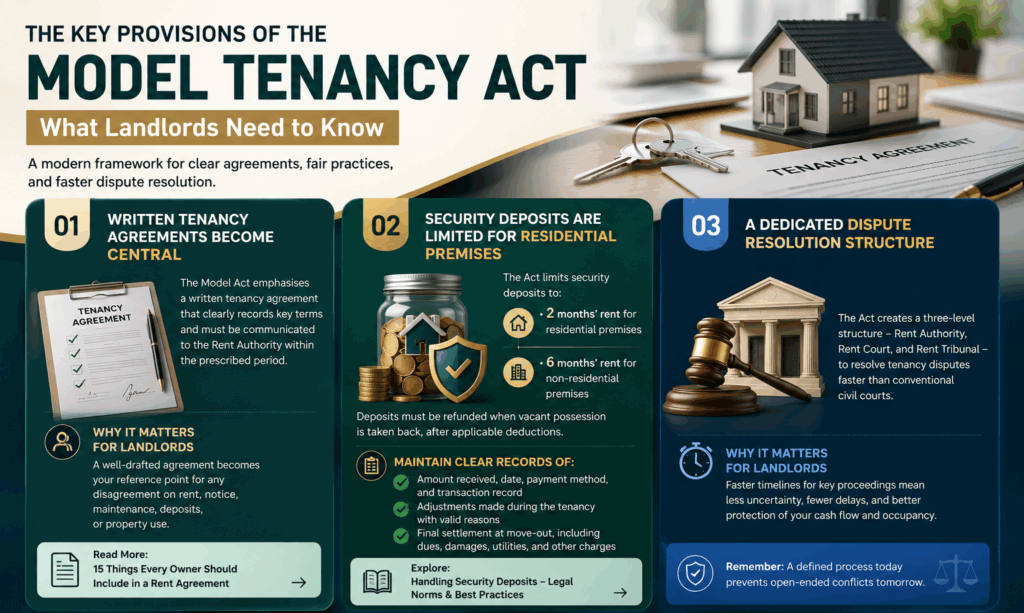
1. Written Tenancy Agreements Become Central to the Relationship
One of the most important features of the Model Act is the emphasis on a written tenancy agreement.
The agreement is intended to clearly record important terms such as the rent payable, tenancy period, rent revision terms, security deposit, permitted reasons for entry, and responsibilities relating to maintenance. The tenancy agreement is also required to be communicated to the Rent Authority within the prescribed period under the model framework.
For landlords, this is more than a documentation requirement.
A properly drafted agreement creates a reference point when disagreements arise. If there is a dispute over rent, notice, maintenance, deposit deductions, or the use of the property, both parties can refer back to the terms they agreed to rather than relying on verbal conversations.
This is one reason why having a structured rent agreement matters even beyond legal compliance. RentOk’s existing guide on the 15 things every owner should include in a rent agreement also highlights how clearly defined terms can reduce confusion around deposits, property use, responsibilities, notice periods, and disputes.
2. Security Deposits Are Limited for Residential Premises
Security deposits are one of the most common sources of disagreement in rental relationships. The Model Tenancy Act proposes a clear limit: not more than two months’ rent for residential premises and six months’ rent for non-residential premises. The deposit is to be refunded when vacant possession is taken back, after applicable deductions.
For landlords, this means deposit management needs to become more structured.
A deposit should not simply be treated as money received at the beginning of the tenancy. It needs to be tracked throughout the tenant lifecycle, particularly when there are outstanding dues, damages, or other liabilities at move-out.
A professional deposit process should therefore maintain records of:
- The amount received and date of payment, along with the payment method and corresponding transaction record.
- Any legitimate adjustments made during the tenancy, ensuring that every deduction can be explained rather than appearing arbitrary.
- The final settlement at move-out, including outstanding rent, utilities, damages, or other charges covered by the tenancy terms.
This is also why documentation becomes particularly important when managing several properties. RentOk’s guide on handling security deposits explores how structured records, inspection processes, and transparent deductions can help reduce deposit-related disputes.
3. A Dedicated Dispute Resolution Structure
Another major change proposed by the Model Tenancy Act is the creation of a dedicated tenancy dispute-resolution mechanism.
Instead of leaving every landlord-tenant disagreement to the conventional civil court system, the framework establishes a three-level structure consisting of the Rent Authority, Rent Court, and Rent Tribunal. The objective is to create a specialised and faster mechanism for handling tenancy matters.
For landlords, this can be significant.
Rental disputes can affect cash flow, occupancy, property condition, and the ability to re-let a premises. A dispute that remains unresolved for a long period can therefore become an operational problem, not just a legal one.
The Model Act provides specified timelines for certain proceedings, including timelines for applications involving rent defaults and certain eviction-related matters.
The broader principle is simple: rental disputes should have a defined process instead of becoming open-ended conflicts.
Which States Have Adopted the Model Tenancy Act?
This is where landlords need to be careful.
The Model Tenancy Act did not automatically become India’s nationwide rental law after its approval in 2021. The Union Government circulated it to states and UTs for adoption through new legislation or amendments to existing laws. Since tenancy is a state subject, the law governing a property depends on the legislation applicable in that jurisdiction.
As per a 4 August 2025 Rajya Sabha reply from the Ministry of Housing and Urban Affairs, the Ministry stated that the following jurisdictions had aligned their tenancy legislation with the MTA framework:
- Assam notified the Assam Tenancy Act, 2021 on 27 September 2021, while Arunachal Pradesh notified its Tenancy Act in November 2022.
- The Union Cabinet approved the Andaman and Nicobar Islands Tenancy Regulation, 2023, the Dadra and Nagar Haveli and Daman and Diu Tenancy Regulation, 2023, and the Lakshadweep Tenancy Regulation, 2023.
- Andhra Pradesh, Tamil Nadu, Uttarakhand, and Uttar Pradesh had already notified tenancy legislation based on an earlier draft of the Model Tenancy Act and had been requested to align their laws with the latest 2021 version.
This distinction is important because saying that a state has simply “adopted the Model Tenancy Act” can sometimes oversimplify the actual legal position.
If you are a landlord in Delhi, Haryana, Maharashtra, Karnataka, or another state, do not assume that the MTA provisions automatically apply to your property. State-level differences matter, as tenancy documentation, tenant verification, registration, and other rental requirements can vary by jurisdiction. For landlords and PG operators looking to build a more structured rental process, RentOk’s PG Rental Agreement Format (Free Template) can serve as a useful reference.
Ultimately, compliance starts with understanding which tenancy law and notifications actually govern your property. Before relying on the MTA, check the applicable state or local requirements and ensure your rental documentation and procedures comply with them.
How Does the Model Tenancy Act Change Eviction Rules?
Eviction is one of the most sensitive parts of a landlord-tenant relationship. Landlords need a practical way to recover possession when tenants stop paying rent, misuse the property, or violate agreed conditions. This may also apply when a tenant stays after the tenancy ends.
However, landlords cannot simply ask tenants to leave without following the applicable legal process.
Under the Model Tenancy Act framework, eviction requires specified grounds and formal adjudication. These grounds include non-payment of rent, unauthorised possession, misuse of the property after written notice, and certain unauthorised structural changes.
This gives landlords something extremely important: clarity on when they can pursue an eviction claim.
For example, if a tenant repeatedly fails to pay rent, the issue should not remain a series of informal WhatsApp messages with no documented timeline. The landlord should be able to demonstrate the tenancy terms, payment history, notices, and other relevant records.
The same principle applies when the issue involves unauthorised subletting or misuse of the premises.
A structured eviction process generally requires landlords to maintain:
- A valid tenancy agreement that clearly establishes the tenant’s obligations and the conditions of occupation.
- Accurate records of rent payments, outstanding dues, notices, warnings, and other relevant communications.
- Proper documentation of the reason for seeking possession, rather than relying on informal conversations or undocumented claims.
- Evidence that the applicable notice and legal procedure have been followed before taking further action.
RentOk’s guide to handling tenant evictions professionally covers the operational side of this process, including notice handling, documentation, final settlement, and maintaining old tenant records.
What Happens When a Tenant Overstays?
The Model Tenancy Act also covers situations where a tenant remains in possession after the tenancy expires or ends.
Under the model framework, an overstaying tenant may be liable for twice the monthly rent for the first two months and four times the monthly rent thereafter. This liability continues while the tenant occupies the premises.
This provision is particularly relevant to landlords because an expired tenancy can create more than a simple documentation problem. It may also lead to financial and legal complications. It can prevent the landlord from using, selling, or re-letting the property as planned.
However, even where enhanced rent provisions exist, landlords should not treat them as permission to bypass the applicable legal process. The actual law governing the property remains the starting point.
What Should Landlords Do Now?
For landlords, the most useful takeaway from the Model Tenancy Act is not simply memorising individual provisions. It is recognising that rental management is moving towards greater formalisation.
Whether your state follows the MTA framework or its own tenancy laws, landlords should build processes that support compliance rather than wait for a dispute to reveal gaps.
Start with the agreement itself. Document the rent, deposit, tenancy duration, notice requirements, maintenance responsibilities, property-use restrictions, and exit conditions clearly.
Then look at the records behind that agreement.
When a tenant disputes rent, can you quickly show the payment history? For a deposit disagreement, can you establish what was received and what deductions were made? And in an eviction issue, can you produce the agreement, notices, and relevant communication in one place?
This is where legal compliance and property management begin to overlap.
A useful compliance system should help landlords:
- Keep tenancy agreements and tenant information organised instead of depending on scattered physical files and conversations.
- Maintain payment and dues records so that financial disputes can be addressed with documented information rather than memory.
- Record move-in and move-out details, including property condition and relevant deductions, so that final settlements are easier to explain.
- Keep important communication and operational records accessible when a tenancy issue requires immediate attention.
Landlords should regularly review their agreements and processes against current state-specific tenancy laws. The Model Tenancy Act does not automatically replace state legislation.

How RentOk Helps Landlords Stay Organised and Compliant
Legal compliance becomes significantly easier when the operational records behind a tenancy are already organised. RentOk helps landlords and PG operators manage key parts of tenant management in one connected platform. It brings together tenant records, agreements, payment tracking, dues, move-in and move-out details, and property operations. Property managers get a clearer view of the tenancy lifecycle. Important information no longer needs to be scattered across spreadsheets, registers, payment screenshots, and WhatsApp conversations. RentOk also supports better documentation for common disputes. These include pending payments, tenant exits, security deposits, and property handovers. RentOk does not replace legal advice or state-specific compliance requirements. However, it provides an organised operational foundation to help landlords manage these requirements consistently.
Conclusion
The Model Tenancy Act represents an important shift in the way India approaches rental housing. Its larger objective is to create a rental environment where agreements are clearer, responsibilities are better defined, disputes have a structured resolution mechanism, and both landlords and tenants operate with greater certainty.
For landlords, the biggest lesson is not simply that there are new rules to remember. It is that good documentation and structured property management are becoming increasingly important to protect the rental business itself.
At the same time, landlords should remember that the Model Tenancy Act is a model framework, not a single law that automatically governs every rental property in India. Before changing your rental practices, always check the tenancy legislation applicable to your state or Union Territory.
Bring your tenant records, payments, agreements, and property operations into one organised system. Take the next step towards better rental compliance with RentOk.
Frequently Asked Questions
Find answers to common questions about this topic
About the Author
Ishika Pannu
Ishika Pannu brings you the latest insights and easy-to-apply strategies in property management—helping you simplify renting and grow with RentOk.
You may also like these
Related Articles

1 min read
Co-living Brands Are Raising Big Money: What It Means for Independent PG Owners
Written by
Posted on
Ishika Pannu
Oct 17, 2026

1 min read
How to Find a Roommate: A Practical Guide to Finding the Right Flatmate
Written by
Posted on
Ishika Pannu
Oct 16, 2026

1 min read
Mumbai Has the Highest Rent, but Is It the Best City to Live In?
Written by
Posted on
Ishika Pannu
Oct 16, 2026

1 min read
Which City in India Has the Highest Rent?
Written by
Posted on
Ishika Pannu
Oct 12, 2026

1 min read
Renting vs. Buying a House in India in 2026: Which Makes More Financial Sense?
Written by
Posted on
Ishika Pannu
Oct 9, 2026

1 min read
Rent vs Commute in Gurgaon: How Much Is Convenience Worth?
Written by
Posted on
Ishika Pannu
Oct 9, 2026

1 min read
Delhi-NCR’s PG Boom: When Family Homes Turn into Hostels
Written by
Posted on
Ishika Pannu
Oct 8, 2026
1 min read
How to Avoid MDR on Rent Payments: A Guide for PG Owners
Written by
Posted on
Shivanshi Dheer
Oct 6, 2026

1 min read
RentOk AutoPay & e-NACH for Automatic Rent Collection
Written by
Posted on
Shivanshi Dheer
Oct 6, 2026

1 min read
What’s Included in My Rent and What Am I Paying Extra For?
Written by
Posted on
Ishika Pannu
Sep 30, 2026
Stay ahead in property management with expert insights
Join thousands of property managers receiving exclusive tips delivered straight to your inbox.
Browse posts by category
Case Study
Cost of Living
Growth
Legal
Market Trends
News
Pg owner app
Property Management
Property Tax
Tech
RentOk
The easiest way to rent and manage your PGs and hostels.
Grievance Officer
Get the app


Contact us
hello@eazyapp.tech
HQ Office
COGROW, BASEMENT F-12/8A
BESIDE HOUSE OF STYLE SALON, SECTOR 28, DLF PHASE 1
GURUGRAM, HARYANA - 122002
South India Office
LUMIODESK COWORKING, 2ND FLOOR, 40, 14TH MAIN RD
BESIDE MC DONALD, 7TH SECTOR, HSR LAYOUT
BENGALURU, KARNATAKA - 560102
©️ 2026 EazyApp Tech Pvt Ltd. All rights reserved


