Market Trends
Pune Police Crackdown: What PG Owners Need to Know

Written by
Ishika Pannu
Read Time
10 min read
Posted on
August 10, 2026
Overview
Overview
Pune Police Crackdown: What PG Owners Need to Know
If you own a house, flat, PG, or rental property in Pune, tenant verification is something you cannot afford to treat as just another piece of paperwork.
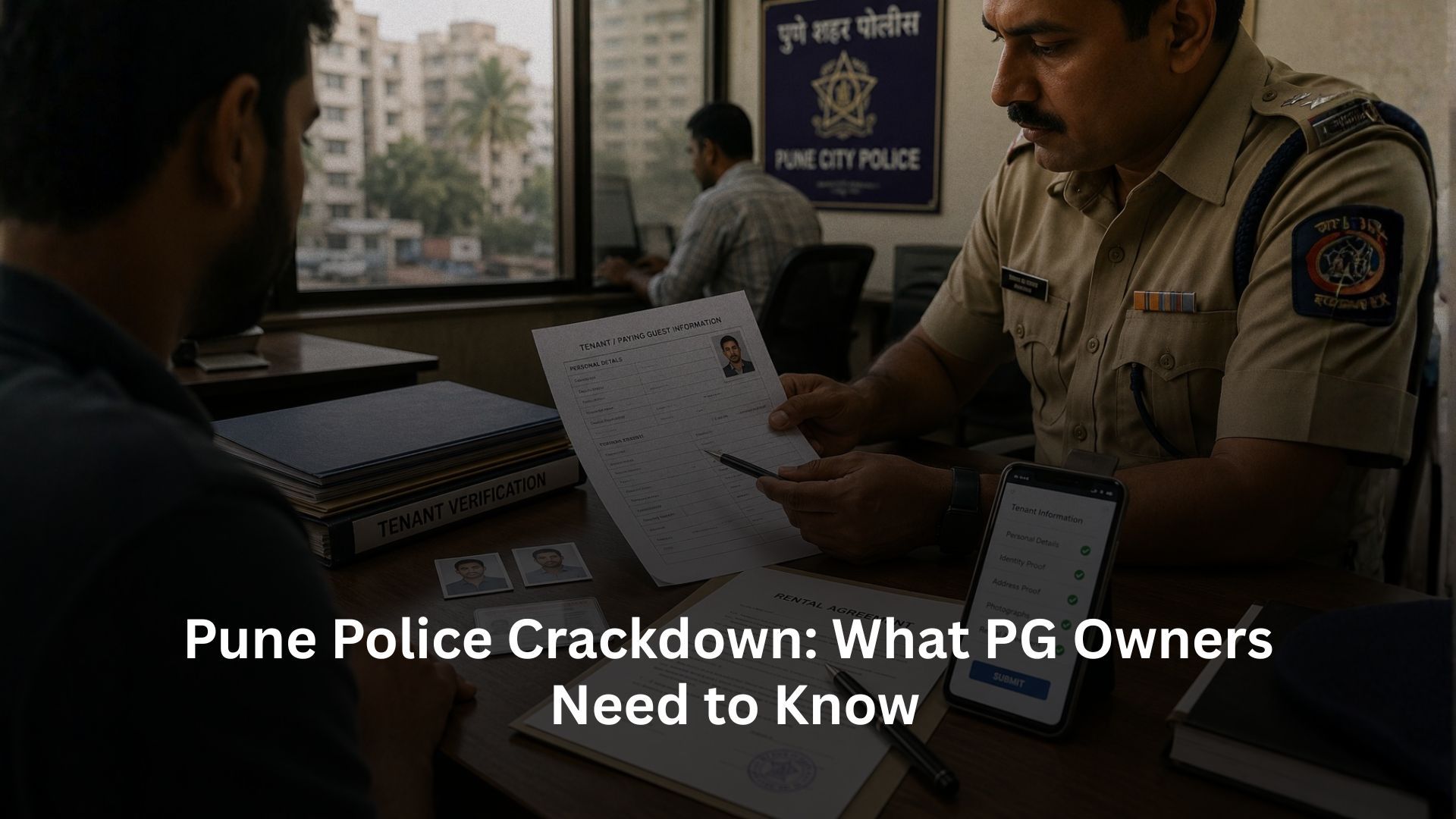
Pune Police have recently intensified action against landlords and PG operators who failed to submit tenant information to the authorities. In one recent enforcement drive, cases were registered against 76 property owners and PG operators within 10 days across areas including Khadki, Shivajinagar, Wagholi, Lohegaon, Warje, Loni Kalbhor, and Ambegaon.
Another Special Branch verification drive reported action against 113 landlords and PG operators for allegedly failing to furnish mandatory tenant details.
The two figures refer to separate enforcement drives, but both reports point toward the same development: tenant verification is being taken seriously, and landlords are being asked to maintain and submit accurate tenant information.
For PG owners, this is particularly important. A property may have dozens of tenants moving in and out throughout the year, making manual verification and documentation increasingly difficult to manage.
Why Is Pune Police Focusing on Tenant Verification?
Pune has a large and constantly changing rental population.
Students arrive from different parts of India for education. Professionals relocate for work. People move to the city for business and other opportunities. Many eventually live in rented flats, PGs, hostels, housing societies, and other rental accommodations.
For authorities, maintaining accurate records of these occupants is an important part of public safety and law enforcement.
For landlords, it creates an equally important operational responsibility: knowing exactly who is occupying the property and maintaining the required records.
The recent enforcement action shows why this cannot be treated as a one-time formality.

What Information Do Landlords Need to Maintain?
According to the reports provided, landlords and PG operators are expected to furnish information such as:
- Tenant’s full name and current address, along with their permanent address for proper identification.
- Two passport-sized photographs as part of the tenant’s documentation.
- Valid identity proof to establish the tenant’s identity.
- Reference person’s details, where required as part of the verification process.
- Registered rent agreement details and other relevant tenancy information.
The exact submission process can depend on the applicable local authority and procedure.
This is where landlords need to make an important distinction.
Collecting documents from a tenant is one step. Completing the required verification and maintaining accurate records is another.
Is Collecting Aadhaar Enough?
This is a common assumption among landlords.
A tenant submits an Aadhaar copy, the owner keeps it on file, and the onboarding process is considered complete. However, maintaining a copy of an ID is only one part of a proper tenant verification process. For a deeper look at how PG owners can structure KYC digitally, read our guide on Aadhaar-Based Digital KYC: A Step-by-Step Guide for PG Owners.
At the same time, tenant KYC should not be confused with police verification. Reports specifically highlight the requirement to furnish tenant information to the concerned police authorities, making police verification a separate aspect of the tenant onboarding process.
Since the exact requirements can vary by state and local authority, property operators need to understand the distinction between digital KYC and police verification. Our guide on Digital KYC and Police Verification: State-wise Compliance in India covers these requirements in greater detail.
A proper tenant onboarding system should make it clear:
- What information has been collected?
- Which documents have been received?
- Has the rent agreement been completed?
- What verification process applies locally?
- Has the required information been submitted?
- Where is the record stored for future reference?
This level of visibility becomes increasingly important when managing a large PG.
Where Manual Tenant Verification Starts Becoming Difficult
For a landlord with two or three tenants, maintaining records manually may seem manageable.
A PG with 100 or 200 tenants is a completely different situation.
Tenant records are constantly changing. New residents move in, existing tenants leave, rooms are reassigned, and agreements are updated.
When these activities are handled through registers, spreadsheets, and WhatsApp messages, information can quickly become scattered.
Some common problems include:
- A tenant’s documents are stored in one location while their agreement is stored somewhere else.
- A caretaker collects new tenant information but the owner does not receive the complete record.
- A tenant moves out but their occupancy status is not updated immediately.
- Staff members maintain different versions of the same information.
- Management cannot quickly identify which tenant records are complete and which still need attention.
The problem is not always negligence.
Often, there simply isn’t a structured system behind the process.
These gaps become much easier to avoid when tenant documents are stored as structured, searchable records rather than scattered files. Learn how to maintain tenant KYC records digitally.
Why Tenant Records Need to Stay Updated
Tenant verification should not be treated as something that happens once and then disappears into a file.
Rental properties are constantly changing.
A tenant leaves.
Another person takes the room.
Someone changes rooms.
A new agreement is signed.
A PG adds more rooms.
Every one of these changes affects the property’s occupancy records.
A good tenant management process should therefore provide clear visibility into:
- Who is currently living in the property
- When they moved in
- Which room they occupy
- What documentation has been collected
- What agreement is associated with their stay
- Whether the tenant has moved out or is still active
Without this visibility, maintaining accurate records becomes much harder.

Pune Police Has Also Moved Toward Digital Submission
One important point highlighted in the reports is that landlords and PG operators can use available online systems to furnish tenant information.
The reports mention that information from online leave-and-licence agreements registered through the IGR (i-SARITA) system is available on the CCTNS platform.
They also mention the Pune Police website and Citizen Portal, where property owners can use the “Tenant/Paying Guest Information Request” facility to submit details to the concerned police station.
This is significant for landlords because the rental ecosystem itself is becoming more digital.
The move toward online submission also means property owners need their own tenant records to be organized digitally.
If the information is still scattered across physical files, the digital submission process can remain difficult and time-consuming.
What Does This Mean for PG Owners?
For a PG operator, the recent action should be viewed as a reason to strengthen the entire tenant onboarding process.
Instead of treating verification as a separate administrative task, it can become part of the standard move-in workflow.
A structured process could include:
1. Collect tenant information
Capture the required personal and contact details when the tenant is onboarded.
2. Collect and organize documents
Keep identity proof, photographs, agreement information, and other relevant records together.
3. Complete the applicable verification process
Follow the process prescribed by the relevant local authority.
4. Update the occupancy record
Make sure the tenant is correctly reflected as an active occupant of the property.
5. Maintain the record digitally
Keep the information accessible so that it can be retrieved whenever required.
This approach reduces the chances of a verification step being forgotten simply because different staff members are handling different parts of the move-in process.
The Risk Is Bigger Than Just Legal Action
The immediate concern for landlords is understandably the possibility of legal action.
But incomplete tenant records create operational problems even before an authority asks for them.
Imagine someone asks for information about a current tenant.
If the owner has to search through:
- a physical register,
- old WhatsApp conversations,
- email attachments,
- spreadsheets,
- and files stored on different devices,
just to find basic information, the process becomes unnecessarily slow.
A centralized digital record changes that.
Management can quickly identify the tenant, their occupancy details, documentation, and other relevant information without depending on one staff member’s memory.
That is where digital tenant management becomes more than just paperwork management.
It becomes a way of maintaining control over the property.
How Can Landlords Make the Process Easier?
The simplest approach is to build verification into the tenant lifecycle rather than handling it separately.
Every new tenant should move through a consistent onboarding process, and every move-out should update the same record.
This creates a clear trail from:
Move-in → Documentation → Verification → Occupancy → Move-out
It also helps management identify gaps before they become bigger problems.
For larger PGs, this becomes particularly useful because the number of tenants makes manual checking increasingly difficult.
If you’re already considering moving away from registers and spreadsheets, choosing the right system matters just as much as going digital. Here’s a practical guide to How to Choose the Right PG Management Software and the features that actually matter for growing PG operations.

How RentOk Helps PG Owners Organize Tenant Records
Managing tenant verification becomes much easier when tenant information, documents, agreements, occupancy, and move-in records are not spread across different systems.
RentOk helps PG and property operators centralize important tenant information, including:
- Tenant details and occupancy records
- KYC and supporting documentation
- Move-in and move-out information
- Agreement-related records
- Payment and dues information
- Tenant management workflows
Instead of depending on physical registers or searching through multiple WhatsApp conversations, operators can maintain structured digital tenant records within one platform.
This becomes particularly useful for properties with high tenant turnover, where keeping track of every occupant manually can quickly become difficult.
The goal is not simply to replace paperwork.
It is to create better visibility into who is living in the property, what information has been recorded, and how the tenant lifecycle is being managed.
What Should Landlords Take Away From the Pune Action?
The recent enforcement drives highlight a simple point: tenant verification and documentation should not be treated casually.
For landlords and PG operators, maintaining accurate tenant information is becoming increasingly important as rental populations grow and verification processes become more actively enforced.
The bigger lesson is also operational.
A property with a few tenants may be able to manage records through a register.
A PG with 100+ tenants needs a system.
The stronger approach is to make documentation and verification part of the regular onboarding process, keep occupancy records updated, and use digital systems to maintain better visibility.
Because ultimately, tenant verification is not only about avoiding penalties.
It is about knowing who occupies your property, maintaining accurate records, and building a more organized rental operation.
And when your property grows, that organization becomes just as important as occupancy and rent collection.
If your tenant records are still spread across registers, spreadsheets, and WhatsApp chats, it may be time to move toward a more structured system with RentOk.
Frequently Asked Questions
Find answers to common questions about this topic
About the Author
Ishika Pannu
Ishika Pannu brings you the latest insights and easy-to-apply strategies in property management—helping you simplify renting and grow with RentOk.