Market Trends
RentOk Pricing Explained: What You Actually Pay For


Written by
Ishika Pannu
Read Time
12 min read
Posted on
June 26, 2026
Overview
Overview
RentOk Pricing Explained: What You Actually Pay For
When property owners search for RentOk pricing, they’re usually looking for one simple answer:
How much does it cost?
That’s a fair question, but it doesn’t tell the complete story. The real value of property management software isn’t defined by its subscription fee alone. It’s measured by the time it saves, the manual work it eliminates, and the structure it brings to your daily operations.
Many PG owners and rental operators start looking for software only after manual management begins creating operational challenges. Rent collection takes longer than expected. Tenant records become difficult to maintain. Communication gets scattered across WhatsApp chats, spreadsheets, and notebooks. Financial tracking also becomes more complicated as occupancy increases. Individually, these problems may seem manageable. Together, they consume valuable hours every week and make it harder to scale the business efficiently.
That is why evaluating property management software should never stop at comparing monthly subscription costs. Instead, the focus should be on understanding the operational value it creates. The right platform reduces repetitive work, improves visibility across the property, and helps standardize everyday processes. Over time, these improvements often create significantly more value than the subscription fee itself.
In this guide, we’ll explain RentOk pricing, what you’re actually paying for, how to choose the right plan, and why software should be viewed as an operational investment rather than simply another monthly expense.
Looking Beyond the Price Tag
Price is often the first thing people compare when evaluating software. Every business wants to control costs, so this approach is understandable. However, experienced property operators know that the lowest subscription price doesn’t always translate into the lowest operating cost.
Every rental business has hidden operational expenses. These don’t appear on invoices, but they affect profitability every day. Staff spend hours following up on rent payments, updating spreadsheets, answering repetitive tenant queries, preparing monthly reports, and searching for information stored across multiple systems. These activities don’t directly generate revenue, yet they consume time that could be invested in growing the business.
The purpose of property management software is to reduce these operational inefficiencies. Instead of simply replacing paper records with digital ones, it creates a structured system that improves the way the entire property operates.
Before comparing pricing plans, ask yourself questions like these:
- Will this platform reduce the manual work my team performs every day, or will we continue relying on spreadsheets and disconnected tools to complete routine tasks?
- Can it improve operational visibility by bringing tenant records, payments, occupancy, and financial data into one centralized system that’s easy to manage?
- Will the software continue supporting our business as occupancy grows, or will we outgrow the platform within a short period?
Looking at pricing from this perspective changes the decision completely. Instead of asking which software is the cheapest, you’re asking which platform delivers the greatest operational value over time.

What Does Your RentOk Subscription Actually Include?
One of the biggest misconceptions about property management software is that you’re paying only for a collection of digital features. In reality, you’re investing in a system that brings different parts of your business together. Instead of managing tenant records in one place, payments in another, and communication through multiple channels, RentOk centralizes these workflows into one connected platform.
This connected approach makes daily operations much easier to manage. Property managers no longer need to switch constantly between spreadsheets, messaging apps, payment records, and handwritten registers. Everything becomes easier to track because operational data is available in one place.
Depending on your subscription plan, RentOk helps streamline several important areas of property management, including:
- Tenant and occupancy management, allowing you to organize resident records, monitor room availability, track move-ins and move-outs, and maintain accurate occupancy information without depending on scattered spreadsheets.
- Rent collection and payment tracking, helping you monitor pending dues, generate payment records, automate reminders, and improve collection consistency without repeated manual follow-ups.
- Financial reporting and expense management, giving you better visibility into revenue, operational expenses, profitability, and cash flow through structured reports that are easier to understand.
- Communication and operational workflows, enabling property managers to coordinate announcements, complaint tracking, tenant updates, and day-to-day administrative activities from one centralized platform.
- Business insights and operational visibility, helping owners monitor performance trends and make informed business decisions using organized operational data instead of manual calculations.
The goal isn’t simply to digitize your existing processes. It’s to create a more organized way of managing the property so daily operations remain efficient as your business continues to grow.
Why Different Properties Need Different Pricing Plans
No two rental businesses operate in exactly the same way. A newly established PG with 20 tenants faces very different operational challenges than a co-living operator managing multiple properties across a city. Their teams are different, their workflows are different, and the amount of coordination required every day is completely different.
This is why property management software shouldn’t follow a one-size-fits-all pricing model. Businesses need different levels of functionality depending on their size, operational complexity, and future growth plans.
Smaller properties usually focus on building operational discipline. Their immediate priorities often include organizing tenant information, improving rent collection, and reducing dependence on manual processes before they become difficult to manage.
As occupancy grows, operational complexity increases naturally. More tenants mean more payments to monitor, more communication to manage, more maintenance requests to coordinate, and greater financial reporting requirements. Businesses operating multiple properties also need centralized visibility so they can monitor operations across locations without constantly switching between different systems.
Choosing the right pricing plan isn’t simply about accessing more features. It’s about selecting a solution that supports the way your business operates today while giving you enough flexibility to grow tomorrow.
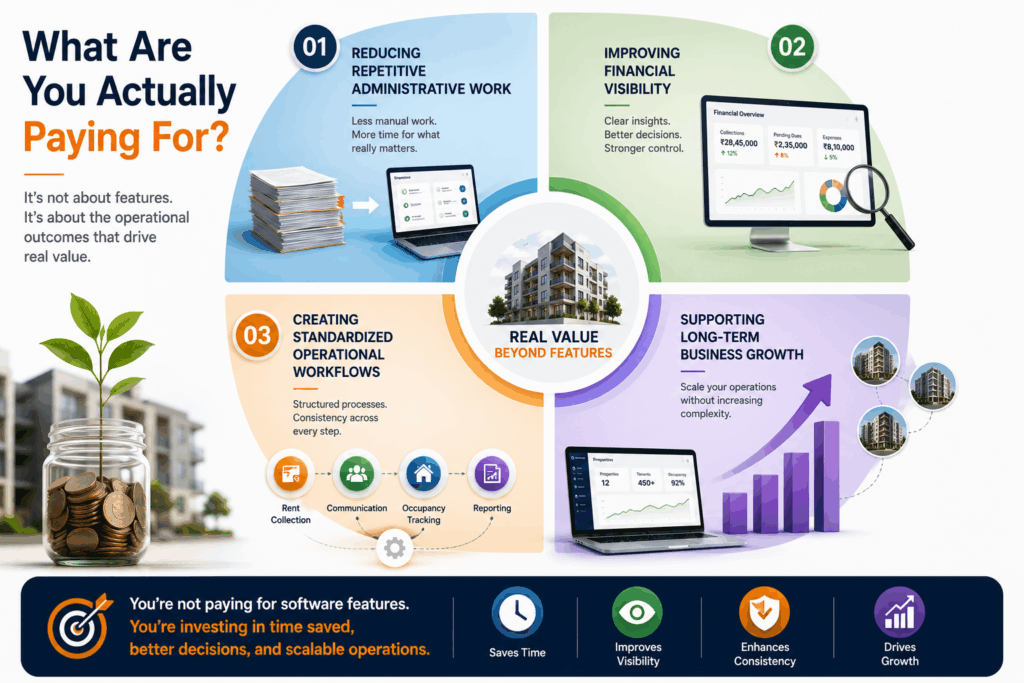
What Are You Actually Paying For?
When evaluating software, many people focus only on the features listed on the pricing page. Features are important, but they don’t represent the full value of the platform. What matters more is the operational outcome those features create.
Take automated rent reminders as an example. Their value doesn’t come from sending notifications. Their real value lies in improving payment consistency by ensuring tenants receive reminders at the right time. Similarly, financial reports aren’t just downloadable documents. They provide business insights within seconds instead of requiring hours of manual calculations.
The same logic applies across every operational workflow. Centralized tenant records reduce the time spent searching for information. Occupancy dashboards provide instant visibility into available rooms. Payment tracking reduces manual reconciliation. Individually, each improvement saves a few minutes. Combined, they transform the way a property is managed every day.
Over time, these improvements eliminate many of the hidden costs associated with manual property management.
Some of the biggest operational benefits include:
- Reducing repetitive administrative work, allowing property managers to spend more time improving occupancy, enhancing tenant satisfaction, and growing the business instead of handling routine paperwork.
- Improving financial visibility, making it easier to monitor collections, expenses, pending dues, and overall profitability without manually consolidating data from multiple spreadsheets.
- Creating standardized operational workflows, ensuring that rent collection, communication, occupancy tracking, and reporting follow structured processes rather than depending on individual staff members.
- Supporting long-term business growth, allowing the same operational systems to continue functioning efficiently as the number of tenants, rooms, properties, and team members increases.
This is why experienced operators rarely compare software using subscription costs alone. They evaluate how much time the platform saves, how much manual work it eliminates, and how effectively it supports long-term operational growth.
Is RentOk Worth the Investment?
Whether RentOk is the right investment depends less on the size of your property and more on how your business operates today. If your daily workflow still depends on spreadsheets, handwritten registers, manual payment follow-ups, and disconnected communication channels, you’re already spending a considerable amount of time on administrative work every month.
These manual processes rarely become easier as occupancy increases. Every new tenant adds another layer of coordination, communication, payment tracking, reporting, and operational management. A process that works well for a 30-bed PG may become difficult to manage once occupancy reaches 150 residents.
The right property management software doesn’t simply replace manual records. It creates a structured operational foundation that supports sustainable growth. By improving visibility, standardizing workflows, and reducing repetitive work, software allows property managers to focus more on strategic decisions and less on everyday administration.
For that reason, evaluating RentOk pricing should go beyond asking whether the subscription fits your budget. The more important question is whether your current manual processes are costing your business more time, money, and operational efficiency than you realize.
How to Choose the Right RentOk Plan
Choosing a pricing plan isn’t just about comparing features. It’s about finding a solution that matches the way your property operates today while supporting future growth. Many operators choose the cheapest plan because it meets their current needs. However, rental businesses rarely remain the same for long. Occupancy grows, teams expand, and operational requirements become more complex. A plan that feels sufficient today may become restrictive much sooner than expected.
Instead of focusing only on the monthly subscription, think about where your business will be over the next year or two. If you plan to increase occupancy, add more properties, or expand your team, selecting a scalable solution from the beginning can save time and prevent unnecessary migrations later.
Before deciding on a plan, consider a few important questions:
- How many tenants and properties do you manage today, and how quickly is that likely to grow? Choosing a plan that accommodates future expansion is often more practical than upgrading repeatedly as your business scales.
- Which operational tasks consume the most time every month? If payment follow-ups, tenant management, reporting, or occupancy tracking take several hours each week, prioritize a plan that automates these activities instead of focusing only on price.
- Will multiple team members use the platform? As operations grow, centralized collaboration becomes increasingly important. A plan that supports your entire team can improve coordination and reduce operational bottlenecks.
Taking the time to answer these questions makes the decision much easier. Instead of buying software based on today’s requirements, you’re investing in a platform that can continue supporting your business as it evolves.
Comparing the Cost of Software to the Cost of Manual Management
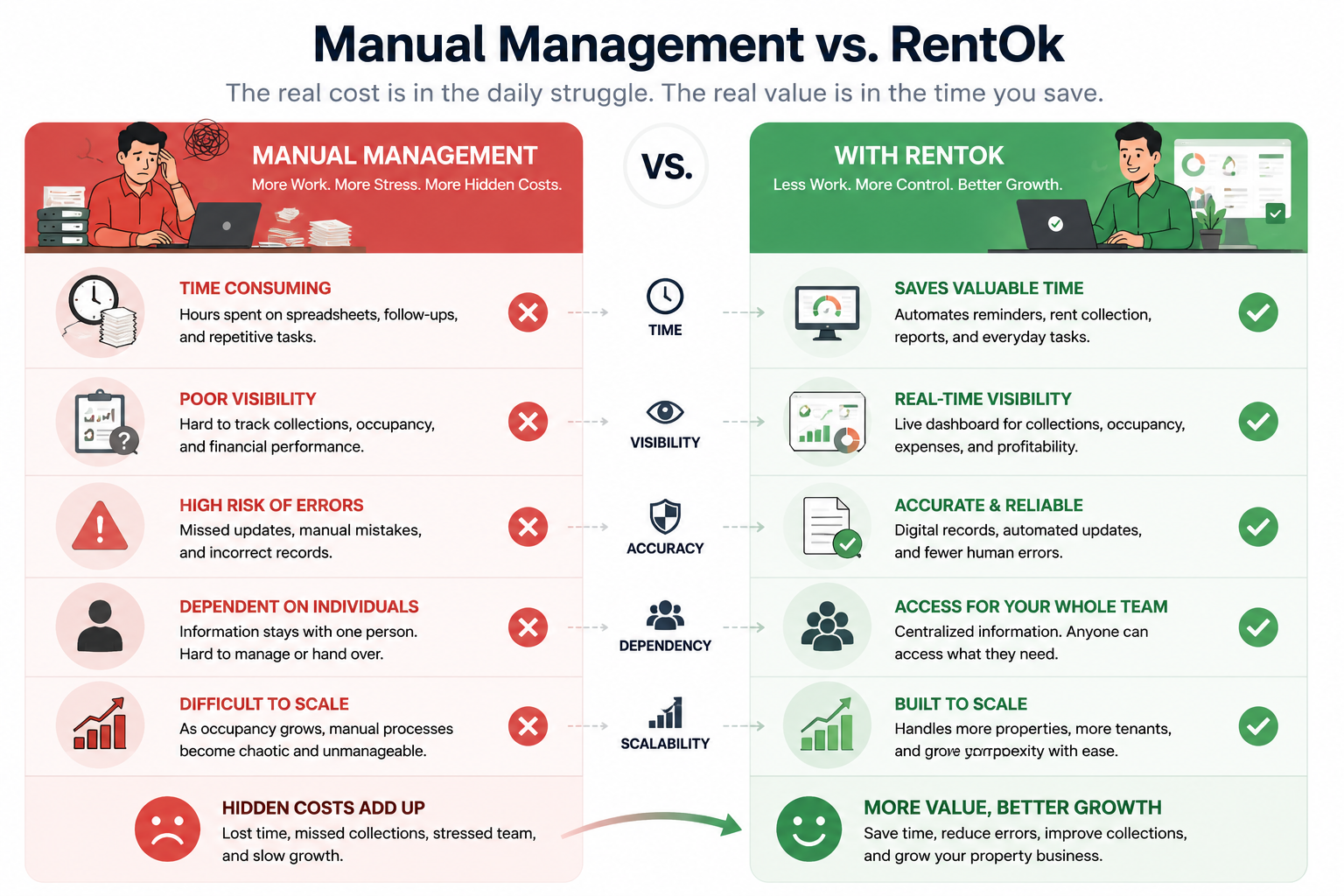
Many property owners view software as an additional monthly expense. In reality, manual property management also comes with significant costs. The difference is that these costs usually appear as lost time, operational delays, and inefficient workflows rather than a subscription invoice.
Think about the amount of time your team spends following up on rent payments, updating spreadsheets, answering repetitive tenant questions, preparing reports, or searching for information across multiple systems. None of these activities directly generate revenue. Yet they consume valuable hours every single month.
Manual systems also increase the chances of operational mistakes. A missed payment update, an overlooked expense, or an incorrect tenant record may seem like a small issue. Over time, however, these mistakes can affect collections, reporting, and decision-making.
Some of the hidden costs of manual property management include:
- Hours spent on repetitive administrative work, preventing property managers from focusing on occupancy growth, tenant satisfaction, or business development instead of routine coordination.
- Limited visibility into business performance, making it difficult to monitor collections, outstanding dues, occupancy trends, and profitability without preparing manual reports.
- Heavy dependence on individual staff members, where important information remains stored in personal spreadsheets, notebooks, or chat conversations instead of one centralized platform.
- Operational challenges as occupancy increases, because manual processes that work for smaller properties often become inefficient once tenant numbers and staff responsibilities begin growing.
When these hidden costs are added together, software becomes much easier to evaluate. Instead of creating another business expense, it helps reduce the operational costs that already exist within manual management.
Common Questions About RentOk Pricing
Investing in property management software is an important decision, so it’s natural to have questions before choosing a plan. Here are some of the most common questions property owners ask when exploring RentOk pricing.
Is RentOk suitable for both small and large properties?
Yes. RentOk is designed to support businesses at different stages of growth. Whether you’re managing a single PG or multiple co-living properties, you can choose a plan that aligns with your operational requirements and business size.
Can I upgrade my plan as my business grows?
Absolutely. As occupancy increases or your operational needs change, you can move to a plan that offers additional functionality. This flexibility allows businesses to start with the features they currently need while ensuring they have room to grow in the future.
Does pricing change based on the size of my property?
RentOk offers different plans to suit different operational requirements. This approach allows smaller properties to avoid paying for functionality they don’t need while ensuring larger businesses have access to more advanced capabilities.
Why shouldn’t I choose software based only on price?
The cheapest option isn’t always the most valuable one. If your team still depends on spreadsheets, manual follow-ups, or disconnected systems after purchasing software, the apparent savings may disappear quickly. The right platform should reduce workload, improve visibility, and simplify everyday operations.
How RentOk Helps You Get More Value From Your Investment
Property management software delivers the greatest value when it improves the way your business operates every day. RentOk is designed with that objective in mind. Instead of offering standalone features, it brings tenant management, occupancy tracking, rent collection, financial reporting, communication, and operational workflows together in one connected platform.
This centralized approach reduces the need to switch between multiple systems throughout the day. Property managers can access important information faster, monitor business performance more easily, and spend less time on repetitive administrative work. As occupancy grows, these structured workflows become even more valuable because they help maintain consistency across every property and every team member.
Whether you’re managing a growing PG, a co-living space, or multiple rental properties, RentOk helps simplify operations without adding unnecessary complexity. It creates a more organized way to manage tenants, payments, finances, and day-to-day activities while giving you greater visibility into how your business is performing.
Conclusion
Choosing property management software shouldn’t be based on subscription cost alone. The right platform should help you save time, improve operational visibility, reduce manual work, and support your business as it grows. Those long-term benefits often deliver far more value than the monthly subscription itself.
When evaluating RentOk pricing, look beyond the numbers on the pricing page. Consider how much time you could save, how many manual processes you could eliminate, and how much easier your property could become to manage with the right operational system in place.
Explore RentOk’s pricing plans, compare the available features, and choose the solution that best fits your property’s operational needs and future growth.
About the Author
Ishika Pannu
Ishika Pannu brings you the latest insights and easy-to-apply strategies in property management—helping you simplify renting and grow with RentOk.