Market Trends
Tax Planning for Landlords: Understanding GST and Commercial Tax in PGs

Written by
Ishika Pannu
Read Time
7 min read
Posted on
April 27, 2026
Overview
Overview
Tax Planning for Landlords: Understanding GST and Commercial Tax in PGs
Tax planning in PG operations is often treated as a once-a-year activity.
Accounts are reviewed at the end of the financial year, numbers are adjusted, and filings are completed, usually under time pressure. On paper, this looks like compliance. In reality, it’s reactive management.
Because taxation in PGs does not begin at filing. It begins much earlier, at how income is structured, how services are positioned, and how consistently financial data is recorded throughout the year.
When these elements are not aligned, two things happen simultaneously: compliance becomes uncertain, and tax liability increases unnecessarily.
Why Tax Planning in PGs Feels Complicated (But Isn’t)
The confusion around taxation in PG businesses doesn’t come from complex laws. It comes from unclear positioning.
A PG is not always treated purely as a rental property. At the same time, it is not always recognized as a full-scale business. It sits somewhere in between, and that grey area is where most operators lose clarity.
Depending on how your PG is structured, your income may fall under:
- Income from house property, where taxation is relatively standardized but deductions are limited
- Business or professional income, where flexibility increases but compliance requirements also expand
The challenge is not choosing one over the other arbitrarily. The classification is determined by how your PG actually operates. If this is not clearly understood, tax planning becomes guesswork.

Tax Slabs for Rental Income: What You’re Actually Paying
When PG income is classified under Income from House Property, taxation follows a predictable structure. The calculation is based on net rental income after standard deductions.
The process typically includes:
- Starting with the gross annual rent collected from tenants
- Applying a standard deduction of 30% to account for maintenance and basic expenses
- Deducting interest on housing loans, if applicable within prescribed limits
What remains is taxed according to your individual income tax slab.
This model works efficiently when:
- The PG is operated as a passive rental asset
- Services are minimal or bundled without separate pricing
- Operational involvement remains limited
However, this structure begins to break the moment your PG evolves beyond basic accommodation.
When PG Income Shifts Into Business Income
The transition from rental income to business income is not always intentional. It often happens gradually as services are added.
Once your PG includes structured offerings such as:
- Meal services with separate pricing
- Housekeeping or facility management
- Subscription-based add-ons
- Vendor-managed services within the property
Your operations begin to resemble a business rather than a passive rental setup.
This shift brings advantages:
- You can claim a wider range of deductions, including operational and administrative expenses
- Cost allocation becomes more flexible
- Financial planning becomes more strategic
But it also requires discipline:
- Proper bookkeeping becomes mandatory
- Expense tracking needs to be consistent and documented
- Compliance requirements increase
Many operators unknowingly operate as businesses while filing as rental income, which creates long-term exposure.
GST on PG Services: Where Most Misunderstandings Begin
GST is one of the most commonly misunderstood aspects of PG taxation.
The assumption is often binary, either GST applies or it doesn’t. In reality, applicability depends on how your services are structured and how your revenue is generated.
In general, GST may not apply when:
- You are providing basic residential accommodation
- There are no structured service components billed separately
- Your turnover remains below the prescribed threshold
However, GST becomes relevant when:
- Services are bundled or offered as part of a package (e.g., food + accommodation + maintenance)
- Your turnover crosses the applicable limit
- Your PG operates more like a managed or co-living setup
This distinction is important because GST impacts pricing directly. If it is applicable and not accounted for, it reduces your margins rather than increasing your compliance.
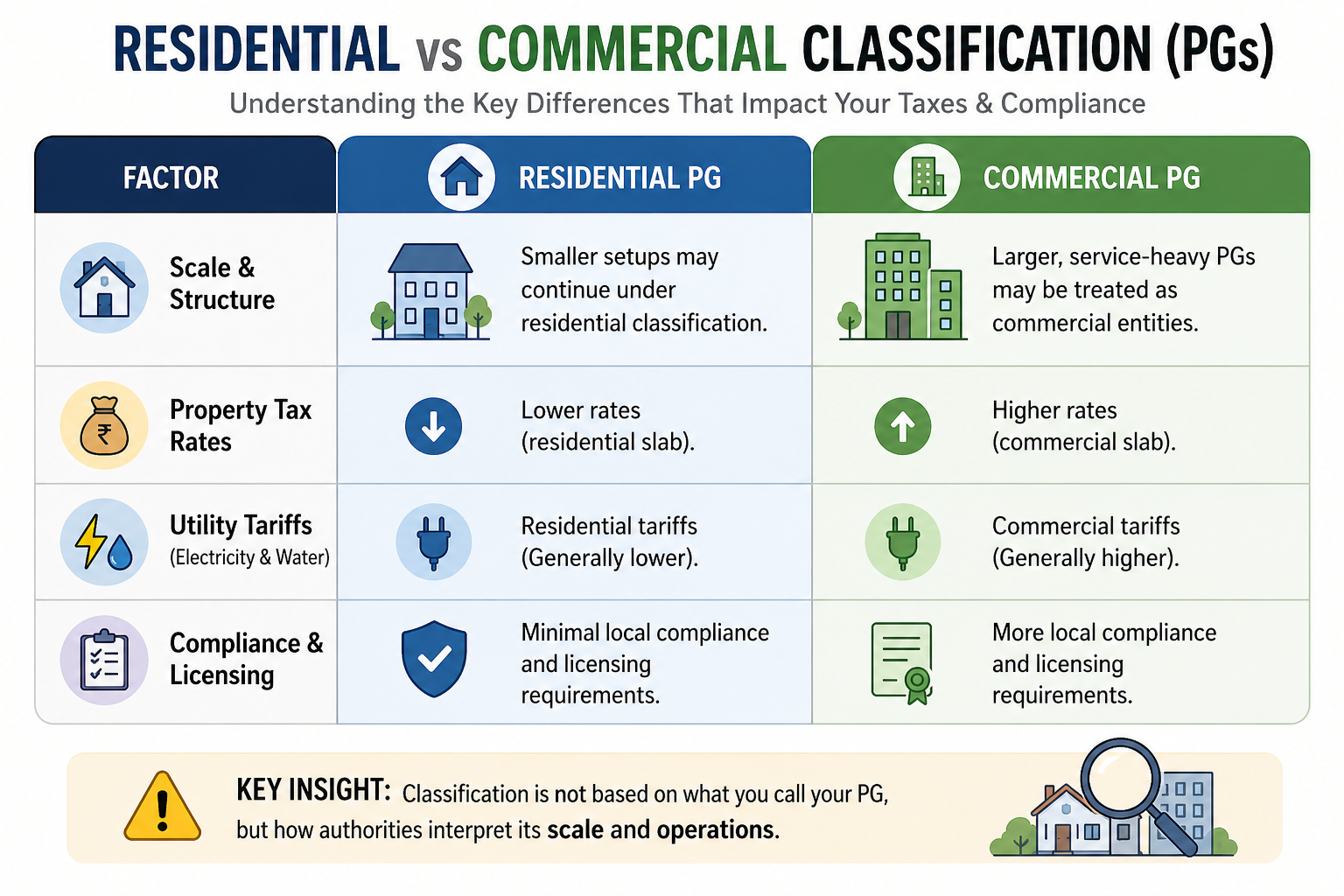
Residential vs Commercial Classification: The Overlooked Factor
Another layer that affects taxation is how your property is classified at a regulatory level.
A PG may be treated differently depending on its scale and operational structure. In some cases:
- Smaller setups may continue under residential classification
- Larger, service-heavy PGs may be treated as commercial entities
This classification influences:
- Property tax rates, which can vary significantly
- Utility tariffs, especially electricity and water
- Local compliance requirements and licensing
Operators often assume classification based on usage, but authorities assess it based on scale and structure. Verifying this early prevents unexpected liabilities later.
Deduction of Expenses: Where Tax Efficiency Is Built
The most significant opportunity in tax planning lies not in reducing income, but in accurately accounting for expenses.
Under business income classification, you can typically deduct:
- Routine maintenance and repair costs that keep the property functional
- Staff salaries or payments made to vendors for operational support
- Utility expenses that are borne directly by the operator
- Administrative costs such as software, management, and documentation
- Interest payments on loans used for the property
The difference between a structured and unstructured system becomes evident here.
Without proper documentation, even valid expenses cannot be claimed effectively. With proper tracking, these deductions reduce taxable income significantly.
The Real Issue: Lack of Structured Financial Records
Most PG operators do incur expenses. The problem is not the absence of costs, it is the absence of records.
Common patterns include:
- Expenses recorded informally or not recorded at all
- Payments made in cash without traceable documentation
- No separation between personal and property-related finances
- Inconsistent tracking of tenant payments and dues
This creates multiple challenges:
- Deductible expenses are missed during filing
- Financial statements lack clarity
- Audit situations become difficult to handle
Tax planning is not about discovering deductions at the end of the year. It is about maintaining records that make those deductions valid and defensible.
Maintaining Digital Records: The Shift From Effort to System
As PG operations grow, manual tracking becomes unreliable.
Spreadsheets, notebooks, and scattered entries may work temporarily, but they do not scale. Errors increase, records become inconsistent, and retrieving information becomes time-consuming.
A digital system changes this completely.
It allows you to:
- Track rent collection and additional income streams in a structured manner
- Record expenses consistently with clear categorization
- Maintain tenant-wise financial data that can be accessed instantly
- Generate reports that reflect actual financial performance
This does not just simplify taxation. It improves overall operational clarity.
Tax Checklist for PG Operators (Practical Reference)
Before focusing on optimization, it helps to establish a clear baseline. A simple internal checklist can highlight whether your current setup is aligned or needs restructuring.
- Income classification clearly defined between rental and business categories, based on actual operations
- GST applicability assessed based on services offered and turnover levels
- All operational expenses recorded with supporting documentation
- Tenant agreements and payment records maintained in an organized manner
- Property classification verified with local authorities to avoid incorrect assumptions
If even a few of these areas are unclear, the issue is not taxation, it is the underlying system.
Building a Tax-Efficient PG Operation
Tax efficiency is not achieved through last-minute adjustments. It is built through consistent alignment between operations and financial tracking.
A well-structured PG setup typically ensures:
- Income streams are clearly categorized and recorded without ambiguity
- Expenses are tracked in real time rather than reconstructed later
- Financial data is accessible and verifiable at any point
- Compliance becomes a byproduct of organized operations, not a separate effort
This reduces both risk and effort.
Instead of reacting to tax obligations, you operate in a way where compliance becomes a natural outcome.

How Rentok Helps You Stay Financially Structured and Tax-Ready
As PG operations expand, maintaining this level of structure manually becomes difficult. This is where systems like Rentok become relevant.
Rentok does not replace tax planning, it strengthens the foundation required for it.
With Rentok, you can maintain consistent visibility across your operations:
- Tenant records, agreements, and payment histories remain organized within a single system
- Rent collection and additional charges are tracked clearly, reducing gaps in income reporting
- Financial data remains structured, making it easier to identify deductible expenses
- Communication and records stay aligned, which becomes critical during audits or reviews
Instead of piecing together information at the end of the year, you operate with clarity throughout. This reduces dependency on memory, minimizes errors, and ensures that your financial data is always ready for compliance.
Final Thoughts
Tax planning in PG operations is not inherently complex. It becomes complex when structure is missing.
When income is clearly classified, expenses are consistently tracked, and records are maintained properly, taxation becomes predictable. More importantly, it becomes manageable.
The real advantage is not just compliance. It is control.
When you understand how your numbers are structured, you make better decisions, not just during tax season, but throughout your operations.
Explore Rentok to bring structure into your tenant management, payment tracking, and financial records, so your PG remains not just compliant, but consistently optimized.
About the Author
Ishika Pannu
Ishika Pannu brings you the latest insights and easy-to-apply strategies in property management—helping you simplify renting and grow with RentOk.