Market Trends
Tenant Handbook for PGs: Rules Without Restrictions

Written by
Ishika Pannu
Read Time
9 min read
Posted on
May 30, 2026
Overview
Overview
Tenant Handbook for PGs: Rules Without Restrictions
Most PG operators think operational problems start when tenants become difficult to manage.
In reality, the majority of issues inside shared living spaces begin much earlier, at the communication stage itself. A resident assumes overnight guests are acceptable because nobody properly explained the visitor policy during onboarding. Another delays rent believing there is flexibility around payment timelines because the rules were communicated casually. Someone starts taking loud work calls at midnight assuming the property has no quiet-hour restrictions.
Individually, these situations feel minor. But inside a shared accommodation environment where dozens of people live together under one operational system, these small misunderstandings slowly turn into recurring complaints, tenant frustration, and management chaos. Over time, the property starts feeling reactive instead of professionally managed.
This is exactly why professionally operated PGs and co-living spaces rely heavily on tenant handbooks today. Not because they want to create rigid hostel environments, but because clear communication creates smoother operations. A well-structured handbook helps tenants understand how the property functions while simultaneously helping the management maintain consistency across:
- rent collection and payment timelines that often become confusing when policies are explained differently to different residents,
- visitor access and guest coordination systems that directly affect security, resident comfort, and operational visibility,
- shared-space etiquette around kitchens, lounges, corridors, and laundry areas where most day-to-day tenant friction usually begins,
- and complaint escalation processes so residents know exactly how maintenance, emergencies, or operational issues are handled.
The strongest tenant handbooks do not feel like legal notices. They feel like operational guides designed to make shared living more predictable and comfortable for everyone involved.
Why Verbal Communication Stops Working as Occupancy Grows
In smaller properties, verbal onboarding feels manageable because the landlord usually interacts directly with every resident. Policies are explained casually during move-in, and operations still feel personal. But once the business starts scaling across multiple floors, larger buildings, or multiple properties, verbal systems become extremely inconsistent.
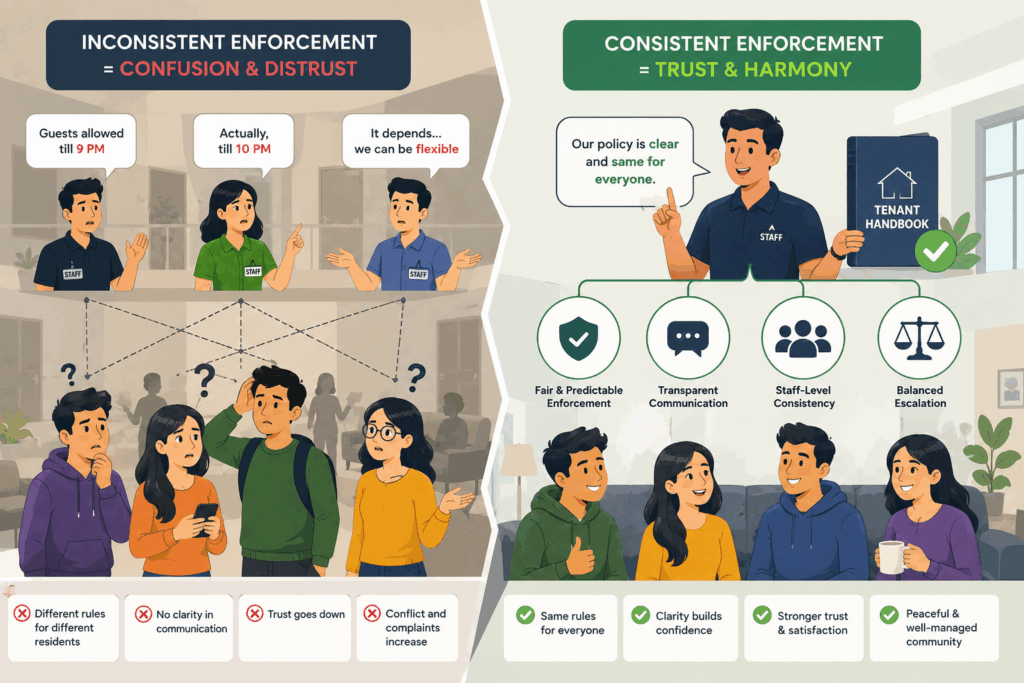
Different tenants begin hearing different versions of the same policy. One resident may be told guests are allowed until 9 PM, while another hears 10 PM. One tenant receives flexibility on payment dates, while another gets late fees immediately. Over time, this inconsistency damages operational trust because rules begin feeling unpredictable instead of structured.
A tenant handbook eliminates this confusion by standardizing communication across the property. Instead of relying on memory, verbal explanations, or staff interpretation, the management creates one centralized operational document that clearly explains:
- what the property expects from residents on a daily basis,
- how operational systems function behind the scenes,
- which rules exist for safety and shared comfort,
- and how management handles recurring situations like complaints, maintenance, or move-outs.
That consistency becomes increasingly important as occupancy grows because operational clarity directly affects tenant satisfaction.

The Biggest Mistake Most PG Handbooks Make
One of the biggest problems with most tenant handbooks is tone.
The document immediately starts sounding aggressive. Pages become overloaded with warnings, penalties, restrictions, and unnecessarily harsh language. Operationally, this creates the wrong impression from the beginning because tenants immediately feel like they are entering a restrictive environment rather than a professionally managed one.
A strong handbook should feel structured, not hostile.
For example, many properties write policies like:
“Strict action will be taken against any tenant creating noise after 10 PM.”
Technically, the message is clear. But operationally, it feels confrontational.
A better version would communicate the same rule like this:
“To maintain a comfortable environment for residents balancing work, studies, and personal schedules, quiet hours are observed during late evenings and nights.”
The rule itself remains unchanged, but the tone feels:
- more professional and operationally mature instead of emotionally aggressive,
- more community-oriented because it explains the reasoning behind the policy,
- and significantly more cooperative from a tenant’s perspective.
This distinction matters because residents cooperate more naturally when systems feel reasonable rather than controlling.
A Good Handbook Creates Predictability
One thing experienced property operators understand very clearly is that tenants are usually comfortable following rules when expectations feel predictable. Most conflicts inside PGs happen not because rules are strict, but because rules appear inconsistent or unclear.
A good tenant handbook creates operational predictability around:
- how payments are handled and what timelines residents are expected to follow every month,
- how complaint resolution works so tenants understand response timelines and escalation processes,
- how visitor access and security procedures function on a daily basis,
- and how move-ins, room shifts, renewals, and move-outs are operationally managed.
This predictability reduces emotional disputes significantly because tenants no longer feel surprised by policies later. Instead of management repeatedly explaining operational procedures individually to every resident, the property creates one standardized communication framework that applies consistently across the board.
Operational consistency always feels more professional than reactive management.
Guest Policies Need Much More Clarity Than Most Operators Realize
Visitor management is one of the most sensitive operational areas inside shared accommodation. Without structured systems, confusion builds extremely quickly because guests directly affect:
- resident comfort and privacy inside shared environments,
- security visibility across the property,
- operational discipline for guards and staff,
- and the overall atmosphere inside the building.
At the same time, extremely rigid visitor restrictions often create unnecessary frustration among tenants. This is why strong guest policies focus on operational clarity instead of sounding overly controlling.
A professional handbook should clearly explain:
- visitor timings and why those timings exist operationally,
- ID verification procedures for safety and resident visibility,
- overnight guest limitations where applicable,
- and common-area access expectations so boundaries remain predictable for everyone.
For example, instead of simply writing:
“No visitors allowed after evening hours.”
A stronger operational approach would explain:
“To maintain resident safety and ensure smooth coordination with property security systems, visitor access follows structured timings and verification procedures.”
The policy remains firm, but the communication feels significantly more balanced and professional.
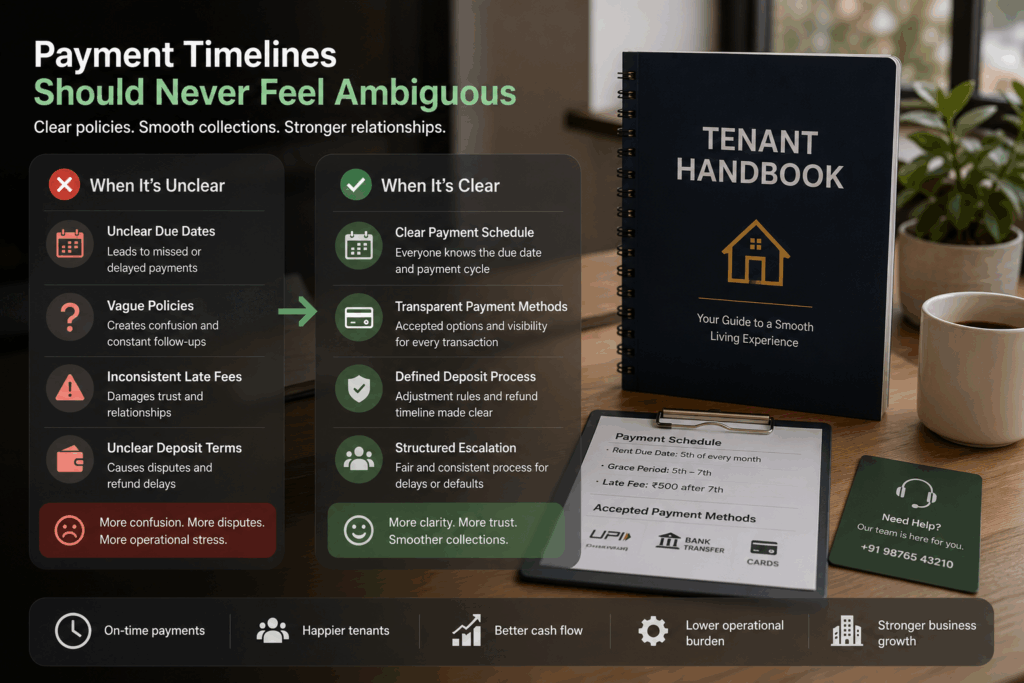
Payment Timelines Should Never Feel Ambiguous
Financial confusion is one of the fastest ways to damage tenant relationships.
Most payment-related disputes happen because:
- due dates were never clearly communicated,
- grace periods remained vague,
- late fee structures changed inconsistently,
- or security deposit expectations were unclear from the beginning.
A strong tenant handbook should remove ambiguity completely around:
- monthly rent due dates and expected payment cycles,
- accepted payment methods and transaction visibility processes,
- security deposit adjustment and refund procedures,
- and escalation systems for delayed payments or repeated defaults.
This does not just improve collection efficiency operationally. It also improves tenant trust because residents know exactly how the financial system works inside the property.
The strongest operators understand that structured payment communication reduces friction for both:
- the management team handling collections,
- and residents trying to understand operational expectations.
Shared Spaces Need Clear Behavioral Expectations
Common areas strongly influence how tenants experience the property overall. Even if rooms themselves are excellent, poor discipline inside:
- kitchens,
- lounges,
- corridors,
- dining spaces,
- and laundry areas
quickly damages the atmosphere across the property.
A strong tenant handbook should clearly define shared-space expectations around:
- cleanliness responsibilities after using common facilities so operational maintenance does not become dependent entirely on housekeeping teams,
- appliance usage etiquette in kitchens or laundry areas where shared infrastructure often creates friction,
- personal item management inside common areas to avoid clutter and operational inconvenience for other residents,
- and waste disposal systems that help maintain hygiene standards consistently across the property.
The objective is not over-policing daily behavior. The objective is maintaining operational harmony inside a high-density living environment where multiple people share infrastructure continuously.
Maintenance Expectations Need Transparency
One major reason tenants become frustrated is because maintenance expectations are rarely communicated clearly during onboarding.
Many residents expect hotel-style response timelines for every issue, while operators internally prioritize complaints based on:
- urgency,
- staffing,
- vendor schedules,
- and operational impact.
Without communication, expectations become mismatched extremely quickly.
A professional tenant handbook should explain:
- how complaints are raised and tracked operationally,
- expected timelines for different categories of maintenance requests,
- emergency escalation procedures for urgent situations,
- and how vendors or staff coordinate repairs inside occupied properties.
For example:
- electrical failures, plumbing leaks, or security-related issues may receive immediate operational priority,
- while cosmetic improvements or non-urgent requests may follow scheduled maintenance timelines depending on operational workload.
Once tenants understand how the system works, frustration reduces significantly because expectations become realistic instead of assumed.
Digital Handbooks Work Better Than Printed Rulebooks
Printed handbooks usually disappear after move-in day. Tenants lose them, ignore them, or simply never revisit them again.
Digital handbooks work significantly better because they remain:
- searchable whenever residents need clarification on policies or procedures,
- easier to update whenever operational systems evolve,
- accessible during emergencies or maintenance situations,
- and far more practical for multi-property operations trying to maintain communication consistency.
Modern operators now:
- send onboarding PDFs digitally during move-ins,
- integrate operational guidelines into apps or resident portals,
- maintain centralized policy links for easy access,
- and update handbook sections whenever processes evolve operationally.
This helps properties maintain much stronger communication consistency long-term.
Why Consistent Enforcement Matters More Than Strict Rules
Even the best-written handbook becomes ineffective if policies are enforced inconsistently.
For example:
- one resident receives exceptions while another gets penalized for the same issue,
- staff communicate different interpretations of the same rule,
- or operational discipline changes depending on occupancy pressure.
This damages trust very quickly because residents begin feeling the system is arbitrary instead of structured.
The strongest properties focus heavily on:
- predictable enforcement that feels operationally fair across all residents,
- transparent communication whenever policies are applied or escalated,
- staff-level consistency so onboarding and daily coordination remain uniform,
- and balanced escalation systems that maintain professionalism without unnecessary aggression.
Operational consistency builds trust much faster than strictness ever can.
How RentOk Helps Operators Streamline Tenant Communication
As occupancy scales, managing onboarding communication, complaint coordination, payment tracking, and tenant operations manually becomes increasingly difficult. Information starts getting scattered across WhatsApp chats, spreadsheets, calls, verbal instructions, and disconnected systems, which eventually creates inconsistency in how residents experience the property.
RentOk helps operators centralize:
- tenant onboarding and communication workflows so operational expectations remain consistent across every resident interaction,
- occupancy and payment visibility systems that reduce confusion around due dates, collections, and resident coordination,
- complaint management tracking that helps teams handle maintenance requests more systematically and transparently,
- and day-to-day property operations that become significantly easier to manage when information is organized inside one centralized platform.
For PGs, hostels, and co-living businesses trying to build more professional resident experiences, centralized operational systems become extremely important because communication clarity directly affects:
- tenant satisfaction,
- operational efficiency,
- retention,
- and long-term occupancy stability.
Final Thoughts
A tenant handbook is not just a document filled with rules.
It is an operational foundation that helps create:
- smoother communication between management and residents,
- clearer expectations around how the property functions daily,
- stronger operational consistency across larger occupancies,
- and significantly more predictable shared living environments.
The strongest PGs and co-living businesses use tenant handbooks not to create stricter living environments, but to reduce:
- misunderstandings,
- repetitive conflicts,
- communication inconsistency,
- and operational chaos before problems escalate.
Because ultimately, shared accommodation works best when:
- systems feel predictable,
- communication remains organized,
- and residents clearly understand how the environment is designed to function.
If you want to improve tenant communication, streamline operational workflows, and manage your rental business more professionally, explore how RentOk helps operators simplify modern property management through one centralized platform.
About the Author
Ishika Pannu
Ishika Pannu brings you the latest insights and easy-to-apply strategies in property management—helping you simplify renting and grow with RentOk.