Market Trends
Why AI-Powered Property Management Software Is the Future

Written by
Ishika Pannu
Read Time
15 min read
Posted on
June 10, 2026
Overview
Overview
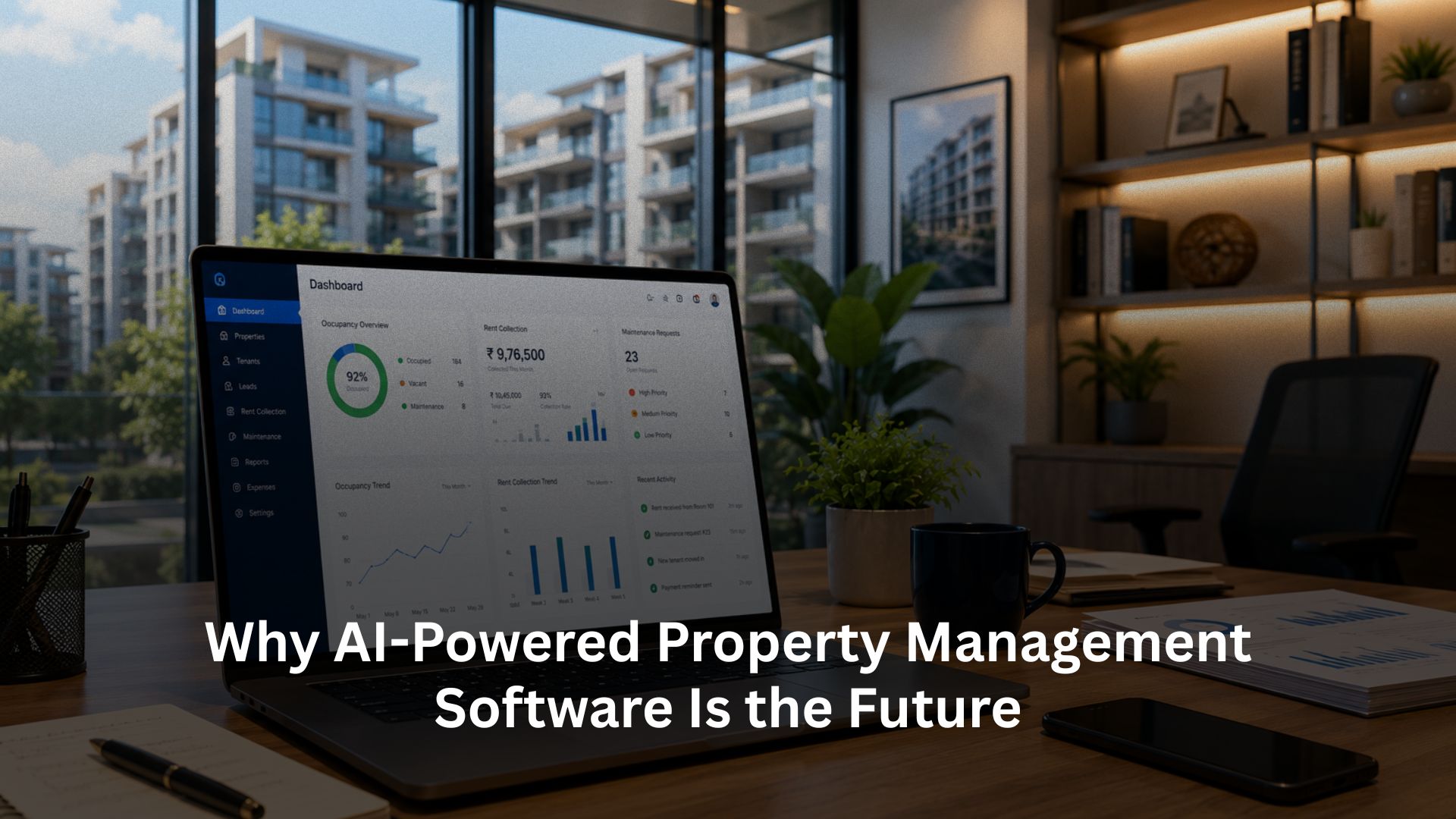
Why AI-Powered Property Management Software Is the Future
Property management today looks very different from what it did a few years ago.
What was once considered a largely administrative role has evolved into a business function that directly affects revenue, occupancy, tenant satisfaction, and profitability. Property managers are expected to oversee rent collections, maintenance, occupancy planning, tenant communication, vendor coordination, and financial reporting—often across multiple properties and with limited resources.
The challenge isn’t simply handling more work. It’s maintaining control as operations become more complex. As portfolios grow, information gets spread across spreadsheets, WhatsApp chats, calls, emails, and disconnected software tools. Teams spend more time chasing updates and less time making decisions.
This is why AI powered property management apps are gaining attention across the rental industry. The value isn’t just automation. The real advantage comes from helping managers identify problems earlier, reduce operational friction, and make better decisions using real-time data.
The Growing Complexity of Modern Property Management
Many property managers don’t realize how quickly complexity increases as occupancy grows.
A process that works for a single property often starts breaking down when applied across multiple buildings, larger teams, and hundreds of tenants. What was once easy to track manually suddenly requires constant follow-ups, coordination, and oversight.
The result is something many operators experience firsthand: everyone feels busy, but not everything moves efficiently.
Some of the most common operational challenges include:
- Rent collection processes that require constant reminders, payment tracking, and reconciliation across multiple tenants.
- Occupancy management that depends on accurate visibility into vacancies, renewals, move-outs, and future availability.
- Maintenance coordination that involves tenants, staff, vendors, and multiple communication channels.
- Tenant communication spread across calls, WhatsApp messages, emails, and in-person interactions.
- Reporting processes that require teams to manually compile information from different systems.
One of the biggest mistakes growing operators make is assuming that hiring more people will solve these challenges. Additional staff can help manage workload, but they don’t eliminate inefficient processes. In many cases, they simply add another layer of coordination.
Over time, the businesses that scale successfully are usually the ones that improve systems before expanding teams. They focus on creating visibility, consistency, and operational efficiency rather than relying solely on manual effort.
That’s exactly why technology is becoming a critical part of modern property management.
What Makes an App Truly AI-Powered?
The phrase “AI-powered” appears on almost every software website today. However, not every platform uses artificial intelligence in a way that creates meaningful value.
The simplest way to understand the difference is to separate automation from intelligence.
Automation helps teams complete repetitive tasks faster. Intelligence helps teams understand what deserves attention and why.
For example:
- Automatically sending rent reminders is automation. Identifying tenants who repeatedly pay only after reminders is intelligence.
- Recording maintenance requests is automation. Detecting recurring maintenance issues across multiple properties is intelligence.
- Generating occupancy reports is automation. Highlighting early signs of occupancy decline is intelligence.
- Organizing operational data is automation. Identifying trends and risks within that data is intelligence.
As operations grow, this distinction becomes increasingly important. Property managers simply don’t have time to manually analyze every report, payment record, or maintenance request.
A genuinely AI powered property management app can help managers:
- Identify occupancy trends before vacancies begin affecting revenue.
- Spot collection patterns that may create future cash-flow challenges.
- Detect recurring maintenance issues that indicate larger property concerns.
- Highlight workflows that consume excessive staff time.
- Compare performance across properties without relying on spreadsheets.
The goal isn’t to replace property managers. The goal is to help them focus on decisions rather than administration.
The more properties a manager oversees, the more valuable that advantage becomes.
Key Features That Deliver Real Operational Value
Many property management platforms compete by offering long feature lists. However, experienced operators know that software should be judged by outcomes, not features.
The best AI property management software helps solve operational problems that directly affect occupancy, collections, tenant experience, and profitability. Rather than adding complexity, it simplifies daily operations and improves visibility across the business.
Intelligent Rent Collection Management
For most rental businesses, collections remain one of the most important operational priorities. Even small improvements in collection efficiency can have a meaningful impact on cash flow.
Traditional systems are good at recording payments. AI-powered platforms go further by helping managers understand payment behavior and identify patterns that require attention.
For example, AI can help identify:
- Tenants who consistently delay payments until multiple reminders are sent.
- Properties where collection performance is gradually weakening.
- Seasonal payment patterns that affect forecasting and planning.
- Collection workflows that create unnecessary administrative work.
- Accounts that may require proactive intervention before becoming larger issues.
Instead of manually reviewing payment records every week, managers can focus on the specific accounts and properties that require attention. This allows teams to spend less time monitoring data and more time improving collection performance.
Smarter Maintenance Operations
Maintenance is often treated as a support function, but it has a direct impact on tenant satisfaction, retention, occupancy, and property reputation.
As portfolios expand, maintenance operations become increasingly difficult to manage without structured systems. Delayed responses, communication gaps, and poor vendor coordination can quickly create frustration for both tenants and staff.
AI-powered platforms help create visibility by organizing requests, tracking response times, and identifying recurring issues.
Rather than reacting to every complaint individually, managers can start identifying larger patterns such as:
- Buildings generating significantly more maintenance requests than others.
- Recurring plumbing, electrical, or infrastructure-related issues.
- Vendors whose response times consistently affect resolution quality.
- Maintenance categories that consume a disproportionate amount of resources.
- Problems that may require long-term corrective action instead of repeated fixes.
This shift from reactive maintenance to proactive maintenance often leads to better tenant experiences and more efficient operations over time.
Centralized Operational Visibility
One of the biggest challenges facing growing property businesses is fragmented information.
Many operators still manage occupancy in one system, payments in another, maintenance requests elsewhere, and tenant communication through separate messaging channels. While each system may work independently, decision-making becomes difficult when information is scattered.
Managers often spend valuable time searching for answers instead of acting on them.
A centralized platform helps bring together:
- Occupancy and availability data.
- Rent collection records and payment history.
- Maintenance requests and resolution tracking.
- Tenant communication and support activity.
- Financial reporting and operational performance metrics.
When all operational data exists within a single ecosystem, managers gain a much clearer understanding of how the business is performing.
Instead of constantly asking, “What happened?”, they can begin focusing on a more important question:
“What should we do next?”
That shift is where technology starts creating real operational value.
How AI Helps Property Managers Make Better Decisions Faster
One of the biggest misconceptions about AI in property management is that its primary role is automation.
While automation certainly reduces manual work, the real advantage lies in decision-making. Most operational problems don’t appear suddenly. They develop gradually through patterns that are easy to miss when managers are focused on day-to-day responsibilities.
Declining collections, rising maintenance costs, increasing vacancies, or weakening tenant satisfaction usually show warning signs long before they become major business concerns. The challenge is that these signals are often buried inside reports, spreadsheets, payment records, and communication logs.
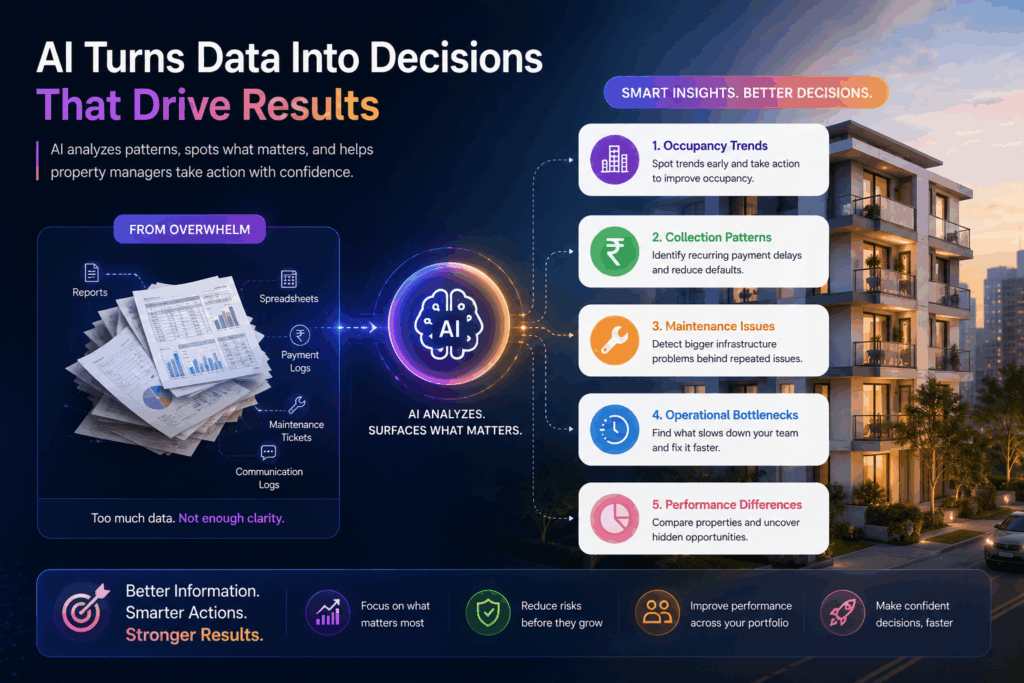
This is where AI creates meaningful value. Instead of requiring managers to manually analyze large volumes of information, AI-powered systems can surface important insights automatically and direct attention toward areas that need action.
For example, AI can help identify:
- Occupancy trends that suggest certain properties may require stronger marketing efforts.
- Collection patterns that reveal recurring payment delays among specific tenant groups.
- Maintenance issues that point to larger infrastructure problems rather than isolated complaints.
- Operational bottlenecks that repeatedly slow down staff productivity.
- Performance differences across properties that might otherwise go unnoticed.
The goal isn’t to replace experience or judgment. Property managers still make the final decisions. AI simply helps ensure those decisions are based on better information and fewer assumptions.
As portfolios grow, this becomes increasingly important. A manager overseeing multiple properties cannot manually monitor every operational detail every day. AI helps prioritize attention by highlighting what matters most.
The Shift from Reporting to Predicting
Traditional reporting helps managers understand what happened.
While historical data is important, it often arrives after a problem has already started affecting the business. A report might show declining occupancy, slower collections, or rising maintenance costs, but by that point managers are already reacting rather than preventing.
AI introduces a different approach.
Instead of focusing only on past performance, AI-powered systems analyze operational patterns to identify what may happen next. This allows managers to move from reactive management to proactive decision-making.
Consider occupancy management as an example.
A traditional report may reveal that occupancy has declined over the last two months. Useful information, but it only confirms the problem after revenue has already been impacted.
An AI-powered property management app can identify earlier indicators such as:
- Increasing notice periods from existing tenants.
- Lower inquiry-to-booking conversion rates.
- Reduced renewal activity across specific properties.
- Demand shifts within particular room categories.
- Seasonal trends that historically affect occupancy levels.
The same principle applies across collections, maintenance planning, tenant retention, and staffing decisions.
Most operational challenges don’t emerge overnight. The warning signs are usually present much earlier. The difference is whether managers have the visibility to identify them before they become expensive problems.
The earlier a trend is recognized, the easier it becomes to respond.
Measuring the ROI of an AI Property Management App
Whenever property managers evaluate new technology, one question inevitably comes up:
“Will this actually generate a return?”
It’s a fair question. Software should not be viewed as an expense simply because it adds new features. It should create measurable improvements in operational performance.
The ROI of an AI powered property management app rarely comes from a single metric. Instead, it usually appears across multiple areas of the business at the same time.
Reduced Administrative Workload
Many property teams spend a surprising amount of time on repetitive coordination tasks.
These activities are necessary, but they don’t directly contribute to growth or tenant experience.
Common examples include:
- Sending payment reminders and follow-ups every month.
- Updating spreadsheets and preparing reports manually.
- Coordinating maintenance requests across multiple channels.
- Responding to repetitive tenant questions.
- Tracking occupancy updates and availability changes.
When these workflows become more streamlined, teams can focus on higher-value activities instead of routine administrative work.
The result is often improved productivity without increasing headcount.
Faster Collections and Better Cash Flow
Cash flow remains one of the most important indicators of operational health in any rental business.
Even small improvements in collection efficiency can create a meaningful financial impact over time.
AI-powered systems help strengthen collection processes by:
- Automating reminders at the right stages of the payment cycle.
- Improving visibility into overdue accounts.
- Highlighting recurring payment behaviors.
- Reducing missed follow-ups and collection delays.
- Helping teams prioritize higher-risk accounts.
This creates a more consistent and structured collection process while reducing reliance on manual intervention.
Improved Occupancy Performance
Vacancies are expensive because lost occupancy cannot be recovered later.
While no technology can eliminate vacancies completely, AI can help managers identify occupancy risks earlier and make more informed decisions around renewals, pricing, marketing, and inventory management.
Some of the areas where AI can support occupancy performance include:
- Identifying properties that may require stronger lead generation efforts.
- Highlighting room categories with weaker demand.
- Monitoring renewal trends and retention performance.
- Revealing seasonal occupancy patterns that require planning.
- Providing greater visibility into future availability.
Over time, even modest improvements in occupancy rates can generate significant financial returns.
Better Operational Visibility
One of the most overlooked benefits of AI is clarity.
Many property managers spend considerable time simply trying to understand what is happening across their portfolio. Information exists, but it is often scattered across different systems and communication channels.
A centralized, AI-powered platform makes it easier to access information, identify trends, and understand performance without relying on manual analysis.
This visibility improves decision-making across every department, from collections and occupancy to maintenance and tenant communication.
In many cases, the ability to make faster and more informed decisions delivers value far beyond what traditional ROI calculations capture.
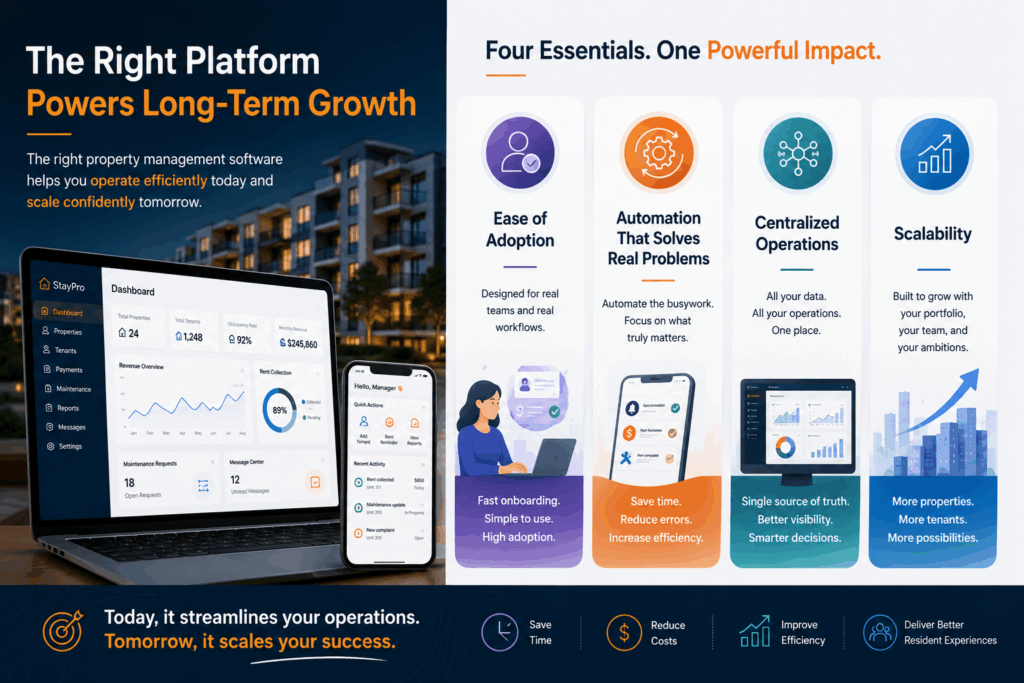
Choosing the Right Platform for Long-Term Growth
Not all property management software is built with growth in mind.
Many platforms solve an immediate operational problem but begin creating limitations as portfolios expand. Others offer extensive feature sets but become difficult for teams to adopt consistently. The result is a system that looks impressive during implementation but delivers limited value in day-to-day operations.
The best property management software isn’t necessarily the one with the longest feature list. It’s the one that helps teams operate efficiently today while supporting the business as it grows.
When evaluating an AI powered property management app, there are a few factors that matter more than most.
Ease of Adoption
Technology only creates value when teams actually use it.
One of the most common reasons software implementations fail is because the platform adds complexity instead of reducing it. If staff members struggle to navigate workflows or require constant training, adoption rates suffer and operational efficiency declines.
Strong platforms typically make it easy to:
- Onboard new staff without extensive training.
- Standardize processes across multiple properties.
- Reduce dependency on individual team members.
- Maintain operational consistency as teams grow.
- Complete routine tasks with minimal friction.
A simple system that gets used consistently will almost always outperform a complex system that teams avoid.
Centralized Operations
As rental businesses grow, visibility becomes increasingly important.
Many operators still rely on separate tools for collections, occupancy tracking, maintenance management, tenant communication, and reporting. While each tool may solve a specific problem, fragmented systems often create new operational challenges.
A centralized platform helps eliminate information silos by bringing together:
- Occupancy management and room availability.
- Rent collection tracking and payment history.
- Maintenance workflows and complaint management.
- Tenant communication records.
- Financial reporting and operational insights.
When information is centralized, managers spend less time searching for updates and more time making decisions.
Automation That Solves Real Problems
Automation should simplify operations, not create additional layers of complexity.
The most valuable automations are usually the ones that remove repetitive administrative work while maintaining visibility and control.
Examples include:
- Rent reminders that reduce manual follow-ups.
- Automated payment tracking and reconciliation.
- Complaint routing and maintenance assignment workflows.
- Occupancy updates that reduce manual record-keeping.
- Reporting processes that eliminate spreadsheet dependency.
The objective isn’t to automate everything. The objective is to automate the right things so teams can focus on higher-value work.
Scalability
A system that works for one property should also work for ten.
This sounds obvious, but many operators discover scalability limitations only after their business begins growing. Processes that seem manageable at a smaller scale often become difficult to maintain as occupancy, staff count, and operational complexity increase.
Scalable platforms help support:
- Larger property portfolios.
- Growing operations teams.
- Higher tenant volumes.
- More complex workflows.
- Long-term business expansion.
The right software should grow with the business instead of forcing managers to replace systems every few years.
Ultimately, choosing a property management platform is not just a technology decision. It’s an operational decision. The software a business adopts today will influence how efficiently it can grow tomorrow.
How RentOk Helps Property Managers Leverage AI
The effectiveness of AI depends heavily on the quality of operational data available to the system.
If information is scattered across spreadsheets, WhatsApp conversations, notebooks, and disconnected tools, generating meaningful insights becomes difficult. Before AI can help managers make better decisions, operations first need to be organized and visible.
This is where RentOk helps.
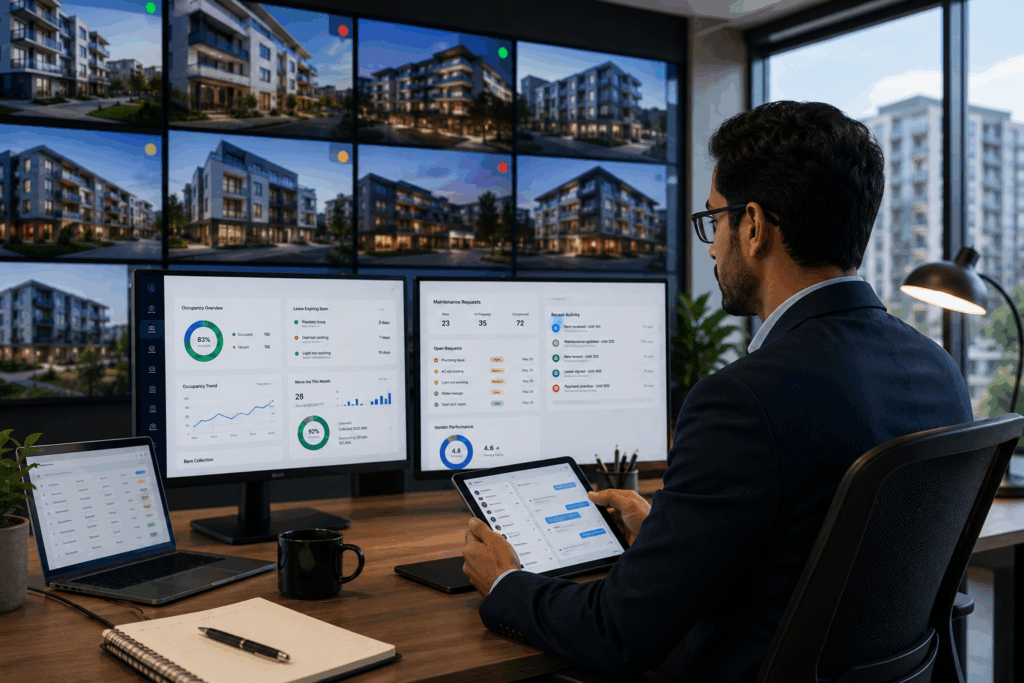
RentOk brings together the core workflows property managers rely on every day, helping operators manage collections, occupancy, maintenance, tenant communication, and reporting from a single platform.
Instead of switching between multiple tools, teams can work within a centralized system that improves visibility and operational consistency.
RentOk helps simplify areas such as:
- Rent collection tracking and payment visibility across properties.
- Occupancy management, including move-ins, move-outs, and room availability.
- Complaint and maintenance coordination that keeps teams organized.
- Tenant communication workflows that reduce manual effort.
- Operational reporting that provides clearer business visibility.
The benefit of centralization goes beyond convenience.
When operational data exists within a unified system, managers gain a clearer understanding of how their properties are performing. They can identify issues faster, monitor key metrics more effectively, and make decisions with greater confidence.
As rental businesses continue to grow, this level of visibility becomes increasingly important. Efficient operations are no longer a competitive advantage, they are quickly becoming a requirement.
The Future of Property Management Is Smarter Operations
Property management is becoming more demanding, more data-driven, and more operationally complex every year.
The businesses that succeed over the next decade won’t necessarily be the ones with the largest teams or the biggest budgets. More often, they will be the ones that build efficient systems, create operational visibility, and make better decisions faster than their competitors.
This is one of the reasons AI is becoming increasingly important within the rental industry.
The value isn’t simply automation. The value comes from helping managers spend less time on administration and more time on activities that directly improve performance.
AI-powered property management platforms help teams:
- Reduce repetitive manual work across day-to-day operations.
- Improve visibility into occupancy, collections, and maintenance.
- Identify operational risks before they become larger problems.
- Make faster decisions using real-time information.
- Create scalable processes that support long-term growth.
For property managers, the goal has never been to collect more data. The goal is to use data more effectively.
As rental portfolios continue to expand, operators will need tools that help them maintain control without increasing complexity. The businesses that embrace smarter systems today will be better positioned to improve tenant experiences, increase profitability, and scale sustainably in the years ahead.
Discover RentOk and see how a modern property management platform can help simplify operations, improve decision-making, and build a stronger foundation for long-term growth.
About the Author
Ishika Pannu
Ishika Pannu brings you the latest insights and easy-to-apply strategies in property management—helping you simplify renting and grow with RentOk.