Market Trends
Working with Brokers: Managing Leads and Commissions Efficiently


Written by
Ishika Pannu
Read Time
11 min read
Posted on
May 23, 2026
Overview
Overview
Working with Brokers: Managing Leads and Commissions Efficiently
For most PG operators and co-living businesses, brokers still remain one of the strongest occupancy channels available. Even though listing platforms, Instagram promotions, Google ads, and direct inquiries have become more common over the last few years, broker networks continue influencing a huge percentage of rental movement across Indian cities. This is especially true in student-heavy markets, relocation-focused metro cities, startup corridors, and high-turnover rental zones where faster occupancy directly impacts monthly revenue.
The reason is simple. The rental market still functions heavily on trust, local familiarity, speed, and human coordination. A student moving into a new city usually does not just want “a room.” They want somebody who can explain which areas are safer, which PGs are operationally reliable, how far the property is from college, whether the food quality is decent, and if the pricing genuinely matches the facilities being offered.
Similarly, working professionals relocating for jobs often need accommodation within a day or a weekend, which is exactly why brokers continue staying relevant despite the growth of digital platforms.
The actual problem is not broker dependency itself. The real problem is that most landlords still manage broker relationships informally while trying to scale professionally. Initially, this feels manageable because inquiry volume remains relatively low. But the moment occupancy starts increasing across multiple rooms or properties, informal coordination begins creating operational confusion very quickly.
This is where rental businesses slowly start losing visibility over:
- commissions and payout tracking, especially when multiple brokers start claiming ownership over the same tenant inquiry,
- lead coordination across different channels like Instagram, WhatsApp, direct calls, and listing platforms,
- occupancy management timelines that become difficult to track manually once inquiry volume increases,
- and broker accountability when verbal communication replaces structured operational systems.
Why Broker Management Becomes Difficult as Occupancy Grows
At smaller occupancy levels, broker coordination feels extremely simple. A broker sends a lead, the tenant visits the property, the room gets occupied, and the commission gets paid. But once multiple brokers, multiple staff members, and multiple inquiry channels start operating simultaneously, things become significantly more difficult to manage operationally.
For example, the same tenant may first discover the property through Instagram or Google, later contact the landlord directly for pricing, then visit through one broker, and eventually reconnect through another referral source. Now the operator is stuck trying to determine who actually generated the lead, who deserves the commission, whether the inquiry was already active, and how the payout should be processed fairly.
Without proper systems, everything becomes dependent on:
- memory-based coordination between staff members, which quickly breaks down once inquiry volume increases across multiple rooms or properties,
- WhatsApp chats and scattered call logs that make lead ownership difficult to verify during commission disputes,
- manually updated spreadsheets that often remain incomplete or outdated when occupancy movement becomes faster,
- and verbal assumptions that create confusion around payout timelines, room availability, and inquiry status.
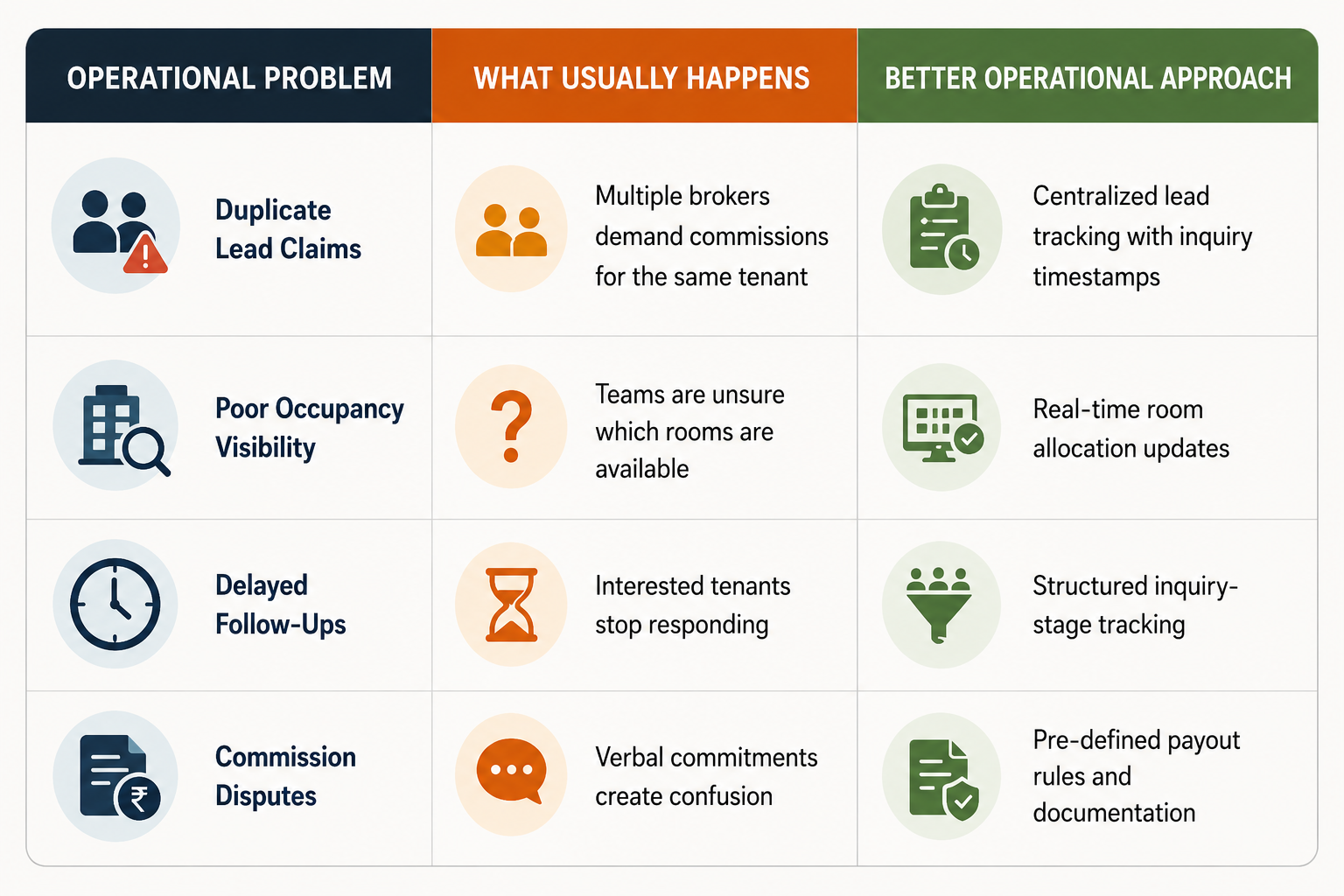
That eventually creates operational problems like duplicate commission claims, delayed follow-ups, occupancy confusion, and unnecessary broker relationship issues. The issue usually is not occupancy demand. The issue is operational visibility.

Why Experienced Brokers Are More Valuable Than Most Operators Realize
Many landlords make the mistake of treating brokers like temporary middlemen who only exist to close occupancy quickly. But experienced brokers often contribute much more than simple lead generation.
Strong brokers usually understand locality-level demand patterns and tenant psychology better than most operators initially realize. They know which areas students currently prefer, which localities parents avoid, which room types convert faster, and what pricing ranges tenants are genuinely comfortable paying within specific markets.
Some brokers also understand operational realities surprisingly well. They often know:
- which PGs struggle with tenant retention because of operational issues like food quality, maintenance delays, or poor management coordination,
- which room layouts consistently convert faster because tenants perceive them as more practical or spacious,
- what parents usually ask during visits so operators can improve how they position their property,
- and which amenities genuinely influence occupancy instead of simply looking attractive on listing platforms.
That kind of market insight becomes extremely valuable for operators trying to reduce vacancy periods and improve occupancy quality long-term. A good broker does not just “bring tenants.” They often help operators understand local market behavior and improve occupancy timing during slower periods.
But this only works properly when landlords build structured systems around broker workflows instead of handling everything casually.
The Biggest Mistake Landlords Make With Commission Discussions
One of the most common operational mistakes is discussing commission structures only after the tenant finalizes the room. This creates confusion almost immediately because expectations were never clearly defined in the beginning.
Questions start appearing later:
- Is the commission fixed or percentage-based?
- Will payment happen during booking or after move-in?
- What happens if the tenant cancels?
- Does the payout apply for short stays?
- What if the tenant shifts rooms later?
And because none of this was clarified earlier, the conversation becomes emotionally driven instead of operationally structured.
Professional operators usually avoid this entirely by defining commission structures, payout timelines, occupancy conditions, lead ownership rules, and cancellation policies before inquiry movement even starts. That single operational shift creates significantly smoother coordination because everyone understands the process from the beginning itself.
A properly defined commission process also helps landlords:
- reduce unnecessary negotiation during occupancy pressure because payout expectations are already documented clearly,
- avoid confusion between brokers and internal teams regarding inquiry ownership or payment timelines,
- maintain more professional broker relationships where coordination feels predictable instead of emotionally reactive,
- and create better operational consistency across multiple properties or staff members.
This is exactly why stronger rental businesses treat broker management like a structured workflow instead of an informal side activity.
Why Verbal Coordination Eventually Stops Working
Most PG businesses still depend heavily on phone calls, WhatsApp chats, voice notes, and verbal commitments to manage broker relationships. Initially, this feels convenient because there is no process overhead. But as occupancy grows, verbal coordination starts creating operational gaps everywhere.
For example, one manager may promise a different commission structure while another staff member changes room pricing without informing the broker properly. Sometimes occupancy availability gets updated too late, leading brokers to bring tenants for rooms that are already blocked.
The result is operational confusion at every level. Brokers lose confidence in the process, tenants experience inconsistent communication, and operators lose visibility over what is actually happening across inquiry pipelines.
This is exactly why professionally managed rental businesses eventually move toward structured workflows instead of purely memory-based coordination. And this does not mean creating complicated corporate systems. It simply means building enough operational structure so lead ownership remains visible, occupancy updates stay accurate, commission handling becomes predictable, and communication remains consistent internally and externally.
Even basic operational systems around inquiry logging, broker tagging, room allocation tracking, and move-in confirmation can dramatically improve workflow stability once occupancy starts scaling.
Why Lead Tracking Is More Important Than Most Operators Think
One of the biggest operational blind spots in broker-heavy businesses is poor lead tracking. Most landlords only realize this problem after duplicate commissions happen, occupancy disputes begin, or brokers start arguing over lead ownership.
The reality is simple: if inquiry tracking is weak, operational confusion becomes unavoidable.
Every broker-generated lead should ideally include complete visibility around:
- broker name and inquiry source so ownership remains traceable throughout the occupancy cycle instead of getting lost between different communication channels,
- tenant profile and room preference details so operators can improve allocation accuracy and reduce unnecessary follow-ups,
- site visit timelines and negotiation-stage visibility so teams know which inquiries are active and which leads require immediate attention,
- payment or booking status updates that help management understand how close the inquiry is to conversion,
- and final move-in confirmation details so commission processing becomes cleaner and easier to verify later.
This is not about creating unnecessary complexity. It is about creating operational visibility.
Because once operators start tracking lead flow properly, they begin understanding which brokers actually convert consistently, which locations generate stronger inquiries, which tenant categories stay longer, and which acquisition channels create healthier occupancy overall.
Without this visibility, decisions become assumption-based instead of operationally informed.
Common Broker Commission Models Used in PG Businesses
Different rental businesses use different commission structures depending on occupancy type, room pricing, tenant category, and operational goals. Some operators prefer fixed payouts because they simplify budgeting, while others use percentage-based structures for premium inventory where pricing varies significantly between room categories.
Here is a simple comparison of the most commonly used commission models:
| Commission Model | Best Used For | Main Advantage | Operational Risk |
|---|---|---|---|
| Fixed Per-Bed Commission | Standard PG occupancy | Predictable payouts and easier budgeting | Less flexibility for premium inventory |
| Percentage-Based Commission | Premium co-living rooms | Better alignment with pricing | Confusion if pricing changes frequently |
| Retention-Linked Commission | Long-term tenant occupancy | Reduces early vacancy risk | Delayed broker satisfaction |
| Seasonal Incentive Structure | Low occupancy periods | Improves inquiry movement faster | Higher short-term acquisition costs |
The important thing is not choosing one “perfect” structure universally. The important thing is ensuring the model feels transparent, predictable, professionally managed, and sustainable long-term.
Because consistency builds stronger broker relationships than aggressive negotiation ever will.
Why Delayed Commission Payments Damage Broker Ecosystems
Many landlords delay commission payouts because they want occupancy security first. Operationally, that concern is understandable because tenants may cancel unexpectedly, move-outs may happen early, or payments may remain pending initially.
But excessive payout delays eventually damage broker ecosystems.
Good brokers naturally prioritize properties where:
- onboarding feels smooth and professionally managed instead of operationally chaotic,
- communication remains clear throughout the inquiry and move-in cycle,
- room availability is updated properly before site visits happen,
- and payouts happen predictably without repeated follow-ups or unnecessary negotiation pressure.
If commission handling becomes inconsistent, emotionally negotiated, or unnecessarily delayed, strong brokers eventually begin prioritizing other inventory.
And this directly affects occupancy quality over time.
The strongest operators usually solve this through structured payout systems where:
- partial commission is processed during move-in confirmation,
- remaining amounts are released after rent clearance,
- or payouts are linked to predefined occupancy duration benchmarks.
This protects the operator operationally while also maintaining broker confidence and long-term relationship stability.
Why Organized Properties Attract Better Brokers
Many landlords assume brokers only care about higher commission payouts. Operationally, that is not entirely true.
Strong brokers also prioritize properties where communication is fast, site visits are coordinated properly, inventory availability remains updated, and onboarding feels operationally smooth for both tenants and brokers.
For example, brokers usually avoid properties where:
- room availability changes constantly without proper updates being shared internally,
- pricing changes randomly during negotiation stages and creates confusion for tenants,
- landlords disappear during follow-ups or delay decision-making unnecessarily,
- or move-in coordination becomes chaotic because operational processes are unclear.
Because inefficient systems waste broker time too.
Good brokers naturally prefer operators who maintain operational clarity, communicate professionally, and confirm occupancy quickly without confusion. This is why operational organization directly affects broker quality. The more structured the property feels, the stronger the broker ecosystem becomes over time.

How RentOk Helps Simplify Broker and Lead Management
Handling brokers and tenant leads manually can become difficult for PG operators and rental property managers, especially when managing multiple properties. RentOk helps simplify this process by creating a more organized system for lead tracking, broker coordination, and tenant management.
Instead of relying on spreadsheets, calls, and scattered chats, operators can manage everything from one centralized platform.
Some of the ways RentOk helps include:
- Broker-wise lead assignment and tracking: Every lead brought in by a broker is properly assigned and recorded, making it easier to track ownership and avoid confusion regarding commissions or follow-ups.
- Better visibility into tenant information: Brokers can access important tenant-related details connected to their leads, helping them stay updated without constant manual coordination.
- Reduced operational confusion: RentOk helps organize broker interactions and tenant records in one place, reducing duplicate entries, missed follow-ups, and communication gaps.
- Centralized rental management: The platform brings together lead management, broker coordination, and tenant tracking, making day-to-day rental operations more efficient and structured.
By improving transparency and simplifying coordination, RentOk helps rental businesses manage operations more smoothly as they grow.
Final Thoughts
Brokers continue playing a major role in the rental ecosystem, especially in fast-moving PG and co-living markets where occupancy depends heavily on speed, local trust, and relationship-driven coordination.
But successful broker management today requires much more than simply paying commissions after move-ins.
It requires:
- operational visibility that helps teams track inquiry movement clearly across multiple channels,
- structured lead systems that reduce duplicate claims and improve occupancy coordination,
- predictable communication workflows that create stronger broker confidence long-term,
- and professionally managed operational processes that improve both occupancy quality and business scalability.
Because once occupancy scales, informal coordination eventually creates more friction than flexibility.
The strongest rental businesses today are not eliminating brokers. They are building smarter systems around them.
And the operators who manage broker ecosystems professionally usually create faster occupancy movement, healthier tenant acquisition, stronger referral networks, and far more stable operational growth long-term.
If you want to streamline broker coordination, improve occupancy visibility, and simplify day-to-day rental operations, explore RentOk and discover how centralized property management systems can help modern landlords scale more efficiently.
About the Author
Ishika Pannu
Ishika Pannu brings you the latest insights and easy-to-apply strategies in property management—helping you simplify renting and grow with RentOk.