Market Trends
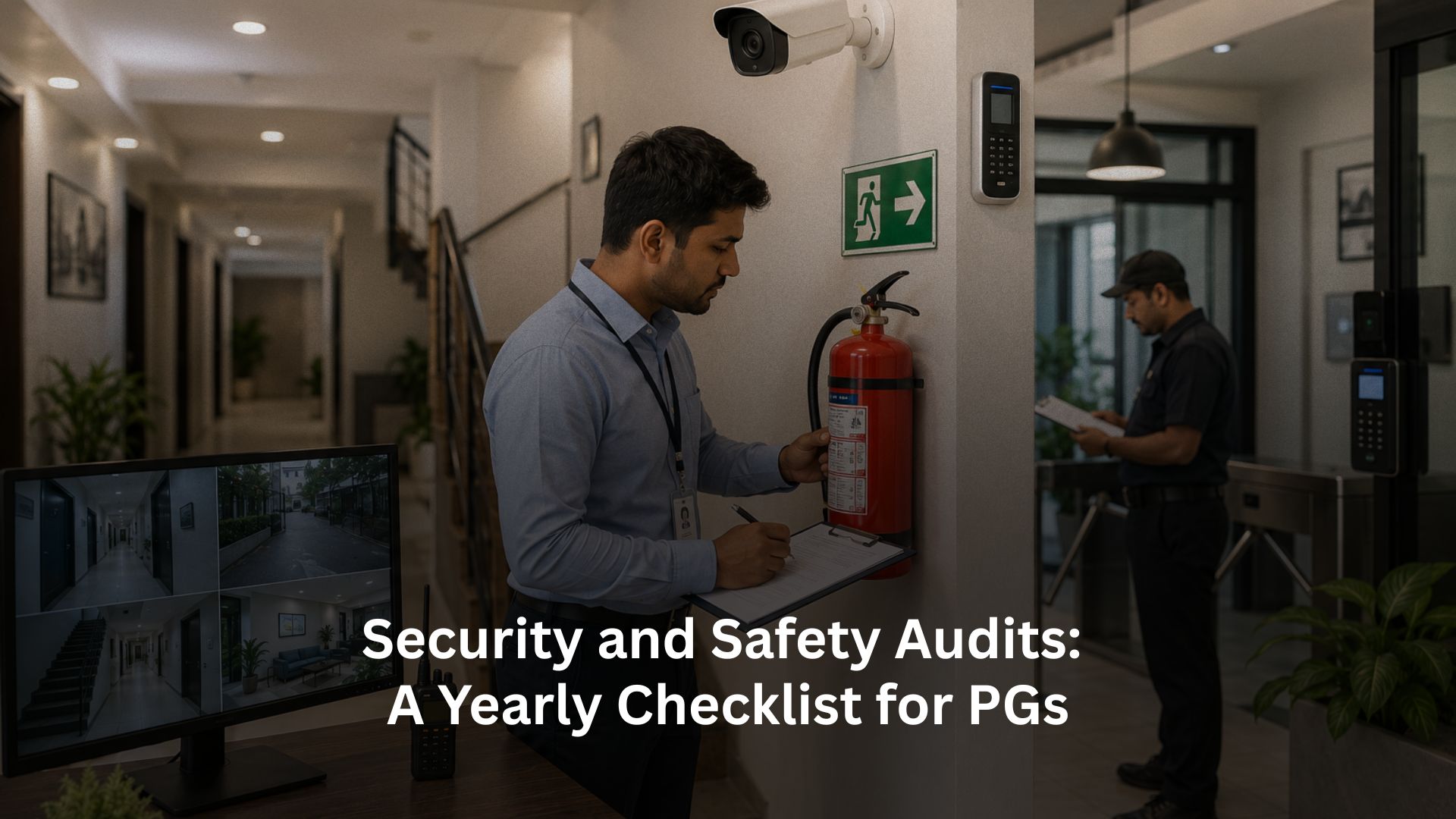
Security and Safety Audits: A Yearly Checklist for PGs

Written by
Ishika Pannu
Read Time
12 min read
Posted on
May 16, 2026
Overview
Overview
Security and Safety Audits: A Yearly Checklist for PGs
In the PG and co-living industry, safety is often treated as a reactive responsibility instead of a structured operational system. Most properties start focusing on security only after something goes wrong, a theft incident, an unauthorized visitor issue, a fire safety concern, or repeated tenant complaints about safety management.
But professionally managed PGs approach this very differently.
For them, safety is not just about installing CCTV cameras or hiring a guard at the entrance. It is about creating an environment where tenants consistently feel secure, operations remain controlled, and risks are identified before they become actual problems.
This is exactly why yearly PG safety audits have become increasingly important.
As rental businesses scale, operational complexity increases naturally. More tenants, more staff movement, more visitors, more vendors, and higher occupancy all create additional pressure on existing systems. Small safety gaps that appear manageable at low occupancy levels can quickly become major vulnerabilities once operations grow.
At the same time, tenant expectations have evolved significantly over the last few years.
Students relocating to metro cities, working professionals living independently, and even parents evaluating PGs remotely are now paying close attention to hostel security standards before making accommodation decisions. They are not just looking at room photos or amenities anymore. They are evaluating whether the property feels professionally managed overall.
Questions like these now directly influence occupancy decisions:
- Is the property monitored properly at night, especially during late entry hours and emergencies?
- Are visitor entries recorded systematically, or does movement happen informally without proper tracking?
- Does the building have functional fire exits, emergency preparedness systems, and operational safety protocols?
- Are tenant complaints around safety resolved professionally, or only after repeated escalation?
- Is there a structured process for handling emergencies instead of relying entirely on verbal coordination?
This shift is important because safety has now become part of the tenant experience itself.
And in competitive rental markets, professionally managed safety systems directly affect:
- occupancy retention,
- online reputation,
- referrals,
- and long-term operational credibility.
Why Most PG Safety Systems Slowly Become Weak Over Time
One of the biggest misconceptions operators have is assuming that safety systems remain effective once they are installed.
In reality, most operational weaknesses develop gradually.
A CCTV system that worked properly six months ago may quietly stop recording because storage backups failed. Fire extinguishers installed during setup may cross servicing timelines without anyone noticing. Visitor management systems may become inconsistent as staff changes happen and operational discipline weakens over time.
The dangerous part is that these issues rarely look serious initially.
But during emergencies, these small operational gaps become critical failures.
This is exactly why yearly audits matter.
They help operators evaluate whether systems are still functioning operationally instead of simply existing physically inside the property.
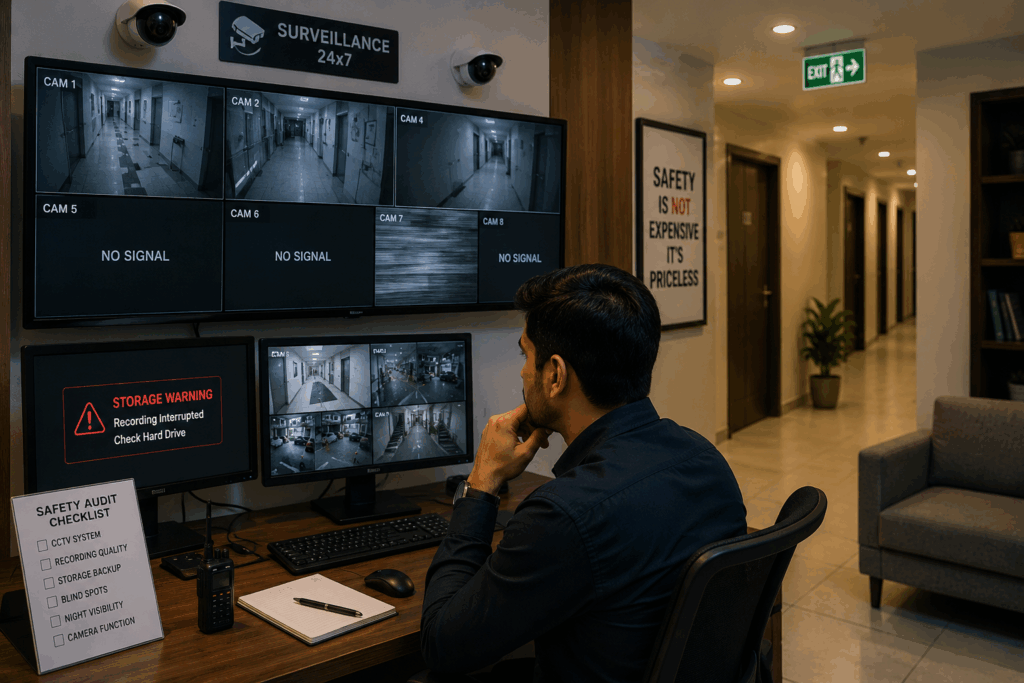
For example, many PGs technically have CCTV cameras installed across common areas. But when audits happen, operators often discover:
- footage retrieval takes too long during incidents because storage organization is poor,
- night recordings are unclear due to inadequate lighting,
- blind spots developed after furniture or layout changes,
- or certain cameras stopped functioning weeks earlier without active monitoring checks.
Similarly, fire safety systems often become neglected because operators assume compliance remains permanent after installation.
But fire preparedness requires continuous operational attention.
Electrical load increases naturally as occupancy grows. Tenants add personal appliances, extension boards, induction systems, chargers, and additional devices over time. Older buildings become even more vulnerable because wiring stress gradually increases without visible warning signs.
A proper safety audit identifies these risks before they escalate into operational emergencies.
Entry and Visitor Management Should Be the First Area Audited
Every strong PG security system begins with controlled access management.
If movement inside the property is not monitored properly, every other safety layer becomes weaker automatically. This is why professionally managed properties prioritize visitor and entry audits before almost anything else.
Unfortunately, many PGs still manage access very casually.
Guards recognize people informally, visitor entries happen verbally, delivery movement remains untracked, and late-night access is handled inconsistently depending on staff availability. This may appear manageable initially, but as occupancy grows, operational visibility starts weakening rapidly.
A proper yearly access audit should evaluate:
- Whether visitor entries are being documented consistently instead of depending entirely on verbal coordination or guard memory.
- Whether delivery personnel, maintenance staff, housekeeping teams, and vendors have controlled movement visibility across the property.
- Whether late-night entry systems remain predictable and professionally managed during emergencies or unexpected situations.
- Whether tenant verification documents, emergency contacts, and onboarding records remain updated and centrally accessible.
- Whether staff access permissions are structured properly instead of allowing unrestricted operational movement across sensitive areas.
The objective here is not creating an unnecessarily restrictive environment for tenants.
The objective is operational predictability.
Because in most PG security incidents, uncontrolled movement becomes the starting point of larger problems.
CCTV Coverage Should Be Evaluated Operationally, Not Just Visually
One of the biggest mistakes operators make is treating CCTV installation as the final step of security management.
In reality, installing cameras is only the beginning.
What actually matters is whether the surveillance system remains operationally reliable throughout the year.
A professionally managed pg safety audit should evaluate CCTV systems from an operational perspective rather than a visual one.
That means checking:
- whether cameras are recording continuously without interruptions,
- whether footage backups remain accessible during investigations,
- whether night visibility quality is usable across common areas,
- whether blind spots exist near entrances, corridors, or staircases,
- and whether storage systems are functioning without unexpected deletion risks.
Many operators also make the mistake of focusing only on camera quantity instead of coverage quality.
But strategically positioned surveillance systems are operationally far more valuable than excessive poorly monitored cameras.
Particular attention should usually be given to:
- entry gates and reception areas where visitor movement remains highest,
- staircases and corridor intersections where visibility gaps commonly appear,
- parking zones and shared community spaces where incidents are harder to monitor manually,
- and rooftop or isolated sections that may become vulnerable during low-staff hours.
Professional operators understand that CCTV systems are not just security tools.
They are operational accountability systems.
And during disputes, theft incidents, safety complaints, or emergency investigations, footage clarity and retrieval speed become extremely important.
Fire Safety Is One of the Most Ignored Operational Responsibilities
Among all hostel security standards, fire preparedness is still one of the most neglected areas across smaller PGs and independent rental properties.
Many operators complete basic compliance requirements during setup and rarely evaluate the systems properly afterward. Over time, this creates silent operational risks that become dangerous during emergencies.
A yearly fire safety audit should never be treated as a simple checkbox activity.
It should involve a practical review of whether the property can actually respond effectively during emergencies.
This usually includes evaluating:
- whether fire extinguishers remain serviced, accessible, and suitable for different risk areas,
- whether emergency exits remain physically clear instead of being blocked by storage or operational clutter,
- whether electrical systems are overloaded due to tenant appliance usage or unmanaged extensions,
- whether smoke detectors, alarms, and emergency lighting systems remain functional,
- and whether evacuation routes are clearly visible and operationally practical.
Older properties require even deeper inspection because infrastructure deterioration happens gradually.
In many cases, operators discover issues like:
- exposed wiring behind appliances,
- overheating electrical panels,
- unsafe extension board usage,
- or overloaded room connections that were never reassessed after occupancy expansion.
These are not dramatic visible failures initially.
But most fire incidents begin exactly this way, through operational negligence that quietly builds over time.
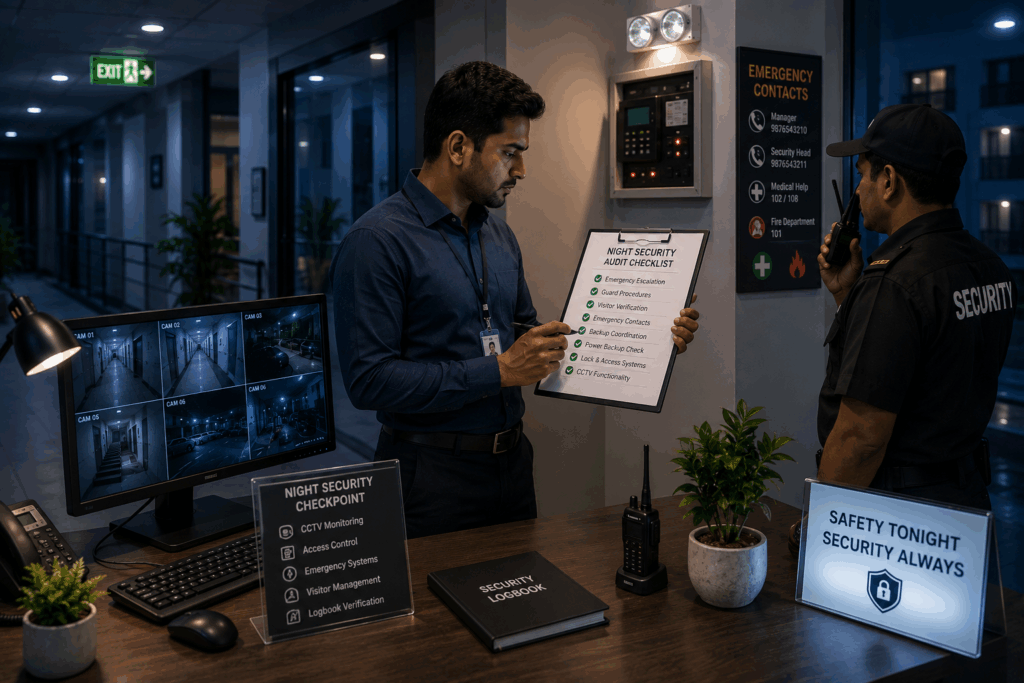
Why Night Security Protocols Need Dedicated Attention
Night operations create a completely different security environment inside PGs and co-living spaces.
Staff availability reduces, tenant movement patterns change, emergency response coordination becomes slower, and operational supervision naturally decreases during late hours.
This is exactly why night security protocols should always be audited separately.
Unfortunately, many PGs rely too heavily on individual guards handling situations informally instead of building structured emergency systems underneath.
A proper night security audit should evaluate:
- whether emergency escalation systems remain active after standard operating hours,
- whether guards have defined response procedures instead of depending entirely on verbal judgment,
- whether late-night visitor entries follow predictable verification protocols,
- whether emergency contact systems remain accessible for tenants during medical or operational emergencies,
- and whether backup coordination exists during power failures, lock issues, or unexpected incidents.
For example, operators should clearly know:
- Who responds if a tenant falls sick at 2 AM?
- What happens if surveillance systems fail temporarily during a power outage?
- How are unauthorized entries handled when management staff are unavailable?
- What escalation path exists if tenant conflicts become aggressive late at night?
These operational questions matter because emergencies rarely happen during convenient timings.
The strongest operators prepare for unpredictable situations before they occur.
Tenant Awareness Is a Major Part of Safety Management
One major operational mistake many PG operators make is treating safety as a backend management responsibility alone.
But even strong security systems become weaker when tenants themselves remain unaware of basic safety protocols.
This is why tenant awareness should always be included inside yearly safety audits.
Professional operators now increasingly evaluate:
- whether tenants understand evacuation procedures,
- whether emergency contacts are visible and accessible,
- whether visitor policies are communicated clearly,
- whether escalation systems feel approachable,
- and whether safety expectations remain consistently explained during onboarding.
Many professionally managed PGs now integrate safety orientation directly into move-in processes.
This may include:
- emergency contact sharing,
- visitor management instructions,
- late-night access policies,
- fire safety guidance,
- and complaint escalation procedures.
Operationally, these steps may appear small.
But during emergencies, preparedness reduces panic significantly.
And in shared living environments, operational confusion spreads extremely quickly once uncertainty begins affecting multiple residents simultaneously.
Documentation Is What Separates Professional Operations From Informal Ones
One of the clearest differences between professionally managed PGs and informal rental operations is documentation discipline.
Most operationally weak properties depend heavily on:
- verbal instructions,
- staff memory,
- scattered WhatsApp conversations,
- and inconsistent follow-ups.
This system eventually collapses during disputes or emergencies because operational visibility becomes fragmented.
A professional yearly safety audit should always include documentation review.
That means maintaining:
- inspection timelines,
- CCTV maintenance records,
- fire equipment servicing reports,
- visitor management logs,
- emergency incident documentation,
- and corrective action follow-ups.
Documentation matters because it creates:
- accountability,
- operational continuity,
- and structured escalation visibility.
It also becomes extremely valuable during:
- insurance evaluations,
- franchise management reviews,
- owner reporting,
- and legal investigations if incidents occur later.
The strongest operators do not manage safety through memory.
They manage it through systems.
Common Safety Gaps Most PG Operators Overlook
During professional safety reviews, certain operational weaknesses appear repeatedly across PGs because they develop slowly and often remain unnoticed initially.
Some of the most common gaps include:
- CCTV systems functioning visually but failing operationally due to storage issues, inactive backups, or poor monitoring discipline.
- Emergency exits becoming partially blocked over time because unused spaces gradually turn into informal storage zones.
- Tenant verification records remaining incomplete after occupancy growth accelerates rapidly during seasonal admissions or hiring cycles.
- Temporary staff, vendors, or maintenance personnel moving through the property without structured movement tracking systems.
- Electrical overload situations developing because appliance usage expands beyond the original infrastructure capacity.
- Outdated emergency contact records creating coordination delays during actual incidents or medical situations.
- Biometric systems becoming inconsistent because manual overrides and informal exceptions slowly weaken operational discipline.
Individually, these issues may appear manageable.
But collectively, they reduce the reliability of the entire safety ecosystem.
And that is exactly why yearly audits are necessary.
Because operational deterioration rarely happens suddenly.
It builds gradually through ignored inconsistencies.
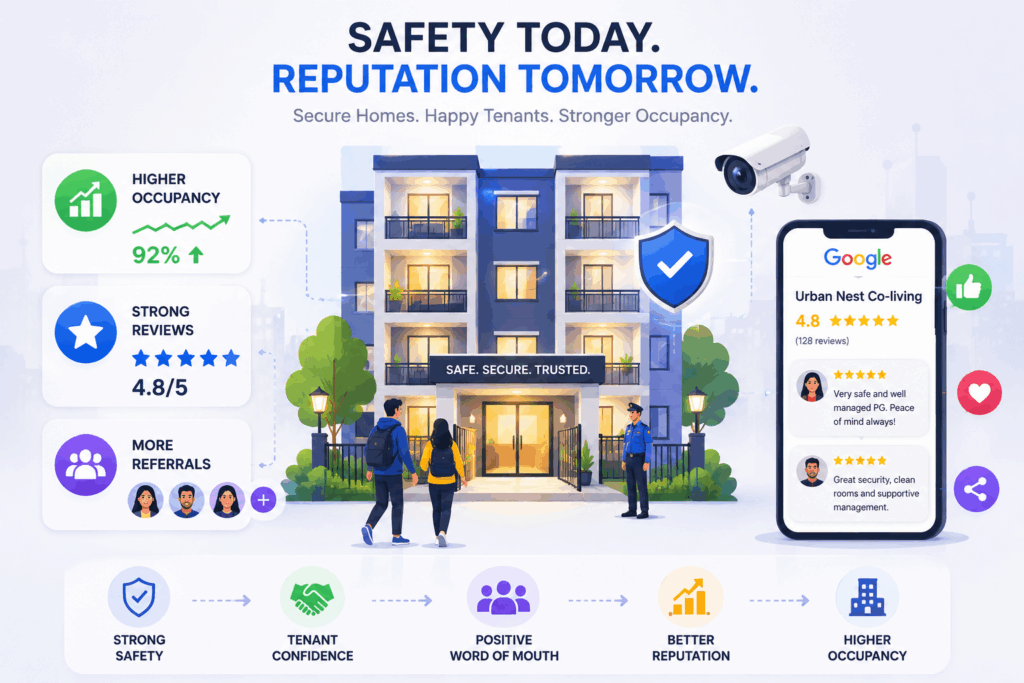
Why Safety Standards Now Influence Occupancy and Brand Reputation
Modern tenants evaluate PGs very differently compared to a few years ago.
Today, safety perception directly affects:
- online reviews,
- referrals,
- occupancy stability,
- and long-term reputation.
A single poorly handled safety incident can spread quickly across:
- Google reviews,
- relocation communities,
- student WhatsApp groups,
- and social media conversations.
At the same time, professionally managed properties naturally create stronger tenant confidence because residents feel:
- more secure,
- better supported,
- and more comfortable recommending the property to others.
This becomes especially important for:
- premium co-living brands,
- student housing operators,
- franchise-led PG businesses,
- and professionally managed rental portfolios competing in organized urban markets.
In many cases, tenants may compromise temporarily on room size or pricing.
But they rarely compromise on safety perception.
Because ultimately, safety affects daily peace of mind far more than amenities alone.
How RentOK Helps Operators Build More Structured and Safer Operations
As PG operations expand, maintaining operational visibility becomes increasingly difficult when tenant records, occupancy tracking, visitor coordination, complaints, and communication systems remain scattered across multiple platforms.
This fragmentation often creates indirect safety risks because management teams lose consistency in tracking operational activity.
RentOK helps operators centralize critical day-to-day workflows by organizing:
- tenant records and occupancy visibility,
- complaint tracking and issue escalation systems,
- communication history across operational teams,
- visitor coordination and resident information management,
- and overall property-level operational monitoring through one connected platform.
This operational structure helps reduce coordination gaps while improving visibility across the property ecosystem itself.
As rental businesses scale across multiple rooms, floors, or franchise properties, organized operational systems become increasingly important because safety management depends heavily on consistency, documentation, and operational clarity over time.
Final Thoughts
Safety audits are no longer optional for professionally managed PGs and co-living spaces.
They have become a core operational responsibility.
The strongest operators are not the ones reacting fastest after incidents happen. They are the ones building systems strong enough to prevent vulnerabilities from becoming incidents in the first place.
From CCTV coverage and fire preparedness to visitor management and night security coordination, every operational layer contributes to how secure tenants genuinely feel while living inside the property.
And in modern rental businesses, that feeling of security directly influences occupancy retention, reputation, referrals, and long-term growth.
If you want to improve operational visibility, organize your property workflows, and build more professionally managed PG operations, explore RentOk and discover how structured property management systems can help streamline tenant coordination, operational monitoring, and day-to-day property management more efficiently.
About the Author
Ishika Pannu
Ishika Pannu brings you the latest insights and easy-to-apply strategies in property management—helping you simplify renting and grow with RentOk.