Market Trends
The Hidden Cost of Chaos in PG Operations

Written by
Ishika Pannu
Read Time
9 min read
Posted on
May 20, 2026
Overview
Overview
The Hidden Cost of Chaos in PG Operations
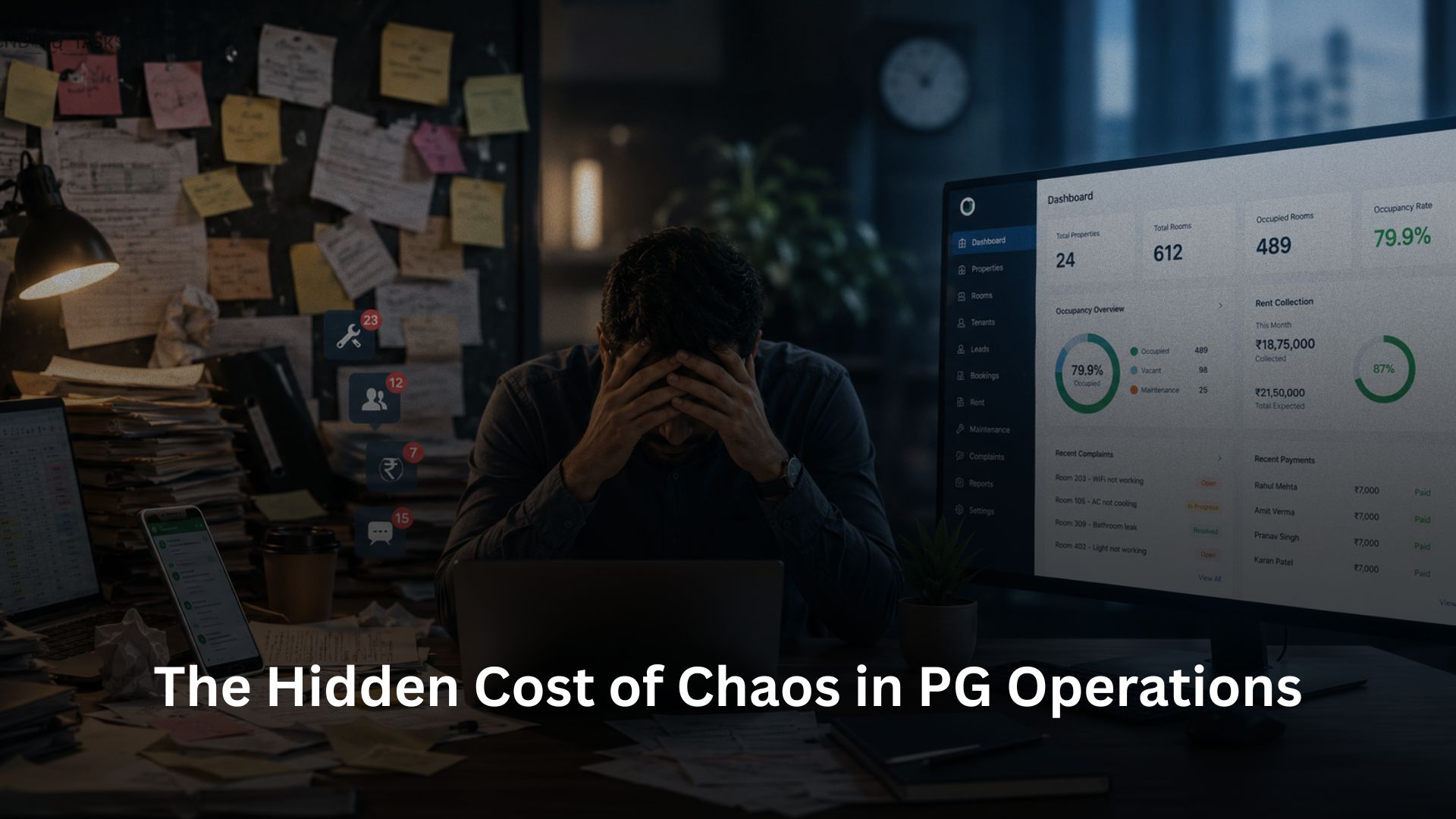
Most PG operators think operational problems begin only after scaling. They assume chaos starts when occupancy becomes too high, when multiple properties are added, or when staff coordination becomes difficult across buildings. But in reality, operational instability starts much earlier, long before the business appears “large.”
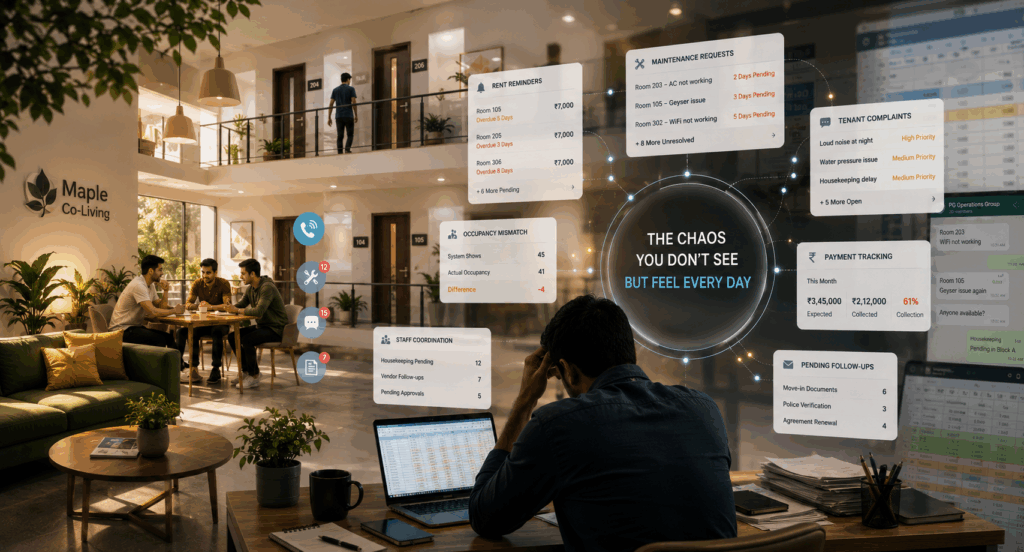
It usually begins when small inefficiencies quietly become part of everyday operations. A rent reminder gets missed because payment tracking is scattered across chats and spreadsheets. A maintenance complaint remains unresolved because communication happened verbally and nobody followed up properly. A room gets double-promised because occupancy visibility is unclear. A tenant issue escalates because previous conversations were never documented systematically.
Individually, these situations seem manageable. But collectively, they slowly create operational disorder underneath the business.
And this is exactly where many PG businesses struggle today. The issue is often not occupancy or competition. The issue is that operations remain dependent on memory, manual coordination, and constant owner involvement instead of structured systems that support consistency.
This difference becomes extremely visible as the business grows.
Because in shared living businesses, systems matter far more than scale. A professionally organized 40-bed PG will almost always operate more smoothly than a poorly structured 200-bed property where the owner spends the entire day solving preventable confusion.
The strongest rental businesses are rarely the ones constantly “handling emergencies.” They are usually the ones where operations feel calm, predictable, and organized even during high occupancy periods.
Why Operational Chaos Quietly Damages Tenant Experience
One of the biggest misconceptions in the rental industry is assuming tenants only evaluate a PG based on rent, food, amenities, or interiors. In reality, tenants experience management quality every single day through operational consistency.
When systems are weak, residents start noticing it almost immediately. Not through one major failure, but through repeated small friction points that slowly reduce confidence in management quality.
For example:
- A maintenance request may require multiple reminders because complaints are not tracked systematically, making tenants feel management is unresponsive even when staff members are trying to help.
- Payment confirmations may remain unclear for days because records are scattered across screenshots, bank messages, and personal chats instead of one organized workflow.
- Different staff members may communicate different rules or timelines, creating confusion around visitor policies, housekeeping schedules, security procedures, or move-out processes.
- Move-in coordination may feel disorganized because onboarding instructions, documentation requirements, and room readiness are not standardized properly across the property.
Eventually, the issue stops being about one isolated operational mistake. The entire property begins feeling inconsistent.
And in shared living environments, inconsistency spreads quickly through perception. One frustrated resident discussing unresolved operational issues with others can slowly affect the atmosphere of the entire property. Over time, this directly impacts:
- tenant retention because residents stop feeling operationally supported,
- online reviews because repeated frustrations become public feedback,
- referrals because existing tenants hesitate to recommend the property confidently,
- and occupancy stability because operational trust quietly weakens underneath.
This is why professionally managed PGs focus heavily on operational discipline. Strong systems improve not just backend management, but the actual resident experience itself.
Most PG Problems Are Actually Workflow Problems
A large number of operational frustrations inside PGs are misdiagnosed completely. Operators often assume the problem is:
- difficult tenants creating unnecessary pressure,
- unreliable staff members,
- occupancy becoming difficult to manage,
- or increasing competition affecting business stability.
But in many cases, the real issue is workflow visibility.
Take complaint management as an example. In many PGs, complaints are still handled through informal communication systems:
- personal WhatsApp chats,
- random phone calls,
- verbal discussions with housekeeping staff,
- or disconnected follow-up coordination.
Initially, this feels flexible because communication appears “fast.” But once occupancy increases, visibility collapses completely.
Nobody clearly knows:
- whether the issue was resolved properly,
- how long it remained pending,
- which staff member handled it,
- whether the same issue is repeating frequently,
- or how many unresolved complaints currently exist across the property.
This creates frustration on every side of operations.
Tenants feel ignored because accountability becomes unclear. Staff feel overloaded because responsibilities remain inconsistent. Operators lose operational visibility because updates are scattered across multiple channels.
The issue is not maintenance itself.
The issue is lack of systems around maintenance.
And this same pattern repeats across almost every operational area inside shared living businesses:
- payment collection,
- occupancy tracking,
- room allocation,
- housekeeping coordination,
- visitor management,
- tenant onboarding,
- and escalation handling.
Without systems, even smaller operations eventually begin feeling operationally exhausting.
Why Informal Management Stops Working as the Business Grows
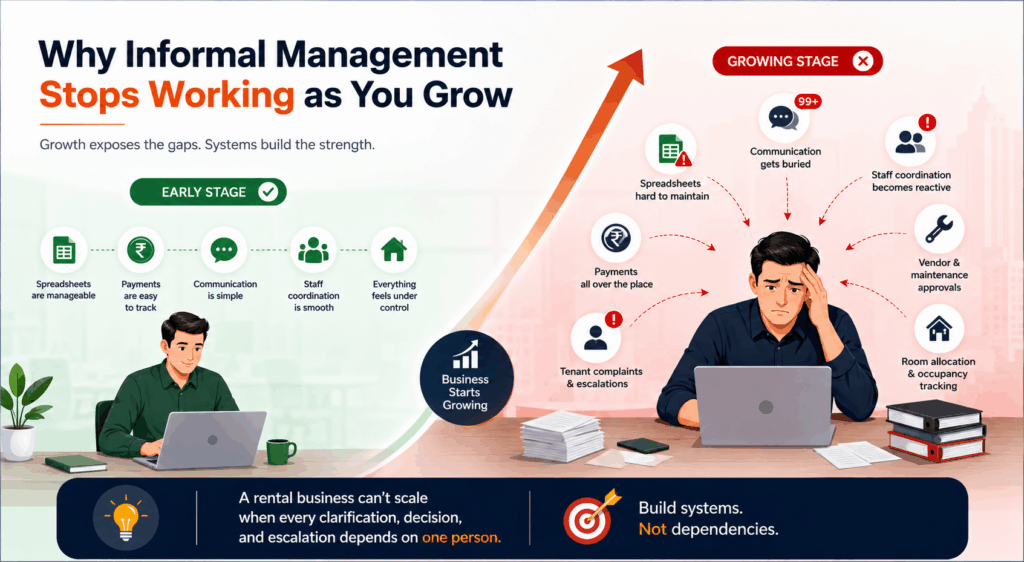
Many PG businesses begin informally and function reasonably well during their early stages. The owner remains personally involved in most activities, occupancy stays manageable, and manual coordination appears sufficient temporarily.
But the challenge begins when the business starts growing faster than the systems underneath it.
At that stage:
- spreadsheets become harder to maintain consistently because data updates start depending on multiple people and inconsistent manual entries,
- payment tracking becomes fragmented across screenshots, bank messages, and disconnected records that are difficult to reconcile quickly,
- communication gets buried across several chats and calls, making follow-ups harder to track operationally,
- and staff coordination becomes increasingly reactive because workflows are no longer clearly visible.
Eventually, the owner becomes the center of every operational process.
Every issue reaches the operator directly:
- tenant complaints and escalations,
- payment clarifications and pending dues,
- vendor coordination and maintenance approvals,
- room allocation decisions and occupancy tracking,
- and operational follow-ups that should ideally already be system-driven.
This creates dependency instead of scalability.
And businesses built heavily on owner dependency always struggle to expand smoothly because growth increases operational pressure faster than visibility improves.
The strongest operators understand one critical principle very clearly: a rental business cannot scale sustainably if every clarification, decision, and escalation depends on one person continuously supervising operations manually.
That model eventually creates exhaustion instead of growth.
The Hidden Financial Cost of Weak Operational Systems
Operational inefficiency does not just create stress. It also creates silent financial leakage that many landlords fail to calculate properly because the losses appear indirectly over time.
For example, delayed complaint handling may initially seem like a service issue. But repeated operational frustration eventually affects:
- tenant retention because residents become less likely to renew their stay after experiencing unresolved issues repeatedly,
- online reputation because operational complaints slowly become public reviews that influence future tenant decisions,
- referral growth because existing tenants stop recommending the property confidently to friends or colleagues,
- and occupancy consistency because operational trust gradually weakens underneath the business.
Similarly, weak payment systems often create:
- delayed collections because reminders and due tracking become inconsistent,
- pending dues confusion because financial records are fragmented across multiple sources,
- inaccurate revenue visibility because reconciliation becomes difficult,
- and avoidable cash flow instability because operators no longer have clear operational visibility into collections.
Even poor occupancy tracking creates hidden losses because room availability updates become inconsistent, causing slower allocation and weaker inquiry conversion.
The dangerous part is that these losses rarely appear immediately. Operators notice declining stability but fail to connect it with operational inefficiency underneath.
Over time, however, operational chaos compounds financially. And unlike visible expenses such as salaries or rent, inefficiency quietly drains profitability month after month without appearing clearly inside reports.
What Professionally Managed PG Operations Usually Have in Common
One interesting pattern becomes visible when you observe high-performing rental businesses closely. Their success is rarely based only on location or infrastructure. In most cases, they simply operate with stronger systems underneath.
Professionally managed PGs usually focus heavily on:
- centralized operational visibility so payments, complaints, occupancy, and communication remain connected instead of scattered across disconnected tools,
- standardized tenant workflows that make onboarding, move-ins, renewals, and escalations feel consistent and organized,
- structured communication systems where tenants know exactly how complaints, updates, and support processes function,
- and process clarity that reduces dependency on verbal coordination and memory-based management.
This creates calmer operations overall.
And calm operations scale much more effectively than reactive ones because management energy shifts away from constant firefighting and toward long-term improvement.
The difference becomes especially visible during high-pressure situations. Professionally managed operations usually recover faster because workflows already exist underneath the business. Poorly structured properties, meanwhile, become dependent on emergency coordination every time something goes wrong.
Why Visibility Matters More Than Micromanagement
Many landlords try solving operational chaos through tighter control, increasing supervision, handling more calls, approving every small task personally, and staying deeply involved in daily operations.
Initially, this creates temporary control. But eventually, excessive owner involvement becomes another operational bottleneck because every workflow starts depending on one person continuously monitoring operations manually.
Professional operators focus on visibility instead.
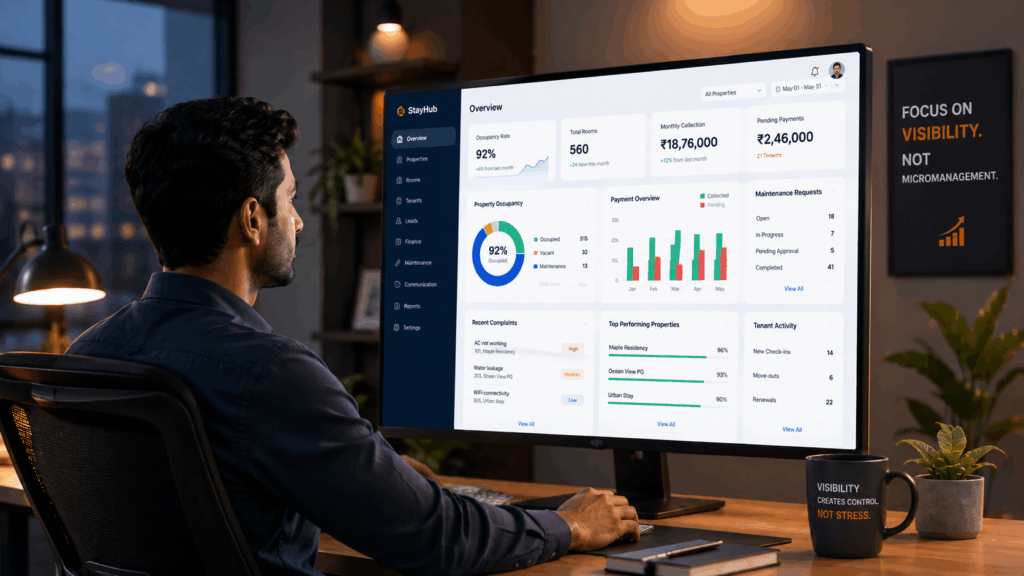
Because when operational information becomes centralized and organized properly, management no longer depends on constantly asking for updates manually.
Operators should be able to quickly understand:
- occupancy performance across rooms and properties,
- pending complaints and escalation timelines,
- payment visibility and collection status,
- operational bottlenecks affecting workflow efficiency,
- and tenant activity patterns that require management attention.
This changes the business completely.
Instead of continuously reacting to operational confusion, operators gain the ability to manage proactively through structured visibility and organized workflows.
And proactive management almost always creates stronger long-term stability than reactive supervision.
How RentOK Helps Operators Build More Structured PG Operations
Many operational issues inside PG businesses become difficult because important information remains fragmented across multiple channels. Payment records may exist inside spreadsheets, complaints happen over chats, occupancy updates are tracked manually, and tenant records become difficult to retrieve during escalations.
RentOK helps operators centralize:
- tenant management workflows so onboarding, records, agreements, and operational communication remain organized instead of scattered across disconnected systems,
- occupancy tracking and room visibility so operators can manage vacancies, room allocation, and tenant movement more efficiently across properties,
- complaint coordination systems that improve issue tracking, escalation visibility, accountability, and operational response timelines,
- payment management visibility that reduces confusion around pending dues, collection tracking, reminders, and financial coordination,
- and day-to-day operational workflows through one structured platform designed specifically for rental businesses and shared living operations.
This creates stronger operational clarity while reducing dependency on scattered records, manual follow-ups, and reactive coordination systems.
As PG businesses grow, centralized workflows become increasingly important because operational quality depends heavily on visibility, process consistency, and communication structure underneath.
Conclusion
Most PG businesses do not struggle because demand is weak.
They struggle because operational systems remain weaker than operational growth.
And in shared living environments, tenants notice operational inconsistency extremely quickly. Delayed communication, unresolved complaints, scattered coordination, and unclear workflows slowly damage trust even when the property itself looks attractive physically.
This is why systems matter so much.
Because professionally managed rental businesses are not built only through:
- better interiors,
- aggressive marketing,
- or higher occupancy numbers.
They are built through operational consistency, visibility, communication clarity, and structured management systems that support growth without creating chaos underneath.
The operators who build long-term stability are usually the ones who create workflows strong enough to support expansion while maintaining operational quality consistently across the business.
Explore RentOk to simplify tenant management, streamline occupancy tracking, improve operational visibility, and build a more structured PG business through one centralized operational platform.
About the Author
Ishika Pannu
Ishika Pannu brings you the latest insights and easy-to-apply strategies in property management—helping you simplify renting and grow with RentOk.