Pg owner app
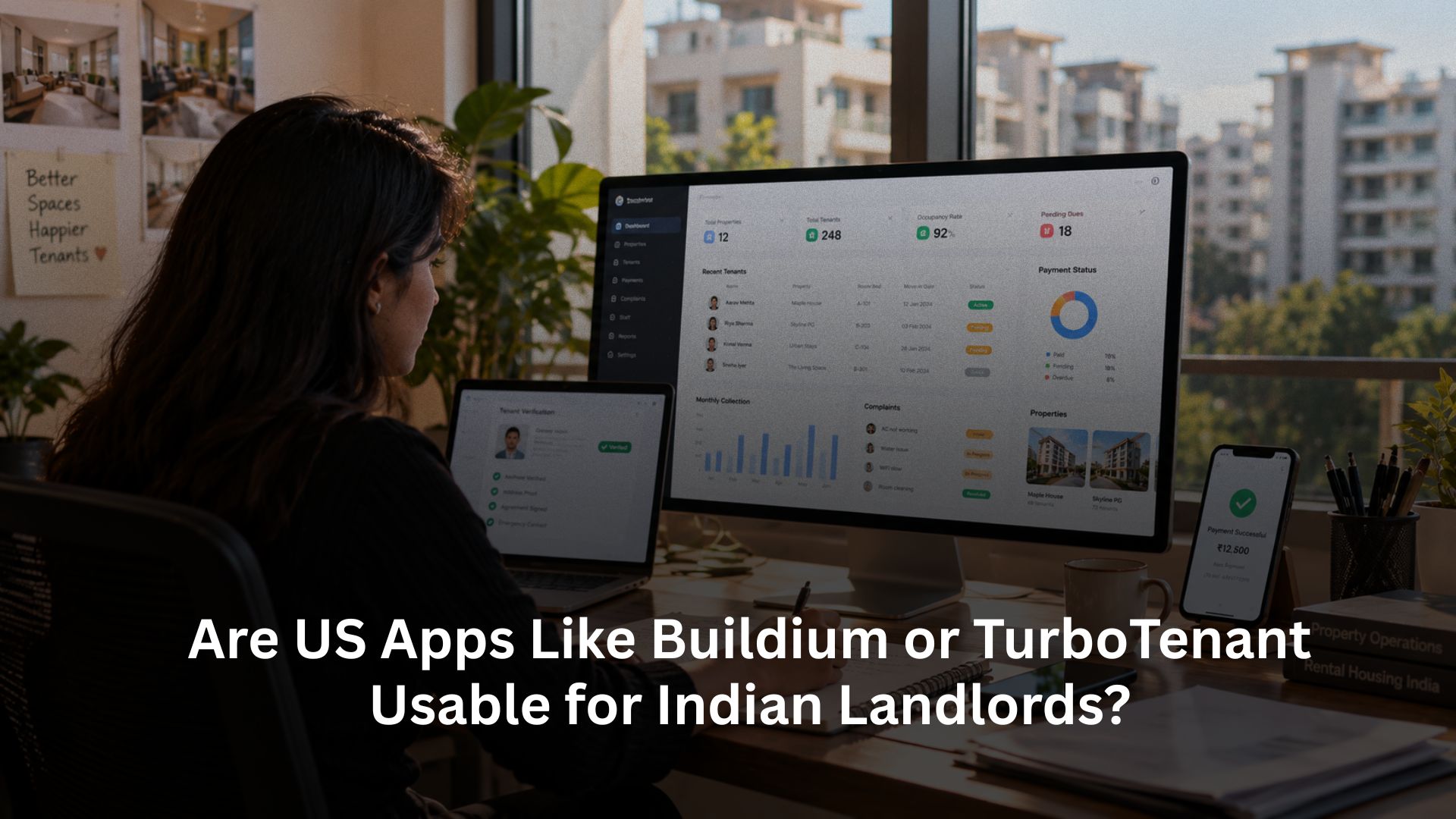
Are US Apps Like Buildium or TurboTenant Usable for Indian Landlords?

Written by
Ishika Pannu
Read Time
14 min read
Posted on
September 29, 2026
Overview
Overview
Are US Apps Like Buildium or TurboTenant Usable for Indian Landlords?
Search for property management software today and you will find plenty of international platforms offering almost everything a landlord could need.
Tenant screening. Online rent collection. Digital leases. Maintenance management. Accounting. Reporting. Tenant portals. Automation.
At first glance, platforms such as Buildium and TurboTenant can look like complete solutions for rental management. They have been built to handle large parts of the landlord’s daily workflow.
However, there is a question Indian property owners should ask before choosing any software.
Was this software actually built around the way rental businesses operate in India?
That question matters more than it may seem.
A rental property is not managed through a feature list. Instead, it is managed through hundreds of small operational decisions. What’s the process for collecting rent? Are tenants verified properly? How are deposits recorded and rooms or beds tracked? And how are tenant complaints handled? What happens when a tenant moves out?
The answers can look very different across countries.
For example, a US property management platform may be excellent at managing a US rental portfolio. However, an Indian PG, hostel, co-living space, or multi-property rental business may need a different operational structure.
The issue is not whether international software is “good” or “bad”.
The issue is fit.
What Are Buildium and TurboTenant Actually Built Around?
Buildium and TurboTenant are established property management platforms with extensive tools for landlords and property managers.
Buildium offers online rent payments, tenant screening, leasing, maintenance, accounting, and resident management. Its tenant screening system uses TransUnion and includes credit, criminal, and eviction information. TurboTenant also provides applications, screening, leases, rent payments, and landlord management tools. Its screening workflow uses US-based credit and background information.
These features make sense within the US rental ecosystem.
More importantly, software reflects the market it was designed for. Its payment systems, screening processes, documentation, and workflows are usually built around local rental practices.
This creates a difference that is easy to miss when comparing platforms from a distance.
For instance, an Indian landlord may see “tenant screening” on one platform and “tenant screening” on another. The label looks identical. However, the actual process may not be.
The same applies to online payments, digital leases, and tenant management.
The feature name can be the same while the underlying workflow is completely different.
Where Does the US Model Start Becoming Different?
Consider a typical Indian PG operator managing 150 beds.
The owner needs to know which tenant occupies which bed. At the same time, they need to track rent, deposits, KYC documents, move-in dates, move-outs, complaints, electricity, food charges, and other property expenses.
Clearly, this is more than traditional lease management.
PGs also experience higher tenant movement than many conventional residential rentals. As a result, one room may have several occupancy changes over a year. That creates a constant cycle of onboarding, verification, payment collection, and exit management.
Therefore, the software needs to handle the property at a more detailed level.
A useful system should give an owner visibility into:
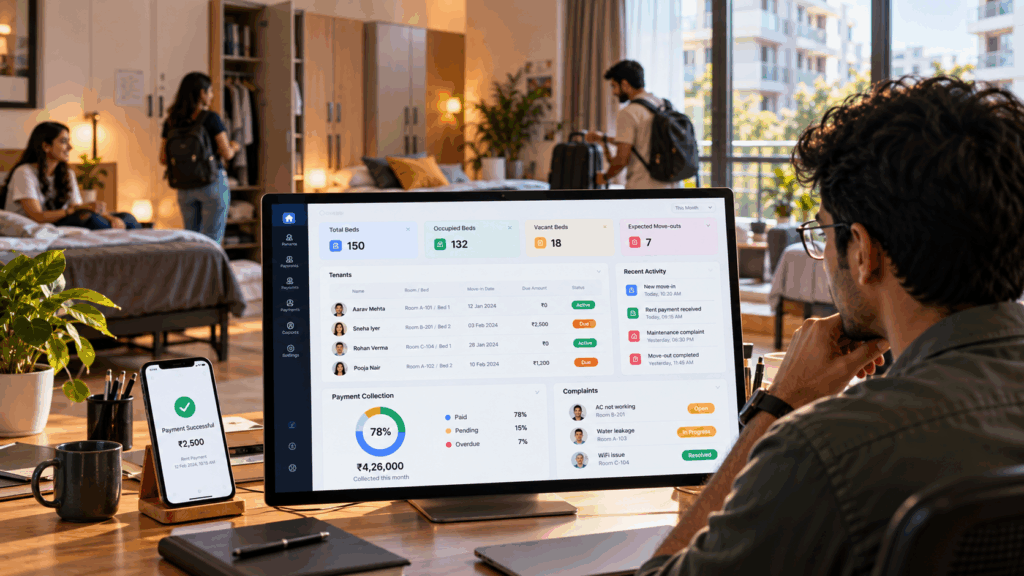
- Occupancy and allocation: Which beds are occupied, which are vacant, and which tenants are expected to move out soon. This gives the owner a clearer view of upcoming occupancy changes.
- Tenant records: Who the tenant is, when they moved in, what documents they submitted, and what their current status is. As the portfolio grows, this information becomes difficult to manage manually.
- Payments and dues: What has been paid, what remains outstanding, and whether the payment has been correctly recorded against the tenant. This reduces the need to cross-check multiple records.
- Property operations: Which complaints are pending, which staff member is handling them, and whether the issue has been resolved. Consequently, managers can spend less time chasing updates.
This is why Indian owners should not evaluate software only by counting features.
Instead, the more important question is whether the software understands the operational structure behind those features.
For a deeper look at this difference, see How to Choose the Right PG Management Software.
ACH Payments and UPI Are Not the Same Workflow
Payments are a clear example of how rental operations differ across markets.
Buildium supports online rent collection through methods such as ACH, which is widely used for recurring electronic payments in the US.
India has a different payment environment. UPI is deeply integrated into everyday transactions, so tenants may expect to scan a QR code, pay within seconds, and receive instant confirmation.
For landlords, though, receiving the payment is only the first step.
Did the payment match the right tenant? Was the outstanding balance updated correctly? And has the receipt been generated? Owners also need to know which tenants are still pending.
This matters even more in PGs, where a tenant’s monthly account can include rent, electricity, food, additional services, late fees, and other charges.
A good rental system should help owners:
- Automate reminders: Send payment reminders before and after the due date without manual follow-ups.
- Track payment status: View paid, partially paid, and overdue amounts in one place.
- Maintain a clear ledger: Link every payment to the correct tenant and outstanding balance.
- Reduce follow-ups: Turn monthly payment collection into a structured process instead of repeated calls and messages.
RentOk’s How to Collect Rent Online from Tenants in India explores this workflow in more detail.
Online payment is a feature. Structured rent collection is an operational system.
Tenant Screening Is Not the Same as Tenant Verification
Tenant screening is another area where the difference between markets becomes obvious.
US platforms commonly use credit history, criminal records, eviction history, and other US-based information to evaluate prospective tenants.
Buildium’s screening service, for example, is powered by TransUnion and includes credit, criminal, and eviction information. Similarly, TurboTenant uses US credit and background screening workflows.
Indian landlords often have a different priority.
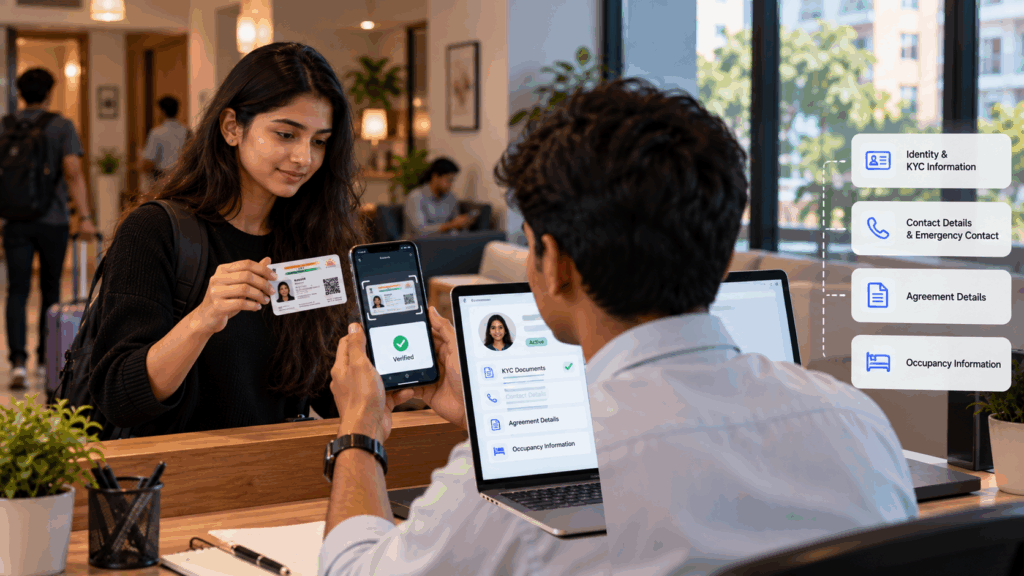
For a PG or co-living operator, tenant verification may focus on establishing identity, collecting KYC documents, recording address details, maintaining emergency contacts, and following applicable local verification procedures.
In other words, that is not exactly the same thing as a US credit-based screening process.
The distinction matters because identity verification and background screening answer different questions.
A credit report may tell an owner about someone’s financial history. However, it does not replace the documentation and identity process required during Indian tenant onboarding.
RentOk’s The PG Owner’s Guide to Tenant Background Verification in 2026 goes deeper into this difference.
Why Aadhaar and Digital KYC Matter for Indian Owners
For years, tenant onboarding in India has involved physical copies, WhatsApp images, spreadsheets, and paper files.
That approach may work when a property has a small number of tenants. However, it becomes harder to manage when the tenant base grows.
Imagine an owner managing 300 tenants across several properties. A new tenant joins every few days. Documents arrive through different channels. Some records are updated in Excel. Others remain in WhatsApp.
The information exists.
Yet finding the right information quickly becomes the problem.
Digital KYC creates a more structured process. Instead of treating documents as isolated files, the information can become part of the tenant’s overall profile.
A stronger digital onboarding process can bring together:
- Identity and KYC information collected during onboarding. This creates a clearer record from the moment the tenant joins.
- Tenant contact details and emergency contact information. Therefore, important information remains easier for the property team to retrieve.
- Agreement and occupancy details linked to the correct tenant. This reduces confusion when multiple tenants are moving in or out.
- Documentation that can be retrieved without searching through old conversations. As a result, staff spend less time looking for information.
This becomes especially useful when properties operate with frequent move-ins and move-outs.
For more detail, see RentOk’s Aadhaar-Based Digital KYC: A Step-by-Step Guide for PG Owners.
The goal is not simply to remove paperwork.
Instead, the goal is to create reliable tenant records that remain useful throughout the tenant’s stay.
What About Rental Agreements and Stamp Duty?
Rental agreements can also create a local-market gap.
A digital lease may look like a universal solution. In practice, however, rental documentation can involve different processes depending on the location and type of arrangement.
Indian property owners may need to consider stamp duty, registration, agreement formats, and local requirements. These processes can vary across states and property types.
Therefore, a software platform should not be evaluated only on whether it can generate a digital agreement.
The larger question is whether the agreement fits into the owner’s overall tenant workflow.
The agreement should connect naturally with:
- Tenant information: The agreement should relate to the correct tenant and property record. This becomes especially important when the operator manages several properties.
- Occupancy details: The system should make it easy to understand when the tenant moved in and when the agreement applies. This helps maintain better occupancy visibility.
- Payment records: Rent and deposit information should not live separately from the tenant’s financial history. Instead, the information should remain connected.
- Move-out processes: Notice periods, settlements, and tenant exits should remain part of the broader record. This reduces confusion during the final stage of a tenancy.
As a result, a locally relevant property management system can become more useful than a collection of disconnected tools.
What Should Indian Owners Look For Instead?
This does not mean every international property management platform should automatically be rejected.
Different landlords have different requirements. Likewise, a platform may still work for a particular business depending on its property type, location, and operating model.
However, Indian owners should evaluate software against their actual daily processes.
A practical checklist should include the following:
- Does the payment workflow fit Indian tenants? Look for support around UPI, digital payments, reminders, receipts, and tenant-wise payment tracking. Most importantly, check what happens after a payment is made.
- Can you manage Indian tenant verification? Check whether KYC documents, tenant information, and verification records can be organized in one place. This becomes more valuable as tenant volume increases.
- Can you manage PG-style occupancy? If you operate shared accommodation, bed-level or room-level visibility can be more useful than simple apartment-level occupancy. Therefore, evaluate the system against your actual property structure.
- Can your team manage complaints? Property operations should not depend entirely on calls and WhatsApp chats. Instead, issues need ownership, status tracking, and follow-up.
- Can you manage several properties? Once the portfolio grows, switching between separate spreadsheets and accounts becomes a serious operational burden. A centralized system can reduce that friction.
- Can you understand the numbers? Owners need clear visibility into collections, dues, expenses, deposits, occupancy, and property performance. Without that visibility, scaling becomes harder.
This is also why RentOk’s Best Tenant Management Software in India is useful when comparing different approaches to tenant management.
Ultimately, the best software is not necessarily the one with the longest feature list.
Instead, it is the one that removes the most manual work from the way your business actually operates.
Does a Foreign Platform Automatically Become a Bad Choice?
No.
That would be an oversimplification.
Buildium and TurboTenant were built to solve real property management problems. Their tools can be relevant for landlords operating within the US rental market.
However, the question for an Indian owner is different.
Suppose you operate a conventional apartment portfolio. Your requirements may be relatively simple. You may mainly need lease management, payment collection, maintenance tracking, and accounting.
Now consider a 500-bed PG.
The operator may need bed-level occupancy, frequent tenant onboarding, KYC, deposits, recurring dues, food charges, complaints, staff management, payment reminders, and multiple property dashboards.
Both businesses are “rental businesses”.
Yet their operational requirements are very different.
Therefore, localization should be treated as an operational advantage, not just a geographic label.
Software should fit the business model.
Making the Switch Without Disrupting Your Operations
Switching property management software does not have to mean changing every process overnight.
Instead, start by identifying where your team loses the most time.
Look at rent collection. Then review tenant onboarding. After that, examine how complaints are recorded. Check where KYC documents are stored. Finally, review how deposits and move-outs are tracked.
You will usually find that important information is spread across several places.
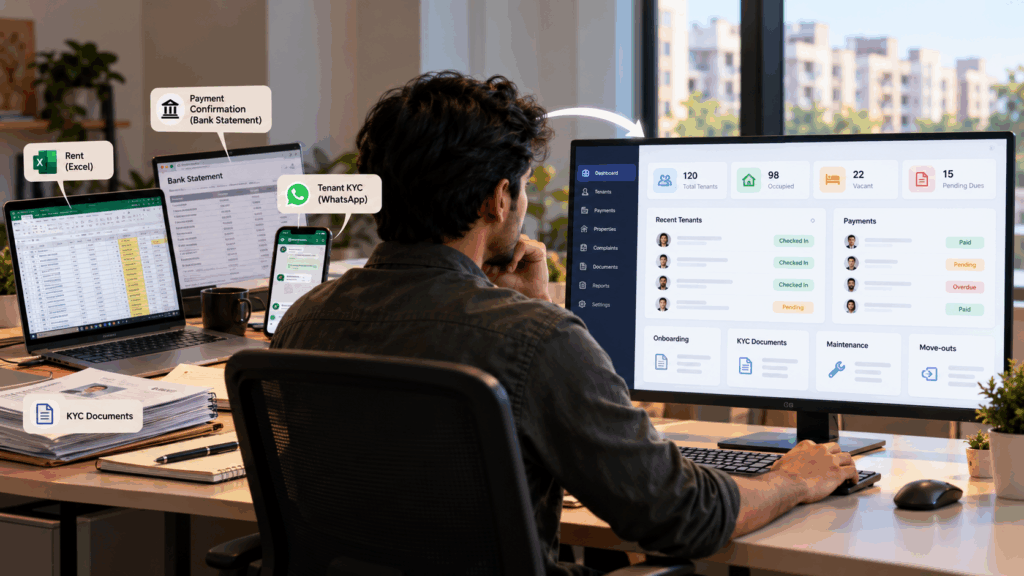
For example, rent may be recorded in Excel. Payment confirmation may sit in a bank statement. The tenant’s KYC may be in WhatsApp. Meanwhile, a complaint may be known only to one staff member.
Each individual process may seem manageable.
Together, however, they create operational friction.
A centralized property management system brings these workflows into one structure. As a result, information becomes easier to find and the amount of manual reconciliation can decrease.
Before switching, it also helps to ask:
- Which existing records need to be migrated? This prevents important tenant or financial information from being overlooked during the transition.
- Which staff members will use the system daily? Their workflow should be considered before the new process is finalized.
- Which workflows should be automated first? Starting with high-frequency tasks can deliver value faster.
- What information should remain accessible after migration? Historical tenant and payment records may still be needed later.
- Can the platform scale when the property portfolio grows? A solution should not become another limitation once the business expands.
Ultimately, a software switch should not simply replace one dashboard with another.
It should make the entire operation easier to control.
How RentOk Helps Indian Landlords Manage Their Properties
RentOk is designed around the operational needs of Indian PGs, hostels, co-living spaces, and rental properties.
The platform brings tenant management, payments, dues, occupancy, documentation, complaints, communication, and property operations into one connected system.
For an Indian rental operator, this means the software can support the workflows that happen every day.
Owners can maintain tenant records, track payments and outstanding dues, manage occupancy, organize verification, handle complaints, and monitor property-level operations without depending on several disconnected tools.
Moreover, the value becomes clearer as the property grows.
At 20 tenants, an owner may still remember most of the important details. At 200 or 500 tenants, that becomes impossible.
Therefore, the system becomes the source of operational visibility.
RentOk’s Best Property Management Software in 2026 covers the wider set of workflows that modern Indian landlords and property managers can bring into one platform.
The objective is straightforward.
The software should adapt to the rental business, not force the rental business to work around the software.
Conclusion
Buildium and TurboTenant show how much modern property management software can automate. Their workflows are designed around the needs of the US rental market.
For Indian landlords, however, the decision requires a different lens.
UPI payments, tenant verification, KYC, rental documentation, shared occupancy, recurring dues, deposits, complaints, and multi-property operations all create local requirements.
That does not make international software automatically unsuitable.
Instead, it means Indian owners should look beyond the feature list.
The better question is not, “Which software has more features?”
It is:
“Which software understands the way my rental business actually works?”
As a rental portfolio grows, that difference becomes increasingly important. The right system should reduce manual work, improve visibility, and give owners more control over everyday operations.
See Why Indian Owners Choose RentOk and explore a property management platform built around the way Indian rental businesses operate.
Frequently Asked Questions
Find answers to common questions about this topic
About the Author
Ishika Pannu
Ishika Pannu brings you the latest insights and easy-to-apply strategies in property management—helping you simplify renting and grow with RentOk.
You may also like these
Related Articles
1 min read
Why Landlords Need a Property Management App in 2025
Written by
Posted on
Ishika Pannu
Sep 2, 2026
1 min read
How Property Management Software Helps You Collect Rent on Time
Written by
Posted on
Ishika Pannu
Aug 26, 2026
1 min read
Why Small Landlords Need Property Management Software
Written by
Posted on
Ishika Pannu
Aug 26, 2026

1 min read
How High-Growth PGs Maintain Occupancy Year-Round
Written by
Posted on
Ishika Pannu
Aug 17, 2026
1 min read
How to Mark PG Attendance Without Biometric Devices
Written by
Posted on
Ishika Pannu
Jun 16, 2026
1 min read
Tracking Staff Performance: From Cleaning to Security
Written by
Posted on
Ishika Pannu
May 13, 2026
1 min read
Automating Complaint Management: Boosting Tenant Satisfaction
Written by
Posted on
Ishika Pannu
May 11, 2026
1 min read
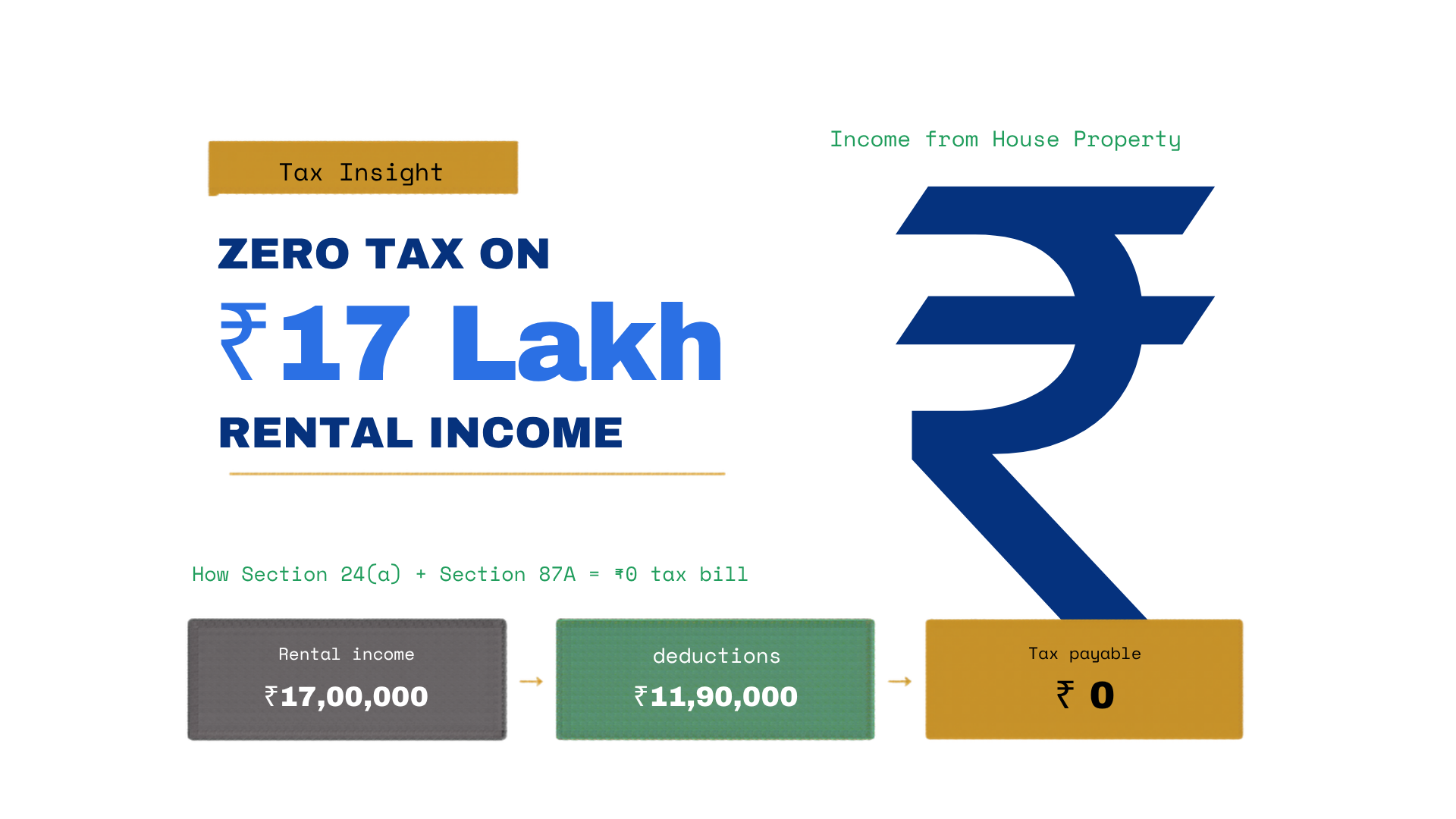
Zero Tax on ₹17 Lakh Rental Income? Here’s How It Works
Written by
Posted on
Shivanshi Dheer
Apr 29, 2026

1 min read
5 Ways PG Owners Lose Money Every Month (And How to Fix It)
Written by
Posted on
Shivanshi Dheer
Jan 13, 2026

1 min read
Best Property Management Software in 2026
Written by
Posted on
Shivanshi Dheer
Jan 5, 2026
Stay ahead in property management with expert insights
Join thousands of property managers receiving exclusive tips delivered straight to your inbox.
Browse posts by category
Case Study
Cost of Living
Growth
Legal
Market Trends
News
Pg owner app
Property Management
Property Tax
Tech
RentOk
The easiest way to rent and manage your PGs and hostels.
Grievance Officer
Get the app


Contact us
hello@eazyapp.tech
HQ Office
COGROW, BASEMENT F-12/8A
BESIDE HOUSE OF STYLE SALON, SECTOR 28, DLF PHASE 1
GURUGRAM, HARYANA - 122002
South India Office
LUMIODESK COWORKING, 2ND FLOOR, 40, 14TH MAIN RD
BESIDE MC DONALD, 7TH SECTOR, HSR LAYOUT
BENGALURU, KARNATAKA - 560102
©️ 2026 EazyApp Tech Pvt Ltd. All rights reserved


