
Legal
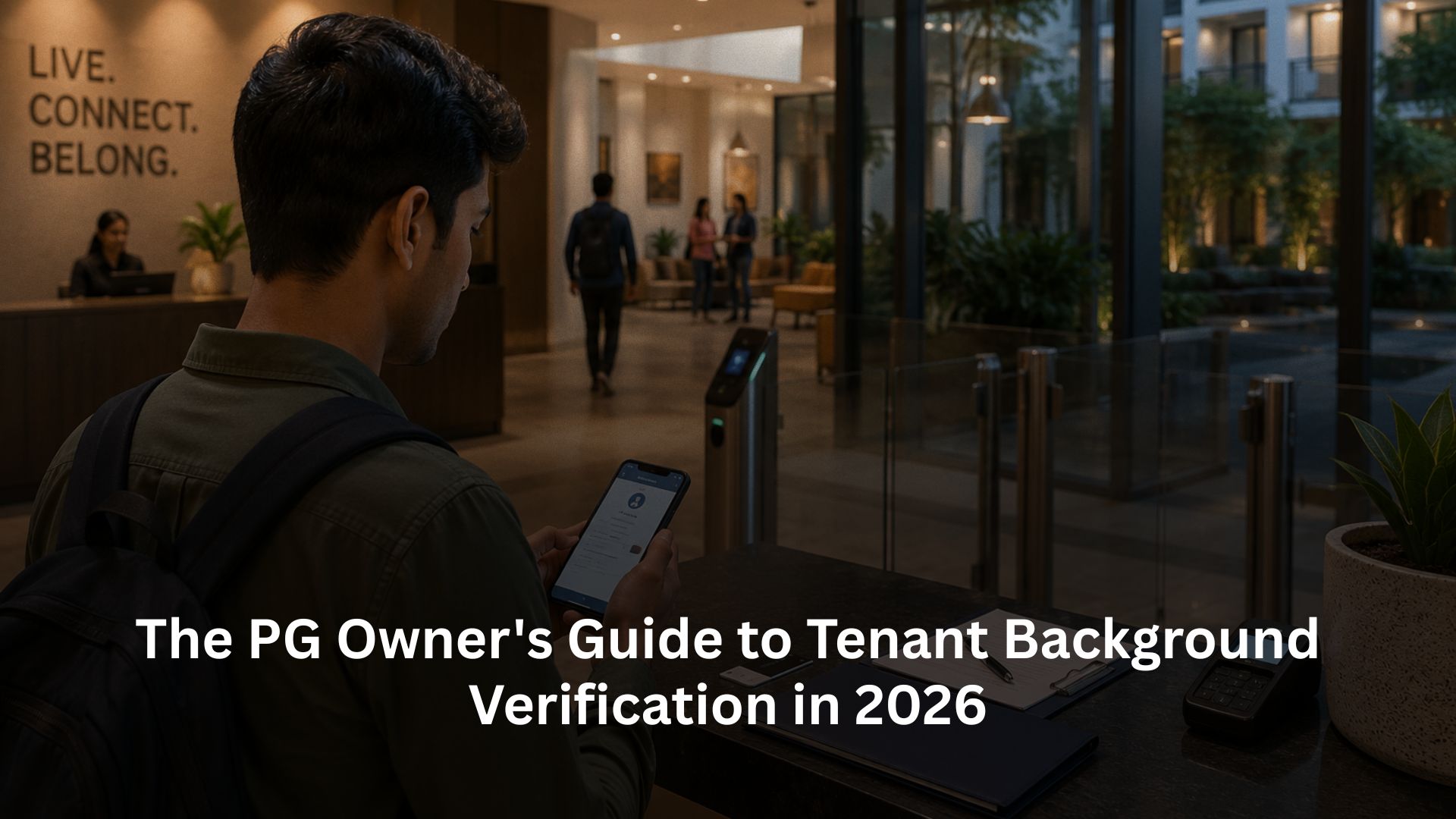
The PG Owner’s Guide to Tenant Background Verification in 2026

Written by
Ishika Pannu
Read Time
15 min read
Posted on
August 6, 2026
Overview
Overview
The PG Owner’s Guide to Tenant Background Verification in 2026
Running a PG in 2026 is no longer just about finding a tenant, collecting the deposit, and handing over the keys. As rental businesses become more organized and occupancy increases, one of the most important responsibilities for a PG owner is knowing exactly who is entering the property and maintaining reliable records throughout the tenant’s stay.
Tenant background verification plays an important role here. But there is a difference between collecting an Aadhaar card and actually carrying out a meaningful tenant background check.
A proper verification process should help a PG owner establish a tenant’s identity, complete the required documentation, follow applicable local verification procedures, and maintain records that can be accessed when needed. For properties with frequent move-ins and move-outs, this becomes even more important because manual verification can quickly turn into scattered documents, incomplete records, and repeated follow-ups.
The process has also become more layered. Aadhaar-based KYC can help establish identity, police verification can provide an additional security and compliance layer where applicable, while reference checks and other screening steps can give operators a broader understanding of the person they are onboarding. These checks serve different purposes and should not be treated as interchangeable.
This is why tenant background verification in India should be viewed as part of the overall risk-management process of a PG, rather than as another piece of paperwork to complete before move-in.
What Does Tenant Background Verification Actually Mean?
Tenant background verification is a broader process than simply checking an identity document.
At the most basic level, a PG owner needs to know whether the person moving into the property is actually the person represented in the documents submitted during onboarding. From there, the operator may need to complete additional checks depending on the property, location, applicable requirements, and internal verification policy.
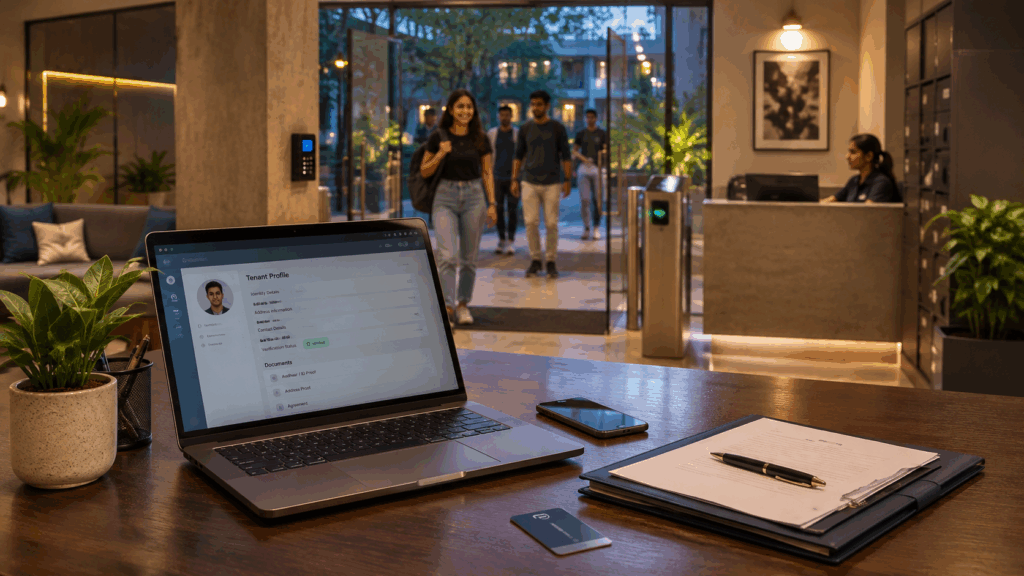
A structured tenant background check can bring together several layers of information, including:
- Identity verification, where the tenant’s submitted identity information is checked and documented so the property has a reliable record of who is occupying the room.
- Address and contact information, which gives the operator relevant details that may be required during emergencies, documentation processes, or future communication.
- Police verification or local tenant verification, where applicable, to follow the procedures required by the relevant local authorities.
- Reference or previous-stay checks, when appropriate, to understand a tenant’s previous rental experience and verify information that may not be visible through identity documents alone.
- Documentation and agreement records, ensuring that the information collected during onboarding remains connected to the tenant’s profile and occupancy record.
The important point is that these checks answer different questions. Identity verification helps establish who the tenant is. Police verification can add another layer to the security and compliance process. References can provide context about previous tenancy behaviour.
Treating all of these as one single “verification” step can therefore create gaps in the onboarding process.
For a deeper understanding of how identity verification and police verification differ, PG owners can also refer to RentOk’s guide on Aadhaar vs Police Verification: A Security Guide for Indian Landlords.
Why Is Tenant Background Verification Important for PG Owners?
The first reason is obvious: safety.
A PG is a shared living environment. Unlike an individual rental property where one household may occupy the entire premises, PGs and hostels often have multiple residents living under the same roof. This makes it important for operators to maintain clear information about who is occupying the property.
However, safety is only one part of the equation.
Verification also affects how professionally the property is managed. When tenant records are incomplete, the problem may not become visible immediately. It usually appears later, when a document is needed, a dispute occurs, an authority requests information, or the management team needs to confirm an occupant’s history.
For example, imagine a PG managing 150 beds. Over the course of a year, dozens of tenants may move in and out. If verification is handled through WhatsApp messages, physical photocopies, and spreadsheets, the owner may technically have all the information but still struggle to retrieve it.
That is where verification becomes an operational issue.
A strong tenant background verification system helps create:
- Better occupancy visibility, because management can connect verified tenant information with the room, bed, and period of stay.
- Stronger documentation, because identity records, agreements, and other relevant information can be maintained together instead of being scattered across multiple locations.
- Faster response during disputes or enquiries, because the operator can retrieve the relevant records without depending on individual staff members remembering where documents were stored.
- Greater consistency in onboarding, because every new tenant can go through a defined process instead of verification changing depending on who handled the move-in.
In other words, verification protects more than the property. It strengthens the operating system behind the property.
Is Aadhaar Verification Enough for a Tenant Background Check?
This is one of the most common questions PG owners have, and the answer requires some distinction.
Aadhaar-based KYC can be an important part of establishing a tenant’s identity, but identity verification and background verification are not necessarily the same thing.
An identity document can help confirm information associated with a person. It does not automatically answer every question a property owner may have about a prospective tenant.
That is why a more complete verification workflow may involve additional steps depending on the circumstances.
For example, an operator may need to consider:
- Whether local police or tenant verification procedures apply to the property.
- Whether the tenant’s permanent and current address information has been properly recorded.
- Whether emergency contact information has been collected.
- Whether the rental agreement and onboarding information are complete.
- Whether additional references or previous-stay information are appropriate for the property’s screening policy.
The key is not to turn verification into unnecessary investigation. It is to make sure the operator has enough reliable information to make responsible onboarding decisions and maintain proper records.
RentOk’s recent coverage on Aadhaar-Based Digital KYC for PG Owners also highlights an important distinction: digital KYC should become part of the onboarding workflow rather than remain a document-collection exercise.
Police Verification Adds Another Layer
Police verification is often discussed alongside Aadhaar verification, but it serves a different purpose.
Depending on the location and applicable local requirements, landlords and PG operators may need to complete tenant verification through the relevant police or government process. Requirements and procedures can vary, so operators should not assume that one process automatically applies across every city or state.
The operational mistake is waiting until after a tenant has already moved in to think about verification.
A better approach is to build verification into the onboarding sequence itself.
The process can be structured around:
- Collecting the required tenant information before occupancy begins.
- Verifying identity and completing the relevant KYC process.
- Following applicable local police or tenant verification procedures.
- Completing the rental agreement and maintaining the associated records.
- Linking the tenant’s documentation with their actual occupancy record.
This creates a much cleaner audit trail.
RentOk has previously covered the practical process in How to Get Online Police Verification for Your PG or Hostel in India, including how digital verification can reduce the manual effort involved in collecting and managing tenant information.
What About Reference Checks and Social Screening?
This is where the phrase “background check” becomes broader than KYC or police verification.
A tenant’s previous rental experience can sometimes provide useful context that official documents cannot. A reference from a previous landlord or accommodation provider, for example, may help an operator understand whether the information provided during onboarding is consistent with the tenant’s previous rental history.
However, reference checks should be handled carefully.
They should not become an informal excuse to collect unnecessary personal information or make decisions based on rumours, stereotypes, or irrelevant personal characteristics. A professional screening process should focus on information that is genuinely relevant to the tenancy and should respect the tenant’s privacy.
For a PG owner, useful reference questions may focus on practical tenancy-related matters such as:
- Whether the person previously occupied the stated property.
- Whether the tenancy period and basic rental information match what the tenant provided.
- Whether there were unresolved rental-related issues that are relevant to the new tenancy.
- Whether the reference itself can be reasonably verified.
Social media screening should be approached with even greater caution. Publicly available information does not automatically make every piece of personal information relevant to a rental decision.
The purpose of screening should be risk reduction and responsible onboarding, not intrusive investigation.

How to Spot Red Flags During Tenant Verification
Good verification is not about assuming that every tenant is a potential problem. It is about noticing inconsistencies before they become operational issues.
Sometimes the warning signs are surprisingly basic.
A tenant may provide information that does not match across documents. A phone number may be different from the one used during initial communication. An address may change repeatedly without a clear explanation. A reference may be difficult to verify. A submitted identity document may show signs that require additional checking.
None of these automatically proves wrongdoing.
But inconsistencies should not simply be ignored because the property is in a hurry to fill a vacant bed.
This is particularly important during high-demand periods when owners may feel pressure to complete move-ins quickly. Occupancy matters, but filling a room should not mean abandoning the verification process that protects the property.
RentOk has also published How to Spot a Fake ID During Tenant Verification, which fits naturally into this stage of the onboarding process.
The broader lesson is simple: speed and verification should not be treated as opposites. With a structured digital workflow, an operator can make verification faster without making it careless.
A Practical Tenant Background Verification Workflow for PGs
A strong verification process should be simple enough for staff to follow consistently.
The first stage should happen before the tenant is fully onboarded. Collect the required information and make sure the person understands why verification is necessary. This is important because transparency at the beginning prevents unnecessary friction later.
Next comes identity verification and documentation. Rather than allowing documents to remain inside individual WhatsApp chats or email threads, they should be attached to the appropriate tenant record.
The next stage is local verification, where applicable. This is where operators should follow the relevant process for their city or jurisdiction rather than relying on a generic nationwide assumption.
Finally, the records should remain accessible throughout the tenant lifecycle.
A practical workflow should therefore cover:
- Pre-move-in information collection, so essential tenant details are available before room or bed allotment is finalized.
- Identity and KYC verification, so the tenant profile is built around reliable documentation rather than manually entered information alone.
- Agreement completion, ensuring the tenancy terms and supporting documentation are connected to the same tenant record.
- Police or local verification, where applicable, based on the procedures relevant to the property’s location.
- Record maintenance, so the information remains accessible during the tenant’s stay, renewal, transfer, or move-out.
This approach turns verification into a repeatable operating process rather than a one-time administrative task.
What Happens When PG Owners Skip Proper Verification?
The consequences are not always immediate, which is exactly what makes weak verification dangerous.
A property can operate for months without encountering any obvious problem. Then one dispute, authority request, payment issue, or unexpected incident can expose how incomplete the underlying records actually are.
Poor verification can lead to:
- Difficulty establishing accurate occupancy records, particularly when tenant movement is high and information is not updated systematically.
- Longer response times during disputes, because staff need to search through multiple folders, chats, and registers before finding the relevant documents.
- Compliance gaps, when required information has not been collected or cannot be produced when needed.
- Operational confusion, especially when the person managing the property changes and important tenant records remain tied to the previous employee’s files or device.
The problem is therefore bigger than “missing paperwork.”
It is also a question of how prepared the property is when documentation is suddenly required. For a broader look at the compliance side of tenant onboarding, see Digital KYC and Police Verification: State-wise Compliance in India.
It is a lack of operational visibility.
A PG owner should be able to answer basic questions about every current tenant without having to reconstruct the entire onboarding process from old WhatsApp messages.
Why Digital Verification Makes More Sense as Your PG Grows
Manual verification can work when the number of tenants is small. The difficulty begins when the volume increases.
Consider an operator managing several properties. Every month, new tenants are being onboarded, existing tenants are transferring rooms, some residents are moving out, and staff members are handling different parts of the process.
At that scale, verification cannot depend on memory.
Digital systems provide structure by connecting documentation with the tenant profile and occupancy information. This makes the verification process easier to repeat and easier to monitor.
It also reduces dependency on individual staff members. If one employee leaves, the tenant records should not leave with them.
This is one of the reasons digital KYC and verification are becoming increasingly important for organized rental businesses. RentOk’s guide on How to Maintain Tenant KYC Records Digitally explores this broader documentation problem and explains why simply storing scanned documents in folders is not the same as maintaining structured digital records.
For PG owners building toward multiple properties, this distinction becomes critical.
Tenant Verification Should Be Part of Your Tenant Experience
Verification is sometimes treated as an uncomfortable administrative hurdle that tenants simply have to tolerate.
It does not have to be.
When the process is clearly explained, digitally organized, and completed as part of a smooth onboarding journey, verification can actually contribute to the professional image of the property.
A tenant who receives a clear verification request, understands what information is required, completes it digitally, and receives proper confirmation gets a very different impression from a tenant who is asked to send photographs of documents to three different WhatsApp numbers.
The difference may seem small, but these small operational details shape how residents perceive management.
Professional onboarding communicates something important:
the property takes documentation, safety, and tenant records seriously.
That matters not only for compliance but also for building trust from the first day of the tenancy.

How RentOk Helps With Tenant Background Verification
As a PG grows, managing tenant verification through spreadsheets, physical files, WhatsApp chats, and separate document folders becomes increasingly difficult. The challenge is not simply collecting documents; it is keeping identity information, KYC records, agreements, occupancy details, and tenant history connected throughout the entire rental lifecycle.
RentOk’s Tenant Verification workflow brings these processes into a more centralized system. The platform supports digital KYC and tenant document management while keeping tenant information connected with the broader property management workflow. RentOk also brings tenant details, rental information, payment history, and verification-related records together so property managers have better visibility instead of relying on scattered documentation.
This becomes particularly useful for operators managing multiple rooms, high tenant turnover, or more than one property. Instead of treating verification as a separate administrative task, it can become part of a standardized onboarding process that is easier for staff to follow and easier for owners to monitor.
Conclusion: Build a Tenant Verification Process That Scales
Tenant background verification in 2026 is no longer something PG owners should approach as a quick document-collection exercise. A responsible verification process combines identity checks, appropriate KYC documentation, applicable police verification procedures, reliable record-keeping, and sensible screening practices into one structured onboarding workflow.
The objective is not to investigate tenants unnecessarily or make the move-in process complicated. It is to create enough reliable information to know who is occupying the property, maintain proper documentation, and reduce avoidable operational and compliance risks.
For a small PG, this may begin with a simple verification checklist. For a growing rental business, it needs to become a system.
If you are looking to streamline tenant verification, digitize tenant KYC, and create a more organized tenant onboarding process, explore RentOk’s Tenant Verification feature and see how digital verification can fit into your everyday PG management workflow.
Frequently Asked Questions
Find answers to common questions about this topic
About the Author
Ishika Pannu
Ishika Pannu brings you the latest insights and easy-to-apply strategies in property management—helping you simplify renting and grow with RentOk.
You may also like these
Related Articles

1 min read
Is a Notarised Rent Agreement Enough, or Do I Need to Register It?
Written by
Posted on
Ishika Pannu
Oct 5, 2026

1 min read
Which Indian Cities Still Fall Under Old Rent Control Laws?
Written by
Posted on
Ishika Pannu
Oct 3, 2026

1 min read
Managing Rental Property in India as an NRI Landlord
Written by
Posted on
Ishika Pannu
Oct 1, 2026
1 min read
What Documents Do I Actually Need Before Handing Over My Rental Property?
Written by
Posted on
Ishika Pannu
Sep 30, 2026

1 min read
Is a Verbal Rental Agreement Legally Valid in India?
Written by
Posted on
Ishika Pannu
Sep 24, 2026
1 min read
What Can I Do If My Tenant Stops Paying Rent?
Written by
Posted on
Ishika Pannu
Sep 23, 2026
1 min read
How to Check If Your PG or Hostel is Legally Registered in India
Written by
Posted on
Ishika Pannu
Sep 20, 2026
1 min read
How to Negotiate Rent and Maintenance Terms Before Signing
Written by
Posted on
Ishika Pannu
Sep 19, 2026

1 min read
What Your Landlord Can and Cannot Store From Your KYC Documents
Written by
Posted on
Ishika Pannu
Sep 19, 2026
1 min read
Why a Digital Rent Agreement Is Just as Legally Valid as a Paper One
Written by
Posted on
Ishika Pannu
Sep 18, 2026
Stay ahead in property management with expert insights
Join thousands of property managers receiving exclusive tips delivered straight to your inbox.
Browse posts by category
Case Study
Cost of Living
Growth
Legal
Market Trends
News
Pg owner app
Property Management
Property Tax
Tech
RentOk
The easiest way to rent and manage your PGs and hostels.
Grievance Officer
Get the app


Contact us
hello@eazyapp.tech
HQ Office
COGROW, BASEMENT F-12/8A
BESIDE HOUSE OF STYLE SALON, SECTOR 28, DLF PHASE 1
GURUGRAM, HARYANA - 122002
South India Office
LUMIODESK COWORKING, 2ND FLOOR, 40, 14TH MAIN RD
BESIDE MC DONALD, 7TH SECTOR, HSR LAYOUT
BENGALURU, KARNATAKA - 560102
©️ 2026 EazyApp Tech Pvt Ltd. All rights reserved


