Pg owner app
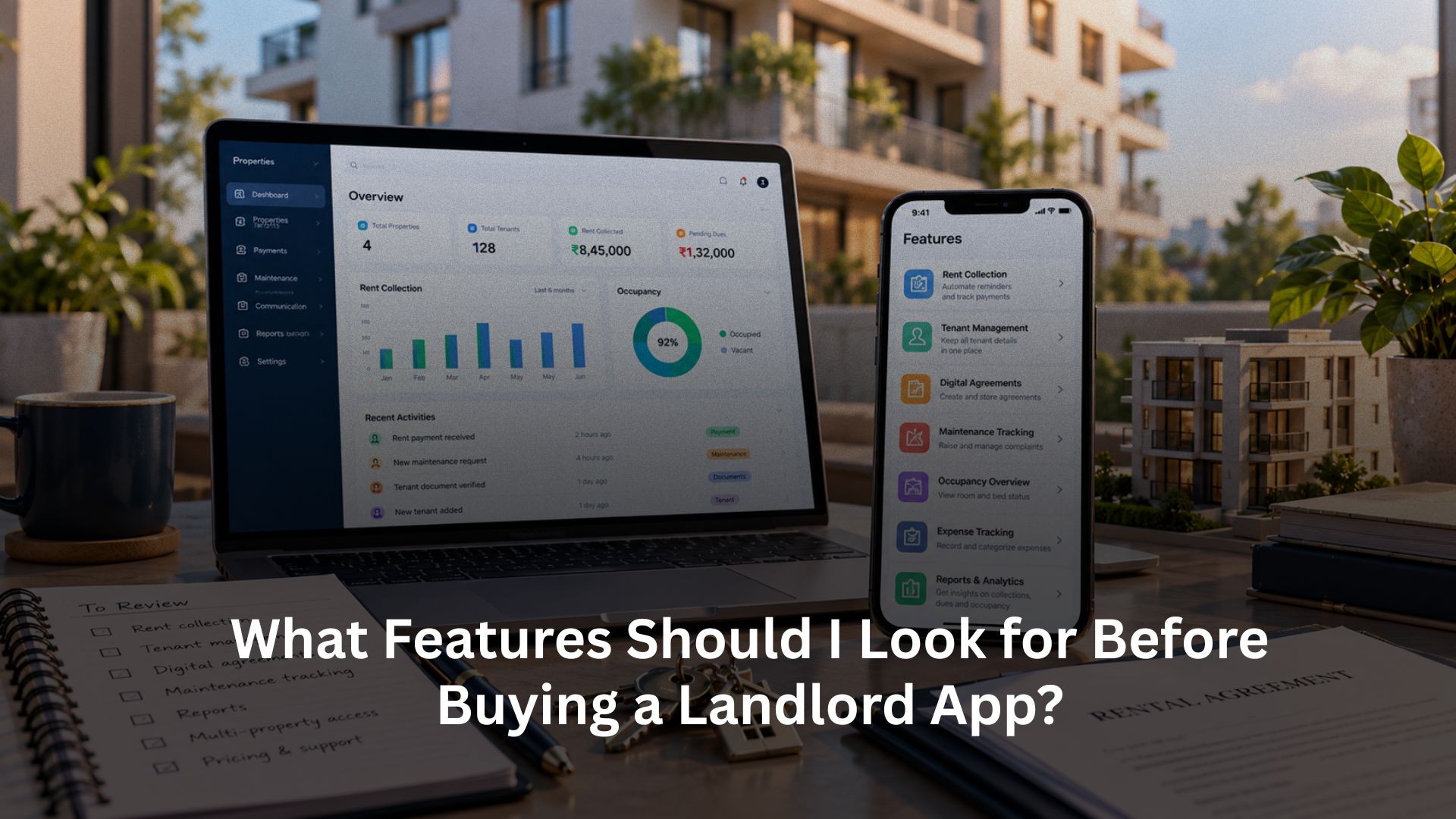
What Features Should I Look for Before Buying a Landlord App?

Written by
Ishika Pannu
Read Time
15 min read
Posted on
October 2, 2026
Overview
Overview
What Features Should I Look for Before Buying a Landlord App?
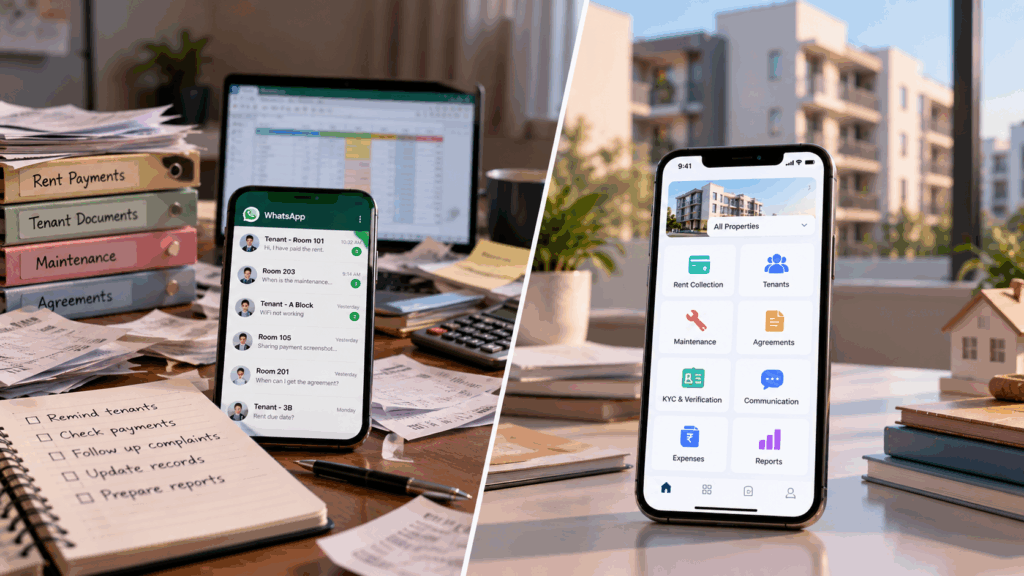
Managing a rental property becomes a very different job once the number of tenants starts increasing. With a few tenants, it may be possible to remember payment dates, keep documents in a folder, and use WhatsApp whenever something needs to be communicated. But once you are managing multiple rooms, properties, or a larger tenant base, these small tasks start becoming a daily operational burden.
This is where a landlord app can make a real difference.
A good property management app does more than help you collect rent online. It should bring tenant information, payments, documentation, maintenance, occupancy, and reporting into a structured system. The objective is not to add another app to your phone. It is to reduce the number of manual processes you have to manage every day.
But not every landlord app is built the same way. Some focus primarily on payments, while others are designed around accounting, tenant communication, or large residential portfolios. For landlords, PG owners, and rental operators in India, the better approach is to identify the problems you face every day and then check whether the software can actually solve them.
Start With the Problems You Want the App to Solve
Before comparing features, look at your current property management process.
Are you manually reminding tenants about rent? Do you search through WhatsApp conversations to find payment screenshots? Are tenant documents stored in different folders? Do maintenance complaints disappear into chat groups? Do you have to open multiple spreadsheets to understand how much each property collected last month?
These are not separate problems. They are signs that different parts of the rental operation are being managed independently.
A useful landlord app should connect these processes rather than simply digitize one of them. A property management system becomes significantly more useful when tenant management, rent collection, accounting, complaints, agreements, KYC, and communication can work together instead of existing as separate processes.
This is also why it helps to understand what a property management app actually does before comparing individual products. The right system should function as a central operating layer for the property, rather than becoming another isolated tool.
Once you look at the problem this way, the feature checklist becomes much clearer.
Rent Collection and Automated Reminders
Rent is at the centre of every rental business, so rent collection should be one of the first things you evaluate.
A landlord app should not merely provide a payment button. It should help you manage the complete rent cycle — from generating dues and reminding tenants to recording payments and maintaining a clear payment history.
This matters because collecting rent manually involves several repetitive steps. Someone has to identify who has paid, check who is overdue, send reminders, verify transactions, update records, and answer tenants when they ask for confirmation.
Look for features such as:
- Automated rent reminders that can notify tenants about upcoming or overdue payments without requiring you to message everyone individually every month.
- Digital payment options that allow tenants to pay conveniently through online methods while giving management clear visibility into the transaction.
- Tenant-wise payment history so previous transactions can be checked without searching through separate WhatsApp conversations, screenshots, or spreadsheets.
- Dues and collection visibility that allows you to quickly identify what has been collected, what remains pending, and how the property is performing overall.
A useful system should make rent collection more predictable, not simply move the same manual process from a notebook to a mobile screen.
Rent collection also needs to be measured, not just completed. RentOk’s guide on how to track rent collection performance looks at why landlords need to understand payment patterns, delays, and collection efficiency instead of focusing only on whether the month’s rent eventually arrived.
Digital Agreements and Receipts
Rental documentation is another area where manual processes become difficult surprisingly quickly.
Agreements, receipts, payment records, tenant documents, and other paperwork are often created at different points in the tenant journey. If these documents are stored separately, finding the right record later can become unnecessarily time-consuming.
A landlord app should therefore provide a structured way to create, store, and access important rental documents.
Digital agreements are particularly useful during onboarding because the process can be completed without repeatedly printing, scanning, and physically storing paperwork. Digital receipts also give both sides a clearer record of completed transactions.
When evaluating this feature, check whether the platform supports:
- Digital rental agreements and e-signing, so agreements can be completed without depending entirely on physical paperwork.
- Digital receipts and transaction records, allowing tenants and management to maintain a clearer payment trail.
- Centralized document storage, so tenant-related documents remain connected to the relevant profile rather than being scattered across folders.
- Easy document retrieval, particularly when you need to check an agreement or transaction months after the tenant moved in.
This becomes even more important when a landlord manages multiple properties. Documentation that is easy to find is operationally much more useful than documentation that merely exists.
Tenant Verification and Digital KYC
Tenant management starts before the tenant occupies the room.
A proper landlord app should help you organize the onboarding process and maintain relevant tenant information in one place. This includes personal details, identification documents, rental information, and other records required by the property.
Digital KYC can reduce the dependence on physical paperwork while creating a more structured tenant profile.
A useful system should ideally allow you to:
- Collect tenant information digitally during onboarding rather than entering the same information repeatedly into different records.
- Upload and organize identification documents so that important information remains connected to the tenant profile.
- Maintain verification status and relevant documentation in one place for easier reference later.
- Keep tenant records accessible alongside payment and occupancy information instead of maintaining separate systems for each.
This becomes particularly relevant for PGs, hostels, and co-living properties where tenant turnover can be significantly higher than in traditional long-term rentals.
Tenant verification should also be viewed as part of the larger onboarding process rather than an isolated compliance task. RentOk’s article on tenant management software explores how tenant records, documentation, communication, and other management activities become harder to coordinate as the tenant base grows.
Maintenance and Complaint Tracking
A property can have excellent rooms and facilities, but that does not mean every maintenance issue will disappear.
The important part is what happens when something goes wrong.
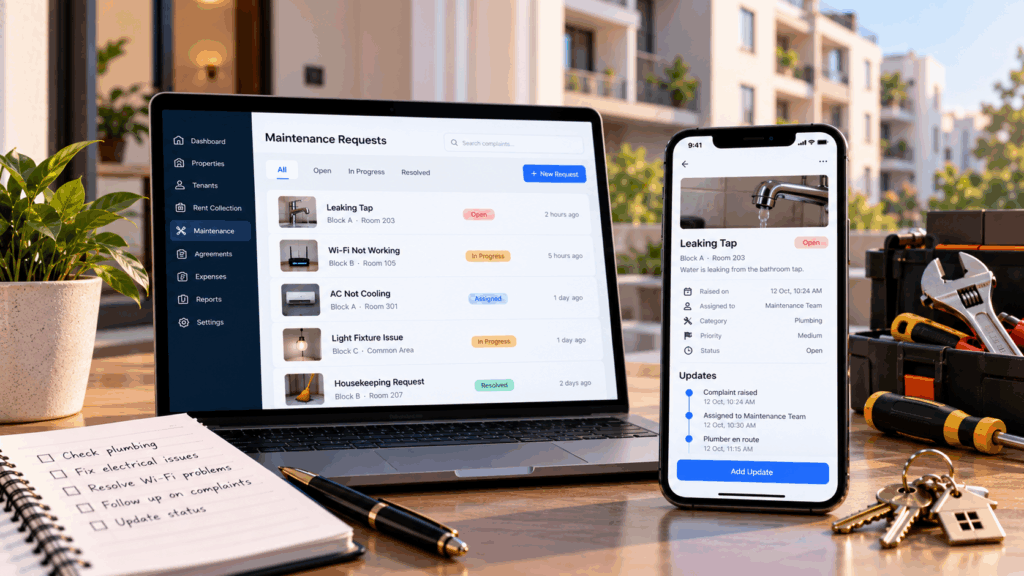
A leaking tap, Wi-Fi problem, electrical issue, broken appliance, or housekeeping complaint needs more than a message saying “I’ll check.” Someone needs to receive the complaint, take responsibility for it, coordinate the resolution, and close the issue.
This is where complaint and maintenance tracking becomes an important landlord-app feature.
Instead of relying entirely on WhatsApp conversations, a structured system can help you keep track of:
- The complaint and when it was raised, so there is a clear record rather than relying on memory or an old conversation.
- The person responsible for resolving it, particularly when different staff members or vendors handle different types of maintenance.
- The current status of the issue, making it easier to distinguish between new, ongoing, and resolved complaints.
- Communication and updates, so tenants do not have to repeatedly ask whether anything is being done.
The benefit is not just faster complaint resolution. It is visibility. Management can see what is still open instead of relying on individual staff members to remember which issues need attention.
For properties with a large tenant base, this difference becomes significant. A few unresolved complaints may be manageable manually. Hundreds of requests spread across different chats are not.
Property, Room, and Occupancy Management
This feature becomes particularly important for landlords managing PGs, hostels, or shared accommodation.
Knowing that a property has 100 tenants is not enough. You need to know where those tenants are, which rooms are occupied, which beds are vacant, and which tenants may be moving out soon.
A landlord app should provide a clear view of occupancy rather than making you reconstruct it manually.
Ideally, you should be able to see:
- Occupied and vacant rooms or beds, so the team can quickly understand current availability and identify spaces that can be marketed.
- Tenant movement and notice information, allowing management to prepare for upcoming vacancies rather than discovering them at the last minute.
- Sharing configurations and rent information, particularly for properties where different rooms and occupancy types have different pricing.
- Property-level occupancy information, especially when the owner manages more than one building or location.
This visibility becomes useful when vacancies directly affect revenue. An empty bed is not simply an empty space; it represents potential income that requires attention.
For a broader look at this problem, RentOk’s property management software guide for landlords also covers vacancy, occupancy, tenant management, expenses, and the operational impact of moving away from manual systems.
Expense Tracking and Financial Visibility
Collecting rent tells you how much money came into the property. It does not tell you how profitable the property actually was.
Maintenance expenses, utilities, vendor payments, staff costs, and other operational expenses all affect the final numbers. If these are recorded separately or only reviewed at the end of the month, it becomes difficult to understand where the money is going.
This is why expense tracking should be part of your landlord app checklist.
A good system should allow you to record expenses against the relevant property and category while making it possible to review collections and expenses together.
That can help answer practical questions such as whether higher collections actually translated into better profitability or whether rising operational costs absorbed the additional revenue.
Financial visibility becomes much more valuable when it moves beyond simple record-keeping. Instead of opening multiple spreadsheets at the end of the month, owners should be able to understand the financial position of their properties through organized and current data.
Reports That Help You Understand the Business
A dashboard full of numbers is not automatically useful.
The real value of reporting comes from turning daily transactions into information that helps you understand the property and make better operational decisions.
At minimum, landlords should look for reports covering collections, outstanding dues, expenses, tenants, leads, and property performance. The system should also make it easy to review information by property and time period where relevant.
Useful reporting can help identify patterns such as:
- Recurring payment delays, allowing management to identify collection issues instead of noticing them only after they become serious.
- Property-level performance, helping owners understand how individual locations are performing rather than relying on an overall figure.
- Expense trends, making it easier to spot increasing maintenance, utility, or operational costs.
- Occupancy and vacancy movement, allowing owners to connect changes in occupancy with collections and overall property performance.
This is why reporting should not be treated as an optional extra. As a rental business grows, reporting becomes part of the decision-making process.
The owner should not have to spend hours compiling data just to understand what happened during the previous month.
Communication Built Into Daily Operations
Communication is often overlooked when landlords compare software because it can appear secondary to rent collection or accounting.
Operationally, it is anything but secondary.
Rent reminders, payment confirmations, tenant notices, onboarding instructions, complaint updates, and other announcements all require communication. If every message still has to be created and sent manually, the software has only solved part of the problem.
The better approach is to look for communication features that are connected to the workflow.
A rent reminder, for example, becomes more useful when it is connected to the tenant’s outstanding dues. A complaint update is more meaningful when it remains connected to the complaint itself. An announcement is easier to manage when it can reach the relevant tenants without requiring management to recreate the same message repeatedly.
This distinction becomes particularly important for landlords who rely heavily on WhatsApp. The goal is not necessarily to stop using WhatsApp. It is to stop using a chat thread as the only place where operational records exist.
Structured communication can reduce repetitive follow-ups while giving management a clearer record of what has been communicated and when.
Multi-Property Access and Scalability
A landlord app should work for the property you manage today, but it should not become a problem when the business grows.
If you currently manage one property, you may not need a complicated system. But if you plan to add another building, more rooms, or another location, the software should be able to accommodate that growth without forcing you to rebuild your entire workflow.
Look at whether the platform provides:
- Multi-property visibility, allowing information from different properties to remain organized instead of being mixed together.
- Property-level reporting, so you can understand the performance and financial position of individual locations.
- Team or staff access, where relevant, so daily tasks do not depend entirely on one person’s account or device.
- Centralized data, allowing the owner or manager to maintain oversight without manually combining information from different systems.
Scalability is not about choosing the software with the largest feature list. It is about choosing a system that continues to make sense as the operation becomes more complex.
A solution that works beautifully for one property but becomes difficult to manage across five properties may not actually be solving the long-term problem.
The Right Landlord App Should Connect the Entire Workflow
One of the biggest mistakes landlords make while comparing software is judging every feature independently.
Automated rent reminders are useful. But they become considerably more valuable when the reminder is connected to the tenant’s dues, payment history, receipt, and reporting.
Tenant KYC is useful. But it becomes more useful when the verified information remains connected to the tenant’s agreement, occupancy, and payment records.
Complaint management is useful. But its operational value increases when complaints can be tracked alongside tenant information and communication.
This is why software evaluation should focus on the workflow rather than the feature count.
The same principle comes through in RentOk’s 5 Best Rent Collection Apps for Landlords, where the emphasis is not simply on accepting payments but on reminders, dues, ledgers, payment visibility, and the overall collection process.
A good landlord app should therefore pass a simple test: does it make the work easier after the tenant is added, or does it simply give you another place to enter information?
That distinction matters. The purpose of property management software is to create a connected workflow that reduces repetitive work while giving the owner a clearer view of what is happening across the property.
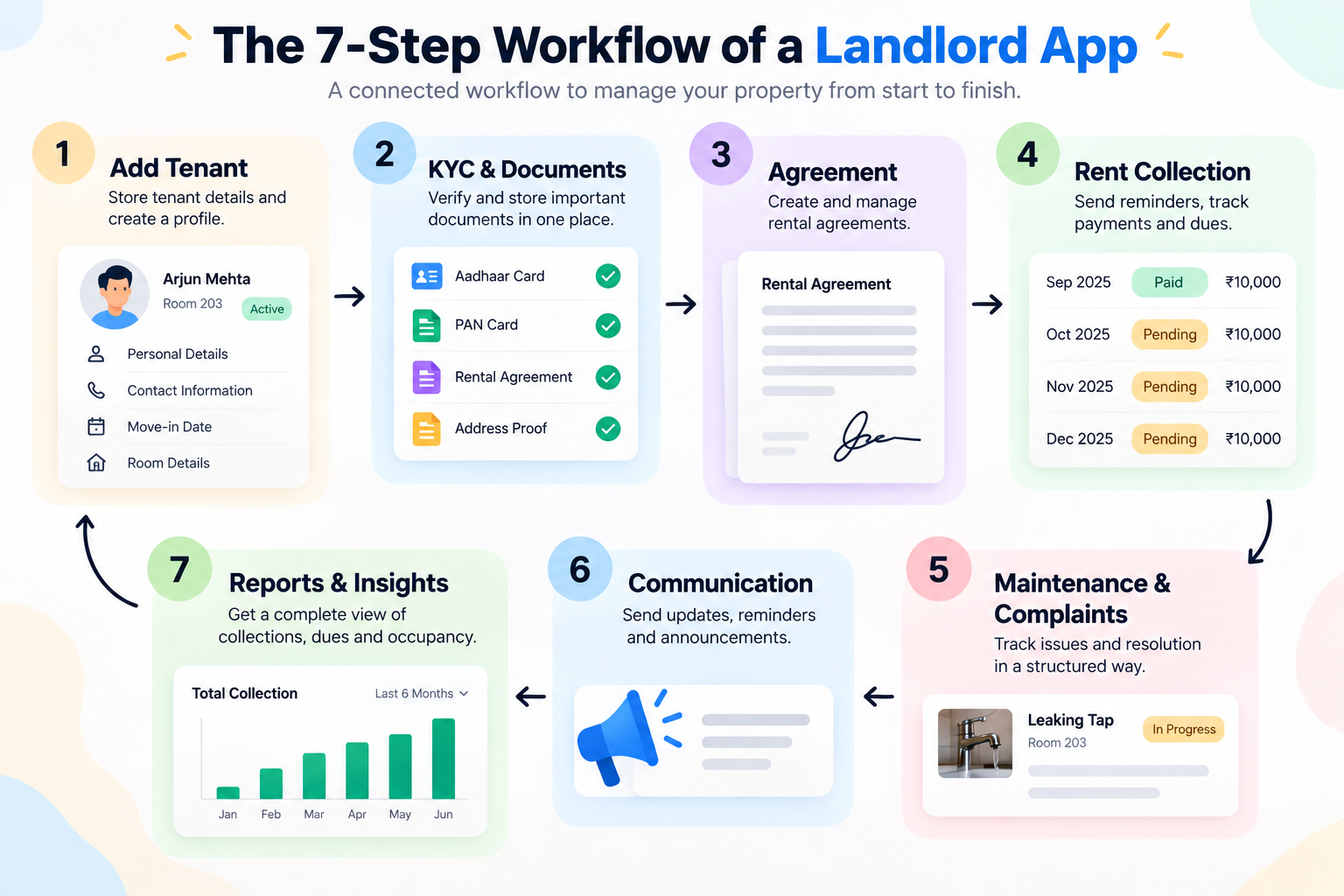
How RentOk Helps Landlords Manage Their Properties
RentOk brings key rental management functions into one connected platform, helping landlords, PG owners, and property operators reduce their dependence on spreadsheets, scattered documents, manual reminders, and disconnected communication.
With RentOk, landlords can manage tenant information, digital KYC, rental agreements, rent collection, automated reminders, payment records, complaints, occupancy, expenses, and reports from a centralized system. Property and room-level information can also be managed from the same platform, giving owners greater visibility into day-to-day operations.
The bigger advantage is how these functions connect. Rent collection does not have to sit separately from tenant records. Occupancy does not have to be maintained in another spreadsheet. A complaint does not have to disappear into a WhatsApp conversation. The objective is to give landlords a more structured operating system for their properties, making daily management easier to track while creating a foundation that can scale with the business.
Conclusion
Choosing a landlord app is ultimately less about finding the platform with the longest feature list and more about finding one that fits the way your rental business actually operates.
Before making a decision, look beyond basic rent collection and check whether the software can support the complete property-management workflow, from tenant onboarding and verification to agreements, payments, complaints, occupancy, expenses, communication, and reporting.
The right system should reduce repetitive work, improve visibility, and make important information easier to access when you need it. Most importantly, it should continue to be useful as your property and tenant base grow.
If you are evaluating software for your rental business, explore all the features on RentOk and see how a connected property management system can bring your daily operations together.
Frequently Asked Questions
Find answers to common questions about this topic
About the Author
Ishika Pannu
Ishika Pannu brings you the latest insights and easy-to-apply strategies in property management—helping you simplify renting and grow with RentOk.
You may also like these
Related Articles

1 min read
How Much Should Property Management Software Cost in India?
Written by
Posted on
Ishika Pannu
Oct 3, 2026
1 min read
RentOk vs Crib vs My PG Manager: Which PG Software Actually Fits My Business?
Written by
Posted on
Ishika Pannu
Sep 30, 2026
1 min read
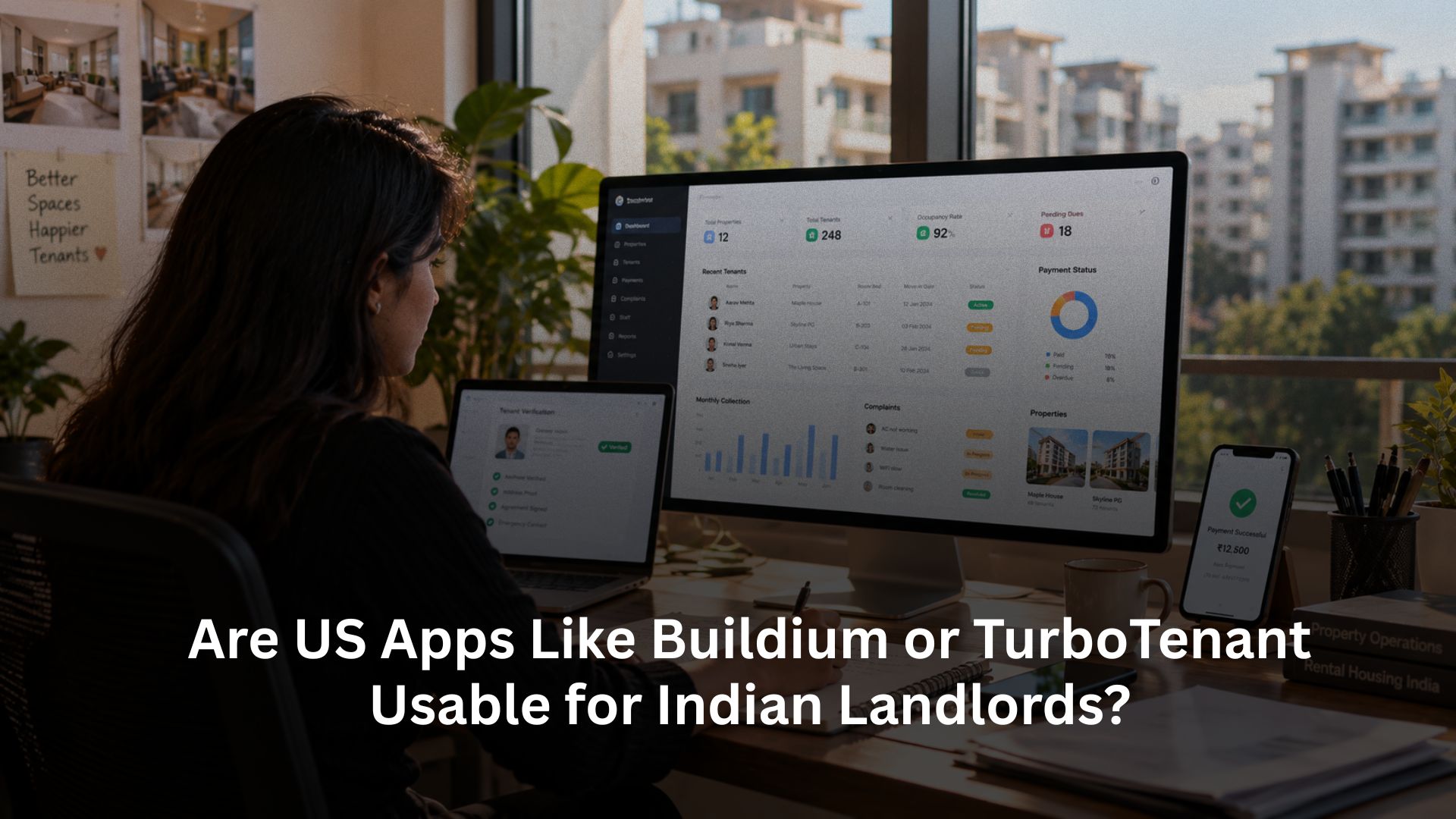
Are US Apps Like Buildium or TurboTenant Usable for Indian Landlords?
Written by
Posted on
Ishika Pannu
Sep 29, 2026
1 min read
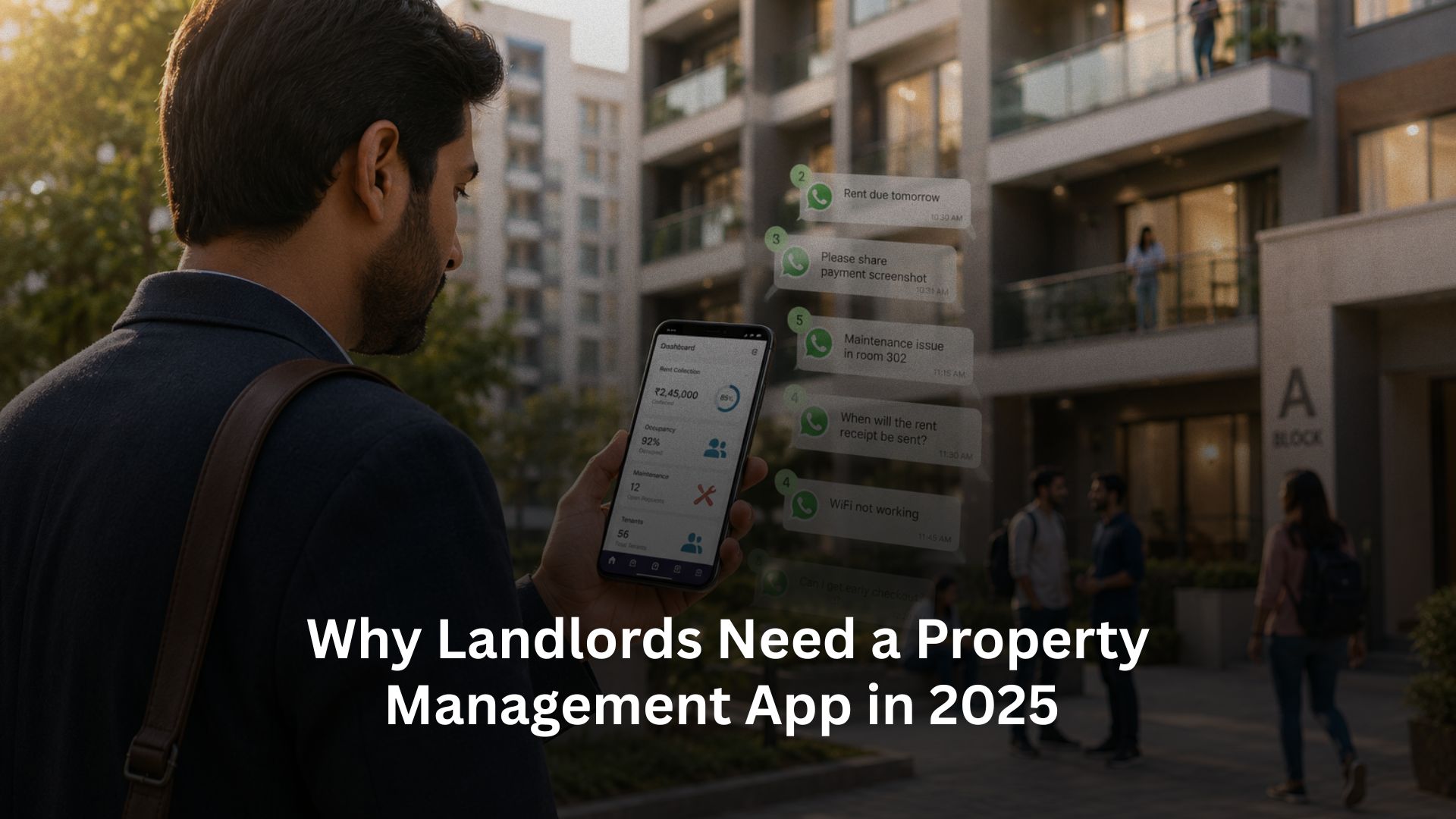
Why Landlords Need a Property Management App in 2025
Written by
Posted on
Ishika Pannu
Sep 2, 2026
1 min read
How Property Management Software Helps You Collect Rent on Time
Written by
Posted on
Ishika Pannu
Aug 26, 2026
1 min read
Why Small Landlords Need Property Management Software
Written by
Posted on
Ishika Pannu
Aug 26, 2026
1 min read
How High-Growth PGs Maintain Occupancy Year-Round
Written by
Posted on
Ishika Pannu
Aug 17, 2026
1 min read
How to Mark PG Attendance Without Biometric Devices
Written by
Posted on
Ishika Pannu
Jun 16, 2026
1 min read
Tracking Staff Performance: From Cleaning to Security
Written by
Posted on
Ishika Pannu
May 13, 2026
1 min read
Automating Complaint Management: Boosting Tenant Satisfaction
Written by
Posted on
Ishika Pannu
May 11, 2026
Stay ahead in property management with expert insights
Join thousands of property managers receiving exclusive tips delivered straight to your inbox.
Browse posts by category
Case Study
Cost of Living
Growth
Legal
Market Trends
News
Pg owner app
Property Management
Property Tax
Tech
RentOk
The easiest way to rent and manage your PGs and hostels.
Grievance Officer
Get the app


Contact us
hello@eazyapp.tech
HQ Office
COGROW, BASEMENT F-12/8A
BESIDE HOUSE OF STYLE SALON, SECTOR 28, DLF PHASE 1
GURUGRAM, HARYANA - 122002
South India Office
LUMIODESK COWORKING, 2ND FLOOR, 40, 14TH MAIN RD
BESIDE MC DONALD, 7TH SECTOR, HSR LAYOUT
BENGALURU, KARNATAKA - 560102
©️ 2026 EazyApp Tech Pvt Ltd. All rights reserved


