
Pg owner app
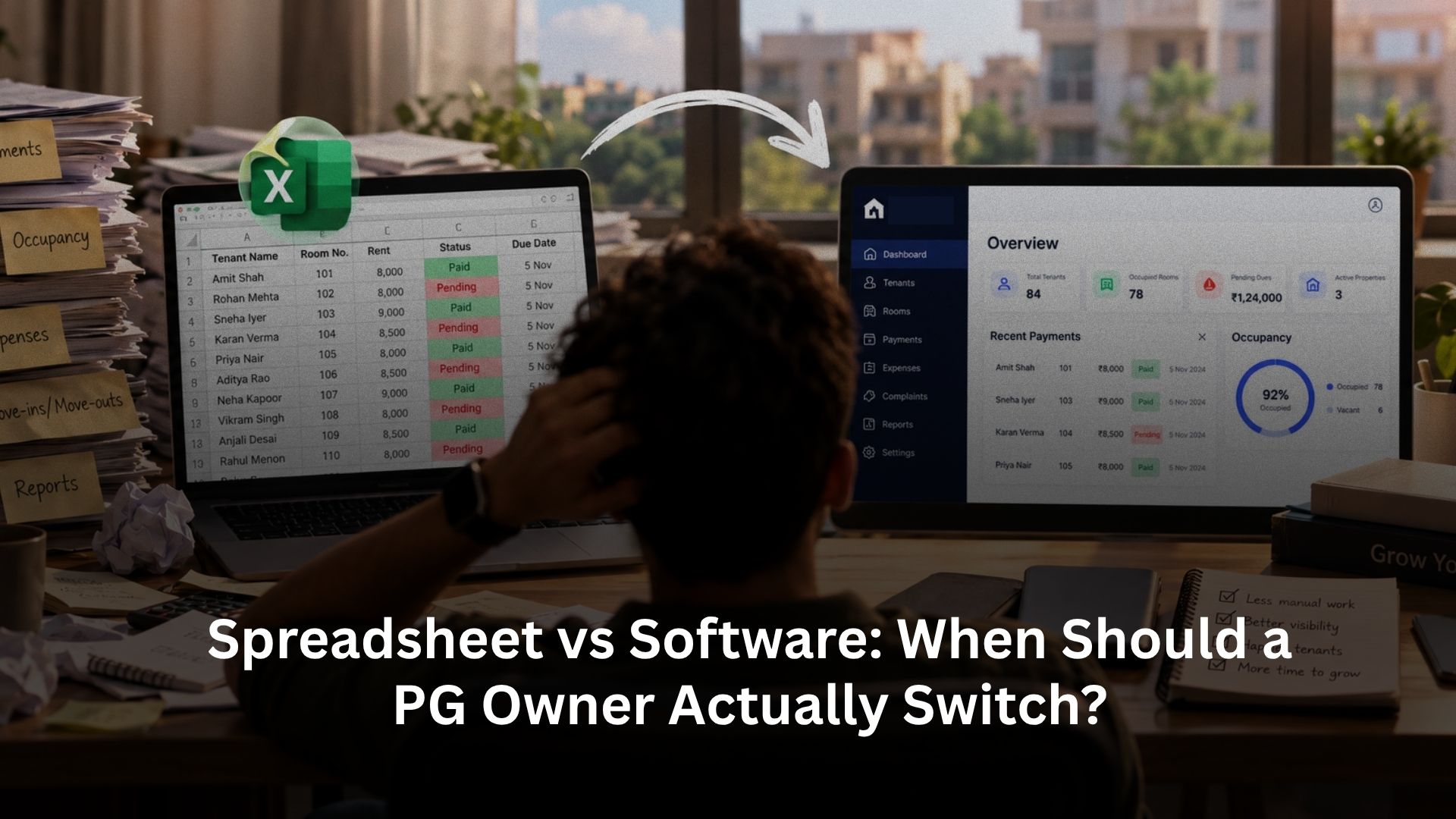
Spreadsheet vs Software: When Should a PG Owner Actually Switch?

Written by
Ishika Pannu
Read Time
17 min read
Posted on
October 4, 2026
Overview
Overview
Spreadsheet vs Software: When Should a PG Owner Actually Switch?
For most PG owners, spreadsheets are not the problem. In fact, they are often where property management begins.
When a property has a few tenants, a straightforward rent cycle, and limited operational activity, Excel can handle a surprising amount of work. Tenant names, room numbers, rent amounts, deposits, expenses, and payment status can all sit inside a well-maintained workbook. It is familiar, flexible, and easy to customise.
The difficulty begins when the business changes but the management system does not.
More tenants bring more payments, more move-ins and move-outs, more room changes, more communication, and more information to keep updated. Add another property or a few team members, and the same spreadsheet that once felt convenient can start demanding constant maintenance.
That is why the real question is not “Is Excel good or bad for property management?”
It is “When does Excel stop being the most practical system for the way my PG operates?”
There is no universal tenant number at which every PG needs software. A 30-bed property with complicated operations may need a structured system earlier than a 100-bed property managed by one person. The real deciding factor is usually the amount of coordination happening behind the spreadsheet.
Where Spreadsheets Start Breaking Down as You Scale
Excel is excellent at storing information. It can sort, filter, calculate, compare, and organise large amounts of data. That flexibility explains why so many PG owners start with it.
But property management is not only a data-storage problem.
Every day, information changes. A tenant pays rent. Someone moves out. Another resident changes rooms. A new tenant checks in. A deposit needs an adjustment. An expense gets recorded. A complaint requires follow-up. An owner wants to know the current occupancy.
With a spreadsheet, each change depends on someone noticing it and updating the relevant information correctly.
That approach works when there are only a few changes to manage. As transactions increase, however, the spreadsheet becomes increasingly dependent on human discipline.
The first signs usually appear gradually
The workbook rarely becomes difficult overnight. Instead, small additions accumulate until the owner realises that maintaining the system itself has become a task.
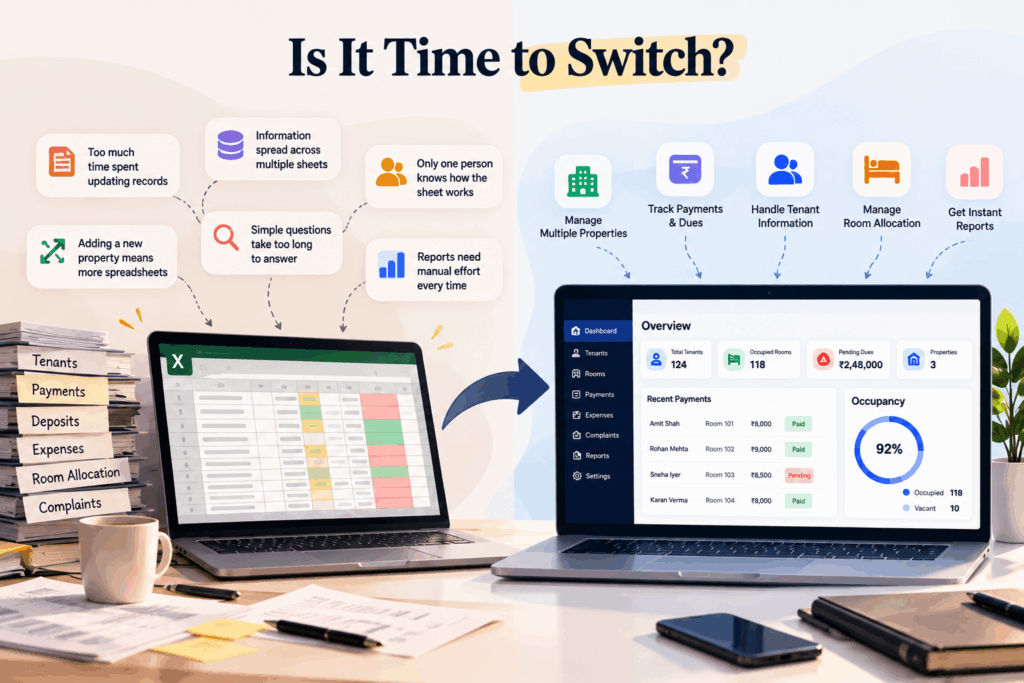
- The number of sheets keeps increasing because every new operational requirement gets its own tab, making the workbook harder for the team to understand and maintain consistently.
- The same tenant information appears in multiple places, so one small change may require several manual updates before every record reflects the latest information.
- Staff members start maintaining separate files or personal records because the central spreadsheet does not give everyone an efficient way to access the information they need.
- Simple operational questions require checking multiple sheets, filtering data, or asking another team member before anyone can confirm the answer.
None of these problems means Excel has suddenly failed.
They indicate something more important: the property has developed workflows that a spreadsheet was never designed to coordinate.
This becomes even more visible when an owner starts managing multiple properties. Information that once lived in one workbook now has to move between different properties, teams, payment records, and occupancy reports.
For a broader look at this transition, How to Manage Multiple Rental Properties Without Spreadsheets explains why adding properties often creates another layer of manual coordination.

The Errors That Quietly Cost PG Owners Money
One of the most underestimated problems with spreadsheet-based management is that the cost of an error rarely ends with the error itself.
Suppose a tenant makes a payment but someone updates the spreadsheet two days later. The payment has not disappeared, but the property manager may still see an outstanding balance during those two days. A reminder could go out unnecessarily, the tenant may need to share proof of payment, and someone eventually has to reconcile the records.
The same thing happens with occupancy.
A tenant moves from one room to another, but one sheet still shows the old allocation. The property may then appear to have a vacancy that does not exist, while another room looks occupied incorrectly.
These are small inconsistencies, but they create a significant administrative burden when they happen repeatedly.
Where does the hidden cost appear?
It usually appears through time, corrections, and delayed decisions rather than one obvious financial loss.
- Staff spend time reconciling payment records instead of focusing on collections, occupancy, tenant support, or other important operational activities.
- Managers spend hours checking whether information is current, particularly when several employees update different parts of the property’s records at different times.
- Owners delay decisions because they cannot immediately trust the numbers they see without checking them against another file, message, payment record, or staff member.
- Tenants may raise disputes when records do not match, especially around payments, outstanding dues, deposits, room allocation, or move-out settlements.
This is why comparing Excel’s price with the subscription cost of property management software does not tell the whole story.
The better comparison is between the cost of software and the cost of maintaining the manual system.
The second cost often stays invisible because it appears inside salaries, working hours, follow-ups, corrections, and management time rather than as a separate software expense.
RentOk’s 10 Signs It’s Time to Stop Using Excel and Switch to a PG App explores several of these operational warning signs in greater detail.
What Software Automates That Spreadsheets Cannot
The fundamental difference between a spreadsheet and property management software is not that one stores data and the other does not.
Both can store data.
The difference lies in what happens around that data.
A spreadsheet can show that a tenant has pending dues. But the spreadsheet does not manage the complete collection workflow. Someone still has to identify the amount, remember to follow up, contact the tenant, confirm the payment, and update the record.
A property management system approaches the same problem as a workflow.
Rent collection can connect tenant information, dues, reminders, payment records, and receipts. Tenant management can connect resident details with room allocation, stay information, and payment history. Complaints can move from being messages in a chat to becoming structured operational tasks that the team can track.
That distinction becomes increasingly valuable as a PG grows.
What changes when the system handles the workflow?
Instead of treating every activity as an individual spreadsheet entry, software can connect the information to the action that follows it.
For example:
- Tenant management can keep resident details, room information, documents, and relevant stay records organised so managers do not have to search through separate files whenever they need context.
- Rent and dues management can give the team clearer visibility into outstanding amounts, payment status, reminders, and collection history without rebuilding the same information manually every month.
- Occupancy management can connect rooms or beds with tenant records, making it easier to understand current availability and upcoming vacancies without relying on several disconnected sheets.
- Communication workflows can reduce dependence on scattered conversations by giving operators a more structured way to handle reminders, updates, and tenant-related communication.
- Reporting can turn day-to-day property activity into usable information instead of requiring someone to collect data from several sheets before preparing a report.
This is why a PG management app is not simply a digital version of an Excel sheet.
It is designed to reduce the amount of manual coordination required around the information.
For more context, Best Tenant Management Software in India looks at the workflows that matter specifically for Indian PGs, including bed-level occupancy, recurring rent cycles, documentation, and payment management.
But Does Every PG Need Property Management Software?
Not necessarily.
This is an important part of the discussion that often gets lost when software is presented as the automatic answer to every management problem.
A spreadsheet can remain practical for a small, straightforward property. If one person manages the operation, tenant turnover is limited, payments are easy to track, and the owner can access accurate information without spending excessive time maintaining the system, there may be no immediate reason to change.
The objective should not be to introduce software simply because software exists.
The objective should be to use the management system that makes the business easier to operate.
When can Excel still make sense?
For a smaller PG, Excel may continue to work when the operational setup remains relatively simple.
- The tenant base remains manageable enough that payment, occupancy, and tenant records can stay accurate without creating a significant administrative burden.
- Most operational decisions remain with one person, so there is little risk of different employees maintaining disconnected versions of the same information.
- The property has straightforward payment cycles, limited room movement, and reporting requirements that do not require constant reconciliation.
- The owner can quickly answer questions about occupancy, collections, dues, expenses, and tenants without spending a large part of the day gathering information first.
The problem starts when those conditions change.
That is why the decision should depend less on a fixed tenant count and more on how complicated the operation has become.
So, When Should a PG Owner Actually Switch?
The most useful way to identify the right time is to look at the work happening around the spreadsheet.
If the spreadsheet requires increasingly more effort to maintain, that is a signal.
Repeated requests from the owner for information that should already be available are another signal.
With every new tenant, property, employee, or operational process adding another layer of manual work, the business may be reaching a point where its management system is holding it back.
Look at the workload, not just the tenant count
A switch becomes worth seriously considering when your team spends more time maintaining records than acting on them. Updating sheets, reconciling payments, checking room allocations, and searching for tenant information should support the business, not consume the team’s working day.
It also becomes important when your property generates too much information for one system to comfortably handle. Tenant records, payments, deposits, expenses, occupancy, complaints, agreements, and communication may all exist separately. At this stage, the challenge is no longer collecting information. It is keeping the information connected.
Another important moment comes when you are preparing to expand.
Adding another property changes the equation. The owner now needs property-level information as well as a consolidated view of the portfolio. If the existing process already feels difficult with one property, adding another layer of spreadsheets will not solve the underlying problem.
The same applies when the team grows. If only one person knows which sheet contains which information, understands the formulas, and knows where the latest records sit, the business has created an operational dependency.
Finally, consider how quickly you need answers.
If answering a simple question such as “How much rent is pending this month?” requires checking several files before anyone can confirm the number, the issue is not a lack of data.
It is a lack of operational visibility.
What Happens If You Keep Scaling With Excel?
The biggest issue with continuing indefinitely is not that the spreadsheet will suddenly stop opening.
It will probably keep opening.
The problem is that the number of processes surrounding it keeps increasing.
Imagine adding a second property. Then a third. Each property has its own tenants, payments, expenses, vacancies, staff, and operational issues. If every property maintains separate spreadsheets, the owner eventually needs another layer of reporting just to combine the information.
Now add a larger team.
One employee handles collections. Another manages tenant coordination. Someone else looks after property operations. The spreadsheet that one person once maintained now becomes a shared operational resource.
Then consider tenant turnover.
Every move-in and move-out creates changes across multiple areas. Frequent movement increases the chance that one record gets updated while another remains unchanged.
More spreadsheets do not necessarily create more control
At this stage, owners often respond by creating additional tabs, formulas, trackers, and separate files.
That can provide a temporary solution, but it can also make the system harder to understand.
The business does not necessarily need more tracking.
It needs better coordination.
RentOk’s RentOk vs Excel: What You’re Really Losing Every Month explores this difference between storing information and actively managing rental operations.
The same principle becomes even more important when an owner manages multiple properties. How to Manage Multiple Rental Properties Without Spreadsheets looks at why portfolio growth requires property-level visibility as well as an overall view of the business.
Is Migration Really as Difficult as Owners Think?
Migration often becomes the biggest psychological barrier.
Owners have years of information sitting inside Excel files. They know where everything is, and even if the system feels messy, it is familiar.
Moving to software can therefore feel like creating another project on top of an already busy operation.
But migration does not mean transferring every historical cell into a new system without deciding what actually matters.
A sensible migration starts by separating active operational information from old, duplicate, or unnecessary records. Current tenants, room allocations, payment information, dues, deposits, property details, and other records that the team still relies on should receive priority.
This process can also expose information that needs cleaning before it moves.
A migration therefore becomes more than a technical exercise. It becomes an opportunity to organise the data that has accumulated over time.
What should the transition actually involve?
A practical transition focuses on keeping the business operational while the management system changes.
- Audit the existing spreadsheets first so the team understands what information it currently maintains, which records remain relevant, and where duplicate or outdated information exists.
- Prepare active tenant and property data before import rather than moving every historical entry into the new system simply because it already exists.
- Introduce the team to the new workflow while the transition takes place so employees understand where they should record information once the new system becomes active.
- Choose a clear point at which the new platform becomes the primary source of operational information instead of maintaining Excel indefinitely alongside it.
The goal is not to make migration feel invisible.
The goal is to make it controlled and manageable.
RentOk’s How RentOk Property Management Makes Rental Life Easy also explains how existing property information can move into RentOk without requiring owners to manually recreate everything from scratch.
What Should You Check Before Choosing Software?
Moving away from Excel only makes sense if the replacement actually addresses the problems that caused you to consider switching.
A PG owner should therefore evaluate software around workflows rather than simply counting features.
Ask whether the system can handle the areas that consume the most time today: tenant management, rent and dues, occupancy, payments, communication, complaints, expenses, agreements, reporting, and team access.
Then look at whether these functions work together.
A platform can have dozens of features and still create the same problem if every feature operates in isolation.
Connected workflows matter more than a long feature list
For example, rent information should connect with tenant records. Occupancy should connect with room allocation. Payments should connect with dues and transaction history. Operational activity should contribute to reporting instead of requiring someone to manually prepare the report later.
This is also why choosing software designed around Indian PG operations matters.
Shared rooms, bed-level occupancy, recurring rent cycles, UPI payments, deposits, partial payments, food, utilities, and high tenant movement create workflows that differ from those of a traditional apartment rental.
A system should fit those realities rather than forcing a PG owner to recreate them manually.
For a broader comparison, The Complete Guide to Rental Property Software for 2026 covers the role of rental software in financial tracking, tenant management, reporting, and reducing manual work.
The Real Cost of Staying With Excel
The spreadsheet itself is rarely the expensive part.
Excel may cost little compared with dedicated property management software. But that is not the comparison that matters.
The better question is: what does it cost the business to keep running the current system?
Consider the time spent checking payment records, sending reminders, correcting entries, preparing monthly reports, finding tenant information, reconciling room allocations, and answering questions that should require only a quick look at the system.
Each activity may take only a few minutes.
Across hundreds of transactions, those minutes accumulate.
The cost goes beyond staff time
The cost also appears in less obvious ways.
A delayed update can create a payment dispute. An incorrect occupancy figure can affect a decision about a vacancy. A report that takes hours to prepare can delay management decisions. A staff member who becomes the only person capable of maintaining the workbook creates a dependency.
This does not mean software automatically creates savings from day one.
It means owners should evaluate the total operational cost of the current process, rather than treating software as an expense and manual work as free.
That distinction matters because a system can look inexpensive on paper while consuming significant management time behind the scenes.

How RentOk Helps PG Owners Move Beyond Spreadsheets
Once a PG reaches the point where spreadsheets create more coordination work than value, the next step is not simply finding a replacement for Excel. It is creating a more connected way to manage the property.
RentOk brings key property operations into one platform, including tenant management, occupancy, payments, dues, expenses, communication, reporting, and other day-to-day workflows. Instead of maintaining separate records and manually connecting information across different tools, owners and property managers can work from a more centralised system.
For an owner, this can mean clearer visibility into collections, occupancy, dues, expenses, and overall property performance. Property managers can use the same system to reduce repetitive coordination and avoid checking multiple places for basic information. As the business grows, a centralized management structure can also support additional tenants and properties without requiring the same increase in manual administrative work.
RentOk’s broader property-management approach also connects with areas such as tenant verification, digital agreements, communication, complaints, payment workflows, and multi-property management. The value comes from bringing these activities into a connected operating system rather than making owners maintain separate tools for each one.
The objective is not to eliminate every spreadsheet from your business. Excel will still have a place for analysis, calculations, and ad-hoc work.
The objective is to make sure your spreadsheet is not the system holding your entire property operation together.
Conclusion
Excel is not something every PG owner needs to abandon simply because the business is growing.
For a small property with straightforward operations, it can remain practical. If the owner can maintain accurate records, answer operational questions quickly, and manage the workload without excessive manual effort, there may be no immediate reason to change.
The decision changes when the spreadsheet starts demanding more attention than the property itself.
When payment reconciliation takes too much time, tenant information sits across multiple files, reporting requires manual preparation, staff become dependent on specific spreadsheets, and every new tenant or property adds another layer of administrative work, it may be time to move beyond Excel.
The right time to switch is not determined by a magic tenant count.
It is determined by whether your current system still supports the way your business operates.
Your spreadsheet may have been the right system when you started. The question is whether it is still the right system for the property you are running today.
Migrate Your Data to RentOk Free and move your PG operations to a property management system built for growing rental businesses.
Frequently Asked Questions
Find answers to common questions about this topic
About the Author
Ishika Pannu
Ishika Pannu brings you the latest insights and easy-to-apply strategies in property management—helping you simplify renting and grow with RentOk.
You may also like these
Related Articles

1 min read
How Much Should Property Management Software Cost in India?
Written by
Posted on
Ishika Pannu
Oct 3, 2026
1 min read
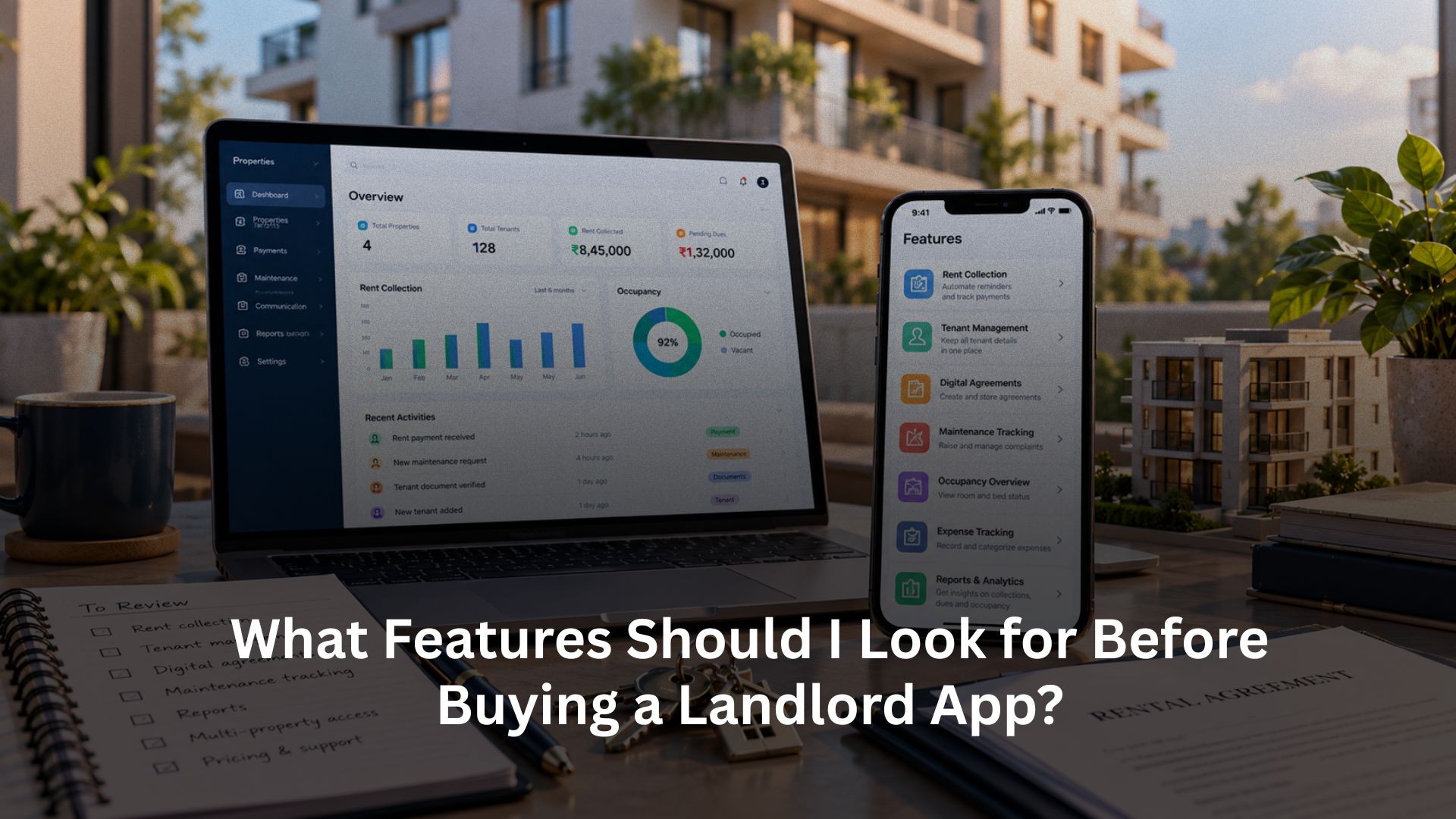
What Features Should I Look for Before Buying a Landlord App?
Written by
Posted on
Ishika Pannu
Oct 2, 2026
1 min read
RentOk vs Crib vs My PG Manager: Which PG Software Actually Fits My Business?
Written by
Posted on
Ishika Pannu
Sep 30, 2026
1 min read
Are US Apps Like Buildium or TurboTenant Usable for Indian Landlords?
Written by
Posted on
Ishika Pannu
Sep 29, 2026
1 min read
Why Landlords Need a Property Management App in 2025
Written by
Posted on
Ishika Pannu
Sep 2, 2026
1 min read
How Property Management Software Helps You Collect Rent on Time
Written by
Posted on
Ishika Pannu
Aug 26, 2026
1 min read
Why Small Landlords Need Property Management Software
Written by
Posted on
Ishika Pannu
Aug 26, 2026
1 min read
How High-Growth PGs Maintain Occupancy Year-Round
Written by
Posted on
Ishika Pannu
Aug 17, 2026
1 min read
How to Mark PG Attendance Without Biometric Devices
Written by
Posted on
Ishika Pannu
Jun 16, 2026
1 min read
Tracking Staff Performance: From Cleaning to Security
Written by
Posted on
Ishika Pannu
May 13, 2026
Stay ahead in property management with expert insights
Join thousands of property managers receiving exclusive tips delivered straight to your inbox.
Browse posts by category
Case Study
Cost of Living
Growth
Legal
Market Trends
News
Pg owner app
Property Management
Property Tax
Tech
RentOk
The easiest way to rent and manage your PGs and hostels.
Grievance Officer
Get the app


Contact us
hello@eazyapp.tech
HQ Office
COGROW, BASEMENT F-12/8A
BESIDE HOUSE OF STYLE SALON, SECTOR 28, DLF PHASE 1
GURUGRAM, HARYANA - 122002
South India Office
LUMIODESK COWORKING, 2ND FLOOR, 40, 14TH MAIN RD
BESIDE MC DONALD, 7TH SECTOR, HSR LAYOUT
BENGALURU, KARNATAKA - 560102
©️ 2026 EazyApp Tech Pvt Ltd. All rights reserved


