Market Trends
RentOk vs Excel: What You’re Really Losing Every Month

Written by
Ishika Pannu
Read Time
10 min read
Posted on
July 1, 2026
Overview
Overview
RentOk vs Excel: What You’re Really Losing Every Month
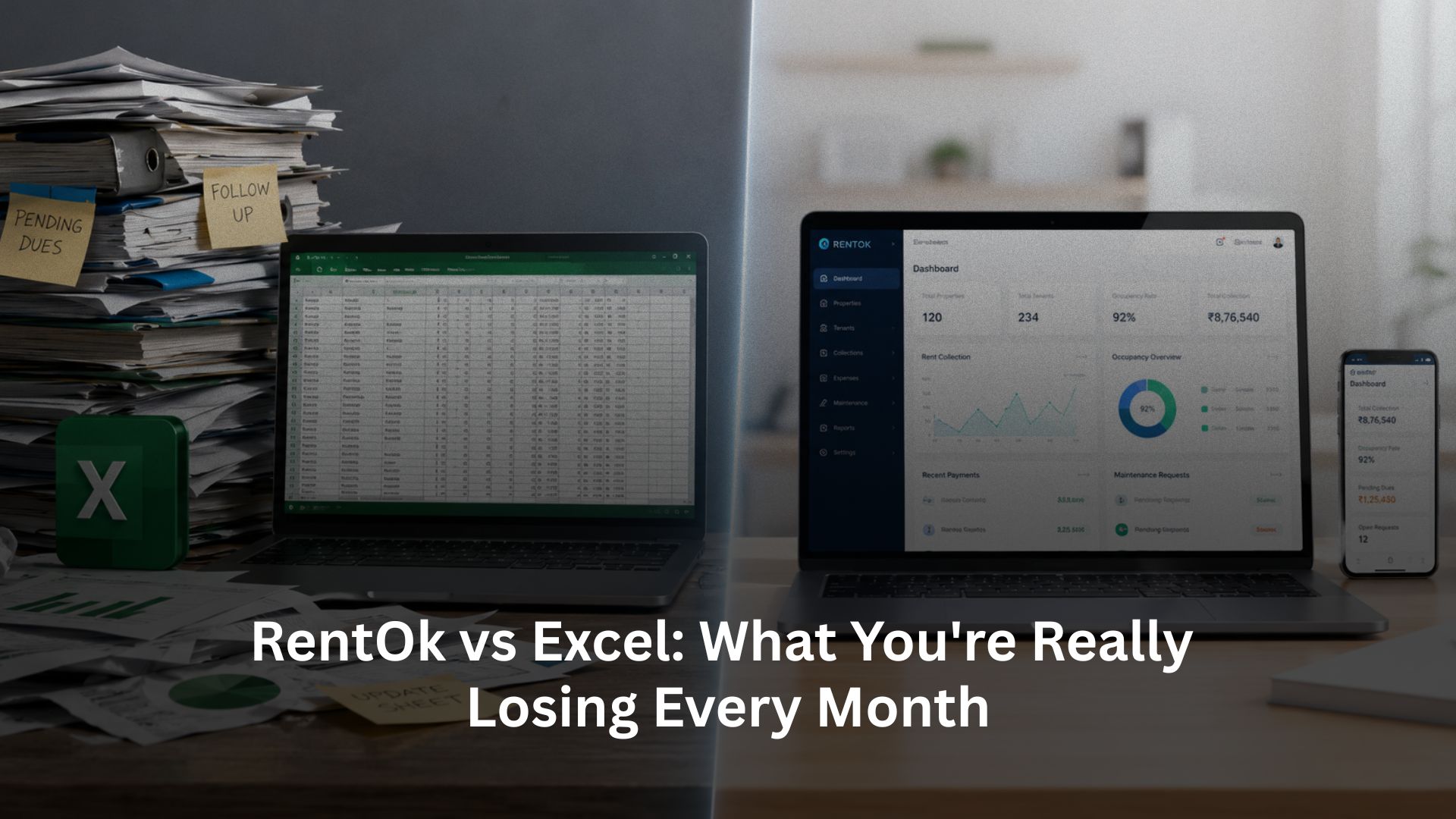
When most landlords or PG operators start managing their properties, Excel feels like the obvious choice. It’s familiar, flexible, and doesn’t require any upfront investment. For a property with a few tenants, a spreadsheet can comfortably handle rent records, occupancy details, and basic financial tracking.
The challenge isn’t using Excel, it’s continuing to rely on it when your business has grown far beyond what spreadsheets were designed to manage.
As occupancy increases, property management becomes less about maintaining records and more about managing interconnected operations. A single move-out impacts room availability, rent collection, security deposit settlements, housekeeping schedules, and new admissions. When all of this is tracked manually, even small delays or errors can create operational bottlenecks that affect both your team and your tenants.
This is why many growing rental businesses don’t switch to property management software because Excel has “failed.” They switch because they’ve realised that the time, effort, and missed opportunities caused by manual processes are costing far more than they initially thought.
Why Excel Works, Until It Doesn’t
There’s a reason Excel has been the backbone of property management for years. It gives landlords complete control over how they organise information, and for smaller properties, that flexibility is genuinely useful.
A spreadsheet can help you maintain records for:
- Tenant details, room allocations, and move-in dates without investing in specialised software.
- Monthly rent collections, security deposits, and utility charges in a single file that’s easy to update.
- Basic occupancy tracking so you know which rooms are available and which are occupied.
- Simple income and expense calculations that provide a rough overview of your property’s finances.
For operators managing 20 or 30 tenants, these capabilities are often enough. The problem isn’t that Excel lacks features, it’s that rental operations become significantly more complex as the business grows.
Managing 150 tenants isn’t five times harder than managing 30. It’s exponentially more complicated because every process becomes interconnected. One payment update affects financial reports. One room transfer changes occupancy data. One delayed maintenance request creates additional tenant communication. Suddenly, multiple spreadsheets need to stay perfectly aligned every single day.
At this stage, Excel stops being a management tool and starts becoming an administrative workload.

The Cost Nobody Includes When Comparing Excel with Software
One of the most common arguments in favour of Excel is that it’s “free.” On paper, that seems true. There’s no monthly subscription, no onboarding cost, and almost everyone already knows how to use it.
But operationally, Excel is far from free.
The real cost isn’t the spreadsheet itself, it’s the amount of manual effort required to keep it accurate.
Every month, someone has to update payment records, verify occupancy, prepare reports, calculate dues, check security deposits, and ensure different spreadsheets contain the same information. None of these tasks directly contribute to business growth, yet they consume a significant portion of the team’s working hours.
More importantly, manual systems create hidden costs that rarely appear in financial reports.
Some of the biggest operational losses include:
- Hours spent updating records instead of managing the business. Staff members often spend valuable time entering data, cross-checking spreadsheets, and correcting mistakes instead of improving tenant experience or increasing occupancy.
- Decision-making based on outdated information. Since reports aren’t updated in real time, managers may unknowingly rely on incomplete occupancy or collection data while making important business decisions.
- Repeated administrative work. The same information is often entered across multiple sheets because different reports require different formats, creating unnecessary duplication of effort.
These costs don’t show up as line items on your expense sheet, but they quietly reduce productivity every single month.
Growth Exposes the Weaknesses of Manual Systems
Most operators don’t wake up one day and decide to replace Excel.
Instead, they begin noticing small operational problems that become more frequent as occupancy increases.
A rent reminder gets delayed because the payment sheet wasn’t updated.
A maintenance request is forgotten because it was shared on WhatsApp instead of being recorded.
Two staff members accidentally work on different versions of the same spreadsheet.
None of these incidents are major on their own. Together, however, they create an environment where management becomes increasingly reactive instead of proactive.
As rental businesses expand, the limitations of manual systems become more visible in everyday operations.
You’ll often notice that:
- Information becomes scattered across multiple platforms. Tenant records may exist in Excel, payment confirmations in WhatsApp, agreements in email folders, and maintenance updates in personal chats. Finding complete information starts taking longer than solving the actual issue.
- Reporting takes longer every month. Instead of instantly understanding occupancy or collections, managers spend hours gathering information from different spreadsheets before they can analyse performance.
- Team collaboration becomes inconsistent. Since spreadsheets aren’t designed for operational workflows, multiple people editing the same data often results in duplicate entries, accidental deletions, or conflicting versions.
These aren’t technology problems, they’re operational challenges caused by using a tool that wasn’t built for managing growing rental businesses.
Excel Stores Data. It Doesn’t Manage Operations.
One of the biggest misconceptions in property management is believing that storing information and managing operations are the same thing.
They’re not.
Excel is excellent at recording data. It can tell you who has paid rent, which room is occupied, or how much revenue was collected last month.
What it cannot do is connect those individual records into a system that actively supports day-to-day operations.
A growing property manager doesn’t just need data. They need visibility.
They need to know:
- Which tenants are likely to delay payments before collections become overdue.
- Which rooms are becoming vacant so admissions can be planned in advance.
- Which maintenance requests are still pending and require immediate attention.
- Which property is performing better if multiple locations are being managed.
- Where operational bottlenecks are slowing down occupancy, collections, or tenant satisfaction.
This shift, from simply storing information to actively managing operations, is where spreadsheets begin falling behind.
As businesses scale, success depends less on how much data you have and more on how quickly that data helps you make better decisions.

RentOk vs Excel: A Practical Comparison
Once rental operations become more structured, the comparison between Excel and a property management platform is no longer about features, it’s about efficiency.
Excel was designed to organize information, while property management software is designed to automate workflows. That difference becomes increasingly visible as tenant count grows.
| Area | Excel | RentOk |
|---|---|---|
| Rent collection | Manual tracking and follow-ups | Automated reminders with payment visibility |
| Occupancy management | Updated manually | Real-time room availability |
| Tenant records | Spread across multiple sheets | Centralized tenant profiles |
| Team collaboration | Multiple file versions | One shared platform with role-based access |
| Reports | Manual preparation | Instant operational dashboards |
| Maintenance | Separate tracking | Centralized complaint management |
| Scalability | Becomes difficult as occupancy grows | Built to support growing rental businesses |
Looking at the comparison, the biggest difference isn’t the number of features. It’s the amount of manual effort required every month.
A spreadsheet still depends on someone remembering to update it. A property management platform reduces that dependency by connecting different workflows into one system.
Is It Time to Move Beyond Excel?
Many operators assume that switching to software is only necessary for very large businesses. In reality, the right time to move away from spreadsheets depends less on the number of tenants and more on the complexity of your operations.
If you’re experiencing any of the following, it’s usually a sign that manual systems are starting to slow your business down:
- Your team spends hours every week updating records instead of focusing on admissions, tenant experience, or occupancy growth.
- Rent collection requires constant follow-ups because reminders, payment records, and pending dues are managed manually.
- Information is spread across Excel, WhatsApp, emails, and handwritten notes, making it difficult to find accurate information quickly.
- Preparing monthly reports has become a task in itself, requiring multiple spreadsheets to be verified before meaningful insights can be generated.
- You’re planning to expand to another property or location, but your existing system already feels difficult to manage.
These challenges don’t necessarily indicate poor management. They simply indicate that the business has evolved beyond what spreadsheets were originally designed to support.
The Biggest Myth About Property Management Software
One misconception that still exists in the rental industry is that property management software is meant to replace Excel entirely.
That’s not actually the goal.
The objective isn’t to stop using spreadsheets. It’s to stop depending on them for every operational decision.
Even today, many operators export reports into Excel for financial analysis or sharing information with accountants. The difference is that the spreadsheet becomes a reporting tool instead of the primary system used to run the business.
That’s an important distinction.
Modern rental businesses don’t succeed because they’ve eliminated Excel. They succeed because they’ve eliminated repetitive manual work.
Automation doesn’t replace good management, it gives managers more time to focus on the parts of the business that actually require human decision-making.
Why More Rental Businesses Are Making the Shift
Over the last few years, the rental industry has become significantly more competitive. Tenants expect faster communication, digital payment options, transparent processes, and quicker issue resolution.
At the same time, operators are managing larger portfolios with leaner teams.
Trying to meet these expectations using disconnected spreadsheets becomes increasingly difficult because operational complexity grows much faster than occupancy itself.
This is why many modern rental businesses are investing in systems that help them:
- Reduce repetitive administrative work so teams can spend more time improving operations instead of maintaining records.
- Improve payment discipline through automated reminders and better visibility into pending dues.
- Centralize tenant information so every department works from the same source of truth instead of multiple disconnected files.
- Generate reports instantly, making it easier to track occupancy, collections, and business performance without manual calculations.
The result isn’t just better organization.
It’s a business that’s able to scale without increasing administrative workload at the same pace.

How RentOk Helps Growing Rental Businesses
As your rental business expands, managing operations across spreadsheets, WhatsApp conversations, payment records, and multiple files quickly becomes difficult to sustain. The challenge isn’t simply storing information, it’s ensuring every part of your operation stays connected.
RentOk brings these workflows together in one centralized platform, helping property owners and managers manage their business with greater visibility and far less manual effort.
Instead of switching between different tools, you can manage:
- Tenant onboarding, room allocation, agreements, and occupancy from one connected dashboard.
- Automated rent reminders, payment tracking, and due management without relying on manual follow-ups every month.
- Maintenance requests, complaint tracking, and operational communication with complete visibility into every update.
- Business reports, occupancy insights, collections, and financial performance through real-time dashboards instead of manually prepared spreadsheets.
If you’re exploring ways to streamline your operations further, you may also find these resources helpful:
- Excel vs Property Management Software – Understand the operational differences between spreadsheets and dedicated property management systems.
- Excel vs RentOk – Watch a practical comparison of how everyday rental operations become simpler with a centralized platform.
Whether you’re managing a single property or multiple locations, the goal remains the same: spend less time maintaining records and more time growing your business.
Conclusion
Excel has helped thousands of landlords and property managers organize their rental businesses, and for many, it’s still where the journey begins. But as occupancy grows and operations become more interconnected, the real challenge shifts from maintaining records to managing an entire business efficiently.
The question is no longer whether Excel can store your data. It’s whether it can keep up with the speed, accuracy, and visibility that modern rental operations demand. Every hour spent updating spreadsheets, every delayed follow-up, and every manual error quietly adds to your operational costs, costs that become more noticeable as your business scales.
If you’re ready to spend less time managing spreadsheets and more time growing your rental business, start your free RentOk trial today. Experience how a centralized property management platform can simplify everyday operations, improve team productivity, and give you complete visibility over your properties, all from one place.
About the Author
Ishika Pannu
Ishika Pannu brings you the latest insights and easy-to-apply strategies in property management—helping you simplify renting and grow with RentOk.