Growth
Cost Per Lead for PGs: Are Your Ads Worth It?

Written by
Ishika Pannu
Read Time
10 min read
Posted on
May 29, 2026
Overview
Overview
Cost Per Lead for PGs: Are Your Ads Worth It?
Most PG operators spend money on marketing every single month, yet very few actually know whether those campaigns are producing profitable occupancy or simply generating temporary activity. Ads get boosted, brokers keep sending inquiries, listing subscriptions get renewed, and Instagram pages continue posting regularly because that has become the “standard” way to market rental properties today. But after all the effort, many operators still struggle with the same recurring problems: inconsistent occupancy, weak inquiry quality, rising acquisition costs, and teams constantly busy without meaningful conversion results.
The issue is not that marketing is not working. The issue is that most landlords are measuring the wrong things.
A campaign generating hundreds of inquiries may look successful on the surface, but if those inquiries never turn into serious tenants, the business is simply spending money to create operational noise. On the other hand, a campaign generating fewer leads may quietly produce:
- faster move-ins because the tenant intent is already strong and locality expectations match properly,
- better tenant quality which often results in longer occupancy cycles and fewer operational disputes,
- lower negotiation pressure because the pricing already aligns with the audience being targeted,
- and significantly less coordination stress for teams handling calls, site visits, and follow-ups daily.
This is why modern rental marketing is no longer about visibility alone. It is about understanding whether every rupee being spent is actually helping the property fill rooms profitably and sustainably. That is where Cost Per Lead analysis becomes extremely important.
Why Most Rental Marketing Feels Random
One of the biggest frustrations landlords face is inconsistency. One month occupancy improves quickly, and the property feels stable. The next month, inquiry quality suddenly drops even though advertising budgets have increased. This unpredictability usually happens because marketing decisions are being made reactively instead of strategically.
Most operators start spending aggressively only when vacancy begins increasing. The thought process is simple:
- occupancy is slowing down, so more ads must be needed,
- inquiry flow has reduced, so campaigns should be boosted immediately,
- competitors are advertising heavily, so visibility must be increased quickly,
- or listing platforms should be upgraded because “more exposure” feels like the solution.
Initially, the activity increases. Instagram DMs start coming in. WhatsApp messages rise. Teams become busy responding to inquiries throughout the day.
But after a few weeks, operators realize something important:
the inquiry volume improved, but the occupancy numbers did not improve proportionately.
Many of the leads turn out to be:
- casual browsers who are only exploring options without immediate move-in intent,
- highly price-sensitive tenants comparing multiple PGs simultaneously,
- inquiries coming from outside the expected budget segment,
- or people who disappear after asking for photos and pricing details.
Meanwhile, another smaller marketing channel may quietly generate:
- fewer leads overall,
- but much stronger occupancy outcomes because the intent quality is significantly higher.
This is exactly why marketing without proper analysis becomes dangerous. Operators start confusing activity with effectiveness, and those are not the same thing.

What Cost Per Lead Actually Means
Cost Per Lead, commonly referred to as CPL, simply measures how much money is being spent to generate one inquiry.
The formula itself is straightforward:
\text{Cost Per Lead} = \frac{\text{Total Marketing Spend}}{\text{Total Leads Generated}}
For example, if a property spends ₹30,000 on advertising and receives 150 inquiries, the Cost Per Lead becomes ₹200.
Now technically, that number sounds useful. But this is exactly where most landlords stop analyzing, and that creates incomplete visibility because not every lead carries the same business value.
Some inquiries may:
- ask for complete room details and then stop responding entirely after the first interaction,
- negotiate aggressively despite clearly not matching the ideal tenant profile for the property,
- continue comparing ten different accommodations simultaneously without real urgency,
- or simply interact because the advertisement looked attractive visually.
At the same time, another acquisition source may produce fewer inquiries but generate:
- faster occupancy confirmations because the tenant already understands the locality and pricing,
- stronger payment consistency due to better tenant matching,
- smoother onboarding experiences with fewer operational complications,
- and longer stay durations which improve overall occupancy stability.
This is why experienced operators never evaluate Cost Per Lead in isolation. They evaluate:
- the seriousness of the inquiries,
- the conversion efficiency,
- the operational effort involved in closing the lead,
- and the final occupancy outcome.
Because inquiries do not generate revenue.
Occupied beds do.
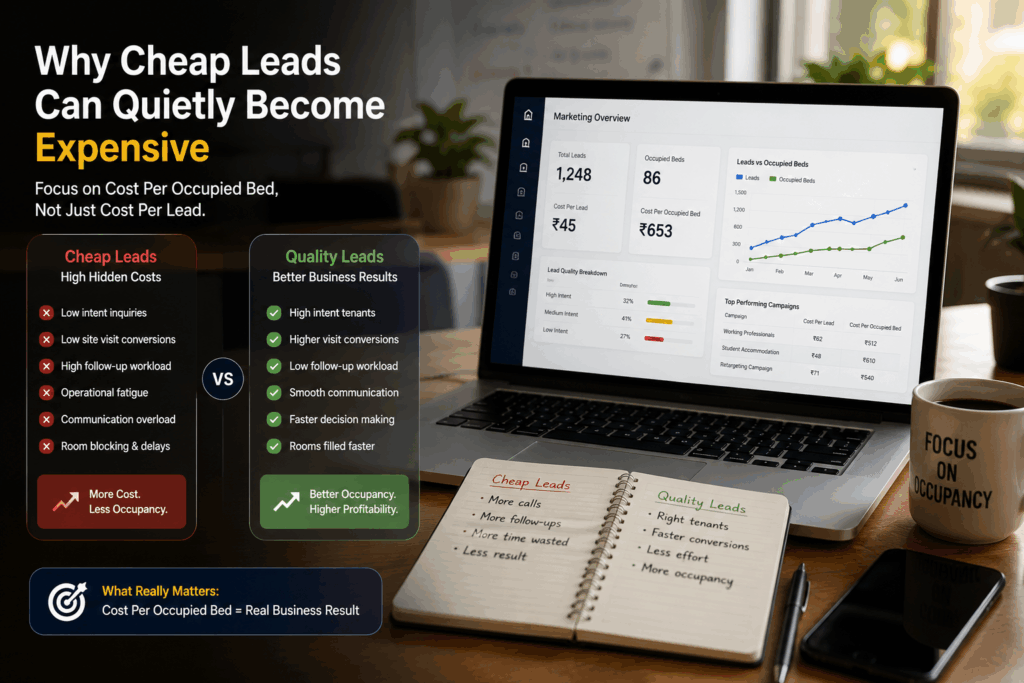
Why Cheap Leads Can Quietly Become Expensive
One of the most common misconceptions in rental marketing is believing that lower CPL automatically means better performance.
Operationally, that assumption is often completely wrong.
A campaign generating extremely cheap inquiries may still create massive inefficiency if:
- most tenants are not serious about moving in immediately,
- site visits rarely convert into occupancy,
- teams spend hours managing repetitive conversations daily,
- or operational coordination becomes overwhelmed by low-quality leads.
This creates hidden costs that many landlords never calculate properly.
For example, weak lead quality often increases:
- follow-up workload because staff repeatedly chase inquiries that were never genuinely interested in moving,
- operational fatigue as teams coordinate unnecessary site visits and repetitive room discussions constantly,
- slower communication efficiency because large inquiry volumes overwhelm response systems,
- and room blocking confusion where uncertain prospects delay actual occupancy decisions.
Over time, this operational drain becomes expensive even if the original CPL appears “cheap.”
Meanwhile, a slightly more expensive campaign may quietly outperform everything else because it attracts:
- working professionals already finalized on the locality,
- students actively searching for immediate accommodation,
- tenants whose expectations already match the property positioning,
- and leads who convert faster with significantly lower negotiation pressure.
This is why smart operators focus more heavily on:
- Cost Per Occupied Bed
instead of simply: - Cost Per Lead.
Because occupancy is the real business result.
Not inquiry count.
Why Conversion Tracking Changes Marketing Completely
Many landlords know where inquiries are coming from. Very few know which channels are actually producing profitable occupancy consistently.
And that distinction matters enormously.
For example, listing platforms may generate heavy inquiry volume because tenants actively browse multiple PGs there. Social media campaigns may improve brand visibility and visual trust. Google Search may produce high-intent leads because users are already searching for accommodation actively. Broker networks may send fewer inquiries overall but generate faster move-ins because the tenant trust level is already stronger.
Without conversion tracking, operators continue spending money emotionally instead of strategically. Budgets keep flowing toward campaigns that “feel busy” rather than campaigns genuinely improving occupancy performance.
Professional rental businesses track:
- which platform generated the inquiry originally and whether the source consistently attracts quality tenants,
- how quickly teams responded to the inquiry because response speed heavily affects conversion probability,
- whether the lead scheduled a property visit and how serious the engagement actually appeared,
- how the follow-up progressed over time instead of treating every inquiry as equal,
- and whether the lead eventually completed move-in and contributed to stable occupancy.
This creates real visibility into marketing ROI.
Because once operators understand which channels actually fill rooms profitably, advertising decisions become significantly smarter.
Different Marketing Channels Serve Different Purposes
One major mistake landlords make is expecting every acquisition channel to behave the same way. But each platform attracts completely different tenant psychology, and understanding that difference is extremely important for improving marketing efficiency.
Listing Platforms
Listing sites are excellent for visibility because tenants actively browse multiple accommodation options there. These platforms work especially well for:
- increasing exposure in competitive localities where tenants compare several PGs before making decisions,
- generating inquiry flow during admission seasons or relocation spikes when search demand increases heavily,
- and helping newly launched properties gain faster market visibility while brand awareness is still developing.
However, listing platforms also attract:
- highly price-sensitive behavior,
- constant comparisons with competing properties,
- and stronger negotiation pressure overall.
That means operators need:
- fast response systems,
- accurate room availability updates,
- structured follow-up workflows,
- and clear pricing communication
to convert effectively.
Otherwise, inquiries simply become operational clutter.
Google Search Leads
Search-driven leads are often among the strongest-performing inquiries because the intent level is already high.
Someone searching:
- “PG near Cyber Hub”
or - “girls hostel near North Campus”
is usually planning accommodation actively.
These leads often:
- convert faster because urgency already exists operationally,
- require less persuasion compared to social media traffic,
- and produce stronger occupancy efficiency overall.
This is exactly why SEO and Google visibility are becoming increasingly valuable for modern rental businesses.
Instagram and Social Media Campaigns
Social media works very differently.
Its primary strength lies in perception-building and lifestyle positioning. It helps create:
- visual trust through interiors, amenities, and branding consistency,
- stronger emotional appeal among younger tenant audiences,
- and a more premium perception for professionally managed properties.
This works especially well for:
- co-living brands,
- premium PGs,
- and aesthetically designed accommodations targeting working professionals.
However, many operators make the mistake of confusing:
- engagement,
with - occupancy performance.
A reel receiving thousands of views may still generate poor conversion quality if the targeting is weak or the tenant expectations do not align properly.
Broker Networks
Broker-generated leads often appear expensive initially because commissions increase acquisition costs directly. But operationally, brokers may still deliver excellent ROI because they usually generate:
- stronger locality matching due to their market familiarity,
- faster occupancy timelines because tenant trust already exists,
- and smoother conversions compared to cold inquiry channels.
During:
- seasonal demand spikes,
- urgent vacancy periods,
- or new property launches,
broker ecosystems become extremely valuable.
The strongest operators rarely depend entirely on one lead source. Instead, they combine:
- search visibility,
- listing platforms,
- broker relationships,
- referrals,
- and social media campaigns
to create more stable occupancy pipelines overall.
Why Lead Handling Matters Just as Much as Advertising
Many landlords assume poor occupancy automatically means weak marketing. But often, the real problem is what happens after the inquiry arrives. Even strong campaigns underperform if:
- responses are delayed,
- follow-ups are inconsistent,
- room availability is unclear,
- or communication feels unorganized.
Modern tenants usually inquire at multiple properties together, so response quality directly affects conversion rates. Strong operators understand that marketing creates interest, but operational systems are what actually close conversions.
That is why successful rental businesses focus heavily on:
- faster response coordination so serious leads are not lost to competitors,
- structured follow-ups that improve conversion consistency over time,
- and smoother communication workflows that make the property feel more professional overall.
Because ultimately, advertising may bring the inquiry.
But lead handling converts it into occupancy.

How RentOk Helps Operators Improve Lead Tracking and Marketing ROI
As rental businesses grow, managing inquiries manually becomes difficult because leads start coming from multiple channels at once. Operators may receive inquiries from listing platforms, Instagram campaigns, Google Ads, brokers, referrals, and direct calls simultaneously, which often creates confusion in follow-ups and occupancy coordination.
RentOK helps streamline these workflows by centralizing lead management, occupancy tracking, tenant coordination, and operational visibility within one connected platform. This helps operators maintain clearer visibility into:
- which campaigns are generating quality leads instead of just high inquiry volume,
- where conversions are slowing down operationally during the follow-up process,
- and how occupancy performance is improving across different acquisition channels.
As rental marketing becomes more competitive and data-driven, organized workflows become essential for improving conversion efficiency, reducing missed opportunities, and maintaining long-term occupancy growth.
Conclusion
Marketing in the PG and co-living industry is no longer just about generating visibility.
It is about generating profitable occupancy consistently and sustainably.
And that requires operators to understand:
- where leads are coming from,
- how much those leads cost,
- how efficiently they convert,
- and whether those acquisition channels genuinely support long-term business growth.
Because ultimately, the best marketing strategy is not the one generating the most noise.
It is the one creating:
- stronger occupancy quality,
- healthier conversion efficiency,
- predictable acquisition costs,
- and operationally manageable growth over time.
If you want to improve lead visibility, streamline occupancy tracking, and manage your rental operations more efficiently, explore how RentOk helps operators centralize modern property management through one connected platform.
About the Author
Ishika Pannu
Ishika Pannu brings you the latest insights and easy-to-apply strategies in property management—helping you simplify renting and grow with RentOk.