Growth
What Nobody Tells You About Scaling a PG Business

Written by
Ishika Pannu
Read Time
8 min read
Posted on
May 28, 2026
Overview
Overview
What Nobody Tells You About Scaling a PG Business
Every property business dreams about scaling.
More buildings. More tenants. Higher occupancy. Stronger revenue. Bigger brand presence.
From the outside, scaling a PG or co-living business to 1000 beds looks like a straightforward success story. Once a few properties start performing well, expansion feels like the obvious next step. Operators begin adding inventory, entering new localities, hiring more staff, and increasing marketing aggressively because demand appears strong.
But this is usually the stage where reality starts changing.
The truth is, running:
- a 50-bed operation,
- a 150-bed operation,
- and a 1000-bed operation
are three completely different businesses operationally.
At smaller scale, businesses can still survive through founder involvement and reactive coordination. The owner knows what is happening inside the property because the business is still manageable manually. Complaints get solved quickly through calls, occupancy updates happen informally, and teams coordinate through WhatsApp or direct supervision.
At institutional scale, that model breaks down very quickly.
Because once you start managing:
- multiple properties,
- hundreds of tenants,
- large operational teams,
- continuous move-ins and move-outs,
- vendor coordination,
- and occupancy across different locations,
complexity increases much faster than most operators expect.
This is exactly where many growing property businesses struggle. Externally, the business may still look successful because occupancy continues growing. Internally, however, operations slowly become fragmented. Communication weakens, accountability becomes unclear, and founders start spending more time fixing operational confusion than actually building the business strategically.
The operators who successfully scale to 1000+ beds understand something important very early: scaling property management is not just about adding more rooms. It is about building systems strong enough to handle complexity without losing consistency.
That is the real difference between a growing rental business and an institutional housing operation.
Why Most PG Businesses Become Operationally Weak While Growing
One of the biggest misconceptions in the rental industry is assuming operational problems only appear when occupancy falls or revenue slows down.
In reality, many businesses become weaker internally during periods of rapid growth.
The reason is simple. Complexity scales faster than systems.
At smaller scale, businesses can still rely heavily on:
- founder involvement for solving tenant issues quickly and maintaining operational visibility personally,
- manual coordination between teams because the number of tenants and properties still remains manageable,
- informal communication systems where managers solve problems directly without structured escalation processes,
- and reactive workflows where operational gaps are fixed after problems appear instead of being prevented through systems.
Initially, this approach feels efficient because the business still moves quickly.
But once operations scale across multiple properties, these same habits begin creating serious operational inefficiencies. One property may have strong onboarding while another handles move-ins casually. One manager may escalate complaints immediately while another delays resolution because no centralized process exists.
Over time, this creates:
- inconsistent tenant experiences across properties operating under the same brand,
- payment visibility gaps because different managers track collections differently,
- operational delays caused by fragmented communication systems,
- and increasing dependency on founders to solve routine coordination issues manually.
The dangerous part is that these operational cracks do not become visible immediately. Revenue may still look healthy while internal systems quietly become unstable underneath.
This is exactly why institutional operators focus heavily on operational structure long before expansion becomes aggressive.

Institutional Property Management Is About Repeatability
Most small rental businesses operate through effort.
Institutional property businesses operate through repeatability.
That difference changes everything.
A founder-led operation can survive temporarily through:
- constant supervision,
- daily firefighting,
- and individual managers handling situations based on personal capability.
But once businesses scale beyond a certain point, operations become too large and too fast-moving for individual effort alone to maintain consistency.
Institutional operators understand that tenants should receive the same operational experience regardless of:
- which property they move into,
- which manager handles the onboarding,
- or which city the business operates in.
That consistency only becomes possible when businesses standardize operations properly.
For example, strong institutional businesses create structured systems around:
- onboarding workflows so move-ins feel organized instead of dependent on whichever staff member is available,
- complaint escalation timelines so unresolved issues do not remain stuck inside informal chats,
- payment collection systems that maintain centralized visibility instead of fragmented tracking,
- housekeeping inspections that follow measurable operational standards across every property,
- and maintenance coordination systems that prioritize accountability and response speed.
The purpose of these systems is not unnecessary bureaucracy.
The purpose is operational predictability.
Because once tenant experiences start varying drastically between properties, operational trust weakens very quickly. And in large-scale housing businesses, inconsistency spreads faster than most operators realize.
Why Centralized Operations Become Non-Negotiable
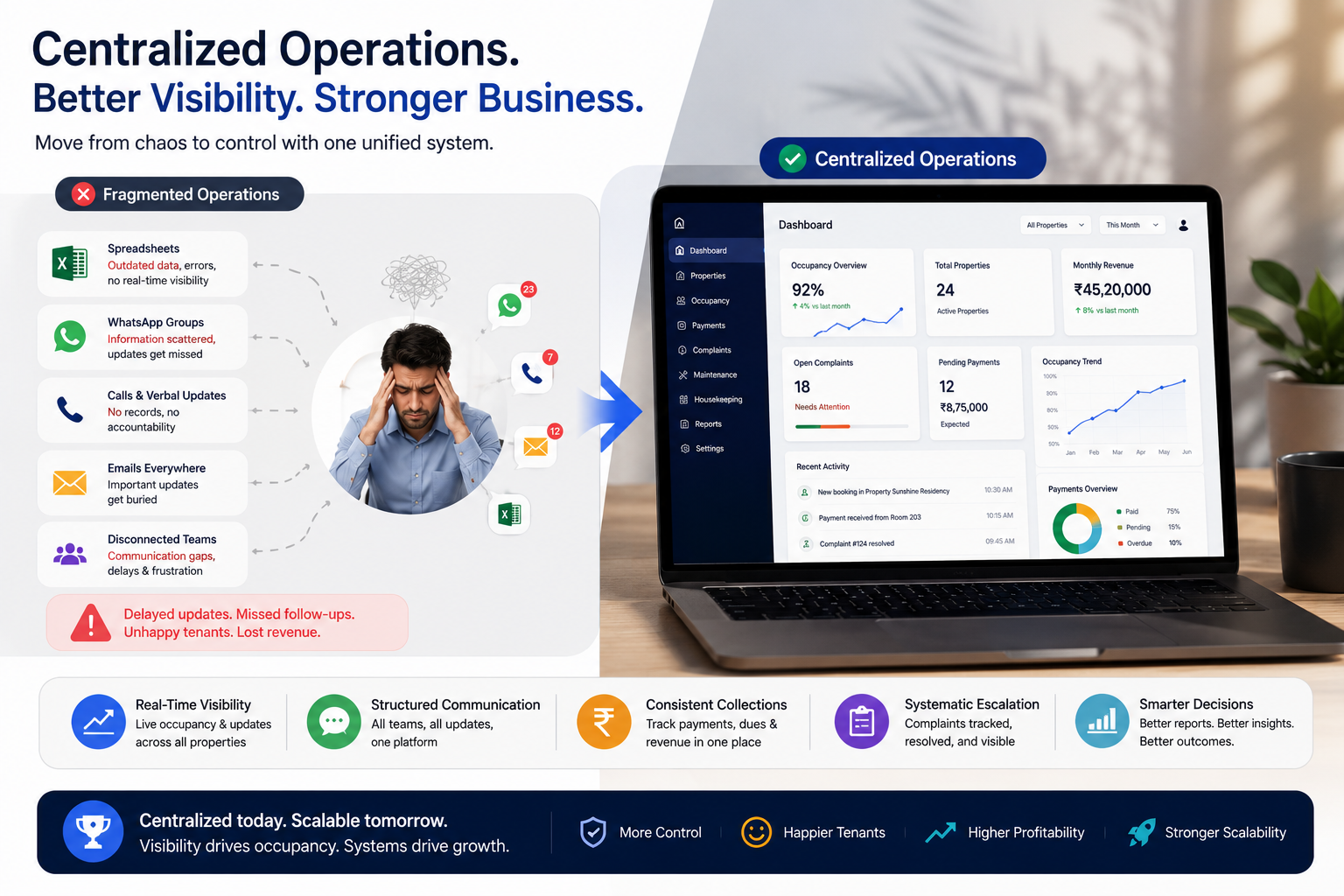
One of the first major shifts institutional operators make is moving away from fragmented operations.
Many growing rental businesses continue operating through:
- spreadsheets,
- calls,
- WhatsApp groups,
- verbal updates,
- and disconnected management systems.
At smaller scale, this still feels manageable because founders can manually fill operational gaps.
At institutional scale, fragmented operations become dangerous.
Imagine trying to manage:
- occupancy movement across multiple properties,
- hundreds of monthly payments,
- maintenance coordination,
- complaint escalation,
- housekeeping operations,
- and staff accountability
through disconnected systems.
Eventually, leadership loses operational clarity completely.
This creates situations where:
- occupancy data becomes outdated because room movement is not updated centrally,
- unresolved complaints remain invisible because escalation happens informally,
- payment delays increase because collection systems are inconsistent across properties,
- and operational bottlenecks become difficult to identify quickly.
Institutional operators solve this through centralized visibility.
Strong centralized systems help businesses:
- monitor occupancy movement in real time instead of relying on delayed manual updates,
- track complaints systematically so unresolved issues remain visible across teams,
- maintain consistent payment tracking across properties and managers,
- improve operational reporting for leadership decision-making,
- and reduce communication fragmentation between departments.
At institutional scale, centralized operations are not just about organization.
They become operational infrastructure.
Because visibility directly affects:
- occupancy,
- profitability,
- tenant satisfaction,
- and scalability.
Why SOPs Matter More Than “Good Managers”
Many growing rental businesses make the mistake of depending too heavily on individual capability.
They assume:
- a strong manager can maintain consistency,
- experienced staff can solve operational issues manually,
- and operational quality will naturally continue during expansion.
Institutional operators know this approach eventually fails because:
- teams change,
- managers leave,
- staff turnover happens,
- and operational pressure keeps increasing.
This is why SOPs — Standard Operating Procedures — become critical at scale.
Strong institutional businesses create structured operational systems around:
- move-ins and onboarding processes,
- room inspections and inventory checks,
- payment follow-up timelines,
- complaint escalation systems,
- maintenance coordination workflows,
- housekeeping quality checks,
- and move-out procedures.
The goal is not making operations rigid.
The goal is reducing inconsistency.
Because when every property follows different systems:
- tenant experiences become unpredictable,
- accountability weakens,
- and leadership loses operational control.
SOPs help businesses create repeatable operational quality even while expanding aggressively.
That repeatability becomes one of the biggest competitive advantages in institutional housing operations.
Regional Management Structures Become Essential Beyond 500 Beds
One of the biggest operational mistakes founders make during expansion is trying to personally supervise everything for too long.
At smaller scale, direct involvement works because operational volume remains manageable.
At institutional scale, it creates bottlenecks.
This is why large housing businesses build layered management structures involving:
- property managers handling day-to-day operational execution,
- cluster managers supervising groups of properties and maintaining consistency,
- regional heads monitoring operational performance across territories,
- and centralized operations teams maintaining reporting visibility and escalation oversight.
Strong regional structures improve scalability because they:
- reduce founder dependency for routine operational decisions,
- improve accountability across properties,
- maintain operational discipline during expansion,
- and create faster issue resolution through defined escalation systems.
Without regional management layers, founders eventually become overwhelmed by:
- complaint escalation,
- staffing coordination,
- occupancy tracking,
- vendor management,
- and operational firefighting.
And once leadership becomes overloaded, strategic growth slows down significantly.
Complaint Management Changes Completely at Institutional Scale
At smaller scale, complaint handling often remains reactive.
Tenants message managers directly. Teams solve problems informally. Most issues can still be handled manually.
At 1000 beds, complaint management becomes operational infrastructure.
Because unresolved operational issues affect:
- tenant retention,
- reviews,
- occupancy reputation,
- referrals,
- and brand perception
extremely quickly inside shared living environments.
For example, recurring issues around:
- internet downtime,
- housekeeping delays,
- maintenance problems,
- food quality,
- or water supply
spread across tenant communities very fast.
Institutional operators solve this through centralized complaint workflows where:
- every issue gets logged systematically,
- escalation ownership remains visible,
- response timelines become measurable,
- and unresolved complaints can be monitored centrally.
This creates stronger:
- accountability,
- communication clarity,
- operational speed,
- and tenant confidence.
At institutional scale, complaint management is not just customer support.
It becomes a core operational system directly tied to occupancy performance.
How RentOk Helps Operators Scale Institutional Housing Businesses
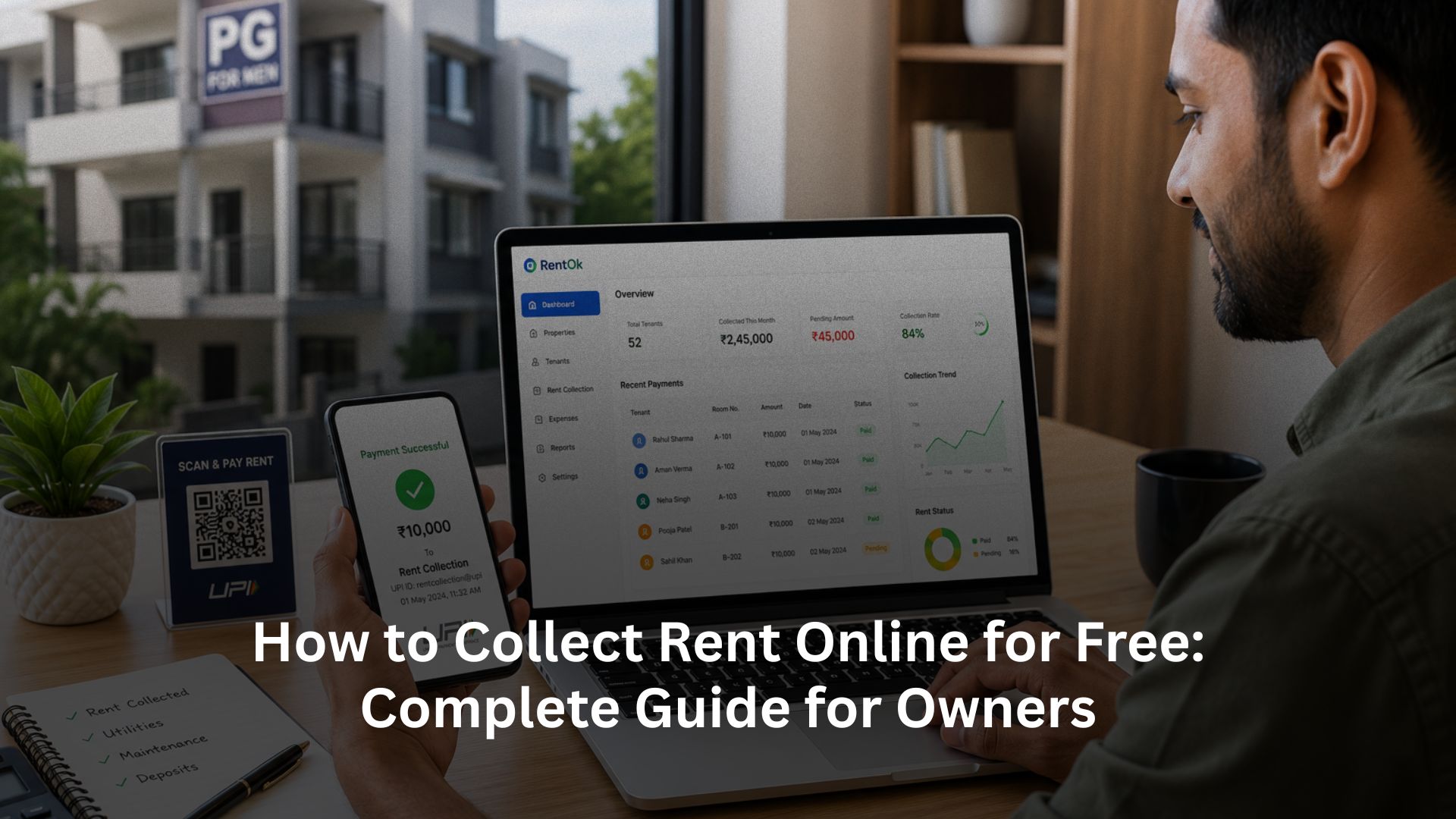
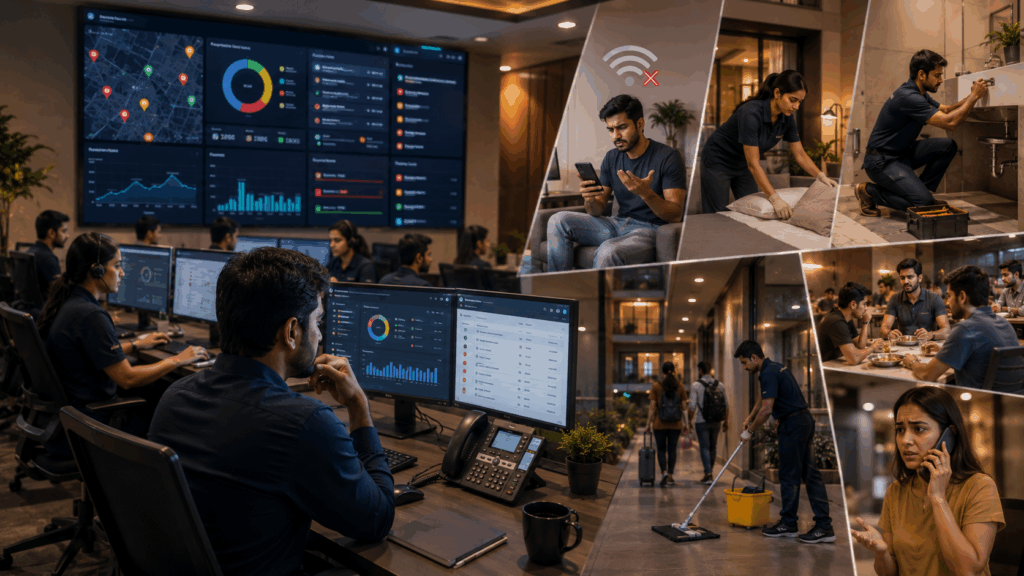
As rental businesses expand across multiple properties and hundreds of tenants, maintaining operational visibility manually becomes increasingly difficult. RentOk helps operators centralize:
- occupancy management,
- tenant tracking,
- payment visibility,
- complaint workflows,
- maintenance coordination,
- operational communication,
- and reporting systems
within one connected platform.
This helps growing rental businesses:
- maintain stronger operational consistency across properties,
- reduce communication gaps between operational teams,
- improve centralized visibility across occupancy and workflows,
- and scale more efficiently without relying heavily on fragmented manual systems.
For operators building institutional-level housing businesses, structured systems become essential for maintaining operational control while continuing expansion sustainably.
Conclusion
Scaling to 1000 beds is not simply about expansion.
It is about operational transformation.
Because beyond a certain point, rental businesses stop functioning through:
- manual coordination,
- founder dependency,
- and reactive management.
They start functioning through:
- systems,
- centralized visibility,
- operational accountability,
- structured workflows,
- and process consistency.
The operators who successfully build institutional housing businesses are usually the ones who understand that sustainable growth is created not by constantly solving operational chaos, but by building systems strong enough to prevent chaos before it begins.
If you want to streamline operations, improve centralized visibility, and scale your rental business more efficiently, explore RentOk and discover how modern operators are managing large housing portfolios through one connected platform.
About the Author
Ishika Pannu
Ishika Pannu brings you the latest insights and easy-to-apply strategies in property management—helping you simplify renting and grow with RentOk.