Growth
The Impact of Local Infrastructure on PG Rents

Written by
Ishika Pannu
Read Time
8 min read
Posted on
May 27, 2026
Overview
Overview
The Impact of Local Infrastructure on PG Rents
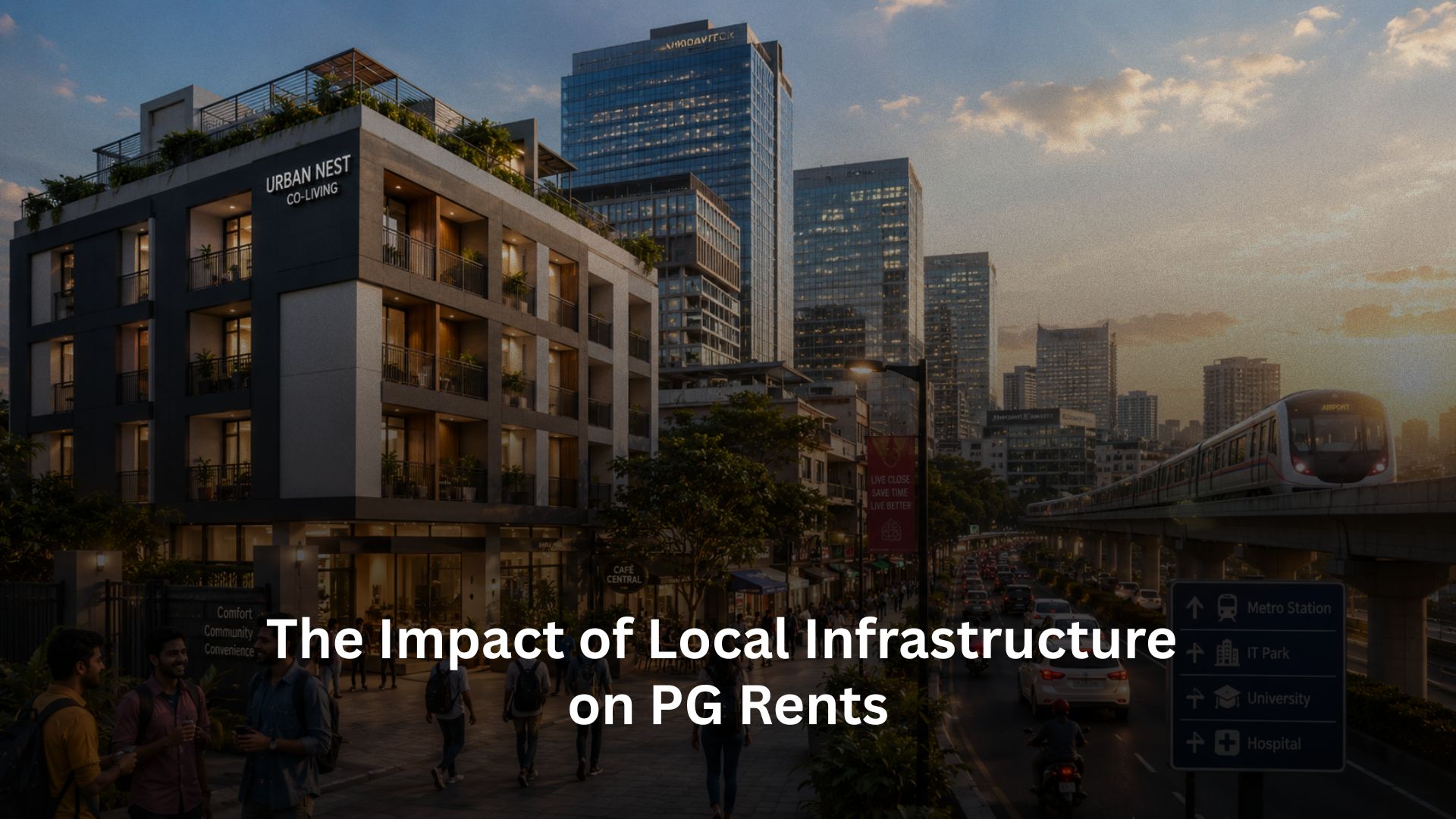
In the PG and co-living business, operators often spend a lot of time improving what exists inside the property. They upgrade interiors, add better furniture, improve Wi-Fi, redesign common spaces, and introduce amenities that make the property feel more premium. While all of these things absolutely matter, one of the biggest drivers of rental pricing usually exists outside the building itself: local infrastructure.
A PG located near a metro station, a corporate office hub, a university cluster, or a commercially active neighborhood will almost always perform differently from a similar property located in an underdeveloped area. Even if the rooms look almost identical, the surrounding ecosystem changes how tenants perceive the value of the property. In modern urban markets, people are not simply paying rent for a room anymore. They are paying for accessibility, convenience, time savings, and a smoother everyday lifestyle.
This is exactly why infrastructure has become such a major pricing force in cities like Delhi, Bangalore, Hyderabad, Pune, and Gurgaon. The operators who understand how infrastructure shapes rental demand are usually the ones who price more intelligently, choose better expansion locations, and maintain stronger occupancy in the long run.
Why Infrastructure Has Become So Important in the Rental Market
Tenant behavior has changed significantly over the last few years. Earlier, people primarily compared PGs on the basis of rent and room quality. Today, the decision-making process is much broader. Tenants now evaluate how a property fits into their daily routine and whether the location actually makes life easier.
A working professional living in a metro city thinks about:
- how much time the daily commute will take and whether traffic will become mentally exhausting after a few months,
- whether grocery stores, gyms, pharmacies, and food outlets are accessible without depending on long cab rides,
- how safe and active the locality feels during late evenings, especially for people returning from offices after dark.
Similarly, students and interns usually prioritize areas where:
- universities, coaching institutes, libraries, and transport access are available within a short distance,
- the neighborhood already has an active student ecosystem with affordable food and convenience services,
- movement between college, accommodation, and daily essentials feels manageable without excessive travel costs.
This is why infrastructure directly affects demand. The more friction a locality removes from everyday life, the more attractive it becomes to tenants. And once tenant demand increases consistently, rents naturally begin moving upward.
Metro Connectivity Has Completely Reshaped PG Pricing
One of the biggest infrastructure shifts affecting rental markets has been metro expansion. Across major cities, metro corridors have transformed previously average localities into premium rental zones simply because connectivity improved dramatically.
For most tenants, especially working professionals, commute fatigue has become a serious quality-of-life issue. Spending two to three hours in traffic every day eventually affects productivity, routine, and even mental health. As a result, properties located near metro stations often command significantly stronger pricing because they reduce this daily stress.
What is interesting is that tenants are often willing to compromise on room size or luxury amenities if the property saves them enough travel time. A tenant may choose:
- a slightly smaller room located five minutes from a metro station,
instead of - a larger room located in an isolated area with poor connectivity.
From the tenant’s perspective, the convenience itself becomes valuable. Saving even one hour every day translates into:
- lower transport costs,
- more personal time,
- less commute exhaustion,
- and a much smoother urban lifestyle overall.
This is why metro-connected PGs generally experience:
- stronger occupancy consistency,
- faster room filling during vacancy periods,
- and better long-term pricing flexibility compared to poorly connected areas.
Commercial Hubs Quietly Create High-Value PG Ecosystems
Commercial infrastructure has one of the strongest long-term impacts on PG rents because office-driven migration creates continuous accommodation demand. Whenever a city develops:
- IT parks,
- startup corridors,
- business districts,
- or large corporate campuses,
the surrounding rental market almost immediately starts evolving alongside it.
Areas like:
- Cyber City in Gurgaon,
- Electronic City in Bangalore,
- HITEC City in Hyderabad,
- and Hinjewadi in Pune
became major PG ecosystems largely because thousands of professionals started relocating there for work opportunities. Once employees began moving into these areas, supporting infrastructure followed naturally:
- cafes,
- coworking spaces,
- gyms,
- restaurants,
- supermarkets,
- and convenience stores.
Over time, the locality itself became more livable and desirable, which further increased rental demand.
For PG operators, this creates a very important business lesson. Sometimes the biggest opportunity is not necessarily in the city’s current premium location, but in emerging commercial zones that are still developing. Operators who identify these growth corridors early usually benefit from:
- lower initial competition,
- stronger future occupancy potential,
- and higher long-term rental appreciation.
Educational Infrastructure Creates Stable Occupancy Cycles
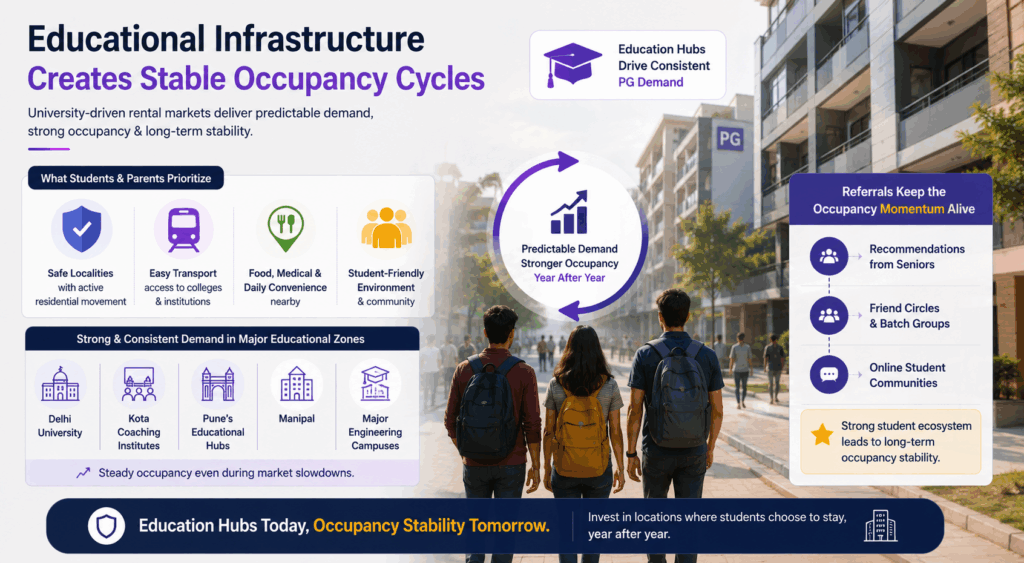
University-driven rental markets behave differently from corporate rental zones because student movement tends to remain more predictable year after year. Properties located near colleges, coaching hubs, or academic clusters often benefit from recurring demand cycles that create greater occupancy stability.
Parents and students usually prioritize:
- safe localities with active residential movement,
- easy transport access between the property and the institution,
- areas where food, medical facilities, and student convenience services are easily available.
This is why educational zones across cities consistently maintain strong PG demand. Locations near:
- Delhi University,
- Kota coaching institutes,
- Pune’s educational hubs,
- Manipal,
- and major engineering campuses
often experience steady occupancy even during broader market slowdowns.
Another important factor is referral-driven growth. Students frequently choose PGs based on:
- recommendations from seniors,
- friend circles,
- batch groups,
- and online student communities.
Once a locality develops a strong student ecosystem, occupancy momentum usually sustains itself for years.
Infrastructure Also Changes Tenant Expectations
One mistake many operators make is assuming that better infrastructure alone justifies premium rents indefinitely. In reality, as localities improve, tenant expectations rise alongside them.
A tenant paying higher rent in a metro-connected or commercially active area usually expects:
- better maintenance responsiveness,
- cleaner property management,
- more organized operations,
- stronger internet connectivity,
- and smoother day-to-day living experiences.
This creates an important operational reality: infrastructure may create pricing power, but operational quality protects that pricing power over time.
Many landlords increase rents after:
- a new metro launch,
- nearby office expansion,
- or rapid commercial growth,
but fail to improve the actual living experience inside the property. Eventually, tenants start comparing the PG not just with nearby rooms, but with the overall standard of the locality itself.
That is where professionally managed operators gain a major advantage.
Why Smaller Convenience Infrastructure Matters Too
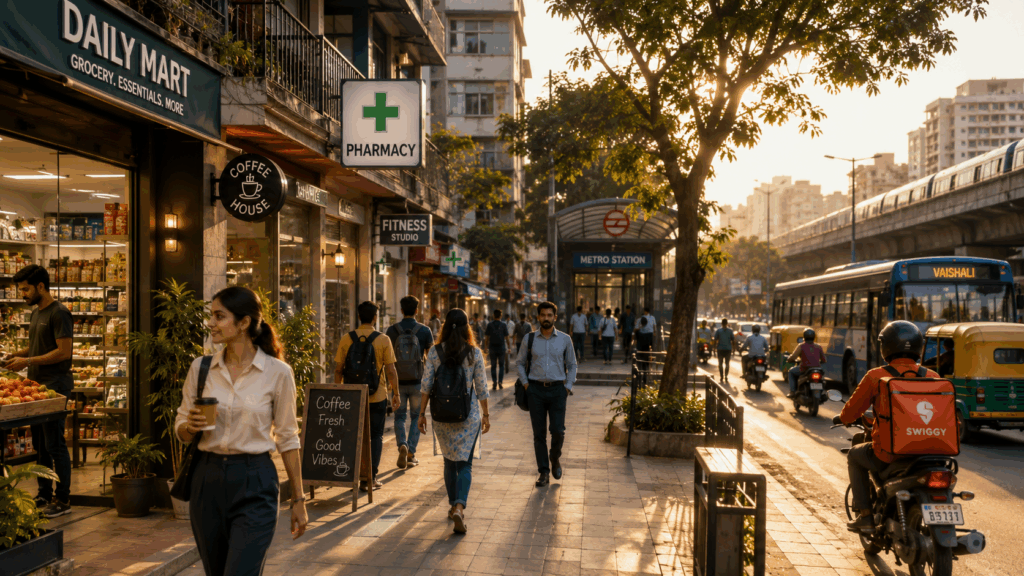
When people discuss infrastructure, they usually focus only on massive projects like highways and metro lines. But smaller neighborhood conveniences influence rental behavior just as strongly.
A locality feels significantly more attractive when tenants have easy access to:
- grocery stores and daily essentials without depending on long commutes,
- nearby cafes, gyms, and coworking spaces that improve lifestyle convenience,
- pharmacies, clinics, and food delivery options that make everyday living smoother.
These things may seem operationally small, but collectively they shape how comfortable daily life feels inside the locality. Modern tenants increasingly optimize for convenience because city life already involves enough stress and movement.
A PG located in a well-connected, active neighborhood naturally feels more livable than a property isolated from basic conveniences, even if both properties offer similar room quality.
Poor Infrastructure Quietly Reduces Rental Potential
The opposite side of this discussion is equally important. Weak infrastructure can suppress rental growth significantly even when the property itself is well-designed.
For example, a PG may offer:
- modern interiors,
- premium furniture,
- and excellent amenities,
but still struggle with pricing because the locality suffers from:
- poor transport access,
- low street activity,
- weak safety perception,
- unreliable utilities,
- or long travel times.
Tenants today evaluate the entire lifestyle experience surrounding the property. If reaching offices, colleges, or daily essentials becomes difficult, the room itself stops feeling convenient regardless of how attractive it looks during a site visit.
This is why some beautifully designed properties underperform despite heavy investment. The operational ecosystem around the property does not support premium living perception.
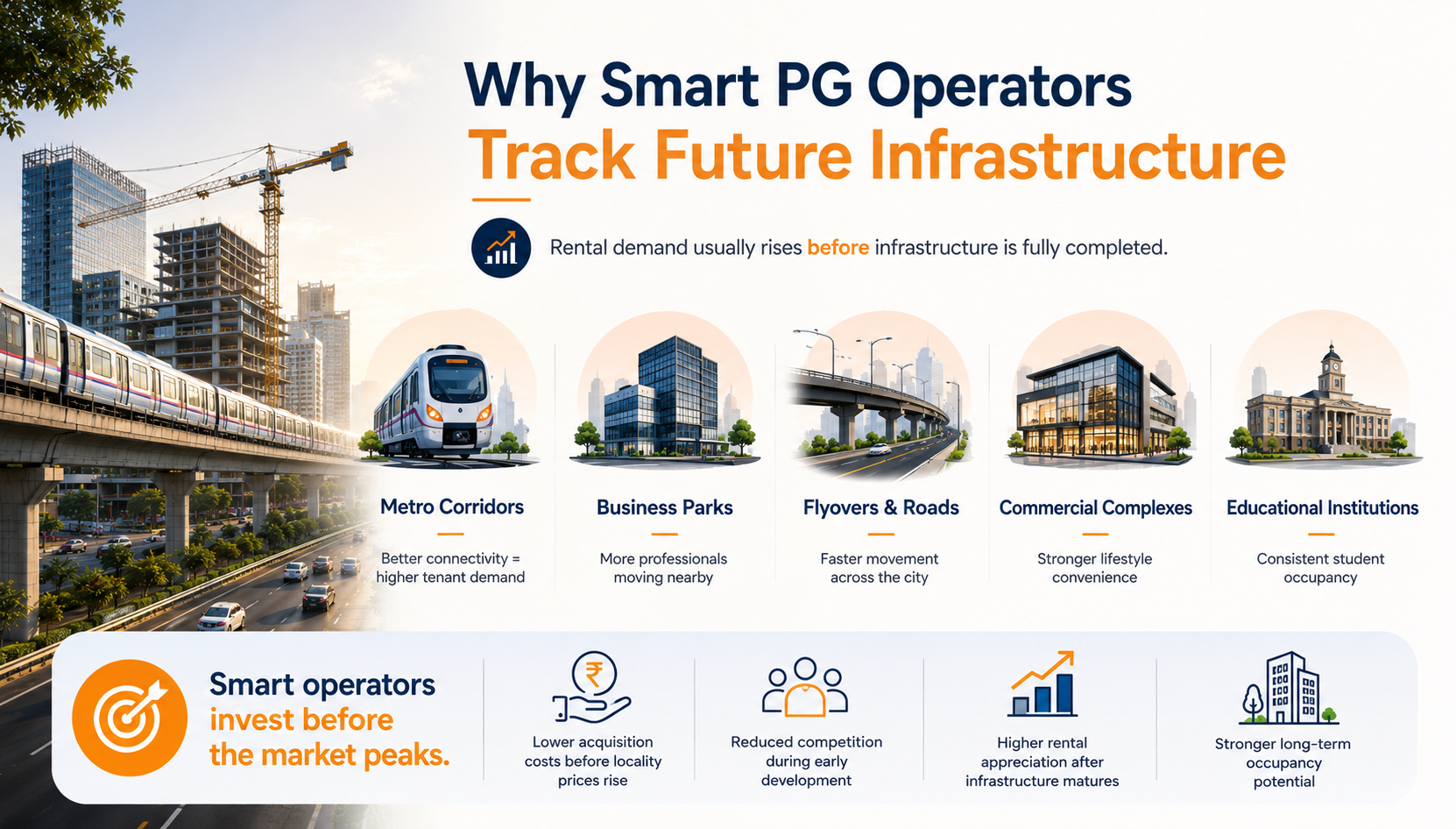
Why Smart Operators Study Future Infrastructure Plans
Experienced landlords rarely look only at current infrastructure. They actively monitor future developments because upcoming projects often reshape rental markets years before completion.
New:
- metro corridors,
- business parks,
- flyovers,
- commercial complexes,
- and educational institutions
can dramatically change tenant movement patterns over time.
Operators who identify these changes early usually gain major advantages:
- lower property acquisition costs before the locality becomes expensive,
- reduced competition during the initial stages of development,
- stronger rental appreciation once infrastructure matures fully.
This is one reason many co-living brands aggressively expand into developing corridors instead of already saturated premium zones. By the time the locality reaches peak demand, those operators are already established inside the market.
How RentOk Helps Operators Manage Growing Rental Markets
As infrastructure-driven demand increases, PG businesses usually experience:
- faster occupancy movement,
- higher inquiry volume,
- more tenant turnover,
- and greater operational complexity across multiple properties.
Managing this efficiently becomes difficult when occupancy tracking, payment records, tenant communication, and complaint handling remain fragmented across spreadsheets and WhatsApp chats.
RentOk helps operators centralize these workflows by bringing:
- tenant management,
- occupancy visibility,
- payment tracking,
- complaint coordination,
- operational communication,
- and property-level workflows
into one connected platform. This allows landlords and PG operators to manage growing rental portfolios with far better visibility and operational control, especially in rapidly developing infrastructure-driven markets where movement and occupancy change quickly.
Conclusion
In today’s PG and co-living industry, infrastructure has become one of the biggest drivers of rental pricing and occupancy growth. Tenants are no longer evaluating only the room itself. They are evaluating how efficiently the property connects them to the city and whether the surrounding ecosystem actually improves everyday life.
Metro connectivity, office hubs, universities, commercial activity, and neighborhood convenience infrastructure all directly influence:
- rental demand,
- pricing flexibility,
- tenant retention,
- and long-term property performance.
The operators who understand these infrastructure patterns early usually position themselves much more competitively as urban rental markets continue evolving.
If you want to streamline your PG operations, improve occupancy visibility, and manage growing rental demand more efficiently, explore RentOk and discover how modern operators are centralizing property management through one connected platform.
About the Author
Ishika Pannu
Ishika Pannu brings you the latest insights and easy-to-apply strategies in property management—helping you simplify renting and grow with RentOk.