Legal
How to Handle a Rental Dispute Without Going to Court

Written by
Ishika Pannu
Read Time
14 min read
Posted on
August 22, 2026
Overview
Overview
How to Handle a Rental Dispute Without Going to Court
Rental disputes rarely begin as legal disputes. More often, they start with something that seems manageable: a tenant questions a deduction from the security deposit, a landlord follows up on unpaid rent, a tenant wants to leave before the agreed notice period, or both sides disagree about who should pay for a repair. When communication is clear and the agreement is properly documented, many of these disagreements can be resolved without going anywhere near a courtroom.
The problem begins when there is no clear record of what was agreed upon. A verbal promise may be remembered differently by both parties, payment records may be scattered across bank statements and messages, and important terms may never have been properly explained at the time of move-in. By the time either side considers legal action, the original operational issue has often become a much larger conflict.
For landlords, PG owners, and co-living operators, preventing this escalation is not only about knowing rental law. It is also about building a system where agreements, payments, notices, tenant information, and communication remain organised from the beginning. A rental agreement is therefore more than a formality; it is one of the first layers of protection against avoidable disputes.
If you are creating or reviewing an agreement, RentOk’s Rent Agreement Checklist: 15 Things Every Owner Should Include is a useful starting point for understanding the clauses that deserve attention before a tenant moves in.
Common Rental Disputes in India
Most rental disputes fall into a fairly predictable set of categories. The disagreement may look different from one property to another, but the underlying issue is usually a lack of clarity around money, responsibilities, timelines, or the conditions under which the tenancy can end.
Some of the most common disputes involve:
- Unpaid or delayed rent, particularly when the landlord and tenant disagree about the amount outstanding, the applicable due date, late charges, or whether a previous payment was actually received and recorded.
- Security deposit deductions, where the tenant believes deductions are excessive or unrelated to actual dues or damage, while the landlord believes the deductions are justified under the agreement.
- Notice periods and early exits, especially when a tenant wants to leave before completing the agreed term or lock-in period and both parties have different interpretations of the exit conditions.
- Maintenance and repair responsibilities, including disagreements over whether a particular repair should be handled by the landlord, tenant, or property management team.
- Property damage, particularly when there is no documented record of the property’s condition at the time of move-in and both sides disagree about when or how the damage occurred.
- Violation of tenancy terms, such as unauthorised occupants, misuse of the premises, or breaches of specific house rules or contractual conditions.
The common thread across these disputes is that they become much harder to resolve when there is no reliable documentation. A well-drafted agreement cannot guarantee that disagreements will never arise, but it can significantly reduce situations where the parties are working from completely different assumptions.
This is especially important when handling security deposits, where even a small disagreement over deductions can quickly escalate into a broader tenant-management issue. For a practical guide to handling this process smoothly, read How to Return a Security Deposit Without a Dispute.

Before You Escalate, Establish What the Agreement Actually Says
When a dispute arises, the first mistake is often to start arguing before checking the agreement.
A rental agreement should be the first reference point. It sets out the terms accepted by both parties at the start of the tenancy. If the dispute involves notice, rent, deposits, utilities, repairs, or early exit, the relevant clause should be checked first.
This is especially important for PGs and co-living businesses. Their agreements often include several operational terms beyond rent. These may cover lock-in periods, notice periods, food charges, electricity, maintenance, guest policies, and other property rules.
For example, if a tenant leaves before the agreed notice period, the issue is not simply whether the landlord can make a deduction. The actual questions are more specific: What does the agreement say? Was the condition clearly communicated? Was the tenant given the required notice? What amount remains payable? Is the deduction supported by the agreed terms?
That distinction matters because dispute resolution should be based on documented obligations rather than assumptions or emotions.
RentOk’s PG Rental Agreement Format also covers important clauses such as security deposits, lock-in periods, notice periods, utility charges, and house rules—areas that frequently become the subject of disagreements later.
First Step: Put the Dispute in Writing
Once the relevant terms are identified, the next step should usually be clear written communication.
This does not necessarily mean sending a legal notice immediately. A written communication can simply record the issue, refer to the relevant agreement terms, and explain what needs to be resolved. The purpose is to move the conversation away from scattered calls and informal conversations and towards a clear record.
A useful written communication should establish:
- The exact issue under discussion, rather than making broad accusations or bringing unrelated complaints into the conversation.
- The relevant agreement clause or transaction record, so that both parties are working from the same information instead of relying on memory.
- The amount, timeline, or action being disputed, particularly where the disagreement involves rent, deposits, damages, or outstanding charges.
- The proposed resolution, giving the other party a clear understanding of what would close the matter.
- A reasonable response timeline, especially when the issue involves an outstanding payment, documentation, or a move-out settlement.
This approach is especially useful for property managers because it creates a documented communication trail. If the dispute later requires mediation or legal intervention, having a clear record of previous communication can help establish how the matter developed.
In other words, documentation should not begin when the dispute becomes serious. It should exist throughout the tenancy.
What If a Legal Notice Becomes Necessary?
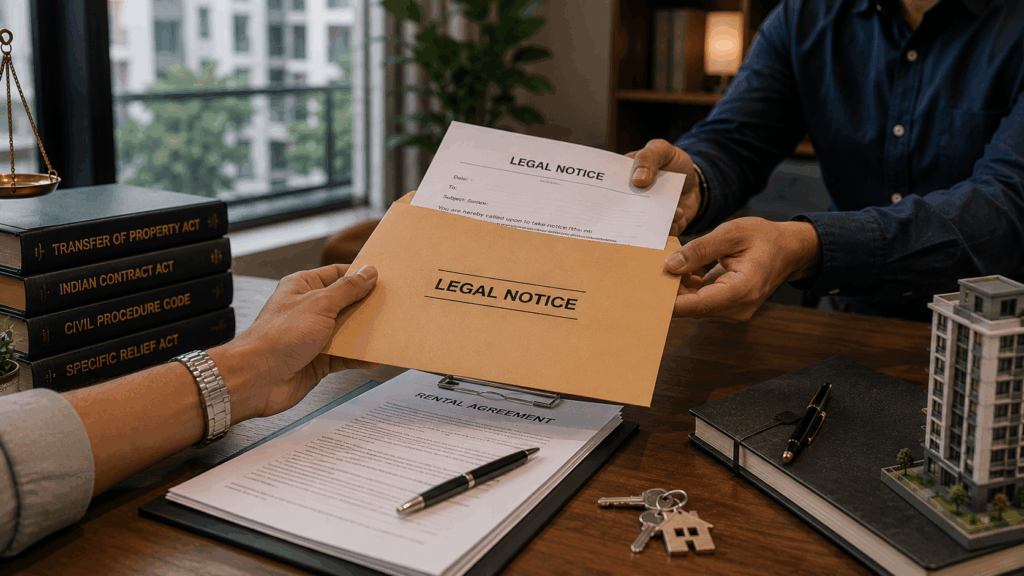
If informal communication does not resolve the issue, a formal legal notice may be considered depending on the circumstances.
A legal notice is more structured than an ordinary follow-up message. It formally communicates a grievance and generally sets out the action being sought from the other party. Depending on the dispute, it may relate to unpaid rent, contractual obligations, possession, termination, or another tenancy-related issue.
However, sending a legal notice should not be treated as simply sending a stronger version of a WhatsApp message.
The facts should be reviewed carefully before one is issued. The agreement, payment records, notices, correspondence, property records, and applicable law all matter. A poorly framed notice can create unnecessary complications, particularly when the underlying facts have not been properly established.
For landlords and tenants, professional legal advice is therefore important when a dispute has reached the stage of formal legal action. Rental laws and procedures can differ depending on the state, the nature of the tenancy, and the specific issue involved.
The objective should be to communicate the legal position accurately and give the dispute a reasonable opportunity to be resolved before litigation becomes necessary.
Not every dispute reaches the stage of a formal legal notice. In many cases, the problem starts much earlier when a tenant remains in the property beyond the agreed exit date. For a practical look at handling this situation, see How to Handle a Tenant Who Overstays the Notice Period.
Rent Authority or Tribunal: Is There an Alternative to Civil Court?
India’s rental framework is not completely uniform across the country. The Model Tenancy Act, 2021 proposes a framework with a Rent Authority, Rent Court, and Rent Tribunal. However, it is a model framework for adoption by States and Union Territories. It does not automatically apply to every tenancy in India.
Where applicable provisions have been adopted, specialised rental mechanisms may help resolve certain tenancy disputes.
This is an important distinction for property owners. Simply reading about a Rent Authority online does not mean the same process applies to every rental property in India. The applicable state law, notifications, tenancy structure, and nature of the dispute should be reviewed before deciding where to file a matter.
The practical lesson is straightforward: identify the legal forum applicable to your property before starting proceedings.
The same state-specific approach is important when determining how much security deposit a landlord can reasonably structure into a tenancy. The Security Deposit Amount: What Is Legal in Your State? explains how deposit rules can vary across jurisdictions and why property owners should avoid applying a one-size-fits-all approach.
For a PG or co-living operator managing properties across multiple cities, this becomes even more important. A process that applies to one location may not necessarily be identical in another. Good compliance therefore requires both a strong documentation system and awareness of the local legal framework.
Mediation Can Resolve the Problem Without Turning It Into a Legal Battle
Not every disagreement needs to end with one party winning and the other losing.
Mediation gives both sides a structured way to discuss the dispute. A neutral third party helps them work towards a mutually acceptable settlement. It can be useful when both parties want to avoid the time, cost, and stress of prolonged legal proceedings.
Consider a security deposit dispute. The landlord believes ₹8,000 should be deducted for unpaid charges and repairs, while the tenant believes only ₹3,000 is justified. If the underlying records are available, both sides can review the agreement, payment history, move-out condition, and documented expenses before discussing a settlement.
Similarly, an early-exit disagreement may sometimes be resolved through a practical transition arrangement. This can help avoid immediate escalation.
India also has the Mediation Act, 2023, which provides a statutory framework for mediation and related processes.
Mediation is not a substitute for legal advice in every situation. It may also be unsuitable where urgent legal remedies are needed. However, when both parties are willing to cooperate, mediation can offer a useful middle ground between informal negotiation and litigation.
Why Documentation Often Makes the Biggest Difference
One of the most underestimated aspects of rental dispute resolution is the quality of the records available before the disagreement begins.
Imagine a tenant claims that the security deposit was supposed to be fully refundable. The landlord says that the tenant had agreed to deductions for unpaid electricity charges. If neither side can produce the relevant agreement or payment records, the disagreement becomes a matter of conflicting statements.
Now consider the same situation where the agreement clearly specifies the deposit conditions, the payment history is recorded, and the final settlement is documented. The conversation may still be uncomfortable, but the factual foundation is much stronger.
The same principle applies to rent payments, maintenance complaints, move-in conditions, and notice periods.
Good rental documentation should ideally make it possible to answer questions such as:
- What did both parties agree to at the beginning of the tenancy, and can the signed agreement be produced without searching through multiple systems?
- Which payments were made, when were they received, and what amount, if any, remains outstanding according to the property’s records?
- What condition was the property in at move-in and move-out, and is there evidence supporting any damage-related claim?
- When was a complaint, notice, or request raised, and what communication followed before the issue escalated?
This is why digital documentation is increasingly becoming an important part of rental operations. RentOk’s Digital Rent Agreements vs. Notarized Paper explores the shift towards digital agreement workflows and the role of digital records in modern rentals.
When Should You Actually Consider Civil Court?
Avoiding court should never mean ignoring a legitimate legal right.
If direct communication, negotiation, mediation, or an applicable specialised tenancy mechanism cannot resolve the matter, civil or other appropriate legal proceedings may become necessary. The correct forum will depend on the nature of the dispute and the laws applicable to the tenancy.
This is where landlords and tenants should avoid relying on generic internet advice. A dispute over unpaid rent may be handled differently from disputes involving possession, termination, property damage, or other legal issues. The value of professional legal advice is in identifying the correct route for the specific circumstances.
Before moving towards litigation, it is useful to have the complete record ready. This can include:
- The signed rental agreement and any subsequent amendments, particularly where the disputed term was changed or renewed during the tenancy.
- Payment and deposit records, including receipts, transaction details, outstanding dues, and the calculation of any proposed settlement.
- Written notices and communication, including messages or emails that establish what each party knew and when they were informed.
- Property condition and maintenance records, especially where the dispute involves damage, repairs, or responsibility for a particular expense.
- Relevant identity and tenancy documentation, which can help establish the parties, property, and period of occupancy involved.
A well-organised record does not guarantee a particular legal outcome. What it does provide is clarity.
That clarity becomes especially important in PG operations. A single agreement may cover rent, security deposits, utilities, notice periods, lock-in conditions, and property rules. For a detailed look at structuring these terms, explore How to Set a Lock-In Period for PG Tenants.
Ultimately, clear documentation and well-defined terms can help reduce misunderstandings before they develop into unnecessarily complicated rental disputes.

How RentOk Helps Prevent Rental Disputes
RentOk helps property owners and managers create a more structured rental operation by bringing key parts of the tenant lifecycle into one connected platform. Instead of relying on separate files, spreadsheets, messages, and physical documents, operators can manage important information around tenant onboarding, digital agreements, payments, dues, and move-in and move-out processes in a more organised way.
Digital agreements are particularly relevant here because they establish the terms of the tenancy at the point when both parties are entering the relationship. RentOk supports digital agreement creation and e-signing as part of its tenant onboarding workflow, helping operators move away from fragmented paper-based processes.
That structure can also become valuable when a disagreement arises. RentOk has documented examples where digital records helped resolve disputes without legal action, including situations involving disputed rent amounts and unclear charges. In one example, a digitally signed agreement provided a clear record of the agreed rent and helped close the disagreement.
The broader advantage is not that a property management platform can replace legal advice or guarantee that disputes will never happen. It cannot. The advantage is that better records, clearer agreements, and organised tenant information can prevent small misunderstandings from becoming much larger operational problems.
Conclusion
A rental dispute does not automatically have to become a court case. In many situations, the most effective first response is to step back, review the agreement, organise the facts, communicate formally, and explore negotiation or mediation before moving towards litigation.
For landlords, PG owners, and co-living operators, the best dispute-resolution strategy often begins long before the dispute itself. Clear rental agreements, properly documented payment terms, transparent deposit conditions, defined notice periods, and accessible tenancy records create a stronger foundation for both sides.
The goal is not simply to avoid court. It is to build a rental operation where disagreements can be addressed using facts, documentation, and clearly defined terms instead of confusion and conflicting memories.
Ready to create clearer rental documentation from the start? Generate & Register Agreements with RentOk and build a more organised, transparent tenancy process for your property.
Frequently Asked Questions
Find answers to common questions about this topic
About the Author
Ishika Pannu
Ishika Pannu brings you the latest insights and easy-to-apply strategies in property management—helping you simplify renting and grow with RentOk.