
Legal
How to Create a Legally Valid Rent Agreement in India


Written by
Ishika Pannu
Read Time
16 min read
Posted on
August 18, 2026
Overview
Overview
How to Create a Legally Valid Rent Agreement in India
A rent agreement is often one of the first documents completed before a tenant moves in. However, its role goes beyond basic paperwork. It records the tenancy’s financial terms and defines both parties’ responsibilities. It also provides a written reference for rent, deposits, maintenance, notice periods, and the tenant’s exit.
For landlords and property managers, this clarity becomes even more important as the number of tenants increases. A property with a handful of tenants may be able to manage agreements through individual files and informal communication. But when a PG, hostel, or co-living business manages hundreds of tenants, inconsistent documentation can quickly become an operational problem.
A legally valid rent agreement, therefore, should not be viewed as a document that is created, signed, and forgotten. It should accurately reflect the actual rental arrangement and be handled with the same level of care as other important property records.
If you are looking for a detailed checklist of the clauses that should go into an agreement, RentOk’s Rent Agreement Checklist: 15 Things Every Owner Should Include is a useful reference before you begin drafting.
What Is a Rent Agreement?
A rent agreement is a written contract between a landlord and a tenant that records the terms under which a property is occupied. Depending on the nature and duration of the arrangement, it may also be referred to as a lease agreement, tenancy agreement, or, in some contexts, a leave and licence agreement.
The purpose is straightforward: both parties should know what they have agreed to before the tenancy begins.
A well-drafted agreement generally covers the identity of the parties, the property being occupied, rent, security deposit, duration, notice requirements, maintenance responsibilities, permitted use, and conditions for termination. The exact clauses required will depend on the nature of the arrangement and applicable local law.
For a PG or co-living operator, the document may need to go beyond basic rent terms. If the tenant is also receiving services such as housekeeping, meals, internet, utilities, or access to shared facilities, the agreement should make the relevant terms clear rather than leaving them to informal conversations.
This is important because most rental disputes do not begin with a major disagreement. They usually start with something that was never clearly documented in the first place.

Why a Proper Rent Agreement Matters
A rent agreement protects both sides by creating a common understanding of the tenancy. The landlord knows what the tenant has agreed to, while the tenant has a written record of the financial and operational terms they accepted.
For property owners, this can be particularly valuable when managing recurring operational issues. A tenant may question a deduction from the security deposit, dispute a late-payment charge, or leave without following the agreed notice period. Without clear documentation, resolving the issue becomes much harder.
The issue is that each bullet contains a long sentence. You can keep the meaning while splitting them into shorter sentences:
- Financial commitments: The agreement records the rent, deposit, and payment schedule. It also covers additional charges and applicable conditions. This reduces disagreements over what the tenant must pay.
- Responsibilities of both parties: Maintenance, utilities, and repairs can be clearly allocated. Property usage and other responsibilities can also be defined. This avoids confusion when issues arise.
- Tenant exit: Notice periods and termination conditions can be established in advance. The agreement can also explain the required procedures. This makes moving out more predictable for both parties.
- Property rules: The agreement can document rules on subletting, guests, and alterations. It can also cover prohibited activities and shared spaces. This establishes clear expectations from the beginning.
The agreement is therefore not only a legal document. For a professionally managed rental property, it is also an operational document that helps establish how the tenancy will function.
Key Clauses Every Rent Agreement Should Include
There is no single universal rent agreement that works perfectly for every property. A residential flat, a furnished apartment, a PG room, and a co-living space may all require different terms.
However, certain areas should receive particular attention when drafting the agreement.
1. Details of the Landlord and Tenant
The agreement should clearly identify the parties entering into the arrangement. This generally includes their names, addresses, contact information, and other identification details required for the applicable documentation process.
These details may appear basic, but accuracy matters. A spelling error in a name or outdated contact information can create unnecessary problems when the agreement needs to be referenced later.
For professionally managed properties, it is equally important to maintain these details consistently across the tenant’s other records.
2. Complete Property Details
The property being rented should be identifiable without ambiguity. Include the complete address and, where relevant, the flat number, room number, floor, building name, parking space, or other specific area covered by the agreement.
This becomes particularly important in PGs and co-living properties where several tenants may occupy different rooms within one building.
The agreement should make it clear exactly what the tenant is receiving access to and whether common areas or shared facilities form part of the arrangement.
3. Rent, Payment Date and Additional Charges
The rent clause should do more than state a monthly figure. It should explain how and when the rent is payable and identify additional charges wherever they apply.
Depending on the property, these may include electricity, water, food, housekeeping, internet, maintenance, parking, or other services.
If charges are calculated separately, explain the basis of calculation. For example, if electricity is billed according to consumption, the agreement should make the applicable rate and billing method clear.
This level of detail may seem excessive at the time of drafting, but it can prevent repeated disputes later.
4. Security Deposit and Refund Conditions
Security deposits are one of the most common areas of disagreement between landlords and tenants, particularly at the time of move-out.
The agreement should clearly record the deposit amount and explain the circumstances in which deductions may be made. It should also establish the process for final settlement after the tenant vacates.
A useful agreement should leave as little room as possible for assumptions around damages, unpaid dues, notice-period obligations, or other legitimate deductions.
If you are also dealing with tenant exits and settlements, RentOk’s guide on How to Manage Move-In and Move-Out Smoothly provides useful context on why documentation and clarity matter throughout the tenant lifecycle.
5. Tenure, Lock-in Period and Notice Period
The agreement should clearly state when the tenancy begins, how long it is intended to continue, and what conditions apply if either party wants to end it.
Lock-in and notice periods are often confused, even though they serve different purposes. A lock-in period generally refers to an agreed minimum period during which early termination may carry specified consequences. A notice period refers to the advance notice that must be given before vacating or terminating the arrangement.
These terms should not be left vague.
For example, if an agreement includes a six-month lock-in and a 30-day notice period, the document should make it clear how those provisions interact and what happens if the tenant wants to leave before the lock-in expires.
This is particularly important for PG operators because unexpected move-outs directly affect occupancy planning and revenue forecasting.
An agreement also becomes much more useful when the information it contains is connected to the rest of the tenant lifecycle. Move-in dates, occupancy records, payments, dues, and eventual move-out details all contribute to a clearer picture of how a property is performing. This is where having clearly defined lock-in and exit conditions becomes particularly important, especially when operators need to balance tenant flexibility with occupancy stability. The challenges around this are explored in Managing Tenant Lock-in Periods Without Conflict.
How to Draft a Rent Agreement Properly
Creating a rent agreement becomes easier when the document is built around the actual rental arrangement rather than copied from a generic template.
Start by identifying the parties and property, then establish the financial terms. Once those fundamentals are clear, document the responsibilities, rules, duration, and exit conditions.
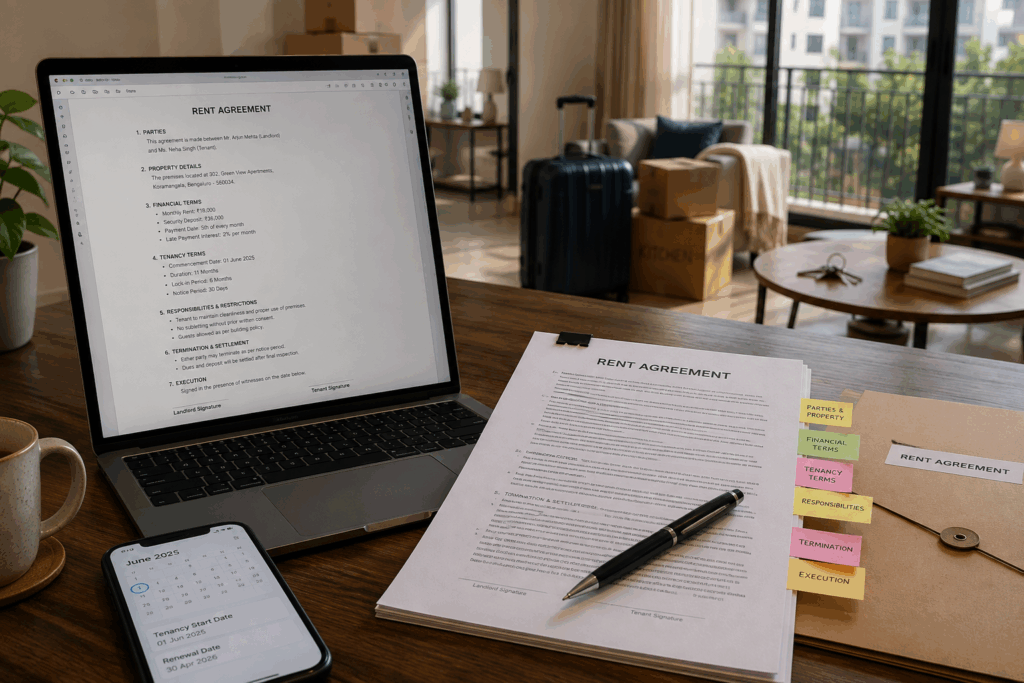
A practical structure can include:
- Parties and property: Identify the landlord, tenant, and exact premises covered by the agreement so there is no confusion about who is entering the arrangement or what is being rented.
- Financial terms: Record rent, deposit, payment dates, utility charges, maintenance fees, and other recurring or one-time charges, along with the method used to calculate variable amounts.
- Tenancy terms: Specify the commencement date, duration, renewal conditions, lock-in provisions, and notice period so that the lifecycle of the tenancy is clearly documented.
- Responsibilities and restrictions: Explain maintenance obligations, property usage, guest policies, subletting restrictions, alterations, and other rules that are relevant to the property.
- Termination and settlement: Explain how the agreement can end, what happens during the exit process, and how outstanding dues or deposit adjustments will be handled.
- Execution: Ensure the final agreement is properly executed by the parties and that all applicable formalities, including witnesses, stamping, or registration, are completed where required.
The most important drafting principle is consistency. If a rule is important enough to enforce later, it should generally be clear enough to document when the agreement is created.
Registration vs Notarisation: What Is the Difference?
One of the most common mistakes landlords make is assuming that notarisation and registration are interchangeable.
They are not.
Notarisation generally involves a notary authenticating the execution of a document or related formalities. Registration, on the other hand, is a formal process carried out with the relevant registration authority.
Under Section 107 of the Transfer of Property Act, a lease from year to year, for a term exceeding one year, or reserving a yearly rent can be made only by a registered instrument. The Registration Act also specifies certain leases that require compulsory registration.
However, rental documentation in India cannot always be reduced to one nationwide rule such as “11 months means no registration.” State-specific laws and requirements can change the position. For example, Maharashtra has specific statutory requirements relating to agreements for leave and licence or letting of premises.
That means landlords should check the rules applicable to the state and nature of the property rather than relying on a generic internet template.
Stamp duty is another consideration. The applicable amount and calculation can depend on the state, duration, rent, deposit, and nature of the agreement. Treating a rent agreement as legally complete simply because both parties have signed it can therefore be risky.
What Should You Check Before Signing?
Before the agreement is executed, both parties should read the final version carefully. The goal is not merely to check spelling and signatures but to make sure the document accurately represents the arrangement that will actually operate.
Pay particular attention to:
- Tenant and property information: Check names, addresses, room or unit numbers, IDs, and contact details. Ensure they match the actual parties and premises.
- Money-related clauses: Verify rent, deposits, payment dates, maintenance charges, and utility calculations. Also check late-payment terms and other financial obligations.
- Exit conditions: Review notice and lock-in periods. Check termination terms, deposit deductions, and the final settlement process.
- Property rules: Include guest policies, subletting restrictions, shared-space rules, and maintenance responsibilities. Make sure all key conditions are clearly written.
- Legal formalities: Check if the agreement requires stamping, registration, or other state-specific compliance steps.
For landlords managing several properties, make this review part of the onboarding process. A standard process helps ensure every agreement receives the same level of attention.
Common Mistakes That Can Make a Rent Agreement Problematic
A rent agreement can look formal and still be poorly drafted. The key issue is often not the absence of legal language, but the absence of clear, relevant terms.
Using a generic template without adapting it to the property is a common mistake. A standard residential agreement may not suit a PG or co-living setup. It may not cover food, housekeeping, utilities, shared facilities, or house rules.
Relying on verbal promises is another common issue. If a landlord agrees to waive a charge, document it. The same applies when a tenant agrees to provide additional notice. Written terms can help prevent disputes.
Other common documentation problems include:
- Leaving important financial terms vague: When rent, utility calculations, deposit deductions, or additional charges are not clearly defined, disagreements become much harder to resolve.
- Ignoring changes after signing: If the rent, occupancy arrangement, services, or other important terms change, continuing to rely on an outdated agreement can create a gap between the document and the actual tenancy.
- Failing to maintain executed copies: A signed agreement is useful only when the relevant parties can actually retrieve it when they need it, particularly during disputes, renewals, or tenant exits.
- Assuming every state follows the same process: Stamp duty, registration, police verification, and tenancy-related requirements can vary, so copying a process from another city can lead to compliance problems.
- Treating the agreement as a one-time task: For growing rental businesses, agreements have start dates, expiry dates, renewal requirements, and exit implications that need to be managed throughout the tenant lifecycle.
If your focus is specifically on PGs, RentOk’s PG Rental Agreement Format guide also covers clauses such as deposits, lock-in periods, notice periods, utility charges, and house rules in the context of managed PG accommodation.
Can You Create a Rent Agreement Online?
Digital documentation has changed how rental businesses handle agreements. Instead of preparing a document manually, printing it, collecting signatures, scanning it, and storing it somewhere on a computer, landlords can now use digital workflows to make the process more structured.
For individual landlords, this can save time. For PG and co-living operators, the larger benefit is consistency.
When onboarding dozens or hundreds of tenants, a digital agreement workflow can simplify the process. It helps standardize formats, collect tenant details, track documents, and retrieve agreements when needed.
RentOk has previously covered the process of creating an online rent agreement in India, including digital tenant onboarding, identity verification, and e-signing workflows. The exact legal and procedural requirements should still be checked for the specific agreement and location.
Digital does not mean “automatically legally valid.” The document still needs to satisfy the applicable legal and execution requirements. What digital systems can do is make the process more organised and significantly easier to manage at scale.
Why Agreement Management Becomes an Operational Problem at Scale
Creating one agreement is relatively straightforward. Managing hundreds of them is a different challenge.
A growing PG operator may manage agreements with different start and end dates. Some tenants may renew under revised terms. Others may leave early. New occupants may also be onboarded every month. When these records are maintained through scattered folders and spreadsheets, important dates and documents can easily get missed.
This is where agreement management starts becoming part of property management rather than a purely legal task.
A structured system makes it easier to track each tenant and their agreement. It shows when the agreement began and which terms apply. It also highlights when action may be needed.
This reduces reliance on one staff member to locate documents.
For businesses managing multiple properties, this visibility is essential. Documentation errors can grow as quickly as occupancy.

How RentOk Helps You Manage Rental Agreements Digitally
A properly drafted agreement creates legal and operational clarity, but managing those agreements throughout the tenant lifecycle requires a system behind them.
This is where RentOk helps PG, hostel, and co-living operators bring rental documentation into a more organised property-management workflow. Instead of keeping tenant information, agreements, payments, dues, and occupancy records in separate places, operators can manage key aspects of the tenant lifecycle through one connected platform.
For growing rental businesses, the advantage is not simply having a digital document. It is having better visibility over the information surrounding that document.
RentOk can help operators streamline agreement-related workflows while also managing broader property operations, reducing the dependence on scattered files, manual tracking, and repeated coordination. This becomes particularly valuable when multiple properties and large tenant volumes make traditional documentation increasingly difficult to maintain.
Conclusion
A legally valid rent agreement is more than a standard format filled with names and numbers. It should accurately document the relationship between the landlord and tenant, clearly define financial and operational responsibilities, and comply with the applicable legal requirements for the particular rental arrangement.
The strongest agreements are created with the future in mind. They answer the questions that are easy to ignore on move-in day but become important later: What happens if rent is delayed? Who pays for a repair? What happens to the deposit at exit? How much notice is required? What happens if someone wants to leave early? Which formalities are required for the agreement to be properly executed?
For landlords and property managers, getting these details right at the beginning can prevent considerable confusion later. And once the number of tenants grows, managing those agreements systematically becomes just as important as drafting them correctly.
Ready to simplify rental documentation and manage agreements more efficiently? Create Your Rent Agreement on RentOk and bring your tenant agreements and property operations into a more organised digital workflow.
Frequently Asked Questions
Find answers to common questions about this topic
About the Author
Ishika Pannu
Ishika Pannu brings you the latest insights and easy-to-apply strategies in property management—helping you simplify renting and grow with RentOk.
You may also like these
Related Articles

1 min read
Fire NOC for PGs and Hostels: Process, Documents and Fees State by State
Written by
Posted on
Ishika Pannu
Oct 19, 2026

1 min read
MCD Structural Safety Certificate for PGs: 15-Day Guide
Written by
Posted on
Ishika Pannu
Oct 19, 2026

1 min read
What Can I Ask a Prospective Tenant Before Renting My Property?
Written by
Posted on
Ishika Pannu
Oct 14, 2026
1 min read
Is a Notarised Rent Agreement Enough, or Do I Need to Register It?
Written by
Posted on
Ishika Pannu
Oct 5, 2026
1 min read
Which Indian Cities Still Fall Under Old Rent Control Laws?
Written by
Posted on
Ishika Pannu
Oct 3, 2026
1 min read
Managing Rental Property in India as an NRI Landlord
Written by
Posted on
Ishika Pannu
Oct 1, 2026
1 min read
What Documents Do I Actually Need Before Handing Over My Rental Property?
Written by
Posted on
Ishika Pannu
Sep 30, 2026
1 min read
Is a Verbal Rental Agreement Legally Valid in India?
Written by
Posted on
Ishika Pannu
Sep 24, 2026
1 min read
What Can I Do If My Tenant Stops Paying Rent?
Written by
Posted on
Ishika Pannu
Sep 23, 2026

1 min read
How to Check If Your PG or Hostel is Legally Registered in India
Written by
Posted on
Ishika Pannu
Sep 20, 2026
Stay ahead in property management with expert insights
Join thousands of property managers receiving exclusive tips delivered straight to your inbox.
Browse posts by category
Case Study
Cost of Living
Growth
Legal
Market Trends
News
Pg owner app
Property Management
Property Tax
Tech
RentOk
The easiest way to rent and manage your PGs and hostels.
Grievance Officer
Get the app


Contact us
hello@eazyapp.tech
HQ Office
COGROW, BASEMENT F-12/8A
BESIDE HOUSE OF STYLE SALON, SECTOR 28, DLF PHASE 1
GURUGRAM, HARYANA - 122002
South India Office
LUMIODESK COWORKING, 2ND FLOOR, 40, 14TH MAIN RD
BESIDE MC DONALD, 7TH SECTOR, HSR LAYOUT
BENGALURU, KARNATAKA - 560102
©️ 2026 EazyApp Tech Pvt Ltd. All rights reserved


