
Legal
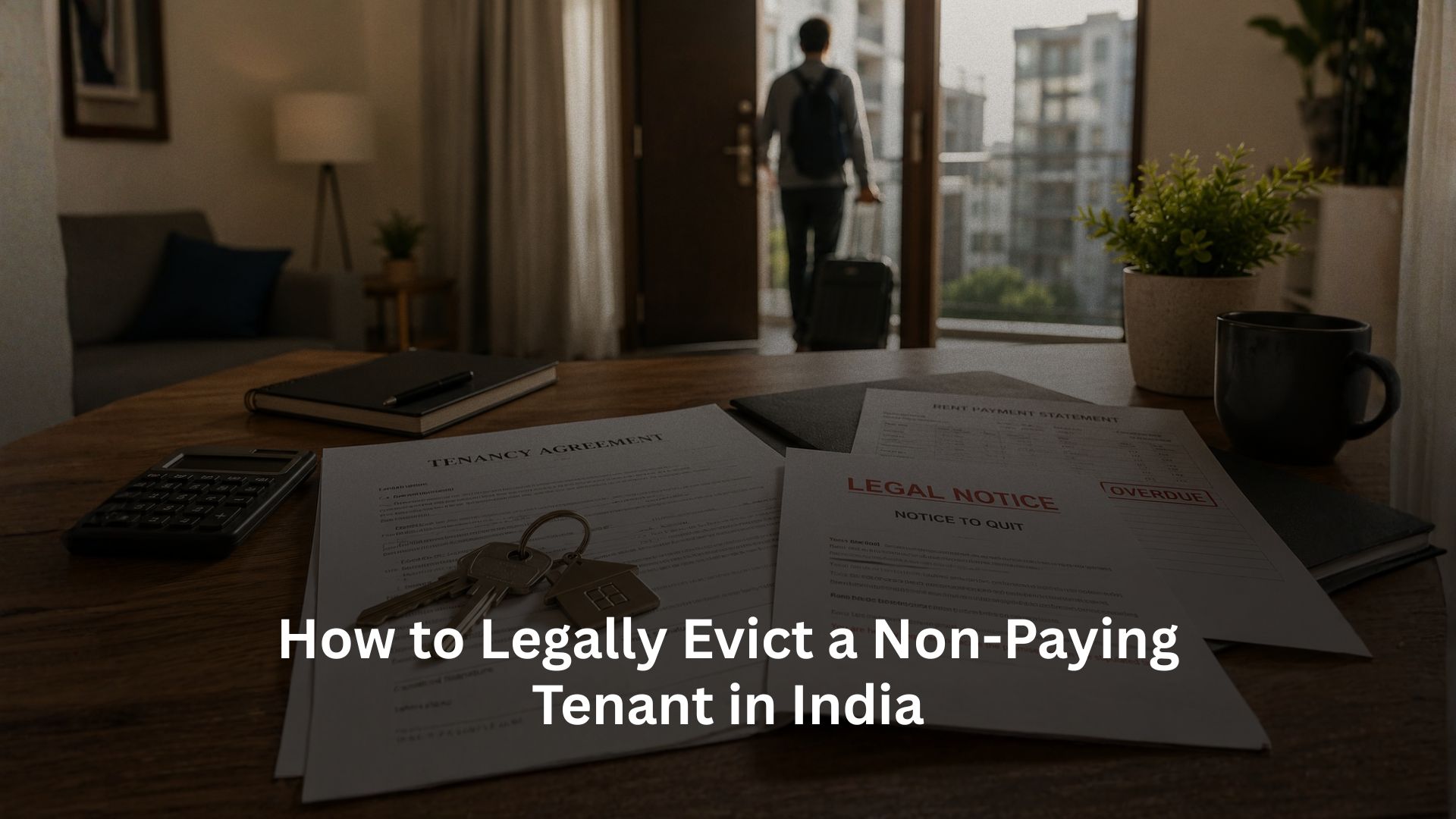
How to Legally Evict a Non-Paying Tenant in India

Written by
Ishika Pannu
Read Time
15 min read
Posted on
August 24, 2026
Overview
Overview
How to Legally Evict a Non-Paying Tenant in India
A tenant missing one rent payment does not automatically mean a landlord can ask them to leave the property immediately. In India, eviction is not simply a matter of ownership. The landlord’s right to recover possession has to be exercised in accordance with the applicable tenancy agreement and the law governing the property.
This becomes particularly important when rent remains unpaid for several months. What may initially look like a straightforward payment issue can quickly turn into a dispute over notices, deposits, agreements, possession, and the tenant’s legal rights. Taking an aggressive step without following the correct process can create a bigger problem for the property owner than the original unpaid rent.
For landlords and PG operators, the better approach is to treat non-payment as both a financial and legal matter. Before thinking about eviction, the owner should establish exactly what is unpaid, check what the agreement says, communicate the default clearly, and understand which rent-control or tenancy provisions apply.
If you are already dealing with delayed payments, it is also useful to understand how to handle tenants who pay late every month. A structured rent-collection process can sometimes resolve the problem before it reaches the eviction stage.
When Can You Legally Evict a Tenant?
A landlord generally cannot evict a tenant simply because they no longer want the person occupying the property. There must be a legally recognized ground for seeking possession, and the specific grounds depend on the applicable state rent-control law, the tenancy agreement, and the nature of the property.
This also applies to eviction for reasons other than non-payment. How to Handle Tenant Evictions Professionally explains the broader eviction process, including notices, documentation, move-out procedures, and final settlement.
Non-payment of rent can be an important ground for eviction. However, the procedure varies across India. Depending on the law, landlords may need to prove rent arrears. They may also need to issue a formal demand notice. In some cases, the tenant must be given time to make the payment. The landlord may then need to approach the relevant authority or court.
Simply stating that “the tenant has not paid rent” may not be enough. The landlord should confirm the amount due and when it became payable. They should also check whether the required notice was given. State-specific tenant protections may also apply.
Before taking action, landlords should review:
- The tenancy agreement: Check rent, payment dates, notice periods, lock-in provisions, default clauses, and termination terms.
- Payment records: Maintain evidence of rent received, unpaid amounts, payment dates, receipts, and part-payments.
- Applicable local law: Rent-control rules differ by state, and some properties or arrangements may be excluded from particular protections.
- Previous communication: Preserve written reminders, notices, acknowledgements, and other communications concerning unpaid rent.
The first step should be to establish the facts and maintain proper documentation. A clearly recorded rent default can provide a stronger foundation for the appropriate legal action.

Grounds for Eviction Under Rent Control Laws
Rent-control laws were introduced to protect tenants from arbitrary eviction and excessive or unfair treatment. At the same time, they recognize circumstances in which a landlord can seek recovery of possession. The precise grounds and procedures vary depending on the state legislation.
Non-payment of legally recoverable rent is one commonly recognized ground. However, it is not the only situation that may lead to eviction proceedings. Depending on the applicable law, other grounds may also apply. These can include unauthorized subletting or misuse of the premises. A breach of tenancy conditions may also be relevant. Other grounds may be recognized under specific state laws.
For example, the Delhi Rent Control Act provides specific protections against eviction. It also addresses non-payment of rent and other circumstances within its statutory framework. Other state laws may set different requirements and timelines.
Landlords should therefore avoid using a generic “rent control law in India” checklist. The rules can vary depending on the state and the type of tenancy. The legal position needs to be checked against the state and tenancy involved.
The rental agreement also becomes important at this stage. A well-drafted agreement can establish the commercial relationship between the parties and make important terms easier to understand. RentOk’s Rent Agreement Checklist: 15 Things Every Owner Should Include is useful for understanding why payment terms, usage conditions, and exit provisions should be clearly documented from the beginning.
A landlord should also distinguish between recovering unpaid rent and recovering possession. They may be connected, but they are not necessarily the same legal remedy. A tenant may owe money without the landlord being entitled to simply remove them without following the required procedure.
That distinction is at the heart of a legally sound eviction process.
Step-by-Step: How to Evict a Non-Paying Tenant Legally
The safest approach is to move through the process systematically rather than reacting to every missed payment with an immediate threat of eviction.
1. Verify the outstanding rent
Start by calculating the exact arrears. Do not rely on an approximate figure or memory.
Your records should establish the agreed monthly rent, the months for which payment is outstanding, any part-payments received, applicable charges, and the total amount currently due. If utilities or other charges are included in the dispute, keep those calculations separate and supported by relevant records.
This matters because an unclear demand can create unnecessary arguments later.
2. Communicate the default clearly
Before escalating the matter, communicate with the tenant in writing. Explain the outstanding amount, the relevant payment dates, and what action is expected.
A professional written communication is considerably stronger than repeated informal calls because it creates a record of what was communicated and when.
The objective at this stage is not to intimidate the tenant. It is to give them a clear opportunity to understand the default and resolve it.
3. Review the agreement and applicable law
Once the payment default is established, check the tenancy agreement alongside the applicable local law.
This is where landlords should be particularly careful. Section 106 of the Transfer of Property Act provides a general framework for certain leases. It applies where there is no contrary contract, local law, or established usage.
For covered non-agricultural or non-manufacturing leases, the provision refers to a 15-day notice period. However, this should not be treated as a universal eviction rule in India.
The applicable notice period can depend on the tenancy terms and the relevant law.
A state rent-control law or the tenancy agreement may impose different requirements.
4. Serve the appropriate notice
If the situation requires formal notice, it should be prepared and served correctly. The process should follow the applicable law and tenancy agreement.
The notice should clearly identify the tenancy. It should state the relevant default or legal ground. It should also explain the required action and applicable notice period.
Section 106 requires notices under that provision to be in writing. It also sets out permitted methods of delivery.
For a more detailed discussion, RentOk’s guide on how to write a formal eviction notice for a PG tenant in India can be linked here as a practical companion to this section.
5. Allow the legally required opportunity to respond or comply
An eviction process should not be treated as complete merely because a notice has been sent.
Depending on the applicable law, the tenant may have an opportunity to pay arrears, respond to the allegations, or contest the landlord’s claim. Some rent-control statutes contain specific protections for tenants who pay or tender the legally recoverable rent within prescribed periods.
For example, the Delhi Rent Control Act contains a specific framework concerning arrears and notice of demand before eviction proceedings can proceed on that ground.
This is one reason landlords should avoid assuming that every notice automatically results in eviction.
6. Proceed through the appropriate legal forum if necessary
If the tenant does not resolve the default, legal proceedings may be necessary. The landlord must also have a valid ground for seeking possession.
Depending on the applicable law, the case may go before a court, Rent Controller, or other authority.
The landlord should keep all relevant documents ready. These may include the tenancy agreement, payment records, notices, proof of service, and correspondence.
Professional legal advice is especially important at this stage. The correct forum and procedure depend on the facts of the tenancy.

Notice Period Rules: Is 15 Days Always Enough?
This is one of the most common misconceptions surrounding tenant eviction in India.
You may come across the claim that landlords must give “15 days’ notice” before asking a tenant to leave.
Section 106 of the Transfer of Property Act does provide a 15-day notice period for certain leases. It applies to leases other than those for agricultural or manufacturing purposes.
However, the rule is not universal. Section 106 applies only when there is no contrary contract, local law, or established usage.
That qualification is extremely important.
A tenancy governed by a particular state rent-control statute may have its own requirements. Similarly, the rental agreement may contain provisions that affect termination. The type of tenancy and property can also influence which rules apply.
Therefore, landlords should not use a fixed notice period simply because it appears online or has been used for another property.
Before serving an eviction notice, verify:
- What the agreement says about termination and notice, including whether specific default provisions apply when rent remains unpaid.
- Which state or local tenancy law governs the property, particularly where rent-control legislation provides additional protections to tenants.
- Whether the tenant has statutory rights to cure the default, such as paying arrears within a specified period after receiving a demand.
- How the notice must be served and documented, because proof of delivery can become important if the dispute later reaches a legal forum.
RentOk’s article on notice periods for PG tenants and how they can be enforced can provide additional context, particularly for PG and managed-rental operators dealing with recurring notice-related disputes.
The key point is simple: notice periods are legal requirements, not just operational preferences.
What Happens When the Tenant Still Refuses to Leave?
Suppose the landlord has followed the required procedure, served the appropriate notice, and the tenant still refuses to vacate. At that point, the matter can move beyond routine property management and into formal legal proceedings.
The landlord may need to approach the appropriate court, Rent Controller, or other authority depending on the applicable law and the nature of the tenancy. The forum and procedure cannot be assumed to be identical across India.
This is also where documentation becomes extremely important.
A landlord who can produce a signed agreement, consistent payment records, clear rent calculations, properly served notices, and documented communication is in a significantly better position to explain the history of the tenancy than an owner whose records are scattered across notebooks, bank statements, screenshots, and personal WhatsApp chats.
It is also important to understand what not to do.
A landlord should not treat self-help measures such as forcibly removing the tenant, threatening them, changing locks, or cutting essential services as a substitute for the legal eviction process. If possession is disputed, the appropriate legal route should be followed rather than attempting to create a forced vacancy.
The objective is not merely to get the tenant out. It is to recover possession lawfully and defensibly.
The Role of Rent Courts and Other Legal Authorities
The term “rent court” is often used broadly, but the actual forum dealing with a tenancy dispute depends on the applicable state law and circumstances.
Rent-control systems can provide a specialized mechanism for deciding disputes involving possession, rent, and tenant protections. In some situations, matters may involve a Rent Controller; in others, the relevant proceedings may fall before a civil court or another designated forum.
The important point for property owners is that the legal authority does more than simply decide whether rent was paid.
It may need to examine:
- Whether the landlord has established a legally recognized ground for eviction under the applicable statute.
- Whether the required demand or eviction notice was correctly issued and served on the tenant.
- Whether the tenant has exercised any statutory protection available under the relevant rent-control legislation.
- Whether the landlord’s documents and payment records support the amount claimed and the relief being requested.
This is why an eviction dispute should be approached as a documentation exercise as much as a legal one.
If the dispute involves significant arrears, contested possession, or uncertainty about the applicable law, a qualified property lawyer should review the matter before the landlord takes a consequential legal step.
RentOk has also documented examples of tenant disputes where proper records and communication helped resolve issues before they escalated. Its RentOk Legal Cases: Tenant Disputes Solved Without Legal Action article can be useful for understanding how documentation can make everyday rental disputes easier to manage.
Prevention Is Better Than an Eviction Dispute
The strongest way to deal with a non-paying tenant is often to build better rental processes before the problem appears.
Clear agreements, consistent rent collection, timely reminders, documented communication, and transparent settlement records make it easier for both sides to understand their obligations. They also reduce the possibility that a simple payment issue turns into a disagreement about what was promised.
For landlords and PG operators, a few operational practices can make a meaningful difference:
- Maintain a complete tenant record from move-in: Store the agreement, KYC details, joining information, payment terms, and other relevant records in an organized system instead of depending on scattered files.
- Create a consistent rent-follow-up process: Automated reminders and clear due-date visibility can reduce the number of cases where a tenant claims they were unaware that payment was pending.
- Document important conversations: Whenever a payment plan, extension, settlement, or other significant arrangement is agreed upon, record it properly instead of relying on verbal promises.
- Keep financial records transparent: Clear dues, receipts, deposit records, and settlement calculations make disagreements easier to resolve because both parties can refer to the same information.
- Treat legal escalation as the last operational stage: A structured process for reminders, communication, documentation, and resolution can prevent many payment disputes from reaching formal proceedings.
This approach is particularly important for owners managing multiple rooms or properties. At that scale, remembering which tenant was contacted, what they agreed to pay, and when a notice was sent becomes increasingly difficult without a centralized system.
The same challenge appears across almost every part of rental operations as a property grows. What Is Rental Management? Tools to Manage Your Property Efficiently explains how automated rent collection, digital agreements, tenant records, maintenance tracking, and occupancy management can work together within a structured rental operation.

How RentOk Helps Property Owners Stay Organized During Tenant Disputes
When rent defaults, notices, tenant communication, and payment records are spread across multiple spreadsheets, WhatsApp conversations, bank statements, and paper documents, even a genuine claim can become difficult to organize. RentOk helps PG owners, landlords, and property managers centralize tenant information, payment tracking, dues, agreements, communication, and property-level records in one connected platform. This gives owners better visibility into what is actually outstanding, what communication has taken place, and how the tenancy has progressed. RentOk cannot replace legal advice or determine whether an eviction is legally valid, but organized records can make day-to-day dispute management far more transparent and help owners maintain the documentation needed when a matter requires professional legal attention.
Conclusion
Evicting a non-paying tenant in India is not simply about sending a message asking them to vacate. The landlord needs to establish the payment default, understand the applicable tenancy and rent-control rules, follow the required notice process, preserve evidence, and use the appropriate legal forum when necessary. Because the exact requirements can differ by state and tenancy, there is no single notice period or eviction procedure that can safely be applied to every rental property.
For property owners, the best protection starts much earlier than the eviction itself. Clear agreements, reliable payment records, documented communication, and organized tenant management can reduce disputes and make legitimate action easier to support when problems do arise.
If you want to protect your property rights while keeping your rental operations organized, start your RentOk free trial and bring your tenant records, dues, payments, and property workflows into one centralized system.
Frequently Asked Questions
Find answers to common questions about this topic
About the Author
Ishika Pannu
Ishika Pannu brings you the latest insights and easy-to-apply strategies in property management—helping you simplify renting and grow with RentOk.
You may also like these
Related Articles

1 min read
Bengaluru PG Rules: 7 Things Every Owner Must Know
Written by
Posted on
Ishika Pannu
Oct 22, 2026

1 min read
PG Registration Rules in India: A City-by-City Guide
Written by
Posted on
Ishika Pannu
Oct 21, 2026

1 min read
Delhi PG Bill Explained: Licence, Deposit Cap, Rent Bands and the GovPG Portal
Written by
Posted on
Ishika Pannu
Oct 20, 2026

1 min read
Fire NOC for PGs and Hostels: Process, Documents and Fees State by State
Written by
Posted on
Ishika Pannu
Oct 19, 2026

1 min read
MCD Structural Safety Certificate for PGs: 15-Day Guide
Written by
Posted on
Ishika Pannu
Oct 19, 2026

1 min read
What Can I Ask a Prospective Tenant Before Renting My Property?
Written by
Posted on
Ishika Pannu
Oct 14, 2026
1 min read
Is a Notarised Rent Agreement Enough, or Do I Need to Register It?
Written by
Posted on
Ishika Pannu
Oct 5, 2026
1 min read
Which Indian Cities Still Fall Under Old Rent Control Laws?
Written by
Posted on
Ishika Pannu
Oct 3, 2026

1 min read
Managing Rental Property in India as an NRI Landlord
Written by
Posted on
Ishika Pannu
Oct 1, 2026
1 min read
What Documents Do I Actually Need Before Handing Over My Rental Property?
Written by
Posted on
Ishika Pannu
Sep 30, 2026
Stay ahead in property management with expert insights
Join thousands of property managers receiving exclusive tips delivered straight to your inbox.
Browse posts by category
Case Study
Cost of Living
Growth
Legal
Market Trends
News
Pg owner app
Property Management
Property Tax
Tech
RentOk
The easiest way to rent and manage your PGs and hostels.
Grievance Officer
Get the app


Contact us
hello@eazyapp.tech
HQ Office
COGROW, BASEMENT F-12/8A
BESIDE HOUSE OF STYLE SALON, SECTOR 28, DLF PHASE 1
GURUGRAM, HARYANA - 122002
South India Office
LUMIODESK COWORKING, 2ND FLOOR, 40, 14TH MAIN RD
BESIDE MC DONALD, 7TH SECTOR, HSR LAYOUT
BENGALURU, KARNATAKA - 560102
©️ 2026 EazyApp Tech Pvt Ltd. All rights reserved


