Legal
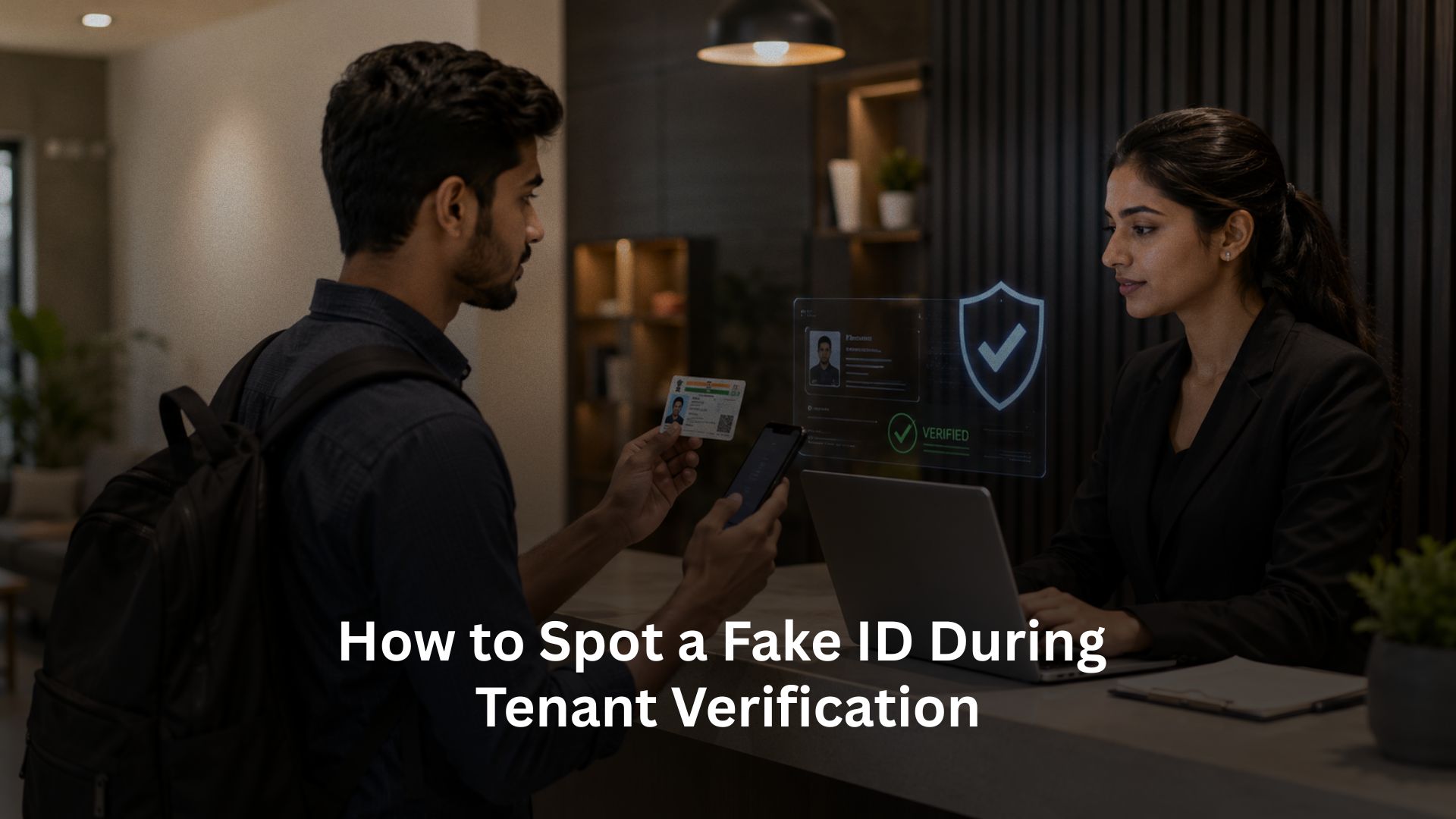
How to Spot a Fake ID During Tenant Verification

Written by
Ishika Pannu
Read Time
11 min read
Posted on
July 8, 2026
Overview
Overview
How to Spot a Fake ID During Tenant Verification
A fake ID can cost far more than a missed rent payment. It can lead to property damage, legal disputes, police inquiries, and tenants who disappear without a trace.
As the rental industry becomes more digital, identity fraud is becoming increasingly sophisticated. Today’s fraudsters use advanced editing software and AI tools to create IDs that look authentic, making it difficult to spot fake documents through a quick visual check.
That’s why tenant verification is no longer just about collecting an Aadhaar card or taking a photograph. It’s about confirming that the person moving into your property is genuinely who they claim to be.
Many landlords and PG operators still rely on manual document checks, assuming that if an ID looks genuine, it must be valid. Unfortunately, that’s exactly what fraudsters count on. A single oversight during onboarding can result in financial losses, compliance issues, and significant operational headaches.
Professional rental businesses take a different approach. They treat tenant verification as a risk management process, combining document checks with identity validation to reduce fraud and protect both the property and its residents.
As your occupancy grows, so does the risk of human error. A structured verification process helps maintain consistency, improves compliance, and creates a safer rental environment for everyone.
In this guide, we’ll look at the key signs of a fake ID and the best practices to verify tenant identities with confidence.
Why Fake IDs Are Becoming More Common in Rental Housing
The rental market offers fraudsters one major advantage, speed. During admission seasons, corporate relocations, or periods of high occupancy, property managers often need to process multiple move-ins every day. The pressure to fill vacant rooms can unintentionally reduce the time spent verifying documents.
Fraudsters take advantage of these situations. Instead of targeting complex security systems, they often depend on rushed onboarding processes where staff members perform only a quick visual inspection before accepting identity documents.
People use fake identities in rental properties for several reasons, including:
- Avoiding previous rental disputes or criminal records. Individuals with a history of unpaid rent, eviction, or legal issues may submit forged documents to conceal their identity and secure accommodation without raising suspicion.
- Escaping financial accountability. A tenant using fake credentials can leave behind unpaid dues, damages, or utility bills while making it extremely difficult for property owners to recover their losses.
- Accessing residential properties under false identities. In some cases, fraudulent documentation allows unauthorized individuals to gain access to secure residential spaces, creating potential safety concerns for other residents.
- Bypassing basic onboarding checks. Many forged documents look convincing enough to pass a quick visual review, especially when operators rely solely on scanned copies shared over messaging platforms.
These situations don’t just affect one tenant. They create operational disruption, increase compliance risks, and consume valuable management time that could have been spent improving the resident experience.

A Genuine-Looking ID Doesn’t Always Mean It’s Genuine
One of the biggest mistakes landlords make is assuming that forged documents are easy to identify. Modern editing software allows fraudsters to produce identity cards that closely resemble genuine government-issued documents. A quick glance often isn’t enough to detect alterations.
Instead of looking at one document in isolation, experienced operators compare information across multiple records. They focus on consistency rather than appearance.
For example, they check whether:
- The name, spelling, and date of birth remain identical across Aadhaar, PAN, passport, driving licence, and any additional identity documents submitted during onboarding.
- The photograph matches the applicant standing in front of them rather than relying solely on the image printed on the identity proof.
- The address aligns with the tenant’s employment, education, or relocation details, helping identify inconsistencies that require further clarification.
- The contact number, emergency contact, and supporting documents support the information provided in the rental application instead of contradicting it.
A fake document might successfully imitate the appearance of a genuine ID, but maintaining complete consistency across several records is far more difficult. Cross-verification often exposes discrepancies that a single-document review would easily miss.
Warning Signs You Should Never Ignore
No single indicator confirms that an identity document is fake. However, certain inconsistencies should immediately encourage property managers to investigate further before approving the tenant.
Pay close attention to signs such as:
- Poor print quality, blurred photographs, or faded text, especially around signatures, QR codes, or official seals. Genuine government-issued documents generally maintain consistent print quality throughout.
- Different fonts, unusual spacing, or misaligned text, which often indicate that someone has edited the document digitally instead of presenting an original version.
- Visible image manipulation, including photographs that appear pasted onto the document, uneven backgrounds, inconsistent shadows, or mismatched colours around the photo area.
- Information that doesn’t match across documents, such as different spellings of the tenant’s name, conflicting dates of birth, or addresses that raise obvious questions during onboarding.
- Damaged or unreadable QR codes, particularly on Aadhaar cards, preventing digital verification of the information printed on the document.
These warning signs don’t automatically prove fraud, but they should always trigger additional verification. Spending a few extra minutes validating suspicious documents is far easier than resolving legal or financial complications after the tenant has already moved in.
Build a Verification Process Instead of Depending on Individual Judgment
Strong tenant verification doesn’t rely on one experienced staff member who can identify fake documents. It depends on a standardized process that every team member follows consistently.
As rental businesses expand across multiple properties, relying on individual judgment often creates inconsistent onboarding practices. One manager may verify every document thoroughly, while another may approve applications after only a quick glance.
Professional operators reduce this inconsistency by creating a verification workflow that every tenant follows before receiving room access.
A reliable verification process should include:
- Collecting multiple identity proofs wherever possible so the management team can compare names, addresses, dates of birth, and photographs instead of relying on a single document.
- Following the same onboarding checklist for every applicant, regardless of occupancy pressure or seasonal demand, ensuring that verification standards remain consistent throughout the year.
- Recording verification details in an organized system, allowing staff members to retrieve documents quickly during audits, police verification, or operational reviews.
- Escalating suspicious cases immediately instead of approving the tenant first and investigating later. A short delay during onboarding often prevents much larger problems after occupancy begins.
The objective isn’t to make onboarding complicated. It’s to ensure that every tenant undergoes the same level of scrutiny before becoming a resident.
Human Errors Cause More Verification Failures Than Technology
While fake IDs continue to evolve, human error remains one of the biggest reasons verification failures occur. Most operators don’t knowingly approve fraudulent documents. They simply overlook important details because their onboarding process lacks structure.
As occupancy increases, staff members often juggle room inspections, payment collection, agreement signing, maintenance coordination, and tenant communication simultaneously. In that environment, document verification can easily become another task to finish quickly rather than a critical security checkpoint.
This usually creates problems such as:
- Accepting documents without reviewing every detail, particularly during busy move-in periods when operational pressure shifts the focus toward completing occupancy instead of verifying identity.
- Storing tenant records across multiple platforms, including WhatsApp, email, spreadsheets, and physical files, making future retrieval slow and increasing the possibility of missing important documents.
- Allowing different staff members to follow different verification methods, resulting in inconsistent onboarding standards across properties and increasing the chances of oversight.
- Missing incomplete or altered documentation because no standardized checklist guides the verification process from start to finish.
The strongest property managers understand that consistency matters more than speed. Every verified tenant strengthens the security of the property, while every shortcut increases operational risk.
Strengthen Your Verification Process with Digital Checks
Collecting physical copies of identity documents is only one part of tenant verification. As rental operations become more organized, operators also need to verify whether the information submitted is authentic and complete. Digital verification helps reduce manual errors, speeds up onboarding, and creates a reliable record that property managers can access whenever they need it.
That doesn’t mean technology replaces human judgment. Instead, it strengthens the verification process by allowing operators to validate information before approving a move-in. When you combine digital checks with manual review, you significantly reduce the chances of approving forged or manipulated documents.
A stronger verification workflow should include:
- Verify digital copies before accepting them as final documentation. Applicants often submit scanned copies or photographs through WhatsApp or email. Compare these with the original documents during move-in instead of relying only on digital images.
- Use QR code verification wherever applicable. Documents like Aadhaar include security features that help confirm authenticity. Taking a few extra minutes to validate these details can prevent much bigger problems later.
- Maintain digital records of every verified tenant. A centralized document repository allows your team to retrieve identity records quickly during audits, police verification, or internal reviews without searching through multiple folders.
- Create one verification workflow for every property. Whether you manage one PG or several co-living spaces, every tenant should pass through the same verification process to eliminate inconsistencies across locations.
Digital verification doesn’t make the process more complicated, it makes it more dependable.
Common Verification Mistakes That Put Properties at Risk
Many landlords assume identity fraud only affects large rental businesses. In reality, smaller properties often face greater risk because they depend heavily on manual processes and informal documentation.
Most verification failures happen because operators skip simple checks during busy onboarding periods. Over time, these shortcuts become routine and increase the chances of admitting tenants whose identities haven’t been properly verified.
Avoid these common mistakes during tenant onboarding:
- Approving tenants after checking only one identity proof. Cross-checking multiple documents gives you a much clearer picture and helps identify inconsistencies that one document alone may hide.
- Accepting cropped screenshots or unclear photographs. Poor-quality images make it difficult to verify important details and may conceal signs of document manipulation.
- Ignoring small inconsistencies because the tenant appears trustworthy. Even minor differences in names, addresses, or dates of birth deserve clarification before you complete the onboarding process.
- Leaving verification until after move-in. Once the tenant occupies the room, resolving documentation issues becomes significantly more difficult and often creates unnecessary conflict.
- Failing to document completed verification. Even if your team verifies every tenant properly, poor record management makes it difficult to prove compliance or retrieve information when authorities request it.
The strongest operators don’t depend on assumptions. They depend on systems that make every verification step consistent, repeatable, and easy to audit.
Identity Verification and Police Verification Should Work Together
Some landlords consider identity verification and police verification as separate formalities. In practice, both processes strengthen each other and help create a safer rental environment.
Identity verification confirms that the documents submitted by the tenant appear genuine and consistent. Police verification supports compliance with local regulations and helps authorities maintain accurate tenant records wherever applicable.
Completing both processes strengthens your onboarding workflow because each step addresses a different aspect of tenant security.
An effective onboarding process should always include:
- Reviewing every identity document before preparing the rental agreement instead of collecting paperwork after the tenant moves in.
- Recording accurate tenant information across agreements, payment records, and verification documents to avoid inconsistencies later.
- Completing police verification within the required timeline whenever local regulations apply to your property.
- Maintaining organized verification records that your team can access quickly during inspections, audits, or legal inquiries.
If you’d like to understand the complete police verification process, you can also read our detailed guide on Police Verification for Tenants, where we explain the documentation requirements, timelines, and best practices for landlords and PG operators.

How RentOk Helps Simplify Tenant Verification
Managing tenant verification manually becomes increasingly difficult as occupancy grows. Documents arrive through multiple channels, verification status becomes difficult to track, and staff members often spend valuable time searching for records whenever they need them.
RentOk helps property managers centralize the entire tenant onboarding process, making verification faster, more organized, and easier to manage at scale.
With RentOk, you can:
- Store tenant identity documents in one centralized platform, giving your team quick access to verified records instead of searching through spreadsheets, WhatsApp conversations, or physical files.
- Track every tenant’s verification status, helping your staff identify pending documentation before completing the move-in process.
- Standardize onboarding across all your properties, ensuring every tenant follows the same verification workflow regardless of who manages the onboarding.
- Maintain complete digital tenant records, making compliance, police verification, and future document retrieval significantly easier as your business grows.
If you’re looking to build a stronger onboarding process, you may also find our guides on Police Verification for Tenants and Digital Tenant Onboarding helpful for creating a more secure and compliant rental workflow.
Conclusion
Tenant verification is no longer a routine administrative task, it is one of the strongest safeguards a rental business can have. As identity fraud becomes more sophisticated, property managers must move beyond collecting documents and focus on verifying their authenticity, maintaining consistent records, and following a standardized onboarding process.
A structured verification system protects your property from financial losses, legal complications, and operational disruptions while creating a safer environment for every resident. Whether you manage a single PG or multiple co-living properties, investing time in proper tenant verification today will always cost less than dealing with the consequences of admitting the wrong tenant tomorrow.
Explore RentOk’s Tenant Verification Feature. Strengthen your tenant verification process with a centralized system that helps you manage identity documents, streamline onboarding, and maintain organized verification records, all from one platform.
About the Author
Ishika Pannu
Ishika Pannu brings you the latest insights and easy-to-apply strategies in property management—helping you simplify renting and grow with RentOk.