
Legal
How to Use Digital Signatures on Rent Agreements Legally in India

Written by
Ishika Pannu
Read Time
16 min read
Posted on
September 1, 2026
Overview
Overview
How to Use Digital Signatures on Rent Agreements Legally in India
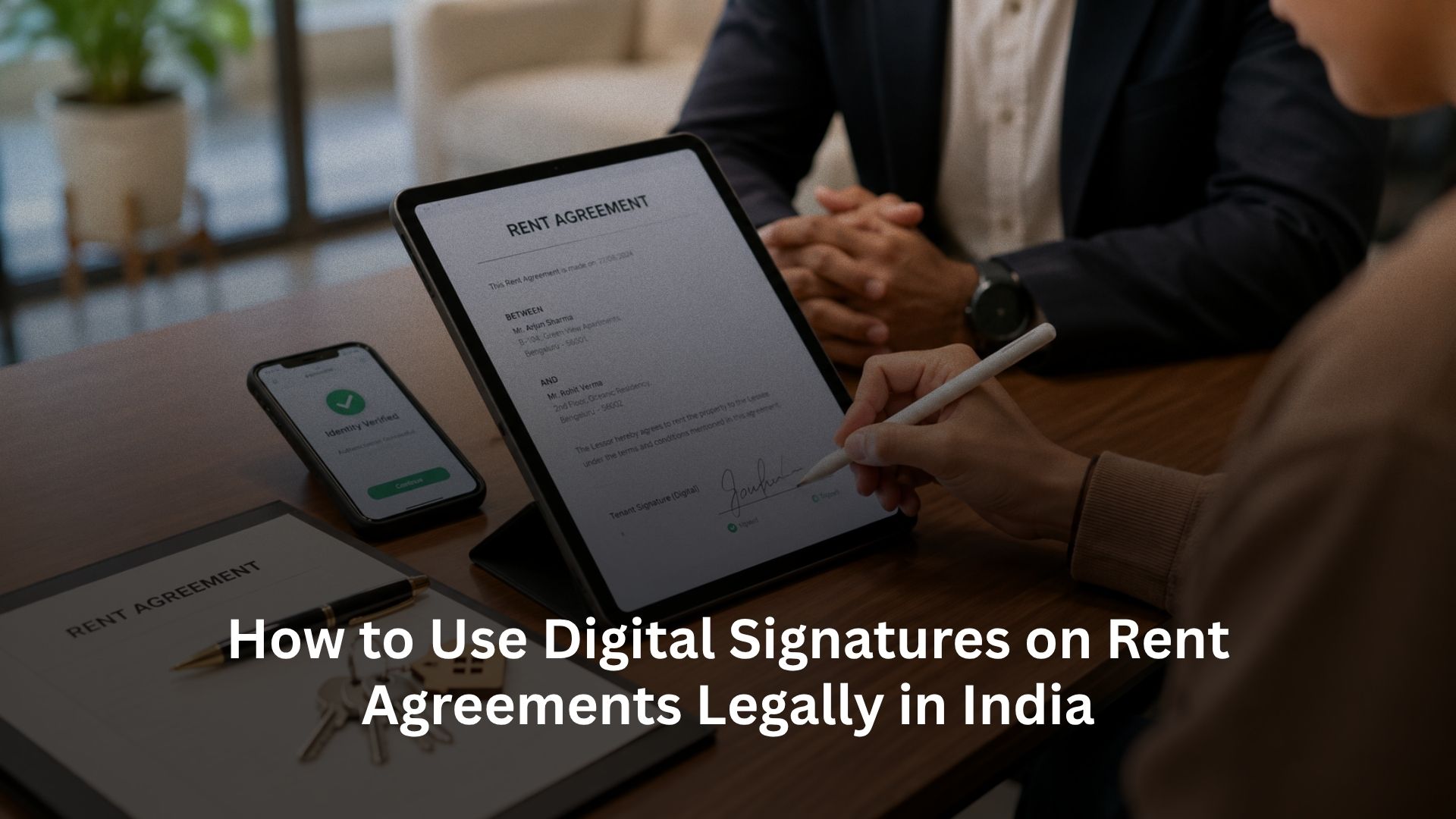
Rent agreements have traditionally been associated with printed documents, physical signatures, stamp papers, and repeated visits to complete documentation. That process may work for a small number of properties, but it becomes increasingly difficult to manage when a PG, hostel, co-living business, or rental operator is onboarding tenants regularly.
A digital rent agreement changes the way this process is handled. Instead of printing multiple copies, coordinating physical signatures, and manually storing documents, landlords and tenants can complete agreement-related steps electronically. But convenience alone does not make an agreement legally valid.
The more important question is whether the electronic signature method being used is legally recognised, whether the agreement has been properly executed, and whether applicable stamp duty and registration requirements have been followed.
Under India’s Information Technology Act, 2000, electronic records and electronic signatures receive legal recognition, and the Act also recognises contracts formed through electronic means. The Controller of Certifying Authorities (CCA) also explains that legally valid eSign services incorporate authentication, consent, signature creation, and an audit trail.
For landlords and property managers, this distinction matters. Going digital should not mean simply replacing a handwritten signature with an image or typing a name into a PDF. It means using an appropriate electronic signing process while continuing to meet the other legal requirements applicable to the rental arrangement.
For a broader understanding of the documentation that should be in place before a tenant moves in, read Digital KYC and Police Verification: State-wise Compliance in India.
Are Digital Rent Agreements Legally Valid in India?
Yes, electronic contracts can be legally recognised in India. However, a rent agreement’s validity depends on more than signing it online.
The Information Technology Act, 2000 recognises electronic records and electronic signatures. Section 10A also recognises contracts formed through electronic means. The CCA explains that eSign supports legally valid electronic signatures through authentication and maintains a digital audit trail.
Therefore, a landlord does not automatically need to print an agreement because it is digital.
However, electronic signing and legal compliance are different matters.
A digitally signed agreement may still need to meet requirements relating to:
- Stamp duty: Applicable stamp duty depends on state law and the nature of the instrument. Digital execution does not remove an applicable stamp-duty obligation.
- Registration: Certain leases must be registered. Under Section 17 of the Registration Act, 1908, some leases exceeding one year require compulsory registration, subject to applicable provisions.
- Contractual validity: The agreement must still meet the requirements of a valid contract. Electronic signing does not fix unclear terms, lack of consent, or other defects.
- State-specific rules: Rental requirements can vary by state, property type, and arrangement. Landlords should verify the rules that apply to their specific tenancy.
This is why the right way to think about a digital rent agreement is not “paper versus digital.” It is “properly executed and compliant versus improperly executed.”
For a broader understanding of what makes a rental agreement legally structured, you can also refer to RentOk’s guide on How to Create a Legally Valid Rent Agreement in India.

What Does the IT Act Say About E-Signatures?
The Information Technology Act is one of the central pieces of legislation behind electronic transactions in India.
The Act recognises electronic records and provides legal recognition to electronic signatures. It also establishes a framework for authentication and regulates the ecosystem around electronic signatures and Certifying Authorities.
The important point for landlords is that the law does not treat an electronic signature as automatically invalid simply because there is no physical ink involved.
The CCA’s official eSign framework describes a process in which the signer is authenticated, gives consent, a Digital Signature Certificate is issued for the signing transaction, the electronic signature is created and affixed, and an audit trail is preserved.
That audit trail is particularly important in rental documentation.
A well-designed electronic signing process can create a record around the signing event rather than leaving the landlord with nothing more than a PDF containing a visual representation of a signature.
This can help establish a clearer documentation trail around:
- Who signed the document and how their identity was authenticated during the process.
- When the signing process took place and the sequence in which the parties completed it.
- Which electronic document was presented for signing and what transaction records were generated around it.
- Whether the signing process was supported by an appropriate eSign or digital-signature framework.
The CCA specifically notes that eSign services preserve a comprehensive digital audit trail and use e-KYC-based authentication options.
For a rental business, that additional documentation can become valuable when agreements need to be retrieved months later or when management is handling a large tenant base.
Not Every “Digital Signature” Means the Same Thing
This is where landlords and tenants often get confused.
A person can place a signature image on a PDF, type their name, or use an electronic signing service. These actions may look similar on screen. However, they do not necessarily provide the same level of authentication, evidence, or legal validity.
The terminology also matters. The IT Act distinguishes between electronic signatures and digital signatures. Digital signatures form a specific category within the broader electronic-signature framework.
For rental agreements, the safer approach is to use a process built around legally recognised electronic signatures. This is preferable to relying on a simple image of a handwritten signature.
A professional eSign process can include identity authentication and transaction records. It can provide stronger evidence and traceability than a signature image.
This distinction matters for property operators. Agreements are not isolated documents. They form part of an ongoing tenancy record.
For landlords managing multiple tenants, the challenge goes beyond getting agreements signed. They also need to store, access, and connect documents with tenant information. Real Estate Property Management Software Explained explores how digital systems connect tenant records, agreements, payments, maintenance, and occupancy information.
Imagine a PG owner managing 150 tenants across several properties. If each agreement is a separate PDF, tracking signed versions can become difficult. The operator may struggle to find the final copy or confirm which version was signed.
A structured digital signing workflow solves more than the paper problem. It creates a more organised documentation process.
This shift is part of a broader move towards paperless rental operations. Will Digital KYC and UPI Replace Paperwork in Indian Rentals? explores how digital verification, payments, and agreements are changing rental processes.
Which Types of E-Signatures Can Be Used?
India’s electronic-signature framework supports recognised electronic authentication methods, and the CCA provides the regulatory framework for Certifying Authorities and eSign services.
For rental businesses, it is useful to understand the difference between a recognised electronic signing mechanism and a basic digital representation of a signature.
A legally structured eSign process generally focuses on authenticating the signer and creating a reliable transaction record.
Some important considerations include:
- Identity authentication: The signing process should provide a reliable mechanism for establishing that the person signing is the intended party.
- Signer consent: The process should capture the person’s intention to electronically sign the document rather than merely attaching a signature without meaningful authentication.
- Document integrity: The system should help establish that the document presented for signing is the document that was actually signed.
- Auditability: A reliable signing workflow should retain appropriate transaction information so the signing event can be verified later.
- Regulatory compliance: The signing method should operate within the applicable electronic-signature framework rather than relying on an informal signature image.
The CCA’s eSign framework specifically describes authentication, consent, signature creation, certificate acceptance, and an audit trail as components of the process.
That is why landlords should evaluate the process behind the signature, not simply how the signature looks on the final PDF.
How Do You Create a Digital Rent Agreement?
Creating a digital rent agreement should begin with the same fundamentals as a traditional agreement: clearly defining the rental arrangement before signing.
Going digital changes how the agreement is executed. It does not remove the need for an accurate document. Before signing online, understand what the agreement should contain. Why Your Rent Agreement Must Be Registered – And How to Do It explains registration requirements and key details landlords should verify.
Start by collecting and verifying details for both parties and the property. The agreement should identify the landlord and tenant. It should also describe the premises and key rental terms.
Next, establish the commercial and operational terms.
Depending on the arrangement, these may include rent, security deposit, tenancy period, payment dates, maintenance, utilities, notice periods, lock-in provisions, permitted use, and exit conditions.
For PGs and co-living properties, include any services or facilities provided to tenants.
Once reviewed, the electronic signing process can begin.
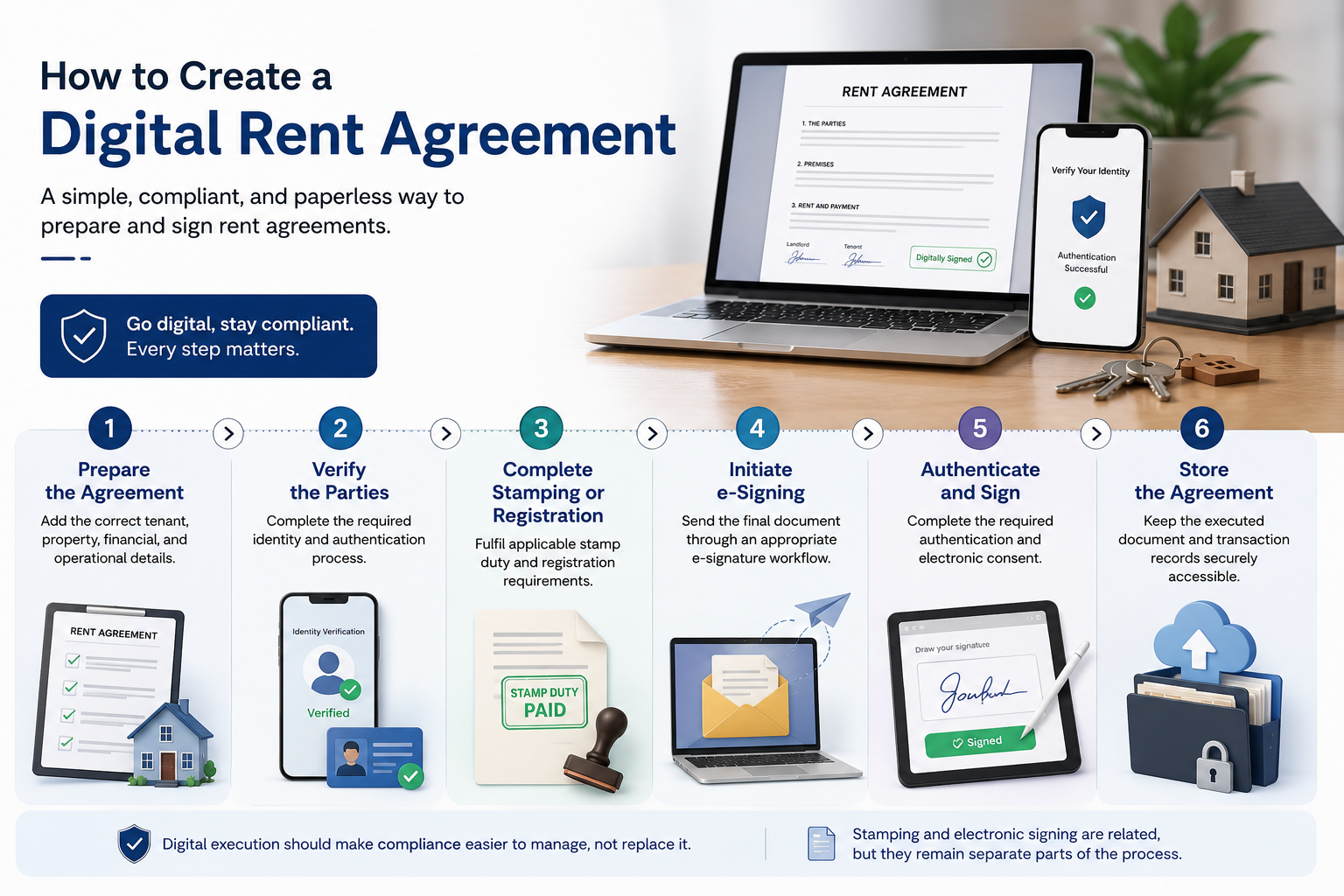
A structured digital workflow generally looks like this:
- Prepare the agreement: Add the correct tenant, property, financial, and operational details.
- Verify the parties: Complete the required identity and authentication process.
- Complete stamping or registration: Fulfil applicable stamp duty and registration requirements.
- Initiate e-signing: Send the final document through an appropriate e-signature workflow.
- Authenticate and sign: Complete the required authentication and electronic consent.
- Store the agreement: Keep the executed document and transaction records securely accessible.
The principle is simple: digital execution should make compliance easier to manage, not replace it.
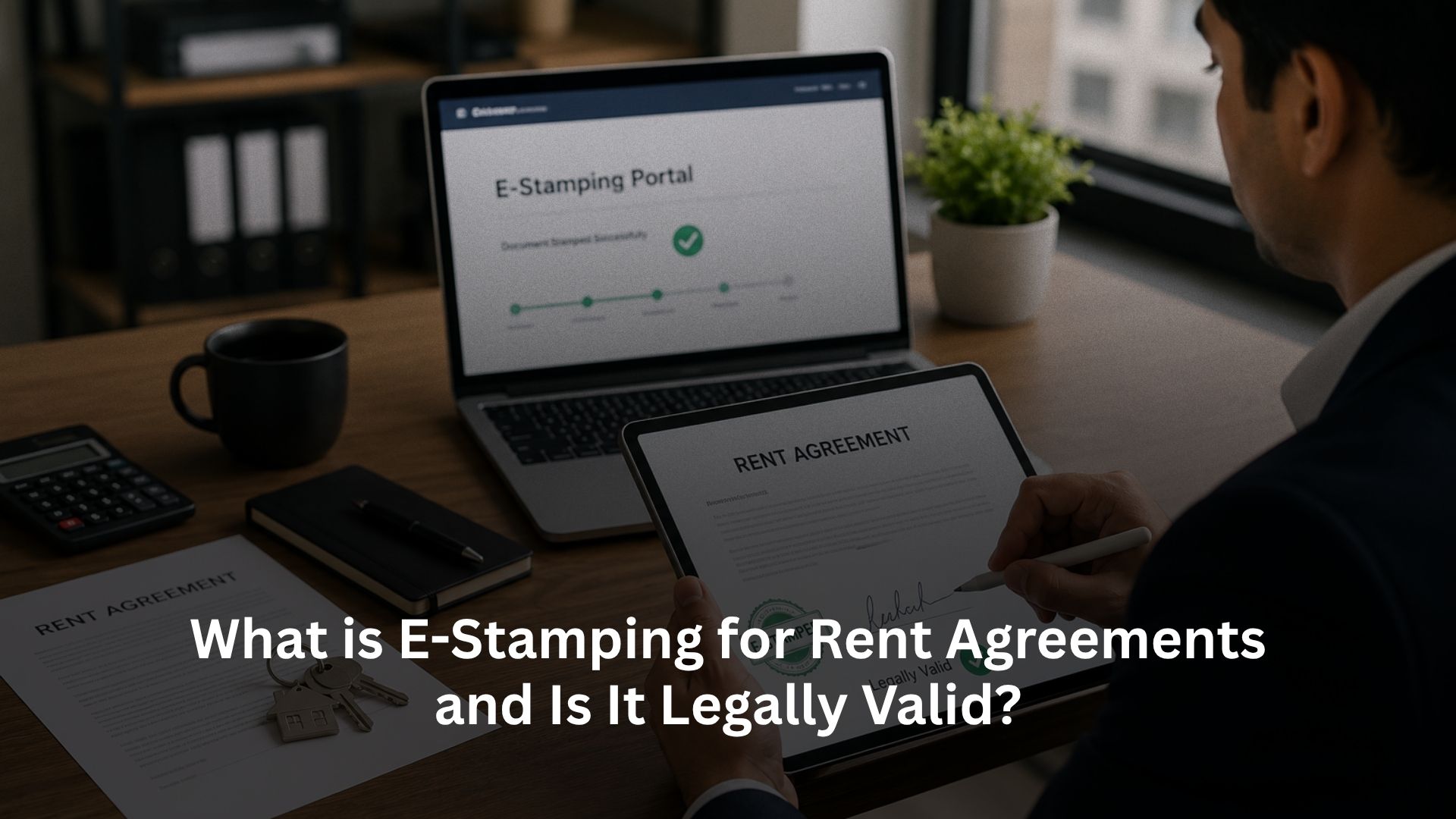
For more on digital rental documentation, see RentOk’s What is E-Stamping for Rent Agreements and Is It Legally Valid?. Stamping and electronic signing are related, but they remain separate parts of the process.
What Should You Check Before Signing Digitally?
The biggest mistake is to treat the final click on “Sign” as the entire process.
Before executing a digital rent agreement, both parties should review the document just as carefully as they would review a physical agreement.
Pay particular attention to:
- Tenant and landlord details: Names and identification details should be accurate and consistent with the supporting documents.
- Property information: The property address, room or unit details, and other identifying information should match the actual premises being occupied.
- Financial terms: Rent, deposit, payment schedule, additional charges, and applicable conditions should be clearly stated rather than left to verbal understanding.
- Tenure and exit terms: Start date, end date, lock-in period, notice period, and termination conditions should be clearly defined.
- Responsibilities: Maintenance, utilities, repairs, property usage, and other responsibilities should be allocated clearly between the parties.
- Execution requirements: Confirm that the chosen electronic-signature process is appropriate and that any required stamping or registration has been addressed.
This level of review is especially important because a digital agreement is still a legal and operational document. Making it easier to sign does not make unclear clauses any less problematic.
Which Platforms Support Digital Rent Agreements?
Today, landlords can use platforms and digital property-management systems that combine agreement creation, tenant onboarding, authentication, and electronic signing into a single workflow.
The advantage of using an integrated platform is that the agreement does not remain isolated from the rest of the tenant’s information.
For example, a property operator may need to connect the agreement with the tenant’s onboarding details, occupancy record, payment information, and subsequent move-out process. When these activities are managed separately, the operator has to repeatedly move information between systems.
A digital rental platform can reduce that fragmentation by bringing these workflows closer together.
However, landlords should not choose a platform simply because it offers a “digital signature” button. The more useful questions are:
Does the platform use an appropriate electronic-signature mechanism? Is identity authentication built into the workflow? Are agreement records accessible after execution? Can the agreement remain connected to the tenant record? And can the system support the broader operational processes around the tenancy?
These questions become increasingly important when managing dozens or even hundreds of tenants. An effective tenancy-management system should do more than facilitate electronic signatures, it should connect agreements with identity verification, payments, tenant records, and the wider property-management workflow.
This is especially important during tenant onboarding, where multiple steps need to work together seamlessly. How to Onboard a New Tenant in Under 10 Minutes explains how agreements, verification, payments, and tenant records can be brought together into a streamlined onboarding process.
Why Digital Agreements Matter More as Rental Businesses Grow
For a landlord managing one or two properties, agreement management may still feel manageable through folders, email, and physical copies.
The situation changes quickly at scale.
A PG operator may have dozens of tenants joining every month. Agreements can have different start dates, different renewal timelines, and different exit conditions. Staff may also need to retrieve documents while handling payment disputes, move-outs, renewals, or tenant queries.
At that point, the challenge is no longer simply “How do I sign an agreement?”
It becomes “How do I maintain reliable agreement records across the entire tenant lifecycle?”
That is where digital documentation becomes particularly valuable.
A structured system can help reduce dependency on:
- Manually searching through folders whenever an agreement is required for reference.
- Repeated WhatsApp conversations to determine whether a tenant has completed documentation.
- Separate spreadsheets for tenant details, occupancy information, and agreement status.
- Physical paperwork that can be misplaced, damaged, or become difficult to retrieve as the business grows.
This is consistent with a broader shift in rental management: technology is increasingly being used not merely to digitise individual tasks, but to connect the processes that happen before, during, and after a tenant moves in.
RentOk’s guide on Best Tenant Management Software in India explores this larger shift and explains why growing rental businesses eventually need systems that go beyond spreadsheets and manual tracking.
Digital Signing Is Only One Part of Better Tenant Onboarding
A digital signature can make agreement execution faster, but it is most effective when it is part of a well-organised onboarding process.
A tenant does not experience the agreement as an isolated legal document. It is one step within a larger journey that may include inquiry, KYC, document collection, room allocation, payment, agreement execution, move-in, and ongoing property management.
If the agreement is digital but everything around it remains fragmented, the operator may still spend considerable time coordinating the process manually.
A better approach is to connect documentation with the wider tenant lifecycle.
That means the tenant’s information should move logically from onboarding to agreement execution and then into ongoing property management. It also makes future actions, such as renewals, payments, move-outs, and document retrieval, easier to coordinate.
RentOk’s Seamless Digital Tenant Onboarding with RentOk article looks at this broader workflow, including digital KYC and electronic agreement execution as part of a more structured onboarding process.
What About Registration and Stamp Duty?
This is one area where landlords should be particularly careful.
Using an electronic signature does not mean that every rent agreement is automatically exempt from stamp duty or registration requirements.
These are separate legal considerations.
The Registration Act, 1908 identifies certain leases as compulsorily registrable, including leases from year to year or for a term exceeding one year, subject to the applicable statutory provisions and exceptions.
Similarly, stamp duty is governed by the applicable stamp laws and can vary depending on the state and instrument.
Therefore, a landlord should not assume that an “online rent agreement” automatically means “no registration” or “no stamp duty.”
The correct process depends on the agreement and the jurisdiction in which the property is located.
For businesses operating across multiple cities or states, this becomes even more important. A process that works for one property should not automatically be copied to another without checking the applicable requirements.
Digital signing solves the execution and workflow problem. It does not erase the underlying legal requirements attached to the agreement.

How RentOk Helps with Digital Rent Agreements
For PG, hostel, and co-living operators, the real advantage of digital rental agreements comes from connecting agreement execution with the rest of property management.
RentOk helps bring digital tenant onboarding, agreement management, tenant records, payment visibility, occupancy information, and other rental workflows into a more structured system. This means operators do not have to treat the rent agreement as a standalone PDF that gets created once and then disappears into a folder.
Instead, agreement-related information can remain connected to the tenant and property throughout the rental lifecycle.
For growing rental businesses, this can make it easier to maintain documentation, reduce manual coordination, retrieve tenant information, and keep operational records more organised. RentOk’s existing digital rental workflow also includes eKYC and electronic agreement signing, helping operators move away from paper-heavy onboarding processes.
The objective is not simply to make signing faster. It is to make the entire rental documentation process more organised, accessible, and scalable as the number of tenants increases.
Conclusion
Digital rent agreements are becoming an important part of modern rental management in India. The legal framework recognises electronic records, electronic signatures, and contracts formed electronically, but landlords still need to pay attention to the requirements that apply to the underlying rental agreement.
The safest approach is therefore not to think of digital signing as a shortcut around traditional rental formalities. It is a more efficient way of executing and managing documentation when the correct electronic-signature process is used and applicable stamping, registration, and contractual requirements are properly addressed.
For individual landlords, this can mean less paperwork and easier document management. For PGs, hostels, and co-living businesses, the impact can be much larger because digital agreements can become part of a structured tenant onboarding and property-management workflow.
If you are looking to move away from manual agreement processes and make tenant onboarding more organised, sign rent agreements digitally with RentOk and simplify the way your rental business manages agreements from onboarding onward.
Frequently Asked Questions
Find answers to common questions about this topic
About the Author
Ishika Pannu
Ishika Pannu brings you the latest insights and easy-to-apply strategies in property management—helping you simplify renting and grow with RentOk.
You may also like these
Related Articles

1 min read
How to Get Society Permission Before Renting Out Your Flat
Written by
Posted on
Ishika Pannu
Aug 31, 2026
1 min read
What is E-Stamping for Rent Agreements and Is It Legally Valid?
Written by
Posted on
Ishika Pannu
Aug 30, 2026

1 min read
How to Legally Evict a Non-Paying Tenant in India
Written by
Posted on
Ishika Pannu
Aug 24, 2026

1 min read
What Stamp Duty Applies to Your Rent Agreement?
Written by
Posted on
Ishika Pannu
Aug 22, 2026

1 min read
How to Handle a Rental Dispute Without Going to Court
Written by
Posted on
Ishika Pannu
Aug 22, 2026
1 min read
How to Do Tenant Police Verification Online: A State-by-State Guide
Written by
Posted on
Ishika Pannu
Aug 21, 2026
1 min read
What is TDS on Rent Under Section 194-IB – Guide for Landlords
Written by
Posted on
Shivanshi Dheer
Aug 21, 2026

1 min read
How to Create a Legally Valid Rent Agreement in India
Written by
Posted on
Ishika Pannu
Aug 18, 2026

1 min read
How to Write a Formal Eviction Notice for a PG Tenant in India
Written by
Posted on
Ishika Pannu
Aug 11, 2026
1 min read
The PG Owner’s Guide to Tenant Background Verification in 2026
Written by
Posted on
Ishika Pannu
Aug 6, 2026
Stay ahead in property management with expert insights
Join thousands of property managers receiving exclusive tips delivered straight to your inbox.
Browse posts by category
Case Study
Cost of Living
Growth
Legal
Market Trends
News
Pg owner app
Property Management
Property Tax
Tech
RentOk
The easiest way to rent and manage your PGs and hostels.
Get the app


Contact us
hello@eazyapp.tech
HQ Office
COGROW, BASEMENT F-12/8A
BESIDE HOUSE OF STYLE SALON, SECTOR 28, DLF PHASE 1
GURUGRAM, HARYANA - 122002
South India Office
LUMIODESK COWORKING, 2ND FLOOR, 40, 14TH MAIN RD
BESIDE MC DONALD, 7TH SECTOR, HSR LAYOUT
BENGALURU, KARNATAKA - 560102
©️ 2026 EazyApp Tech Pvt Ltd. All rights reserved


