
Legal
How to Get Society Permission Before Renting Out Your Flat

Written by
Ishika Pannu
Read Time
15 min read
Posted on
August 31, 2026
Overview
Overview
How to Get Society Permission Before Renting Out Your Flat
Renting out a flat in a housing society may appear to be a straightforward process. You find a tenant, finalise the rent, prepare the agreement, collect the necessary documents, and hand over the keys. However, if the property is located inside a residential society, there is another important layer that landlords need to address before the tenancy begins: housing society rental permission and compliance.
This is where many flat owners become confused. Some societies ask landlords to submit a tenant application, provide a copy of the rent agreement, or obtain an NOC before the tenant moves in. Others may only require prior intimation and tenant details. The exact process can vary depending on the society’s registered bye-laws, state-specific regulations, and the nature of the proposed occupancy.
The important point is that there is no single society rental permission process that applies identically across India. A landlord should therefore understand what their particular society requires instead of assuming that an NOC is either mandatory everywhere or unnecessary everywhere.
For example, RentOk’s recent legal coverage on starting a PG in India highlights that society requirements can become particularly important where the proposed use involves paying guests, shared accommodation, or other forms of managed residential use. For a standard residential tenant, the applicable process may be different.
Before you rent out your flat, the goal should be simple: understand the society’s rules, complete the required documentation, and create a proper record of the approval or intimation before the tenant moves in.
Can Your Housing Society Stop You From Renting?
This is often the first concern when a society committee says that permission is required.
The answer is more nuanced than simply yes or no.
Owning a flat gives you important rights over the property. However, those rights operate within applicable laws, registered society bye-laws, building rules, and legitimate restrictions on property use.
At the same time, a society cannot necessarily impose any restriction simply because its managing committee prefers it.
The situation can also depend on how the property will be used. A family renting a flat for normal residential purposes is different from converting it into a PG, hostel, short-term accommodation, or commercial establishment. Different uses may involve different rules and permissions.
If a society says an NOC is mandatory, ask for the rule behind that requirement. Check whether it comes from the registered bye-laws, a valid society resolution, local regulations, or another applicable provision.
Before entering into a tenancy, consider the following:
- Review the society bye-laws: Check provisions covering tenants, letting, occupants, subletting, and residential use. Do not rely only on verbal explanations.
- Understand the required process: The society may require an NOC, written permission, prior intimation, tenant registration, or specific documents. These requirements are not always interchangeable.
- Clarify the proposed use: A standard residential tenancy may be treated differently from a PG or other high-turnover arrangement.
- Keep communication documented: If the society objects, request the reason and relevant rule in writing. This creates a useful record.
The key principle is simple: examine society rental restrictions against the actual bye-laws and applicable law.
However, landlords should not ignore valid society procedures. If a legitimate process applies, completing it before move-in can help prevent unnecessary disputes.

What Permissions Are Typically Required Before Renting Out a Flat?
Apartment rental requirements in India can vary significantly between housing societies. Some require formal rental permission, while others only require tenant intimation or a specific NOC.
Before renting out your flat, obtain the society’s current rental procedure rather than relying on an old form or information from another owner.
A society may typically ask for:
- Rental application or written intimation: Details of the proposed tenant and tenancy period.
- Society NOC or permission letter: Required by some societies before the tenant moves in.
- Rent or leave-and-licence agreement: Confirms tenancy terms, landlord and tenant details, and intended use.
- Tenant ID and address proof: For maintaining accurate occupant records.
- Police or tenant verification: Requirements vary by location. RentOk’s tenant police verification guide explains the applicable process.
- Additional society forms: These may include photographs, emergency contacts, vehicle details, or move-in information.
Society permission is part of the wider tenant onboarding process. Preparing the rental agreement, KYC documents, verification records, society forms, and move-in details together can reduce delays and missing paperwork.
For a streamlined onboarding approach, see How to Onboard a New Tenant in Under 10 Minutes.
Also check applicable stamp duty requirements before finalising the agreement. RentOk’s rent agreement stamp duty guide provides further context.
Planning these steps before move-in can help ensure a smoother handover.
A Good Time to Start the Society Permission Process
Ideally, society compliance should begin before the tenancy is finalised to the point where the tenant is expecting immediate possession.
Once the tenant has paid the deposit, booked movers, and planned their move-in date, discovering an unexpected society requirement can create unnecessary pressure for everyone involved.
A better sequence is to:
- Confirm the society’s rental procedure before promising a move-in date.
- Collect the tenant’s basic information and required documents.
- Prepare the rental agreement according to the applicable requirements.
- Submit the society application, NOC request, or tenant intimation as required.
- Preserve the acknowledgement or approval.
- Complete other applicable verification and compliance steps before handover.
This approach creates a much cleaner rental trail and reduces the chances of a last-minute disagreement with the society.
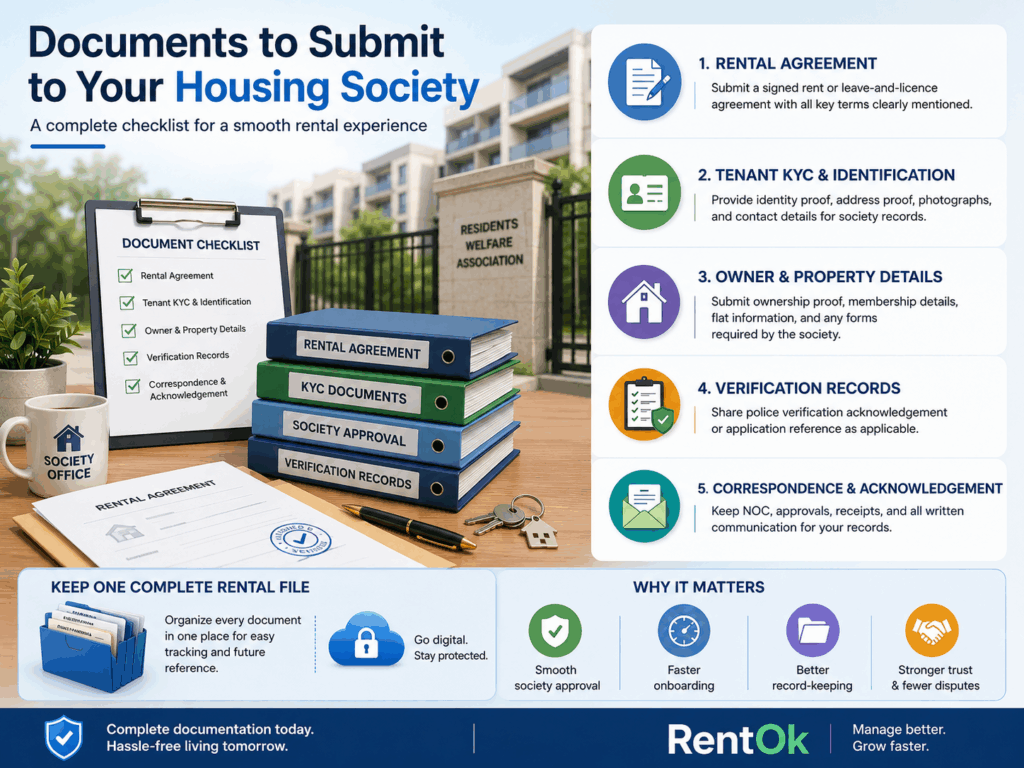
What Documents Should You Submit to the Society?
Once the society’s requirements are clear, documentation becomes the next major step.
A complete application is more likely to move smoothly than one that requires repeated follow-ups because basic information was missing. More importantly, maintaining your own copy of every document creates a useful record if questions arise later.
The exact checklist will depend on the society, but landlords should generally be prepared to provide the relevant documents connected to the tenancy.
Documentation is only one part of tenant screening. If you want to understand the wider verification process before onboarding a tenant, read The PG Owner’s Guide to Tenant Background Verification in 2026 for a more detailed look at what landlords should check.
Rental Agreement
The society may ask for a signed copy of the rent agreement or leave-and-licence agreement. This should accurately reflect the actual arrangement between the owner and tenant.
The agreement is more than a formality. It establishes important details such as rent, security deposit, duration, notice period, responsibilities, and permitted use of the property. RentOk’s recent How to Create a Legally Valid Rent Agreement in India explains why a properly prepared agreement should be treated as an important operational record rather than something that is simply signed and filed away.
Tenant KYC and Identification
Societies commonly need basic tenant information for their records. Depending on the applicable process, this can include identity proof, address details, photographs, contact information, and other supporting documents.
The important thing is consistency. The tenant’s name and other details should match across the rental agreement, society submission, and verification documents wherever applicable.
Owner and Property Details
The society may also require information establishing the owner’s connection with the flat. Depending on its internal procedure, this could involve membership information, flat details, or other property-related records.
If the society provides a prescribed application form, use that format rather than submitting an informal letter unless the society specifically permits an alternative.
Verification Records
Where tenant verification or police verification applies, keep the relevant acknowledgement, application number, or completed record along with the rest of the tenant documentation.
RentOk’s current legal guidance similarly recommends treating tenant verification as part of a structured onboarding process, rather than as a separate task that is remembered only after the tenant has moved in.
The same principle applies to society permission.
Do not just submit the documents. Keep proof that you submitted them.
An email acknowledgement, stamped copy, receipt, approval letter, or other written confirmation can become valuable if there is later a question about whether the owner completed the required procedure.
Maintaining a proper digital trail can also become valuable when a rental disagreement arises later. RentOk has covered practical examples of this in RentOk Legal Cases: Tenant Disputes Solved Without Legal Action.
Keep One Complete Rental File
For every tenancy, it is useful to maintain a single organised record containing:
- The final rent agreement and related documentation.
- Tenant KYC, contact details, and applicable verification records.
- Society application, NOC, approval, or intimation acknowledgement.
- Important correspondence regarding the tenant’s move-in and occupancy.
- Relevant property and owner information required for the tenancy.
This becomes particularly important for owners managing more than one property. As the number of tenants grows, relying on memory, individual WhatsApp chats, scattered emails, and physical files can make even routine compliance and record-keeping unnecessarily difficult.
A centralized system can help reduce this operational burden by keeping tenant records, payments, agreements, notices, and occupancy information organized in one place. RentOk’s Landlord Tenant Management Software: A Complete Overview explores how landlords can use such tools to manage a growing tenant base more efficiently.
The objective is not to create more paperwork. It is to maintain one reliable record of the tenancy from the moment the tenant is onboarded, making ongoing management and compliance easier to track.
As rental operations become more digital, maintaining this kind of centralized record is increasingly becoming part of professional property management. RentOk’s What Is Rental Management? Tools to Manage Your Property Efficiently explores how digital systems can bring these recurring tasks together.
What Should You Do If the Society Refuses?
A society refusing your rental request can become stressful, particularly when you already have a tenant ready to move in. But the most effective response is usually to slow the process down and establish exactly what the refusal is based on.
Start by asking the society for the reason in writing.
A verbal statement such as “renting is not allowed” does not tell you enough. You need to understand whether the objection concerns the tenant, the proposed use of the property, missing documents, a society bye-law, a resolution, or another applicable restriction.
Once the reason is documented, you can examine the relevant rule and determine what your next step should be.
If the issue is simply incomplete documentation, the solution may be straightforward. If the society is objecting to a particular type of occupancy, the legal and regulatory position may require closer examination.
This distinction is especially important because society rules for renting a flat are not necessarily the same as rules governing other forms of accommodation. A landlord planning a normal residential tenancy should not assume that restrictions applicable to a PG or commercial use automatically apply in the same manner.
If you believe the refusal is unreasonable or inconsistent with the applicable rules, keep a written record of your application and the society’s response. Depending on the state and the nature of the society, there may be appropriate cooperative or legal mechanisms available to address the dispute.
Before escalating the matter, however, it may be helpful to understand the practical ways rental disputes can be resolved without immediately resorting to litigation. RentOk explains these options in How to Handle a Rental Dispute Without Going to Court.
Most importantly, do not attempt to resolve a permission dispute by moving the tenant in before completing the required process. Doing so could turn a manageable documentation issue into a much more serious conflict.
What Are the Legal Rights of Flat Owners?
Flat owners have important rights over their property, including the ability to use and deal with it subject to applicable laws, regulations, contractual obligations, and valid society rules.
However, the existence of ownership rights does not mean that every society procedure can be ignored. Similarly, the existence of society bye-laws does not automatically mean that a managing committee can impose any restriction it wants.
The right approach is to examine the specific rule, the applicable law, and the actual circumstances of the tenancy.
This is particularly important because legal requirements can vary by state and property type. RentOk’s legal content itself follows this approach: its current guidance on tenant verification notes that requirements can differ depending on the city, state, police jurisdiction, and type of rental property.
So, if a dispute arises, avoid relying on broad claims such as “a society cannot stop any owner from renting” or “every society has the right to approve every tenant.” Neither statement is sufficient to determine a specific case.
Instead, establish:
- What the registered society rules actually say: Identify the relevant clause instead of relying on an informal interpretation.
- What type of tenancy is proposed: A standard residential rental arrangement may raise different questions from a PG, hostel, short-term stay, or commercial use.
- What the society has formally decided: Ask for written communication, especially if the committee is refusing permission or imposing conditions.
- Which authority or legal mechanism applies: If the disagreement cannot be resolved internally, professional legal advice can help determine the appropriate next step based on the property’s location and society structure.
The objective is not simply to “win” an argument with the society. It is to establish a legally and operationally sound rental arrangement that protects the owner’s interests while complying with legitimate building and local requirements.
A Practical Society Rental Permission Checklist
Before your tenant moves in, take a final look at the entire process rather than checking only whether the NOC has been obtained.
A rental-ready file should ideally include the following:
- Society requirement confirmed: You know whether the society requires an NOC, written permission, prior intimation, tenant registration, or another procedure.
- Tenant documents prepared: The required KYC, identity, address, contact, and verification documents have been collected and checked.
- Agreement completed correctly: The rental agreement reflects the actual tenancy and has been executed according to applicable requirements.
- Society submission recorded: You have retained proof of the application, acknowledgement, approval, NOC, or other communication submitted to the society.
- Move-in details organised: The tenant’s occupancy date, property details, and relevant records are available before possession is handed over.
A checklist like this may seem excessive when renting a single apartment. In practice, it prevents the kind of small documentation gaps that often create bigger problems later.
More importantly, it creates a repeatable process. When the current tenant leaves and a new tenant arrives, you do not have to start from scratch or remember what was submitted last time.
This is what makes rental compliance manageable: not more paperwork, but better organisation.

How RentOk Helps Keep Your Rental Operations Organised
Society permission is only one part of managing a rental property. Once the tenant is approved, landlords still need to maintain KYC information, agreements, occupancy records, payment details, verification documents, and other important tenant information throughout the rental lifecycle.
RentOk helps bring these activities into a more structured digital workflow. Its platform supports areas such as tenant management, KYC, documentation, occupancy tracking, rent collection, and property operations, helping landlords and rental operators avoid the fragmentation that comes with managing everything through spreadsheets, physical files, and separate conversations. RentOk’s current tenant-verification guidance similarly positions digital records and structured workflows as particularly useful as rental operations grow.
For an individual flat owner, this can mean having important tenant information organised instead of searching through multiple folders whenever a document is needed. For owners and operators managing several properties, the benefit becomes even more significant because every new tenant adds another set of documents, dates, payments, and compliance tasks to track.
RentOk does not replace the society’s authority, local regulations, or professional legal advice where a dispute exists. What it can do is make the rental management workflow around those requirements more organised, giving landlords better visibility over their tenant records and day-to-day property operations.
Conclusion
Getting housing society rental permission should not be treated as a last-minute formality before handing over your flat. It is part of preparing the property for a properly documented tenancy.
The exact requirement can vary between societies and jurisdictions. Some landlords may need a formal NOC or permission, while others may have to submit an intimation and supporting documents. The safest approach is to understand the applicable society rules, confirm the required process in writing, prepare the tenant documentation in advance, and preserve a record of every submission.
When society compliance, tenant verification, rental agreements, and occupancy records are handled as one connected process, renting out a property becomes far easier to manage.
Stay Rental-Ready with RentOk and bring your tenant records, documentation, payments, and property operations into a more organised rental management workflow.
Frequently Asked Questions
Find answers to common questions about this topic
About the Author
Ishika Pannu
Ishika Pannu brings you the latest insights and easy-to-apply strategies in property management—helping you simplify renting and grow with RentOk.
You may also like these
Related Articles
1 min read
What is E-Stamping for Rent Agreements and Is It Legally Valid?
Written by
Posted on
Ishika Pannu
Aug 30, 2026
1 min read
How to Legally Evict a Non-Paying Tenant in India
Written by
Posted on
Ishika Pannu
Aug 24, 2026
1 min read
What Stamp Duty Applies to Your Rent Agreement?
Written by
Posted on
Ishika Pannu
Aug 22, 2026
1 min read
How to Handle a Rental Dispute Without Going to Court
Written by
Posted on
Ishika Pannu
Aug 22, 2026
1 min read
How to Do Tenant Police Verification Online: A State-by-State Guide
Written by
Posted on
Ishika Pannu
Aug 21, 2026
1 min read
What is TDS on Rent Under Section 194-IB – Guide for Landlords
Written by
Posted on
Shivanshi Dheer
Aug 21, 2026

1 min read
How to Create a Legally Valid Rent Agreement in India
Written by
Posted on
Ishika Pannu
Aug 18, 2026
1 min read
How to Write a Formal Eviction Notice for a PG Tenant in India
Written by
Posted on
Ishika Pannu
Aug 11, 2026
1 min read
The PG Owner’s Guide to Tenant Background Verification in 2026
Written by
Posted on
Ishika Pannu
Aug 6, 2026
1 min read
How to Recover Rent from a Tenant Who Has Already Vacated
Written by
Posted on
Ishika Pannu
Aug 5, 2026
Stay ahead in property management with expert insights
Join thousands of property managers receiving exclusive tips delivered straight to your inbox.
Browse posts by category
Case Study
Cost of Living
Growth
Legal
Market Trends
News
Pg owner app
Property Management
Property Tax
Tech
RentOk
The easiest way to rent and manage your PGs and hostels.
Get the app


Contact us
hello@eazyapp.tech
HQ Office
COGROW, BASEMENT F-12/8A
BESIDE HOUSE OF STYLE SALON, SECTOR 28, DLF PHASE 1
GURUGRAM, HARYANA - 122002
South India Office
LUMIODESK COWORKING, 2ND FLOOR, 40, 14TH MAIN RD
BESIDE MC DONALD, 7TH SECTOR, HSR LAYOUT
BENGALURU, KARNATAKA - 560102
©️ 2026 EazyApp Tech Pvt Ltd. All rights reserved


