Property Management
Free PG Food Menu Template: Weekly Planner for Mess Owners

Written by
Ishika Pannu
Read Time
16 min read
Posted on
August 10, 2026
Overview
Overview
Free PG Food Menu Template: Weekly Planner for Mess Owners
Running a PG mess is not simply about deciding what to cook every morning. Once you are serving meals to dozens or even hundreds of residents, the food menu becomes an operational system of its own. What looks like a simple weekly chart actually affects grocery procurement, kitchen workload, food costs, resident satisfaction, wastage, and even the number of complaints your team receives.
A random menu may work when you are managing a small property. But as occupancy grows, planning meals day by day becomes difficult. Vegetables need to be purchased in advance, kitchen staff need preparation time, residents expect variety, and the menu still needs to remain practical within the available food budget.
This is where a PG food menu template becomes useful.
A weekly planner gives mess owners a fixed structure without making the kitchen completely rigid. It allows you to decide meals in advance, identify repetitive dishes, estimate ingredients, and communicate the menu to residents before the week begins.
More importantly, a good menu is not about making every meal elaborate. It is about finding a balance between variety, nutrition, cost, preparation time, and what residents will actually eat.
Why a Weekly PG Food Menu Matters More Than You Think
Food is one of the few parts of PG living that residents experience every single day. A maintenance issue may affect one room. A delayed service request may be forgotten after it is resolved. Meals, however, become part of everyone’s routine.
Breakfast, lunch, evening snacks, and dinner create multiple daily touchpoints between the property and its residents. That makes food one of the easiest areas for dissatisfaction to become visible.
Residents notice when the menu repeats too often. They notice inconsistent meal timings. They also notice frequent changes in portion sizes. Even when the food is reasonably good, poor planning can make the overall mess experience feel disorganized.
This is why menu planning should be treated as part of PG operations, rather than something the cook decides each morning.
A structured weekly menu can help mess operators:
- Plan grocery requirements ahead of time instead of making repeated last-minute purchases that can increase costs and create unnecessary procurement pressure.
- Balance heavier and lighter meals across the week so residents do not feel that every lunch and dinner follows the same pattern.
- Coordinate kitchen preparation more efficiently because staff know what needs to be prepared instead of constantly waiting for decisions.
- Identify repetitive dishes before residents start complaining, allowing operators to make changes proactively rather than reacting after dissatisfaction builds.
- Communicate meals clearly to residents, reducing the daily questions around “Aaj kya ban raha hai?” and making the food service feel more organized.
The objective is not to create a restaurant-style menu.
It is to create a repeatable food system that a PG can realistically operate every week.
What Makes a Good PG Mess Menu?
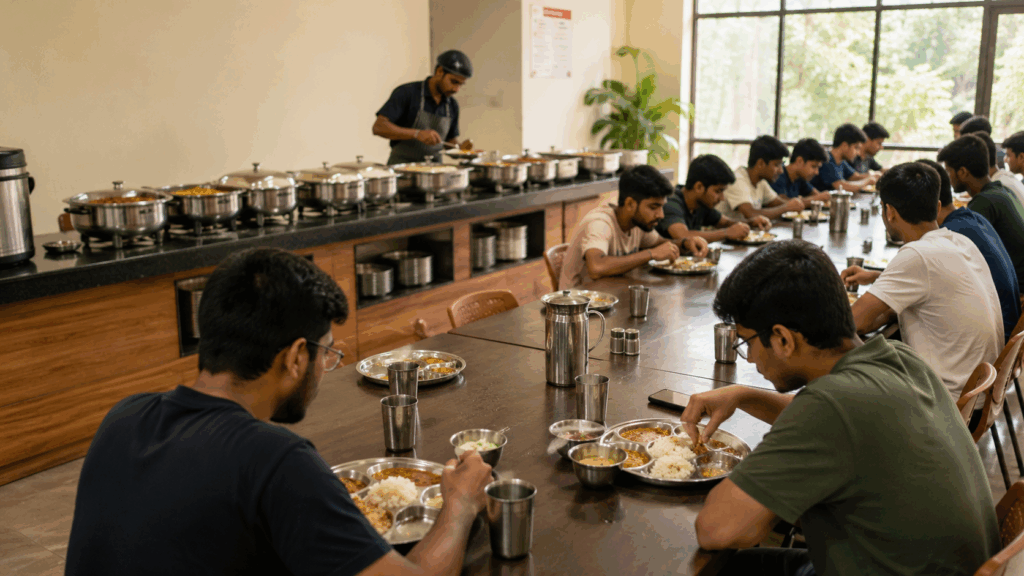
A common mistake is to judge a menu only by how attractive the dishes look on paper. A weekly plan can contain paneer, biryani, parathas, noodles, pulao and multiple other popular dishes and still be difficult to operate profitably.
The real test is whether the menu works when it meets the reality of your kitchen.
A practical PG food menu should consider four things at the same time: resident preferences, food cost, kitchen capacity, and ingredient availability.
For example, if one particular vegetable is used in three different meals during the same week, procurement becomes easier. But if the same preparation is repeated several times, residents may feel that the menu lacks variety. Similarly, adding a complicated dish every other day may look good to residents but create excessive workload for the kitchen team.
The strongest menus are therefore built around a manageable rotation.
A useful weekly structure can include:
- Breakfast: Rotate between filling staples such as poha, paratha, upma, idli, sandwiches, eggs or other locally suitable options rather than repeating the same breakfast throughout the week.
- Lunch: Keep lunch relatively balanced with a combination of a staple, vegetable preparation, dal or another protein source, and an accompaniment such as curd or salad where practical.
- Evening snack: Keep snacks simple enough for the kitchen to execute consistently while still giving residents some variation throughout the week.
- Dinner: Use dinner to introduce a little more variety while avoiding dishes that require excessive preparation during peak operational hours.
The exact menu will naturally differ depending on the city, tenant profile, food budget, kitchen setup and whether the PG provides vegetarian or non-vegetarian meals.
That flexibility is important. There is no single “perfect” PG menu for every property.
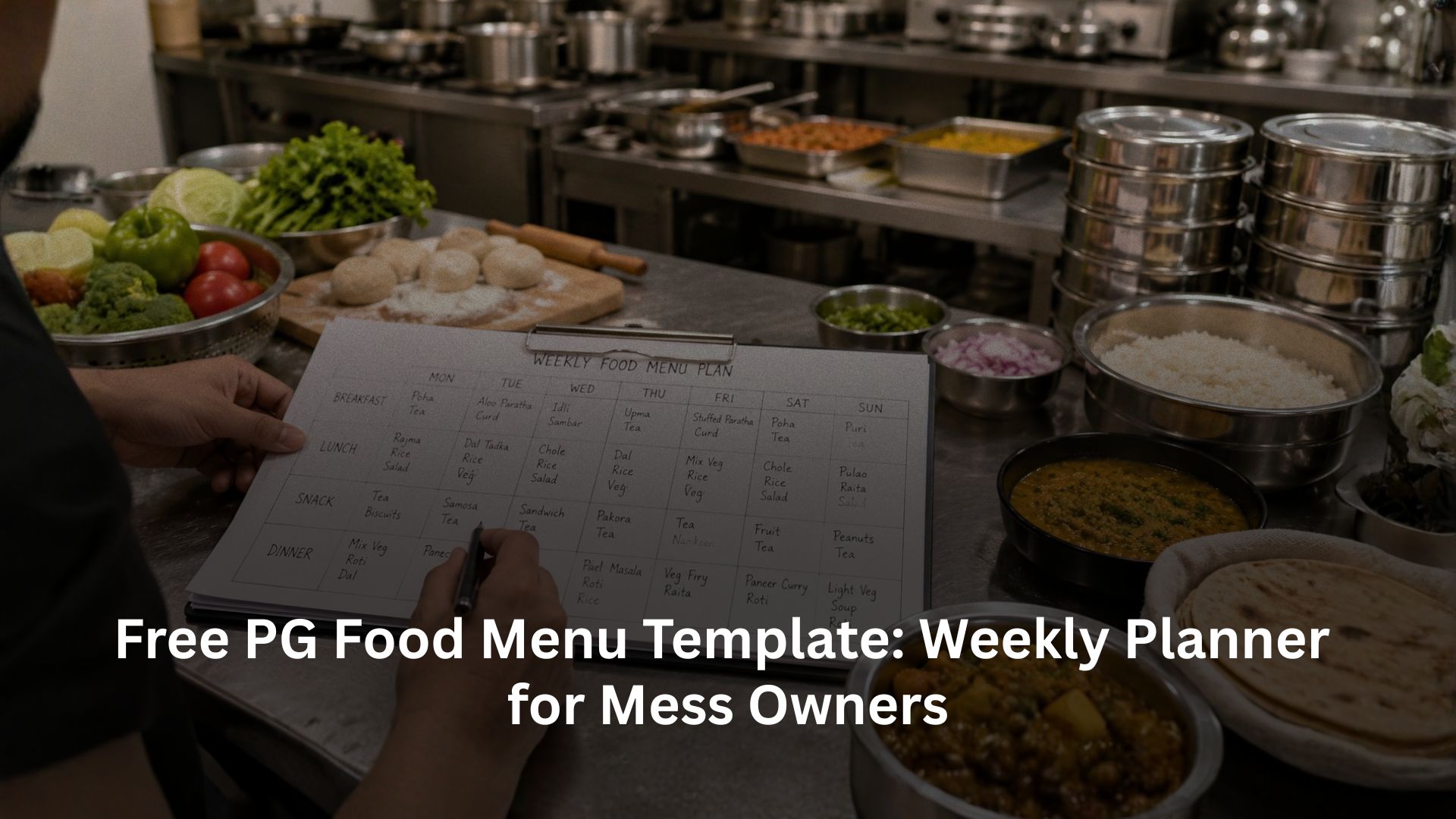
A Free Weekly PG Food Menu Template
The easiest way to start is to stop planning meals independently and build a weekly rotation.
Here is a sample structure that mess owners can adapt according to their property and resident preferences:
| Day | Breakfast | Lunch | Evening Snack | Dinner |
|---|---|---|---|---|
| Monday | Poha, tea & fruit | Dal, rice, roti, seasonal vegetable & salad | Tea & biscuits | Rajma, rice, roti & salad |
| Tuesday | Aloo/paratha, curd & tea | Chole, rice, roti & vegetable | Samosa/seasonal snack & tea | Mix veg, dal, roti & rice |
| Wednesday | Idli, sambar & chutney | Dal, rice, roti & seasonal vegetable | Sandwich & tea | Paneer curry, roti, rice & salad |
| Thursday | Upma, tea & fruit | Rajma/chole, rice, roti & vegetable | Pakora/roasted snack & tea | Dal, pulao, roti & curd |
| Friday | Stuffed paratha, curd & tea | Dal, rice, roti & vegetable | Tea & namkeen | Veg pulao, raita, roti & curry |
| Saturday | Sandwich/poha, tea & fruit | Chole, rice, roti & salad | Seasonal snack & tea | Special meal based on resident preference |
| Sunday | Poori/poha/paratha & tea | Special lunch with pulao, dal, vegetable & dessert | Tea & light snack | Light dinner with dal, roti & vegetable |
This is only a starting point. A mess owner should modify the menu according to the residents actually living in the property.
For example, a student-heavy PG may prefer heavier breakfasts before classes, while a property occupied largely by working professionals may see greater demand for quick and convenient breakfast options.
The important part is not copying the exact dishes.
It is using the weekly planning framework.
Should You Change the Menu Every Week?
Not necessarily.
Changing every single meal every week can actually create more problems than it solves. Residents do want variety, but variety does not mean completely different food every day.
A better approach is to create a rotating menu where some reliable meals return at predictable intervals while other dishes change based on seasonality, feedback, and availability.
This gives the kitchen a degree of familiarity while preventing the menu from becoming monotonous.
For instance, if rajma rice performs well with residents, there is no operational reason to remove it permanently simply because it appeared the previous week. Instead, it can return after a suitable gap while other meals around it change.
This is where resident feedback becomes important.
Instead of asking whether residents “like the food” as a broad question, operators can look for more specific patterns:
- Which meals receive repeated positive feedback and which dishes are frequently left unfinished?
- Are complaints concentrated around taste, variety, portion size, timing, or food temperature?
- Do residents prefer certain meals on specific days, such as heavier weekend lunches?
- Are there recurring requests for vegetarian, non-vegetarian, regional, or dietary alternatives?
This information can gradually turn the weekly menu from a guess into a system based on actual resident behavior.
For more on why food quality has such a direct impact on hostel and PG operations, see RentOk’s guide on standardizing food quality in mess and hostel canteens.
Menu Planning Should Start With Your Grocery List
One of the biggest advantages of a weekly menu is that it allows food planning and procurement to work together.
Without a menu, grocery purchasing often becomes reactive. Someone notices that vegetables are running low, another person remembers that rice needs to be ordered, and the kitchen discovers halfway through the week that an ingredient required for a planned meal is unavailable.
These small gaps eventually become expensive.
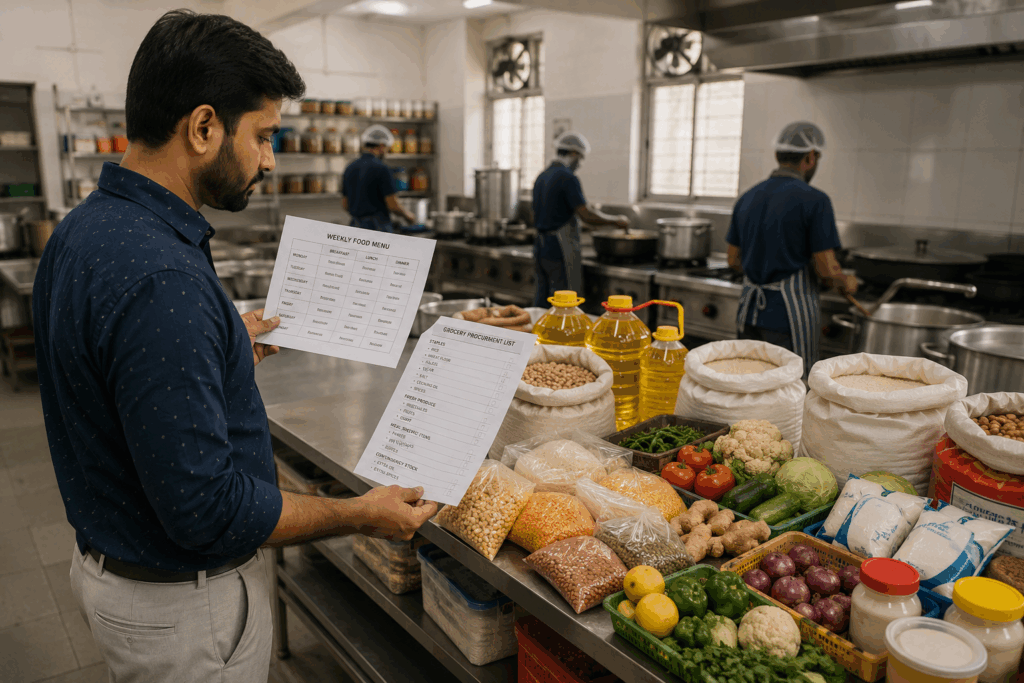
Once the weekly menu is finalized, the operator can work backwards and estimate what the kitchen will require. This does not mean calculating every gram of every ingredient immediately. Even a broad weekly estimate can significantly improve planning.
For example, the procurement team can categorize requirements into:
- Staples: Rice, wheat flour, pulses, cooking oil, spices, sugar and other ingredients used consistently throughout the week.
- Fresh produce: Vegetables, fruits, dairy and other items where freshness and procurement frequency matter more.
- Meal-specific ingredients: Ingredients required for particular dishes that may not be used regularly.
- Contingency stock: A reasonable buffer for unexpected occupancy changes, wastage, or additional meal requirements.
This approach makes the relationship between the food menu and food expense much clearer.
If you are tracking the financial side of your PG as well, it is useful to separately monitor food and mess-related expenses rather than treating all operating costs as one number. RentOk’s guide on preparing monthly PG financial reports covers how operators can structure income and expense visibility more systematically.
How to Balance Variety Without Increasing Food Costs
Variety is important, but it does not have to mean expensive ingredients.
One of the better ways to create menu variation is to change the preparation rather than constantly changing the core ingredients.
For example, a few staple ingredients can appear in different meals throughout the week without making the menu feel repetitive. Seasonal vegetables can also be rotated based on local availability and price rather than locking the kitchen into ingredients that are expensive at certain times of the year.
This creates a more sustainable menu because the operator is planning around both resident experience and procurement reality.
A cost-conscious menu can therefore focus on:
- Using seasonal vegetables where possible, since availability can make them more practical for large-volume cooking than expensive out-of-season alternatives.
- Building meals around ingredients that can be used across multiple preparations, reducing leftover stock and unnecessary procurement complexity.
- Reserving more expensive or labour-intensive dishes for selected days instead of making them part of the everyday menu.
- Reviewing food wastage regularly so the operator knows which meals are consistently overproduced or poorly received.
The objective is not to make food as cheap as possible.
That approach can quickly backfire if quality falls and residents become dissatisfied.
The better objective is to make the available food budget work harder.
Use Resident Feedback to Improve the Menu
A weekly food menu should not be a permanent document that nobody revisits.
Resident preferences change. Occupancy changes. Seasons change. Even the kitchen team can change. A menu that worked perfectly six months ago may not work equally well today.
That is why feedback should become part of the menu cycle.
A simple feedback process can look like this:
Plan → Serve → Collect feedback → Identify patterns → Adjust → Repeat.
The important word here is patterns.
One resident disliking a particular dish does not necessarily mean it should disappear from the menu. But if the same complaint appears repeatedly over several weeks, it deserves attention.
The same applies to food wastage. If a particular meal regularly comes back unfinished, that is operational information. It could indicate that the portion, preparation, timing or dish itself needs to be reconsidered.
This makes food feedback more useful than simply asking residents whether they are satisfied.
The same principle applies to the wider tenant experience: feedback becomes far more valuable when it is collected and acted upon systematically rather than treated as an occasional complaint. RentOk’s “How to Grow Your PG Business in 2026” also highlights tenant experience as an important part of sustainable property growth.
It gives mess operators a way to continuously improve the system without constantly redesigning the entire menu.
Seasonal Planning Can Make Your Menu Better
A good weekly food planner should not remain identical throughout the year.
Weather affects food preferences, ingredient availability and even kitchen operations. What works during summer may not be equally appealing during winter, while certain seasonal ingredients can become more practical or economical at different times of the year.
During hotter months, for example, lighter meals, curd-based accompaniments, seasonal fruits and adequate hydration may become more relevant. During colder months, residents may prefer warmer and more filling meals.
Seasonal planning also helps procurement.
Instead of forcing the kitchen to source the same ingredients throughout the year, operators can adapt parts of the menu according to what is locally available and practical.
This creates a menu that feels more natural to residents while also giving the kitchen greater flexibility.
Common PG Food Menu Mistakes to Avoid
Even a well-intentioned food planner can become ineffective if the menu is designed without considering day-to-day execution.
Some mistakes are particularly common in growing PGs.
- Planning dishes without checking kitchen capacity: A meal may look excellent on paper but become difficult to prepare when hundreds of portions need to be served within a short window. The menu should always match the equipment, staff and preparation time available.
- Creating variety without considering procurement: Constantly changing ingredients can increase purchasing complexity, create unused stock and make food costs harder to control. Variety should be planned around what the kitchen can procure and use efficiently.
- Ignoring resident feedback: A menu designed entirely by management may look balanced but still fail to match what residents actually prefer. Feedback should influence future rotations instead of being treated only as a complaint-management exercise.
- Changing the menu too frequently: Residents need some predictability as well. A completely different menu every few days can make procurement and kitchen execution unnecessarily complicated.
- Treating food cost and food quality as opposites: Reducing costs by continuously cutting portions or quality can damage resident satisfaction. The better approach is to identify wastage, inefficient procurement and unnecessary complexity first.
The goal of a good mess system is therefore consistency with controlled flexibility.
Residents should know that the food service is reliable, while operators should still have enough flexibility to adapt when circumstances change.
Turning a Weekly Menu Into a Proper Food Management System
A food menu becomes significantly more useful when it is connected to the rest of the property’s operations.
The menu tells the kitchen what to prepare. But occupancy tells the kitchen how much to prepare. Procurement determines whether the ingredients are available. Resident feedback indicates whether the meals are working. Expenses tell the operator whether the system is financially sustainable.
These pieces should not operate independently.
For example, if your PG has 150 occupied beds one week and only 125 the next, the kitchen’s procurement and preparation requirements should reflect that change. Similarly, if a particular meal repeatedly creates wastage, the operator should be able to identify the pattern rather than continuing to purchase and prepare the same quantity every week.
This is where structured property management becomes useful.
The objective is not to make the kitchen unnecessarily complicated with technology. It is to make the information surrounding the kitchen more visible so that decisions are based on actual property operations rather than memory and assumptions.
For operators interested in broader automation, RentOk’s guide on how to automate PG management completely also explores how food and expense visibility can become part of a larger operational system.
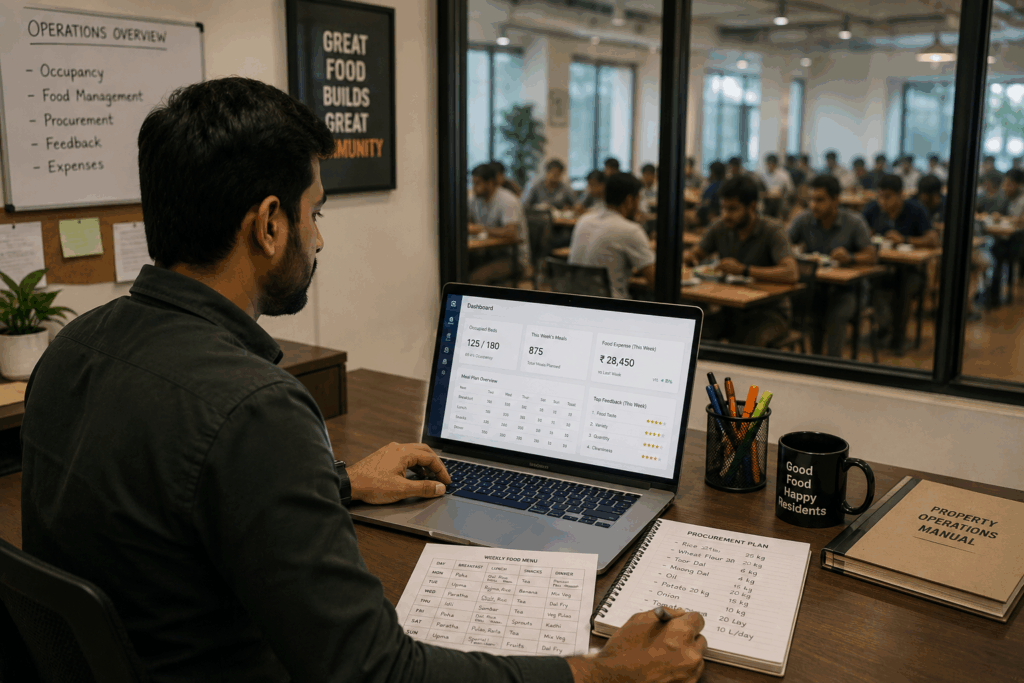
How RentOk Helps PG Operators Manage Food and Property Operations
A weekly food menu solves one part of the mess-management problem, but running food operations at scale requires visibility into the larger property. Occupancy changes affect meal quantities, food expenses affect profitability, resident feedback affects menu decisions, and communication determines whether tenants know what is being served.
RentOk helps PG and hostel operators bring their day-to-day operations into one connected property management system. For operators evaluating what the right solution should actually handle, “How to Choose the Right PG Management Software” highlights the key features and workflows to consider when moving away from spreadsheets and manual processes. From tenant management and occupancy tracking to food operations, expenses, complaints, communication, and reporting, it brings essential operations into one place, giving operators better visibility, reducing manual coordination, and minimizing their reliance on scattered spreadsheets and notebooks.
For a growing property, this connected approach becomes especially important when managing food operations. The mess menu should not exist separately from the numbers behind it. When occupancy, food expenses, and day-to-day property activity are connected, operators can better understand costs, plan meals more effectively, and make practical decisions about how the mess should be managed.
Conclusion: Make Your PG Food Menu Work for the Business
A weekly PG food menu is more than a list of breakfast, lunch and dinner options. When planned properly, it becomes a simple operational tool that helps mess owners bring consistency to procurement, kitchen preparation, resident communication and food-cost management.
The strongest menus do not try to impress residents with a completely different dish every day. They create a reliable rhythm where residents get enough variety, kitchen teams can execute meals without unnecessary pressure, and operators can plan purchases and expenses with greater confidence.
Start with a weekly rotation. Track what residents actually prefer. Watch food wastage. Review your costs. Adjust the menu according to seasonality and occupancy. Then repeat the process until your food operation becomes predictable rather than reactive.
And if you want to make this process easier, explore RentOk’s Food Menu Generator and turn weekly meal planning into a simpler, more organized part of your PG operations.
Frequently Asked Questions
Find answers to common questions about this topic
About the Author
Ishika Pannu
Ishika Pannu brings you the latest insights and easy-to-apply strategies in property management—helping you simplify renting and grow with RentOk.