Property Management
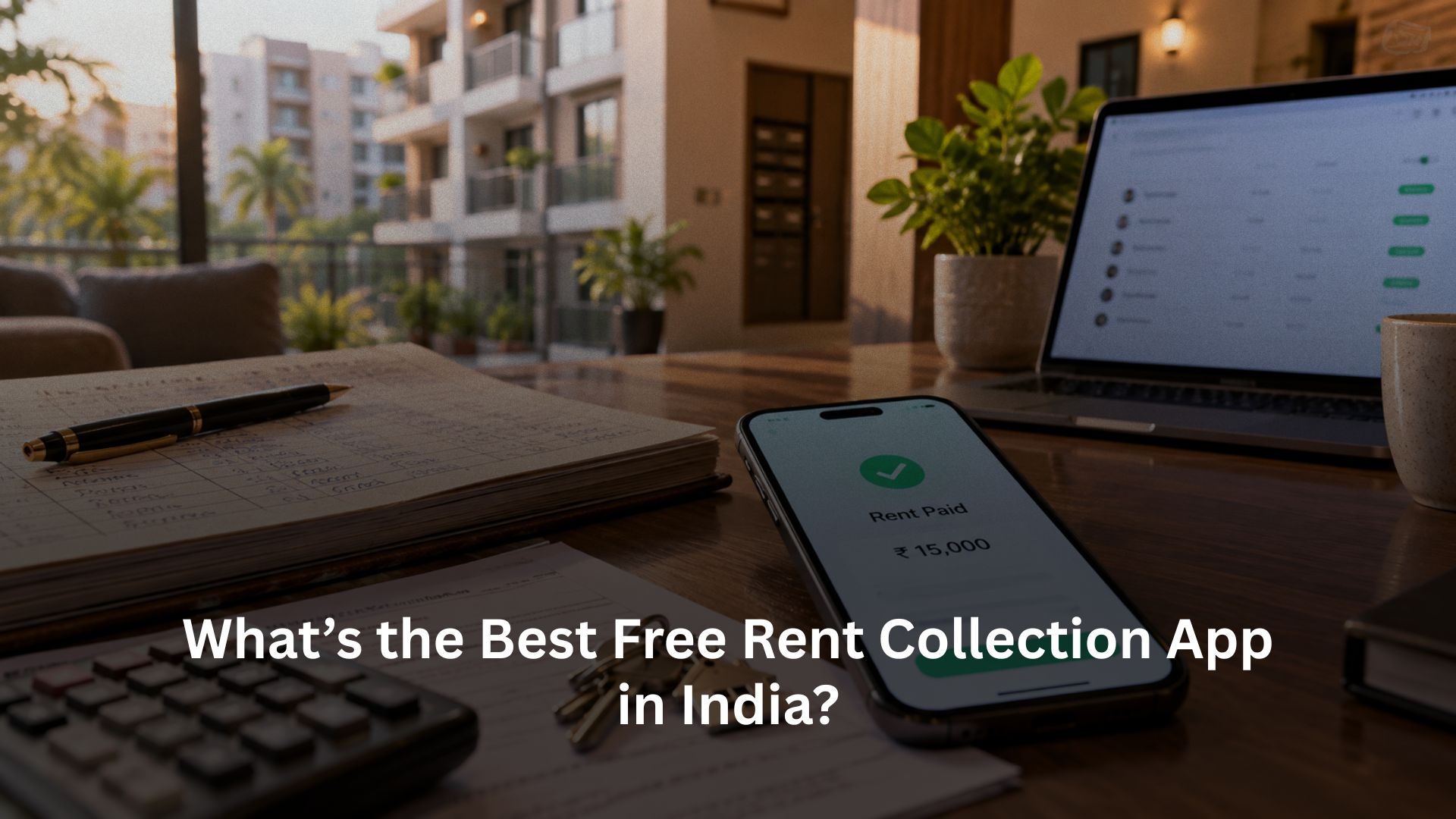
What’s the Best Free Rent Collection App in India?

Written by
Ishika Pannu
Read Time
14 min read
Posted on
September 24, 2026
Overview
Overview
What’s the Best Free Rent Collection App in India?
Rent collection sounds simple when you have only a few tenants. A tenant pays, the owner confirms the amount, and the month moves on.
The process changes once the number of tenants starts growing.
You may have one tenant paying through UPI, another using a bank transfer, and someone else paying in parts. Then come the usual questions. Who has paid? Who still has dues? Was that ₹15,000 payment from the tenant or someone else? Did the reminder go out? Was the payment recorded correctly?
This is where a free rent collection app in India can become useful.
A digital system can bring payments, tenant information, reminders, and basic records into one place. For smaller landlords, that may be enough to replace notebooks, spreadsheets, and scattered WhatsApp messages.
But there is an important difference between collecting rent digitally and managing rent digitally.
A UPI app can help you receive money. A rent collection platform should also help you understand where that money came from, what remains pending, and what needs to happen next.
If you are still deciding whether moving online is worth it, RentOk’s guide on How to Collect Rent Online from Tenants in India covers the basic transition from manual collection to a structured digital workflow.
So, what should you expect from a free plan? And when does it make sense to move beyond one?
What Do Free Rent Collection Plans Usually Include?
Free plans are generally designed for landlords who want to start digitising their rent collection without immediately paying for a full property management system.
The exact features vary between platforms. Still, most free tools focus on the basics of digital collection and record keeping.
You may get features such as:
- Digital payment collection: Tenants can pay through online methods such as UPI or payment links. This reduces the dependence on cash and manual bank details.
- Basic tenant records: You can maintain essential tenant information and connect payments with individual residents instead of keeping separate handwritten records.
- Payment tracking: A basic dashboard can show completed or pending payments. This gives owners a clearer view than checking individual bank transactions.
- Rent reminders: Some free plans provide limited reminders. These can reduce the need to personally message every tenant before the due date.
- Basic reporting: Simple collection reports can help owners understand how much has been received and what remains outstanding.
For a landlord managing a few rooms, these features can make a real difference.
The benefit is not only convenience. It is also consistency. Once payments and records follow the same process every month, there is less room for forgotten entries or missed follow-ups.
However, free plans should be evaluated carefully. The important question is not just what the app offers for free. It is also what happens when your rental operation becomes larger.
Where Free Plans Start to Fall Short
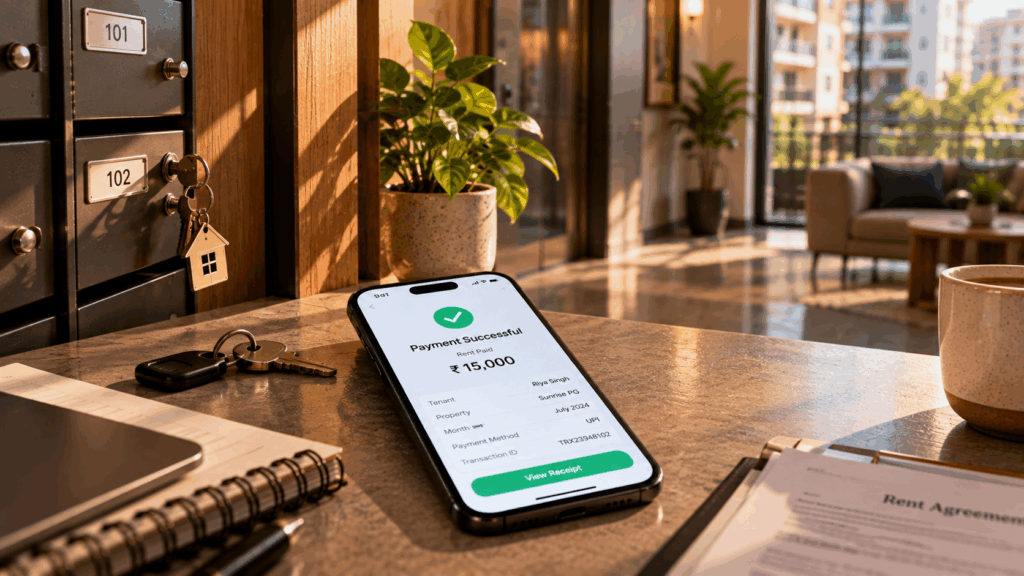
A free rent collection app can work well when your operation is small. The limitations usually become visible when the number of tenants, properties, or transactions increases.
Imagine managing 10 tenants. You can probably remember most payment situations.
Now imagine managing 100 tenants.
There are more payment dates, more outstanding balances, more reminders, and more records to maintain. At that point, even a small limitation in your software can create additional manual work.
The common pressure points include:
- Tenant and property limits: A free plan may restrict the number of tenants or properties you can add. This can become a problem when your portfolio expands.
- Limited automation: Basic reminders may be available, while advanced recurring payment workflows or automated follow-ups may require additional features.
- Basic reporting: A simple paid/unpaid list may not provide the property-wise or tenant-wise financial visibility needed by a growing operation.
- Limited team access: Once staff members become involved, you need a system where everyone can work with the same information without creating duplicate records.
- Narrow operational scope: Rent is only one part of property management. Growing businesses also need tenant management, complaints, occupancy tracking, communication, and reports.
This is why a free UPI rent collection app and a property management platform should not always be treated as the same thing.
A payment application primarily answers one question:
“Can the tenant send the money?”
A property management system needs to answer several more:
“What is due?” “Who has paid?” “What is still pending?” “What happened last month?” and “How does this payment fit into the property’s overall operations?”
That distinction becomes important as soon as rental management starts becoming a business rather than a side activity.
The Hidden Cost of Staying Free for Too Long
There is another side to the word “free”.
Software may cost nothing, but the process around it can still consume time.
Consider an owner managing 40 tenants. The owner receives payments digitally, but still checks bank statements manually. They then match each payment with a tenant, update a spreadsheet, send reminders to defaulters, and answer payment-confirmation messages.
The software may be free.
The management time is not.
Manual rent collection creates several indirect costs. They are easy to overlook because they do not appear on a monthly invoice.
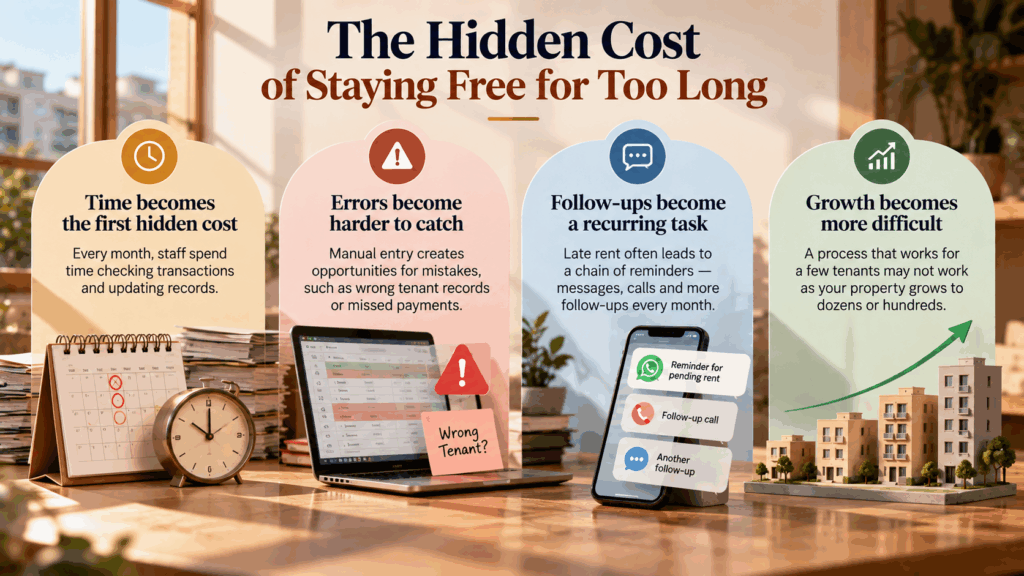
Time becomes the first hidden cost
Every month, staff spend time checking transactions and updating records. The workload may feel manageable at first. It becomes much harder when the same process has to be repeated across dozens or hundreds of tenants.
Errors become harder to catch
Manual entry creates opportunities for mistakes. A payment can be recorded against the wrong tenant. A partial payment may be missed. An old outstanding balance may not be updated correctly.
Follow-ups become a recurring task
Late rent often creates a chain of reminders. First comes a WhatsApp message. Then a call. Then another follow-up. The process repeats every month unless the system can automate more of it.
Growth becomes more difficult
A process that works for 15 tenants may not work for 150. If the software cannot grow with the property, the owner eventually ends up creating additional spreadsheets and manual workarounds.
This is why cost should be evaluated beyond the subscription price.
RentOk’s guide to how property management software helps you collect rent on time explains how reminders, payments, ledgers, receipts, and follow-ups can work as one connected process.
When Does Paying for an Upgrade Make Sense?
Upgrading does not automatically make sense just because a paid plan has more features.
The better question is whether those features solve a real operational problem.
For a landlord with five or ten tenants, a free system may be perfectly adequate. There is no reason to introduce unnecessary complexity when the existing process is already manageable.
The calculation changes when the property begins generating more administrative work.
You may want to consider upgrading when:
- You spend several hours every month checking payments and following up with tenants who have not paid.
- You manage multiple properties and need to see collections separately instead of combining everything in one spreadsheet.
- Your staff members need access to tenant and payment information to handle daily operations.
- Partial payments and overdue balances have become difficult to track consistently.
- You want recurring rent collection instead of depending on tenants to initiate every payment manually.
- You need better reports to understand collections, outstanding dues, and property-level performance.
The goal should not be to buy the most expensive software.
The goal should be to remove enough manual work to make the investment worthwhile.
This is also where automation starts becoming valuable. RentOk’s guide to UPI Autopay for rent collection explains how tenants can authorise recurring payments once and avoid repeating the same payment process every month.
For a growing PG, that difference can be significant.
What Should You Compare Before Choosing a Free App?
“Free” should be only one factor in your comparison.
Before choosing a rent collection app, look at what the system actually allows you to manage. A platform that looks attractive because it costs nothing may become inconvenient if you still need three other tools to run the property.
Start with the payment process.
Can tenants pay through familiar methods? Does the system provide payment confirmation? Can the owner identify the tenant behind each transaction?
Then look at what happens after the payment.
Does the tenant’s record update? Can you see outstanding dues? Is payment history available? Can you generate reports without manually combining information from different sources?
It is also worth checking the system’s ability to grow.
A useful rental platform should ideally support:
- Multiple payment methods: UPI and other digital payment options give tenants flexibility and reduce friction during collection.
- Automated reminders: The system should reduce the need to remember every due date and send individual messages every month.
- Tenant-wise records: Payments should connect with the right tenant so that outstanding balances and payment history remain easy to understand.
- Property-level visibility: Owners managing multiple properties should be able to separate collections and understand performance across locations.
- Scalability: The system should remain useful when you move from a few tenants to a much larger portfolio.
RentOk’s 5 Best Rent Collection Apps for Landlords also looks at the features that matter when comparing rent collection solutions, including reminders, payment methods, dues tracking, and tenant-wise ledgers.
Free Rent Collection vs. Complete Property Management
This is where the comparison becomes more important.
A free rent collection app may solve one problem very well. It may help tenants make payments online and give the owner a basic payment record.
But a growing rental business has more than one recurring process.
The owner may also need to manage tenant onboarding, KYC, complaints, occupancy, maintenance, communication, expenses, and reports.
This is why property management software has a different role.
Instead of treating rent as a standalone transaction, it connects rent with the rest of the property operation.
For example, a tenant’s payment history can become part of their broader tenant record. Outstanding dues can remain visible alongside occupancy information. A complaint can be tracked without depending entirely on a WhatsApp conversation.
The objective is not to make the software more complicated.
It is to make the operation less complicated for the person managing it.
RentOk’s Landlord Tenant Management Software guide looks at this broader relationship between tenant records, payments, documentation, and daily property operations.
Is a Free Plan Enough for a Small Landlord?
For some landlords, yes.
If you manage a small number of tenants and your collection process is straightforward, a free plan can be a sensible starting point.
The important thing is to know what you need today and what you may need later.
There is no advantage in paying for features that you will never use. At the same time, there is also little benefit in choosing a free tool that forces you back into Excel or WhatsApp every time you need to perform a basic management task.
A simple test is useful.
Ask yourself:
How many manual steps remain after the tenant makes the payment?
If the answer is “almost none,” your current system may be working well.
If the answer is “I still have to check the bank, update the spreadsheet, send a receipt, mark the payment, and follow up,” then the payment may be digital, but the process is still largely manual.
That distinction can help you decide whether a free plan is genuinely solving the problem.
What Happens as Your Rental Business Grows?
Growth changes the economics of rent collection.
At a small scale, an owner can compensate for an inefficient system with personal attention. They can check every payment, remember individual tenants, and handle questions themselves.
That becomes difficult at scale.
Once multiple properties or larger tenant volumes are involved, the business needs visibility that does not depend on one person’s memory.
This is also where reporting becomes more useful.
Instead of asking only whether rent was collected, owners can start looking at broader questions:
Are payments becoming consistently late? Which property has the highest outstanding dues? How much manual follow-up is required each month? Are recurring payments working as expected?
These questions turn rent collection data into an operational tool.
The same principle applies to communication. A reminder should not exist only as a WhatsApp message that disappears into a chat history. It should form part of a predictable collection workflow.
That is the difference between using technology to receive rent and using it to manage rent.

Trying RentOk’s Free Tier
For landlords who want to test a more structured approach without immediately committing to a larger setup, starting with RentOk’s free tier can be a practical first step.
The idea is simple. Start with the processes that consume the most time and see how much easier they become when they are brought into one system.
Instead of treating each month’s rent as a fresh task, you can build a repeatable workflow around it.
The important part is not simply whether a tenant can make a UPI payment. It is whether the system helps you manage the complete journey from rent generation to reminder, payment, tracking, and outstanding dues.
That is what makes a rent collection system useful for a growing property.
You can also explore RentOk’s property management software guide if you are evaluating whether your requirements have moved beyond rent collection and into broader property management.
How RentOk Helps
RentOk brings rent collection into a wider property management workflow. Landlords and PG operators can manage rent generation, digital payments, automated reminders, dues, tenant records, and payment visibility from a connected platform. This reduces the need to maintain separate spreadsheets or manually track every transaction. RentOk also supports UPI Autopay, which can automate recurring monthly collections after tenant authorisation.
The bigger advantage is the connection between these processes. Rent does not have to remain a separate monthly task. As the property grows, operators can use the same system to improve payment visibility and reduce repetitive follow-ups. This makes the platform useful not only for collecting rent, but also for building a more organised rental operation.
Conclusion: Start With Free, Scale When You Need To
The best free rent collection app in India is not simply the one that charges nothing.
It is the one that solves your current collection problems without creating more manual work somewhere else.
A free plan can be enough for a small landlord. But as the tenant base grows, automation, payment tracking, reminders, reporting, and tenant-level visibility become more important.
So before choosing a platform, look beyond the price.
Ask what happens before the payment, during the payment, and after the payment.
If you want to move from manual rent tracking to a more structured collection system, Start Free on RentOk and see how digital rent collection can fit into your property management workflow.
Frequently Asked Questions
Find answers to common questions about this topic
About the Author
Ishika Pannu
Ishika Pannu brings you the latest insights and easy-to-apply strategies in property management—helping you simplify renting and grow with RentOk.
You may also like these
Related Articles

1 min read
Women’s Safety in PGs: What Owners Should Know
Written by
Posted on
Ishika Pannu
Sep 28, 2026

1 min read
What to Do When Your Landlord Won’t Make Repairs
Written by
Posted on
Ishika Pannu
Sep 12, 2026

1 min read
Can Landlords Ban Pets in Rental Properties? What Indian Law Says
Written by
Posted on
Ishika Pannu
Sep 11, 2026
1 min read
Why You Should Always Insist on a Registered Rent Agreement
Written by
Posted on
Ishika Pannu
Sep 10, 2026

1 min read
How Landlords Must Legally Handle Your Personal Data During Verification
Written by
Posted on
Ishika Pannu
Sep 10, 2026

1 min read
What Fire Safety Rules Must PG Owners Follow in India?
Written by
Posted on
Ishika Pannu
Sep 2, 2026
1 min read
Why Landlords Need a Property Management App in 2025
Written by
Posted on
Ishika Pannu
Sep 2, 2026

1 min read
How to Manage Multiple Rental Properties Without Spreadsheets
Written by
Posted on
Ishika Pannu
Aug 31, 2026

1 min read
What Licenses Do You Need to Run a PG in India?
Written by
Posted on
Ishika Pannu
Aug 27, 2026

1 min read
How to Start a PG Business Legally in India: Step-by-Step Guide
Written by
Posted on
Ishika Pannu
Aug 27, 2026
Stay ahead in property management with expert insights
Join thousands of property managers receiving exclusive tips delivered straight to your inbox.
Browse posts by category
Case Study
Cost of Living
Growth
Legal
Market Trends
News
Pg owner app
Property Management
Property Tax
Tech
RentOk
The easiest way to rent and manage your PGs and hostels.
Grievance Officer
Get the app


Contact us
hello@eazyapp.tech
HQ Office
COGROW, BASEMENT F-12/8A
BESIDE HOUSE OF STYLE SALON, SECTOR 28, DLF PHASE 1
GURUGRAM, HARYANA - 122002
South India Office
LUMIODESK COWORKING, 2ND FLOOR, 40, 14TH MAIN RD
BESIDE MC DONALD, 7TH SECTOR, HSR LAYOUT
BENGALURU, KARNATAKA - 560102
©️ 2026 EazyApp Tech Pvt Ltd. All rights reserved


