Property Management
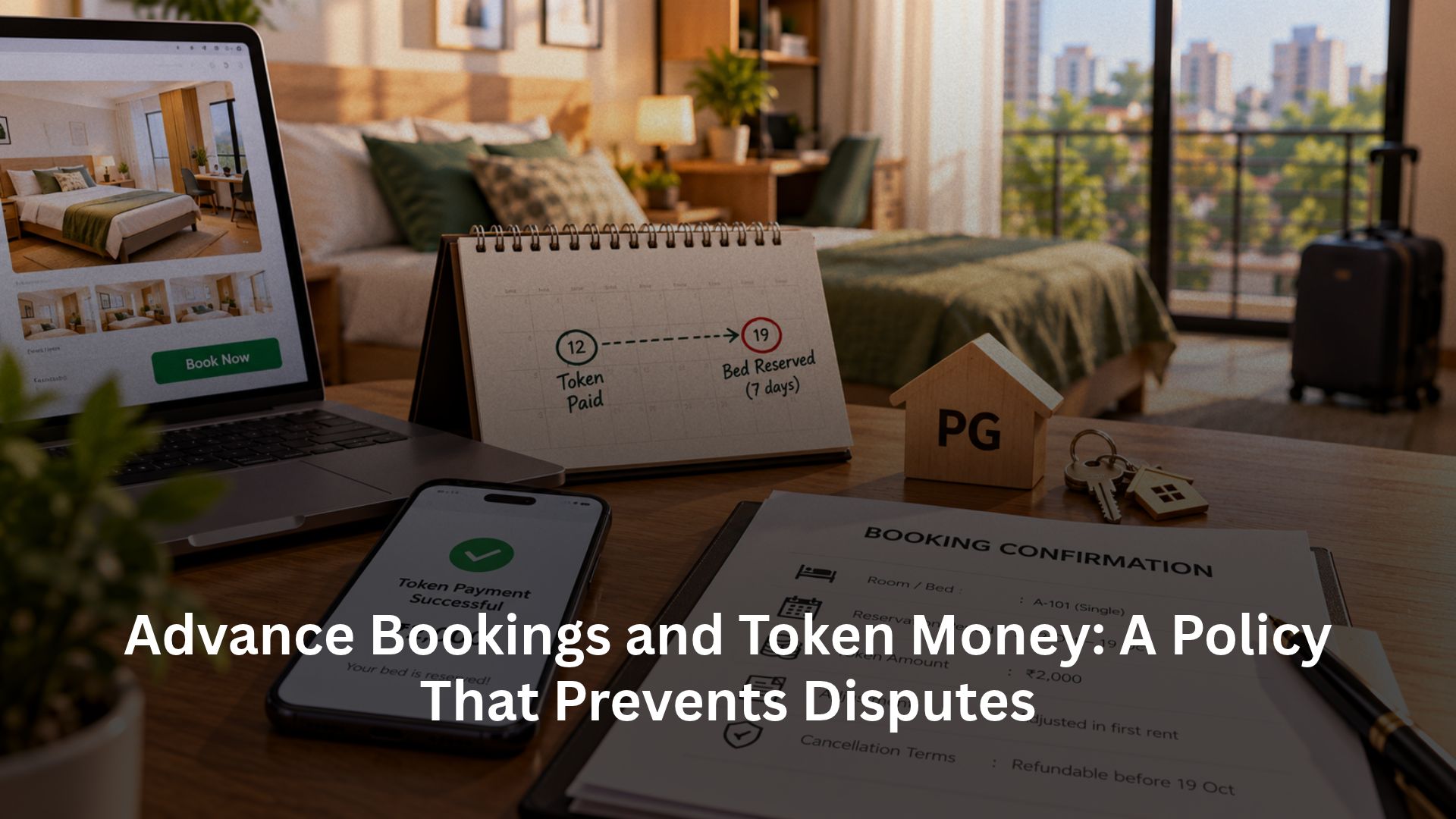
Advance Bookings and Token Money: A Policy That Prevents Disputes

Written by
Ishika Pannu
Read Time
12 min read
Posted on
October 21, 2026
Overview
Overview
Advance Bookings and Token Money: A Policy That Prevents Disputes
A prospective resident pays ₹2,000 to reserve a PG bed and cancels two days later. The manager considers the payment a charge for holding the bed. The resident expects it back because they never moved in. Both have proof of the transfer, but neither has a written record explaining what the payment meant. That missing explanation is where a routine booking becomes a dispute.
A useful advance booking policy answers the important questions before money changes hands: which bed you reserve, how long you hold it, how you adjust the token against rent, and what happens after cancellation. For PG and hostel operators, clear PG token amount rules should connect the promise made during the enquiry with the booking acknowledgement you issue after payment. The policy below shows how to make that connection and includes a template you can adapt for your property.
Why token money causes so many fights
The word “advance” often covers several different payments. A booking token reserves accommodation before move-in. Advance rent pays for a specified rental period. An operator holds a security deposit against agreed liabilities during the stay. Calling all three a “PG booking amount” leaves residents unsure whether the operator will refund, adjust, or retain the money.
Consider a booking for a double-sharing room. The resident may believe they have reserved a particular bed with a window, while the manager has recorded only the room category. If the manager offers a different bed on arrival, the argument concerns the booking promise as much as the refund itself. The confirmation should identify the bed or clearly explain the allocation arrangement.
Disputes also arise when one staff member promises a refund and another applies a different rule. A payment screenshot cannot settle that disagreement because it records the transfer without recording the bargain. RentOK’s discussion of how an unclear booking refund escalated into a tenant dispute illustrates why operators need retrievable terms alongside transaction records.
What a fair token policy looks like
A fair token policy explains the commitment on both sides. The resident commits money to a booking; the operator commits to holding the agreed accommodation until a stated deadline. Decide on an amount that fits that reservation purpose, and make the cancellation consequences easy to understand before requesting payment.
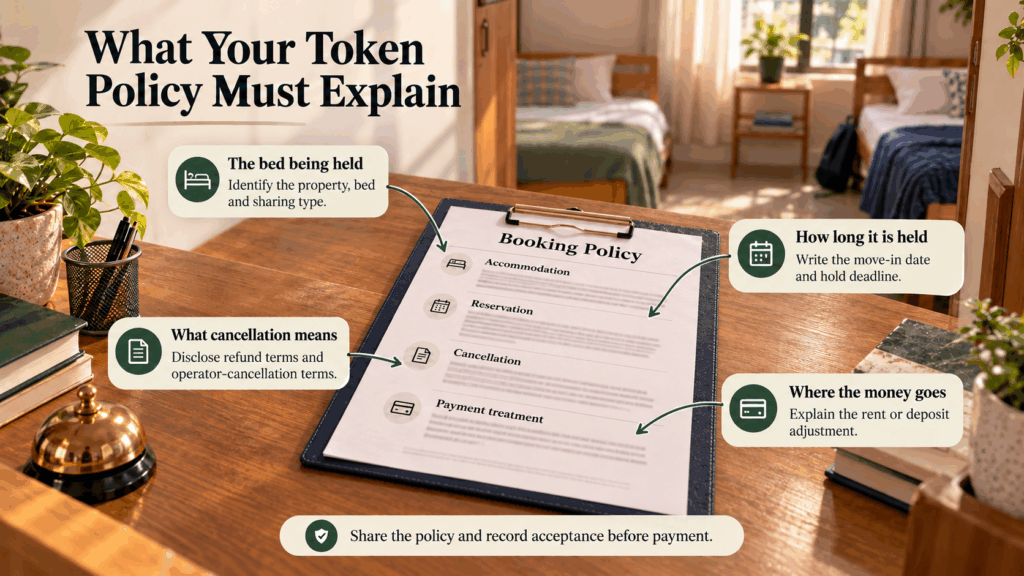
Your policy should cover these practical details:
- The accommodation promised: Record the property, room or bed identifier, sharing type, agreed rent, and relevant inclusions. Describe any provisional allocation explicitly.
- The reservation period: Specify the move-in date and the final date and time until which you will hold the bed. Include the time zone for online bookings.
- The treatment of the money: State whether the token becomes part of the first rent payment, part of the security deposit, or a separate disclosed charge. Avoid leaving the adjustment undecided.
- Cancellation and operator failure: Explain the resident’s cancellation options and what happens if your property cannot provide the promised accommodation.
- The refund process: Give a contact, required booking reference, refund calculation, and processing commitment. Identify who can approve an exception.
Record the security deposit separately, even if you collect both amounts together. The record-keeping approach in how to track security deposits in a PG helps explain why the purpose and subsequent movement of each amount should remain visible.
Refundable or not: what to write
Write the actual refund outcome instead of relying on “terms apply.” “Refundable before the cancellation deadline” needs a deadline. “Partially refundable” needs a calculation. “Non-refundable” needs particular care: a non-refundable label alone does not establish your right to keep the money.
Section 74 of the Indian Contract Act, 1872 addresses situations where a party breaches a contract that names a sum or penalty for breach. It provides for reasonable compensation up to that amount. It does not make every stated cancellation penalty automatically recoverable. The treatment of a particular booking payment depends on the arrangement, circumstances, and applicable law; ask a qualified adviser to review your deduction clauses for your property and jurisdiction.
An illustrative refund policy
A balanced starting policy can provide a full refund up to a specified deadline, a clearly limited and supportable deduction for later resident cancellations, and a full refund where the operator cannot fulfil the booking. The following is an illustrative policy, not a prescribed fee schedule:
| Situation | Example policy treatment |
|---|---|
| Resident cancels by the written deadline | Full token refund |
| Resident cancels after the deadline | Refund after a justified deduction, no higher than the cap you disclose before payment |
| Resident does not arrive by the hold deadline | Contact the resident, then apply the disclosed no-show terms unless both parties agree to an extension |
| Operator cannot provide the promised accommodation | Full token refund; an alternative requires the resident’s agreement |
| Resident moves in as agreed | Credit the token against the first rent payment, if both parties agreed to that treatment |
For example, if the token is ₹2,000 and a valid, justified late-cancellation deduction is ₹500, the refund is ₹1,500. The ₹500 figure is only an illustration. It should not become a standard charge simply because it appears in a sample policy. Retain records explaining any amount kept, and review the deduction if another resident books the bed for the same period.
Collecting tokens online with receipts
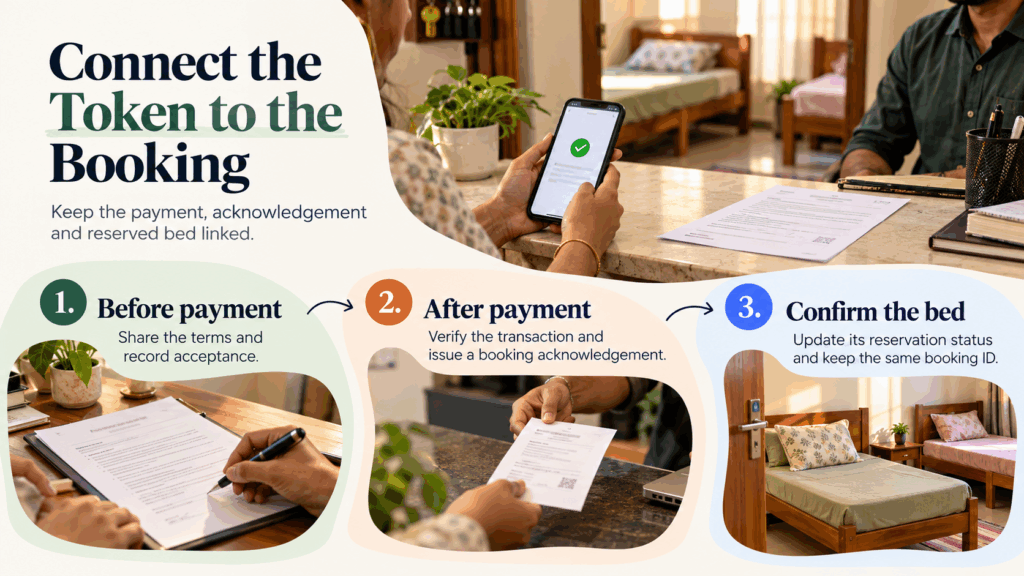
Online collection makes a payment easier to trace, but the policy must still reach the resident before payment. Share the complete terms and booking summary first, record their acceptance, and then send the payment link or QR code. If a parent pays, connect the payer’s name and transaction reference to the intended resident’s booking.
Confirm successful payment through the receiving account or payment system before marking the booking paid. A screenshot may show a pending transaction or belong to a different booking. If payment status is uncertain, check it before asking the resident to pay again, and resolve any duplicate payment separately from cancellation charges.
Issue a booking receipt or acknowledgement containing:
- The operator’s name and contact, property address, resident’s name, and booking ID.
- The amount received, payment purpose, date, payment method, and transaction reference.
- The accommodation reserved, move-in date, and reservation expiry.
- The agreed adjustment against rent or deposit, plus the policy version or attached terms.
Describe a token as a booking payment rather than issuing a document that suggests the resident has already paid rent for an occupied month. The distinction matters when the resident later checks their balance. RentOK’s guide to rent receipt generators and payment records explains the broader value of connecting receipts with recorded transactions.
Update the bed’s status immediately after confirmation and keep the booking ID consistent across records. The same principle underlies a collection workflow that connects payments, ledgers, and receipts: receiving money is one step in maintaining a complete financial record.
Handling delayed move-ins and cancellation requests
A resident’s joining date may change because of travel, admission, or employment delays. Decide whether you can extend the reservation and confirm the new hold deadline in writing. Explain separately whether the rent start date changes. A postponed arrival should not leave the resident assuming rent starts later while your accounts continue from the original date.
For cancellations, record when the request arrived and acknowledge it against the booking ID. Send a refund calculation showing the token received, any proposed deduction and its reason, the refund due, and the expected processing date. A manager should review disputed deductions against the original terms and supporting records rather than making a fresh rule during the conversation.
After you return the money, retain the refund reference and share confirmation with the payer. Keep the original payment entry and record the refund separately so the history remains understandable. If you offer a booking credit or transfer to another property, obtain the resident’s agreement; a credit should not silently replace a refund already due under your policy.
A ready-to-use policy template
The template below uses a resident-friendly full-refund deadline and a capped deduction after it. Complete every placeholder, set deadlines appropriate to your booking cycle, and review the terms against applicable law before use. These are suggested contractual terms, not nationwide PG booking advance refund rules.
Booking details and payment terms
- Property and operator: [Name, address, operator name and contact]. Booking ID: [ID]. Resident and payer: [Resident name, contact, payer name if different]. Policy version: [Version and date].
- Accommodation and charges: We will reserve [room/bed ID, sharing type and agreed facilities] for move-in on [date]. Monthly rent is ₹[amount]. We record the ₹[amount] security deposit separately. Other agreed charges are [itemised amounts or “none”].
- Token and confirmation: The booking token is ₹[amount]. We confirm the reservation in writing after successful payment. We will hold the accommodation until [date, time, IST]. On move-in, we will credit the full token against [specified first rent payment]. The remaining amount payable is ₹[amount], due on [date].
Cancellation, no-shows and operator changes
- Resident cancellation: Send cancellation requests to [WhatsApp number/email], quoting the booking ID. If we receive your request on or before [date, time, IST], we will refund the full token. For later cancellations, we may deduct only a reasonable, justified amount that applicable law permits, up to ₹[disclosed cap, no higher than the token]. We will provide the calculation and reasons. We will not add an undisclosed cancellation fee.
- No-show and date changes: If you have not arrived by the hold deadline, we will attempt contact using [contact method]. Unless we agree to an extension in writing, we may release the bed after that deadline and apply the late-cancellation terms above. Both parties must agree in writing to any revised move-in date, hold deadline, rent start date, and additional charge.
- Operator cancellation or material changes: If we cannot provide the confirmed accommodation on the agreed terms, we will offer a full token refund. We will provide a different room, property, or booking credit only with your agreement. This clause does not limit rights available under applicable law.
Refund processing and policy acceptance
- Refund processing: We will initiate refunds within [number] working days of receiving the cancellation request, or of confirming that we cannot fulfil the booking. We will notify you promptly if essential payment details are missing. Refunds will be processed through the original payment source where supported by the payment provider, or through another verified account approved by the payer. Once processed, we will share the refund reference, although the time it takes for the funds to appear may vary depending on the bank or payment provider.
- Queries and acceptance: Contact [responsible manager and escalation contact] for clarification or a disputed deduction. Before payment, please confirm: “I have read the booking summary and policy version [version], including the reservation deadline, rent adjustment, cancellation terms, and refund process.” Both parties will retain a copy of the accepted terms and payment acknowledgement.
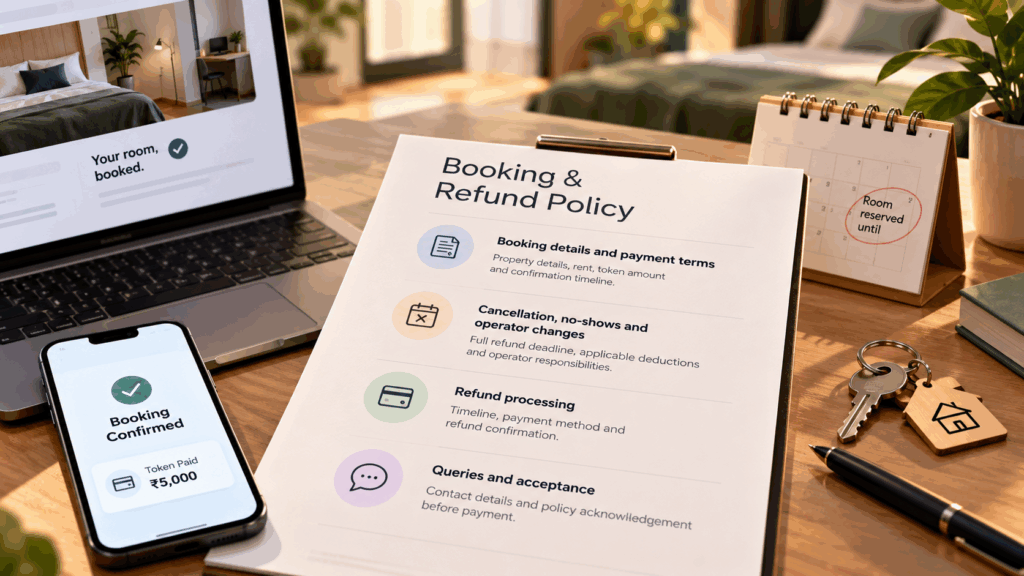
How RentOK helps manage token bookings
A clear token policy works best when your team can connect it to the payment your team receives and the bed it reserves. RentOK brings booking and payment tools into the property-management workflow, helping PG operators maintain that connection as enquiries become confirmed reservations.
- Collect tokens through a clear payment route: RentOK supports WhatsApp payment links and QR codes, along with a “Reserve Bed” option on property websites. After sharing the booking terms and recording acceptance, operators can use these supported routes to collect the token online.
- Connect the commitment to the bed: Room and bed blocking helps your team record which bed it has reserved. Updating the reservation after payment confirmation helps staff avoid offering the same bed to another resident while the agreed hold remains active.
- Keep payment details available for follow-up: Transaction updates and tenant payment records help operators check the amount received and connect it to the relevant booking. These records support clearer conversations when a resident asks about an adjustment or refund.
- Carry the booking into onboarding: RentOK’s digital tenant onboarding workflow describes digital booking tokens and payment confirmation. Use the supported booking and receipt workflow in your setup to keep the payment acknowledgement connected to the incoming resident’s record.
Your team should still keep the accepted policy retrievable, communicate changes, and review refunds against the agreed terms. Payment and booking records support those decisions; they do not automatically enforce your cancellation policy or settle a dispute.
Conclusion
A token policy should give the resident and your team the same understanding of the booking: which bed the operator reserves, how long the operator holds it, how the operator adjusts the payment, and what cancellation would mean. Share those answers before collecting money, record acceptance, and keep the payment acknowledgement and any later changes together. That preparation makes a refund conversation easier to handle with clear terms and records.
Put the policy into your daily booking process so every staff member follows the same steps. Collect token money online on RentOK and connect each reservation with the payment and confirmation your team needs to manage it clearly.
Frequently Asked Questions
Find answers to common questions about this topic
About the Author
Ishika Pannu
Ishika Pannu brings you the latest insights and easy-to-apply strategies in property management—helping you simplify renting and grow with RentOk.
You may also like these
Related Articles
1 min read
RentOk vs Crib vs My PG Manager: Which PG Software Actually Fits My Business?
Written by
Posted on
Ishika Pannu
Sep 30, 2026

1 min read
Women’s Safety in PGs: What Owners Should Know
Written by
Posted on
Ishika Pannu
Sep 28, 2026
1 min read
What’s the Best Free Rent Collection App in India?
Written by
Posted on
Ishika Pannu
Sep 24, 2026

1 min read
What to Do When Your Landlord Won’t Make Repairs
Written by
Posted on
Ishika Pannu
Sep 12, 2026

1 min read
Can Landlords Ban Pets in Rental Properties? What Indian Law Says
Written by
Posted on
Ishika Pannu
Sep 11, 2026
1 min read
Why You Should Always Insist on a Registered Rent Agreement
Written by
Posted on
Ishika Pannu
Sep 10, 2026
1 min read
How Landlords Must Legally Handle Your Personal Data During Verification
Written by
Posted on
Ishika Pannu
Sep 10, 2026

1 min read
What Fire Safety Rules Must PG Owners Follow in India?
Written by
Posted on
Ishika Pannu
Sep 2, 2026
1 min read
Why Landlords Need a Property Management App in 2025
Written by
Posted on
Ishika Pannu
Sep 2, 2026

1 min read
How to Manage Multiple Rental Properties Without Spreadsheets
Written by
Posted on
Ishika Pannu
Aug 31, 2026
Stay ahead in property management with expert insights
Join thousands of property managers receiving exclusive tips delivered straight to your inbox.
Browse posts by category
Case Study
Cost of Living
Growth
Legal
Market Trends
News
Pg owner app
Property Management
Property Tax
Tech
RentOk
The easiest way to rent and manage your PGs and hostels.
Grievance Officer
Get the app


Contact us
hello@eazyapp.tech
HQ Office
COGROW, BASEMENT F-12/8A
BESIDE HOUSE OF STYLE SALON, SECTOR 28, DLF PHASE 1
GURUGRAM, HARYANA - 122002
South India Office
LUMIODESK COWORKING, 2ND FLOOR, 40, 14TH MAIN RD
BESIDE MC DONALD, 7TH SECTOR, HSR LAYOUT
BENGALURU, KARNATAKA - 560102
©️ 2026 EazyApp Tech Pvt Ltd. All rights reserved


