
Property Management
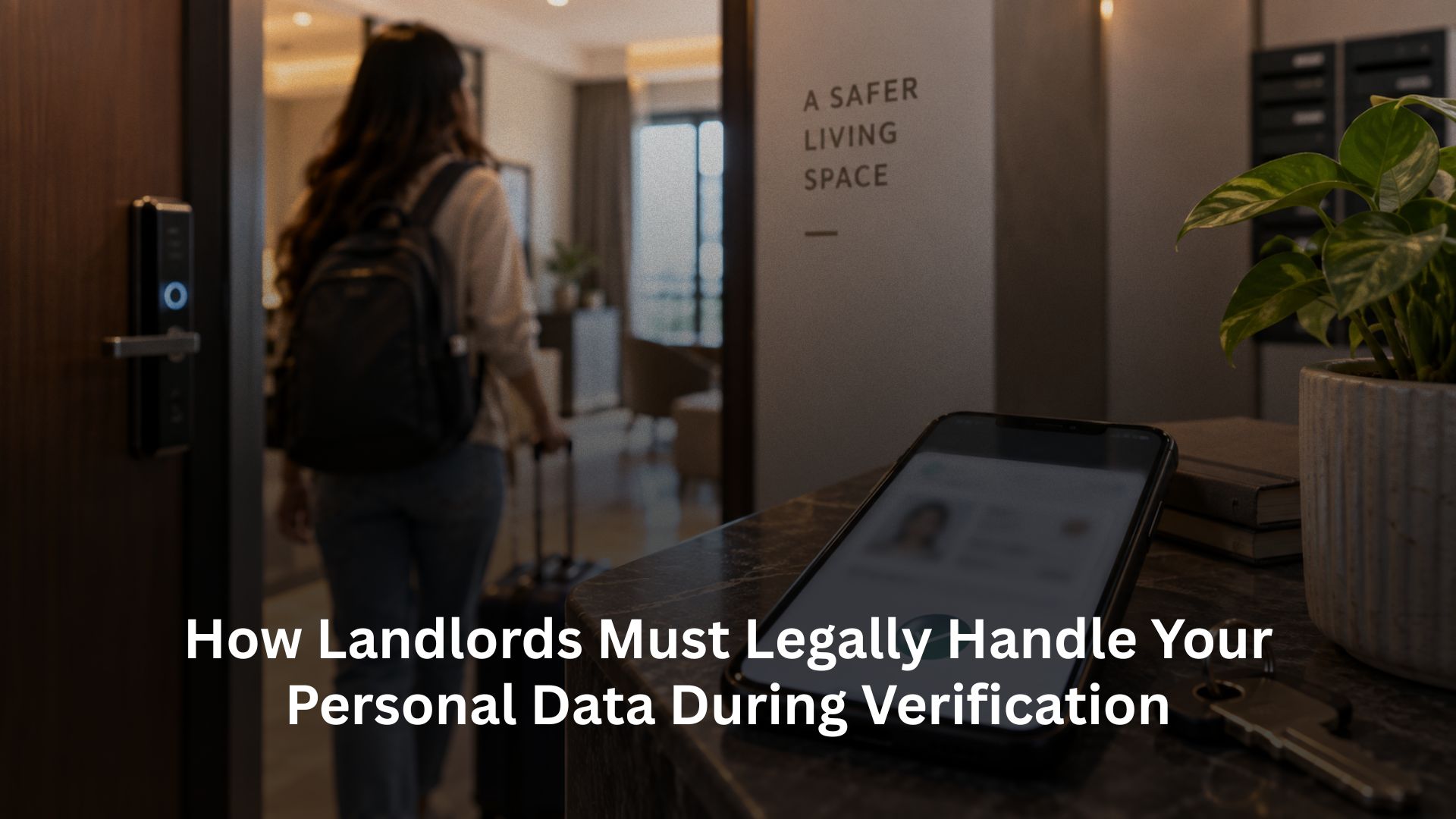
How Landlords Must Legally Handle Your Personal Data During Verification

Written by
Ishika Pannu
Read Time
15 min read
Posted on
September 10, 2026
Overview
Overview
How Landlords Must Legally Handle Your Personal Data During Verification
When you rent a PG, hostel, co-living space, or residential property, sharing personal information is usually part of the move-in process.
You may be asked for your Aadhaar card, photograph, phone number, permanent address, emergency contact details, college information, or employment details. Some properties may also ask for documents required for tenant verification or police verification.
Most tenants understand why this information is needed. A landlord needs to know who is occupying the property. They may also need certain records for agreements, verification, payments, or property management.
But there is another question that deserves equal attention.
What happens to your personal information after you submit it?
Your identity document remains personal data even after verification is complete. The same applies to your phone number, photograph, address, and other information linked to you.
The issue becomes more important as rental operations become digital. Tenant information may now move through apps, email accounts, cloud storage, messaging platforms, and property-management systems.
This makes tenant data privacy an important part of responsible rental management.
India’s data-protection framework has also evolved in recent years. The Digital Personal Data Protection Act, 2023 (DPDP Act) establishes a framework for processing digital personal data. It also gives individuals certain rights over their personal information. The Digital Personal Data Protection Rules, 2025 add more operational requirements. Their provisions are being brought into force through a phased timeline.
For tenants, verification should therefore mean more than proving identity.
It should also mean knowing what information is collected, why it is collected, who can access it, and how it is handled after verification.
What Information Do Landlords Typically Collect During Verification?
The exact information requested can vary from one property to another. It can also depend on the type of tenant and the purpose of verification.
A student PG may ask for college information. A property housing working professionals may request employment details. A landlord may also need contact and address information for tenancy records.
Commonly requested information includes:
- Identity information, such as your name, photograph, and government-issued identity documents required for the property’s verification process.
- Contact information, including your mobile number, email address, and emergency contact details where these are relevant to managing the tenancy.
- Address information, such as your permanent address or previous address, where this information forms part of the applicable verification process.
- Tenancy information, including your move-in date, room or property details, agreement information, and expected duration of stay.
- Supporting documents, such as college or employment information, where the property has a legitimate reason to request them.
The important point is that collecting personal information for one purpose does not automatically make it appropriate to use that information for every other purpose.
A verification document should not become a general-purpose source of tenant information.
This distinction is becoming more important as landlords move away from paper-based onboarding. A digital system can make verification faster, but it can also create larger privacy risks if information is collected without proper controls.
RentOk’s Aadhaar vs Police Verification guide explains an important distinction here. Aadhaar-based identity verification and police verification serve different purposes. They should not be treated as the same process.

Verification Does Not Mean Unlimited Data Collection
One of the biggest misconceptions around tenant KYC is that landlords can collect anything they want once they have a legitimate reason to verify a tenant.
That is not a good approach to data management.
The DPDP Act creates a framework around the processing of digital personal data. It also places importance on lawful processing and transparency around why information is being collected.
For tenants, the practical question is simple:
Why does the landlord need this information?
If an identity document is needed to establish a tenant’s identity, the purpose is relatively clear. If additional information is requested, the property should have a reasonable purpose for collecting it.
A professional rental operation should be able to explain:
- What personal information is being collected and which parts of the information are necessary for onboarding or verification.
- Why each category of information is required and how it will be used during the tenancy.
- Who may have access to the information within the property-management operation.
- How the information is stored and protected against unnecessary access or misuse.
- What happens to the information when the original purpose for keeping it no longer exists.
These are reasonable questions for a tenant to ask.
They also help landlords build a better verification process.
The goal should not be to collect as much information as possible. The goal should be to collect the information that is actually needed and manage it responsibly.
What Does India’s Data Protection Framework Mean for Tenants?
The Digital Personal Data Protection Act, 2023 uses specific terms for the people and organisations involved in data processing.
An individual is referred to as a Data Principal. The person or organisation that determines the purpose and means of processing personal data is referred to as a Data Fiduciary.
The framework covers areas such as notice, consent, correction, erasure, grievance redressal, and other responsibilities connected with personal data.
However, there is an important detail that should not be overlooked.
The DPDP Act and the DPDP Rules have a phased commencement structure.
That means a blog about tenant data privacy should not suggest that every provision is already operational in exactly the same way.
For tenants, the broader principle remains useful. Personal information should be handled through a clear and accountable process.
A good rental onboarding system should therefore give tenants enough information to understand what they are agreeing to.
It should also avoid hiding important information behind complicated legal language.
What Should a Tenant Be Told Before Sharing Personal Data?
A tenant should not feel that their only option is to send documents first and ask questions later.
The DPDP framework places importance on notice and transparency. The notified Rules specify that notices should be understandable and should provide an itemised description of the personal data involved and the purpose or purposes for processing it.
In a rental environment, this can be handled without making onboarding unnecessarily complicated.
For example, a property could clearly explain that certain information is being collected for identity verification, tenancy documentation, applicable verification requirements, or property management.
The explanation does not need to become a lengthy legal document.
It simply needs to be clear.
A tenant should be able to understand what they are sharing and why they are sharing it.
That clarity also benefits landlords. When residents understand the reason behind a verification request, there is less confusion during onboarding.
How Long Can a Landlord Keep Your KYC Data?
This is one of the most important questions tenants can ask.
Verification does not automatically mean that every document must be kept forever. At the same time, it would also be incorrect to assume that every record must be deleted as soon as a tenant moves out.
There can be legitimate reasons to retain certain information. These may include tenancy administration, contractual requirements, accounting, dispute resolution, or another legal requirement.
The DPDP Act also recognises situations where personal data may need to be retained for a specified purpose or to comply with another law.
So the better question is not:
“Can my landlord keep my data?”
The better question is:
“Why is this data still being retained, and is it being handled for a valid purpose?”
This distinction matters because old tenant records can easily remain in a property’s systems for years.
A former tenant’s documents may sit inside:
- Old email attachments that were never removed after the tenancy ended.
- WhatsApp conversations containing identity documents and photographs.
- Physical folders that are stored without any clear retention process.
- Spreadsheets containing personal information long after the tenant has moved out.
- Cloud folders that can still be accessed by staff who no longer need the information.
This is why responsible data management needs a retention process.
RentOk’s How to Maintain Tenant KYC Records Digitally explains why organised digital records are increasingly important for rental businesses. The larger issue is not simply storing documents digitally. It is keeping them organised and manageable throughout the tenant lifecycle.

Do Tenants Have a Right to Ask for Their Data to Be Deleted?
The DPDP Act provides Data Principals with rights relating to their personal data. These include rights connected with correction and erasure in specified circumstances.
However, the right to erasure is not an instruction to delete every record immediately.
Certain information may still need to be retained when there is a valid reason to do so or when another law requires its retention.
This creates an important balance.
Tenants should be able to ask questions about their personal information. Landlords should also be able to retain information when there is a legitimate reason for doing so.
A tenant can therefore ask the relevant organisation about:
- What information is still being retained, particularly after the tenancy has ended and the tenant no longer uses the property.
- Whether any information is inaccurate, such as an old phone number, incorrect address, or other outdated tenant details.
- Whether information can be erased, where it is no longer required and the applicable legal conditions for erasure are satisfied.
- How a privacy concern can be raised, including the appropriate grievance mechanism for the organisation handling the data.
The DPDP framework provides for grievance redressal and establishes a process for individuals to raise concerns about relevant obligations.
For tenants, this means privacy concerns should not simply disappear into an unmonitored inbox.
For landlords, it reinforces the value of having a clear internal process for handling such requests.
What If Your Personal Data Is Misused?
The greatest risk is not simply that a landlord has your information.
The greater concern is what happens when that information is handled carelessly.
Consider a common situation. A tenant sends an identity document to a property manager over WhatsApp. The manager forwards it to another staff member. That staff member saves it on a personal phone. Months later, the document is still sitting there even though the original verification process ended long ago.
The problem is no longer just document collection.
It is uncontrolled access.
Tenants should pay attention when:
- Documents are requested through informal channels without explanation, especially when nobody clearly explains why the information is required or who will access it.
- Personal information is shared beyond the original purpose, such as forwarding documents to unrelated people without a clear operational reason.
- Records contain incorrect or outdated information, particularly when those records continue to be used for agreements, communication, or verification.
- There is no clear way to raise a privacy concern, leaving the tenant unsure about whom to contact when something appears to have gone wrong.
If you believe your information has been mishandled, start by documenting the issue.
Keep relevant messages and identify what information was shared. Then ask the landlord, property manager, or organisation handling the information for clarification.
Where applicable, use the organisation’s grievance mechanism. The DPDP framework provides for grievance redressal before matters can be escalated to the Data Protection Board under the applicable framework.
The exact legal route can depend on the circumstances and the provisions in force at the time.
Why Digital KYC Needs More Than a Document Upload
Moving KYC online does not automatically make tenant information safer.
A poorly designed digital process can create the same problems as paper records. The only difference is that the documents are now sitting inside phones, cloud folders, email accounts, or messaging applications.
The real advantage comes from structured digital KYC.
A well-designed process can connect a tenant’s identity information with their agreement, room allocation, onboarding status, and other relevant records. This reduces the need for staff to repeatedly request the same documents.
It can also make it easier to maintain consistent records across a growing property.
RentOk’s Digital KYC and Police Verification: State-wise Compliance in India looks at the operational side of this process. It highlights why digital KYC should move beyond document collection and become part of a structured onboarding workflow.
For a property with a small number of tenants, manual systems may appear manageable.
For a large PG or co-living operation, the same approach can quickly create gaps.
The objective should therefore be simple:
Collect necessary information, organise it properly, restrict unnecessary access, and manage it throughout the tenant lifecycle.
Data Privacy Is Also a Tenant-Experience Issue
Data privacy is often discussed as a legal matter.
But it is also a question of professionalism.
Imagine two properties.
At the first property, a tenant sends an Aadhaar copy to one number. A photograph goes to another staff member. The rental agreement is emailed separately. Nobody explains where the information is stored.
At the second property, the tenant receives a structured verification request. The purpose is explained. Documents are submitted through an organised process. The tenant receives confirmation when onboarding is complete.
Both properties may collect similar information.
The experience is completely different.
The second process creates a stronger sense of control and professionalism.
This matters because verification is often the tenant’s first major interaction with property management. If the process feels organised, the tenant receives an early indication that the property takes documentation seriously.
RentOk’s Aadhaar-Based Digital KYC guide for PG Owners similarly treats verification as part of the wider onboarding process rather than as a simple document-collection exercise.
For landlords, this creates an important shift in thinking.
Data protection should not be treated as something that begins only after a problem occurs.
It should be built into the tenant journey from the beginning.
A Better Way to Think About Tenant Data
The strongest rental businesses do not view KYC documents as files that need to be collected and forgotten.
They treat tenant information as part of an ongoing operational record.
That means the process should begin with a clear reason for collection. It should continue with appropriate storage and access controls. It should also include a process for updating information and handling records when the tenancy ends.
This becomes even more important as properties scale.
A landlord managing ten tenants may remember where each document is stored. A property manager handling hundreds of residents across multiple buildings cannot depend on memory.
Structured systems become necessary.
This is also why verification, agreements, occupancy records, and tenant communication should not exist as completely separate processes. They form part of the same tenant lifecycle.
RentOk’s recent coverage of tenant police verification and onboarding makes a similar operational distinction. Identity verification, police verification, and documentation are separate steps, but they work best when they are connected within a proper onboarding system.

How RentOk Helps With Secure Tenant Verification
Managing tenant KYC manually becomes difficult as occupancy increases. Documents can end up across WhatsApp chats, spreadsheets, email accounts, physical folders, and individual devices.
RentOk helps bring tenant verification and property-management workflows into a more structured system. Its digital KYC process helps operators collect and organise tenant information as part of onboarding. The wider platform also connects tenant records with other property operations.
This gives property managers better visibility over documentation and tenant records. It can also reduce repeated document requests and the confusion created by scattered information.
For tenants, a structured process can make verification feel more organised and professional.
For property managers, it creates a clearer record of the onboarding process.
The larger principle is straightforward:
Tenant verification should create trust, not unnecessary privacy risk.
Conclusion: Your KYC Documents Deserve Responsible Handling
Tenant verification is an important part of responsible rental management.
But collecting an identity document is only the beginning.
The real responsibility starts once that information enters the landlord’s or property manager’s system.
Tenants should know what information is being collected. They should understand why it is required. They should also have clarity about how that information is handled.
Landlords, meanwhile, need processes that support lawful data processing, accurate records, appropriate security, and responsible retention.
India’s evolving data-protection framework makes this responsibility increasingly important. The DPDP Act provides a formal framework for digital personal data. The DPDP Rules, 2025 add further operational requirements through a phased implementation structure.
For tenants, the takeaway is simple: your KYC documents are not just paperwork. They are personal information, and responsible verification should treat them that way.
Frequently Asked Questions
Find answers to common questions about this topic
About the Author
Ishika Pannu
Ishika Pannu brings you the latest insights and easy-to-apply strategies in property management—helping you simplify renting and grow with RentOk.
You may also like these
Related Articles
1 min read
Why You Should Always Insist on a Registered Rent Agreement
Written by
Posted on
Ishika Pannu
Sep 10, 2026

1 min read
What Fire Safety Rules Must PG Owners Follow in India?
Written by
Posted on
Ishika Pannu
Sep 2, 2026
1 min read
Why Landlords Need a Property Management App in 2025
Written by
Posted on
Ishika Pannu
Sep 2, 2026

1 min read
How to Manage Multiple Rental Properties Without Spreadsheets
Written by
Posted on
Ishika Pannu
Aug 31, 2026

1 min read
What Licenses Do You Need to Run a PG in India?
Written by
Posted on
Ishika Pannu
Aug 27, 2026

1 min read
How to Start a PG Business Legally in India: Step-by-Step Guide
Written by
Posted on
Ishika Pannu
Aug 27, 2026

1 min read
What Revenue Leaks Look Like in Rental Businesses
Written by
Posted on
Ishika Pannu
Aug 17, 2026

1 min read
Free PG Food Menu Template: Weekly Planner for Mess Owners
Written by
Posted on
Ishika Pannu
Aug 10, 2026
1 min read
How to Deal with Tenants Who Pay Late Every Single Month
Written by
Posted on
Ishika Pannu
Aug 3, 2026

1 min read
PG Management Annual Planner: Month-by-Month Guide
Written by
Posted on
Ishika Pannu
Jul 31, 2026
Stay ahead in property management with expert insights
Join thousands of property managers receiving exclusive tips delivered straight to your inbox.
Browse posts by category
Case Study
Cost of Living
Growth
Legal
Market Trends
News
Pg owner app
Property Management
Property Tax
Tech
RentOk
The easiest way to rent and manage your PGs and hostels.
Get the app


Contact us
hello@eazyapp.tech
HQ Office
COGROW, BASEMENT F-12/8A
BESIDE HOUSE OF STYLE SALON, SECTOR 28, DLF PHASE 1
GURUGRAM, HARYANA - 122002
South India Office
LUMIODESK COWORKING, 2ND FLOOR, 40, 14TH MAIN RD
BESIDE MC DONALD, 7TH SECTOR, HSR LAYOUT
BENGALURU, KARNATAKA - 560102
©️ 2026 EazyApp Tech Pvt Ltd. All rights reserved


