Property Management
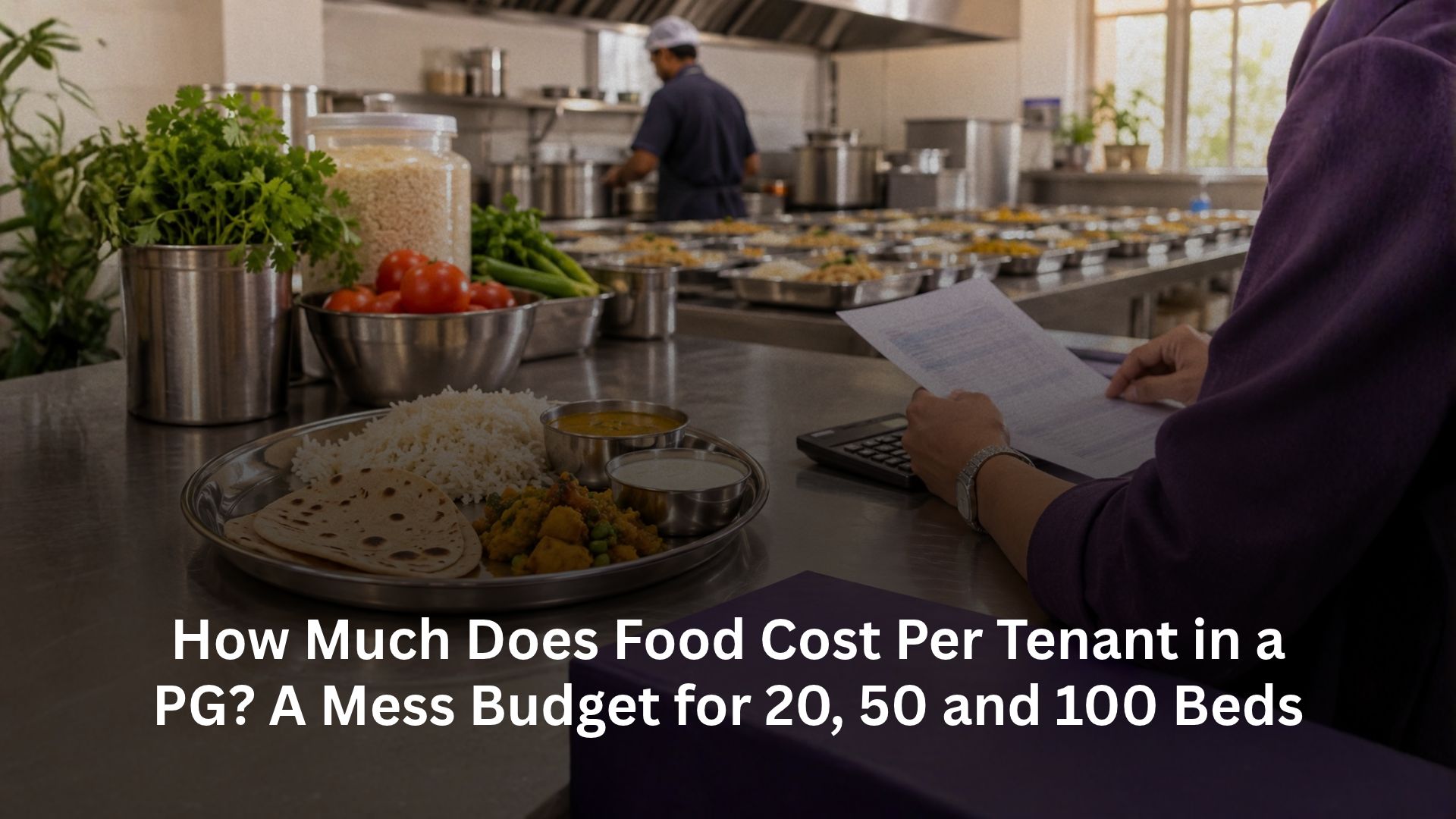
How Much Does Food Cost Per Tenant in a PG? A Mess Budget for 20, 50 and 100 Beds

Written by
Ishika Pannu
Read Time
10 min read
Posted on
November 24, 2026
Overview
Overview
How Much Does Food Cost Per Tenant in a PG? A Mess Budget for 20, 50 and 100 Beds
A PG mess can spend less per resident as it grows, yet still lose money if the owner prices meals against full capacity and actual occupancy falls. Groceries tell only part of the story: the same kitchen must also pay cooks, buy gas and keep service reliable when fewer people eat.
For planning, the illustrative PG food cost per person below ranges from ₹3,315 to ₹4,200 a month across fully occupied 100-bed and 20-bed properties. This is an operating budget, not a surveyed Indian average or an all-inclusive selling price. Use it to compare scale, calculate meal costs and decide what your own mess charges must cover.
What should your PG food budget include?
Start with residents on the meal plan, rather than sanctioned beds. A 100-bed building with 60 food subscribers cannot spread kitchen costs across 100 people. Distinguish subscribers from the number who actually attend each meal; both affect planning differently.
This model assumes a 30-day month, three meals daily plus evening tea, and a standard vegetarian menu with paneer or sweets on two days each week. That means 90 meals per resident, with tea as an additional service. It assumes full occupancy and unchanged portions at each property size.
The budget covers dry groceries, produce, dairy, LPG, consumables and kitchen wages. Add your property’s kitchen electricity, water, space allocation, equipment replacement, repairs, pest control, applicable compliance costs and staff cover before setting a final price. Avoid counting shared expenses twice.
Keep purchase bills and separate food spending from accommodation costs. RentOk’s guide to preparing monthly PG financial reports explains how expense categories make monthly comparisons more useful.
Separate cash purchases from ingredient consumption when stock changes materially. For a monthly consumption check, add opening stock to purchases and subtract closing stock, using consistent values. Buying a large rice sack on the last day should not make that month’s meals appear more expensive if most of it remains unused.
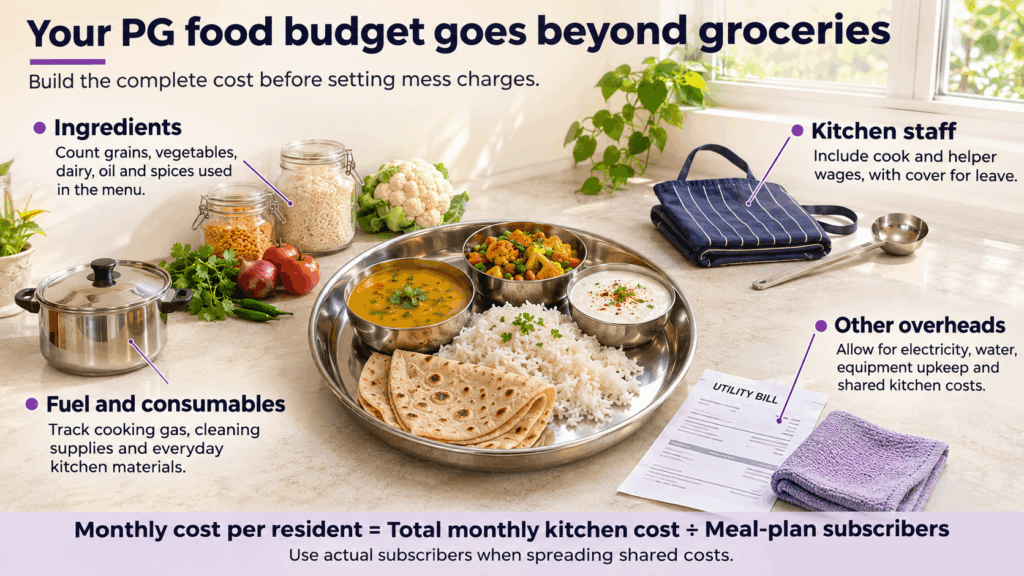
Monthly mess budget for 20, 50 and 100 beds
The following figures are planning assumptions, not supplier quotations for Bengaluru, Pune or Gurugram. The 50-bed case applies a 5% discount to ingredients; the 100-bed case applies 10%. Actual discounts depend on purchase volumes, quality and vendor terms.
| Monthly expense | 20 residents | 50 residents | 100 residents |
|---|---|---|---|
| Dry groceries: atta, rice, dal, oil, spices | ₹22,000 | ₹52,250 | ₹99,000 |
| Fresh produce: vegetables and fruit | ₹18,000 | ₹42,750 | ₹81,000 |
| Dairy: milk, curd, paneer, butter | ₹11,000 | ₹26,125 | ₹49,500 |
| Commercial LPG and consumables | ₹7,000 | ₹15,000 | ₹26,000 |
| Kitchen staff wages | ₹26,000 | ₹45,000 | ₹76,000 |
| Model operating subtotal | ₹84,000 | ₹1,81,125 | ₹3,31,500 |
| Cost per resident/month | ₹4,200 | ₹3,622.50 | ₹3,315 |
| Average per meal: subtotal ÷ residents ÷ 90 | ₹46.67 | ₹40.25 | ₹36.83 |
The meal averages allocate tea, wages and gas across 90 meals. They do not mean breakfast costs the same as dinner. The dairy row excludes eggs because this baseline is vegetarian.
Fewer subscribers raise the cost per person
At 50 subscribers, a ₹45,000 payroll costs ₹900 per person. With 35 subscribers, the same payroll costs approximately ₹1,286 per person. The kitchen’s wage bill has not changed; fewer residents now share it.
If ingredients fall proportionately to ₹84,787.50 while wages and the ₹15,000 gas-and-consumables allowance stay unchanged, the monthly subtotal becomes ₹1,44,787.50. That equals ₹4,136.79 per person, around 14.2% above the full-occupancy case. Gas may also fall in practice, so replace this simplifying assumption with actual consumption.
Budget against expected subscribers and test a lower-occupancy month. A universal claim that 80% occupancy increases every PG’s food cost by 10–15% would overlook different staffing and fuel arrangements.
For frequent mid-month arrivals or departures, use subscriber-days divided by 30 as the equivalent monthly headcount. This makes the comparison fairer than dividing the entire month’s spending by the number present on its final day.
Breakfast, lunch, dinner and tea: the ingredient split
At 20 residents, the model allocates ₹2,550 per person monthly to ingredients, or ₹85 daily. One possible allocation looks like this; it illustrates a budget envelope rather than verified dish prices.
| Service | Ingredients per person/day | Monthly allowance |
|---|---|---|
| Breakfast | ₹18 | ₹540 |
| Lunch | ₹29 | ₹870 |
| Dinner | ₹31 | ₹930 |
| Evening tea | ₹7 | ₹210 |
| Total ingredients | ₹85 | ₹2,550 |
The remaining ₹1,650 per person covers the model’s wages, LPG and consumables. Adding these again to ₹4,200 would double-count them. At 50 and 100 residents, the assumed purchasing discounts reduce the ingredient allowance to ₹2,422.50 and ₹2,295 respectively.
Build a weekly rotation around affordable staples, dal, seasonal vegetables and practical breakfast dishes. RentOk’s weekly PG food menu planner connects menu choices with procurement and kitchen capacity.
For eggs or non-vegetarian meals two or three times weekly, test an additional ₹400–₹700 per subscriber as an initial scenario allowance. Confirm it through recipes, portions and quotations; it is not a guaranteed market rate. Identify whether the supplement replaces an existing dish or adds to it.
Review supplier rates against local alternatives and the Department of Consumer Affairs’ retail and wholesale price monitoring. National benchmarks can flag an unusual quote, but your invoices determine your actual PG mess cost.
Is an in-house kitchen cheaper than a caterer?
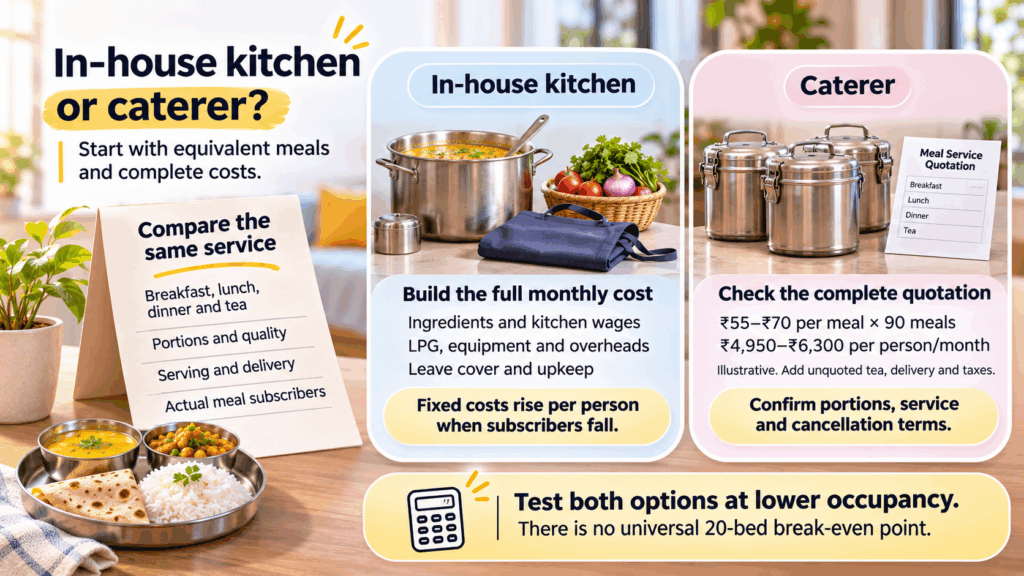
The answer depends on staffing, service scope and subscriber numbers. Compare equivalent breakfasts, lunches, dinners and tea before choosing; a two-meal tiffin quote cannot fairly compete with a three-meal kitchen budget.
Cook salaries, helpers and commercial gas
The staffing assumptions are ₹16,000 for one cook plus ₹10,000 for one helper at 20 beds; ₹45,000 for a head cook, assistant and helper at 50; and ₹76,000 for a head cook, two assistants and two helpers at 100. These are budget allocations, not prescribed staffing levels or verified local wage rates.
Obtain local quotations and allow for working hours, leave cover, applicable wage obligations and peak serving times. Clear purchasing, preparation and cleaning responsibilities matter alongside headcount; the guide to managing PG staff efficiently explains that operational structure.
Track LPG separately within the combined allowance. IndianOil’s published commercial-cylinder prices, updated 1 November 2026, list a 19 kg cylinder at ₹2,820 in Delhi. Your city’s price and actual refill consumption must drive the fuel budget.
Compare complete vendor quotations
Using an illustrative caterer quote of ₹55–₹70 per meal, 90 meals cost ₹4,950–₹6,300 per person monthly, before any unquoted tea, delivery or taxes. Ask about portions, serving staff, cancellations, food quality and replacement meals.
Outsourcing can avoid kitchen payroll and equipment commitments at low occupancy. However, there is no universal 20-bed break-even point. Compare your fixed kitchen costs plus ingredients and fuel against a complete vendor quote, then repeat the calculation at lower occupancy before committing.
Setting mess charges that cover the full cost
Food cost per tenant and the price you charge serve different purposes. Cost measures spending; price must also cover omitted overheads and your intended margin. A ₹3,000–₹3,500 fee would fall below this model’s operating subtotal at 20 or 50 subscribers.
At 100 subscribers, ₹3,500 leaves only ₹185 per person before the excluded overheads. That small difference cannot safely represent profit. Check whether accommodation income intentionally subsidises meals and record that decision rather than hiding the shortfall inside room rent.
For a target margin, use selling price = complete cost ÷ (1 − target margin). At ₹3,622.50, a 15% margin implies approximately ₹4,262, but only before adding the overheads this model excludes. Multiplying cost by 1.15 gives a markup, which produces a different margin.
Offer terms that residents can understand:
- Bundled meals: State which meals, days and services the accommodation package covers. Explain holiday closures and menu changes before admission.
- Optional mess subscription: Show the separate price, subscription period and any cancellation or absence-credit policy. Do not promise automatic refunds for skipped meals unless your terms provide them.
- Revisions: Specify when you review charges and how you will communicate changes. Avoid unexpected additions halfway through an agreed period.
RentOk’s guide to rent inclusions and extra charges helps frame that disclosure. Keep the costing sheet separate from the resident-facing price list, while making both consistent.
Cutting waste without reducing food quality
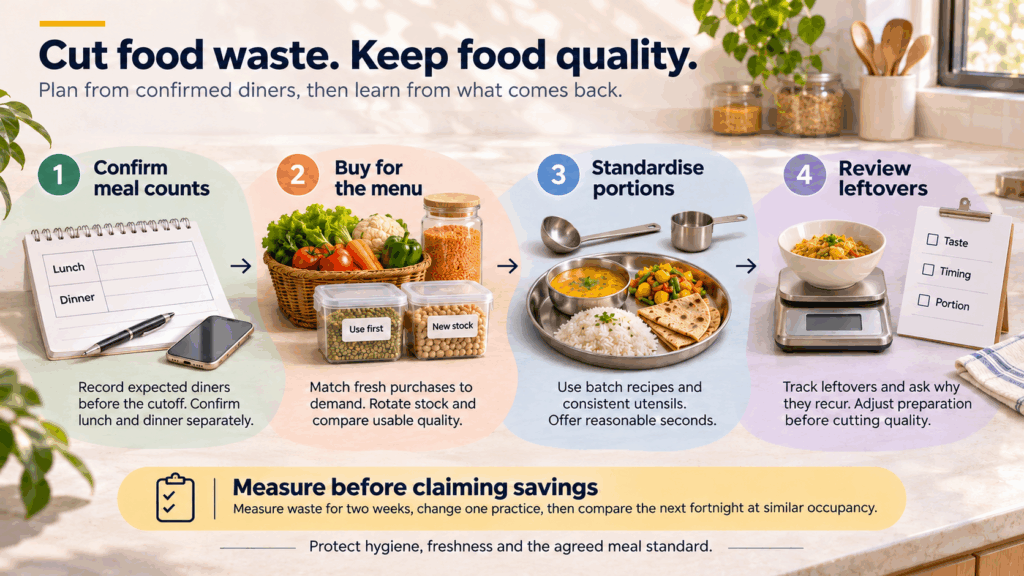
Start with a meal-count routine: record expected diners before a practical cutoff, tell the kitchen the confirmed number, then compare portions prepared, meals served and leftovers. Count lunch and dinner separately because attendance can differ substantially.
Use a register, form or suitable tool for meal-skip information. Do not assume that every absent resident cancels meals, or promise a fixed 10–15% saving without measuring your own results. RentOk’s guide to improving PG profitability also treats food-cost measurement as an operational priority.
- Standardise recipes and serving utensils: Track ingredient quantities for a batch. Offer reasonable seconds rather than preparing oversized first portions that residents leave behind.
- Buy for the menu: Match fresh purchases to confirmed demand and rotate stock. Compare suppliers on usable quality and delivered quantity, not the cheapest quoted price alone.
- Investigate repeated leftovers: Ask whether taste, timing, portion size or a disliked dish causes the waste. Change the preparation before removing a useful ingredient or reducing portions across the board.
Protect hygiene, freshness and the agreed meal standard throughout. Measure waste for two weeks, change one operational practice and compare the next fortnight under similar occupancy. That gives your team a useful baseline instead of an unsupported savings target.
How RentOk helps you plan menus and review food spending
A workable mess budget connects the weekly menu with subscriber numbers, purchases and actual spending. RentOk supports the surrounding planning and property records, while your kitchen team still needs to cost recipes and confirm daily meal requirements.
- Plan the weekly menu: Use RentOk’s food menu tool to organise meal choices, then turn the plan into a grocery list and preparation schedule. Check quantities against expected diners before ordering.
- Keep residents informed: RentOk supports food-menu visibility in the tenant app. A clear published plan helps residents know what to expect and gives staff a common reference when discussing changes.
- Review the financial result: Record expenses consistently and use RentOk’s income, expense and profit reports to compare months. Keep grocery invoices, payroll and LPG records so you can explain changes in cost per subscriber.
Menu visibility alone does not calculate recipe costs or guarantee lower waste. Pair the tool with a simple meal-count register and a monthly costing review.
Conclusion
A sustainable PG food budget starts with the number of residents who actually subscribe, the meals you promise and the full cost of delivering them. In this illustrative model, scale reduces the operating subtotal from ₹4,200 to ₹3,315 per person, but vacancies and omitted overheads can quickly narrow that advantage.
Before setting mess charges, obtain local ingredient and staffing quotes, cost a practical weekly rotation and test a quieter month. Review waste and resident feedback together so savings come from better purchasing and preparation. Plan menus with RentOk’s food menu tool, and keep the menu connected to the figures you review each month.
Frequently Asked Questions
Find answers to common questions about this topic
About the Author
Ishika Pannu
Ishika Pannu brings you the latest insights and easy-to-apply strategies in property management—helping you simplify renting and grow with RentOk.