Tenant Rights
Can a Tenant Sublet a Room in India?

Written by
Ishika Pannu
Read Time
11 min read
Posted on
November 24, 2026
Overview
Overview
Can a Tenant Sublet a Room in India?
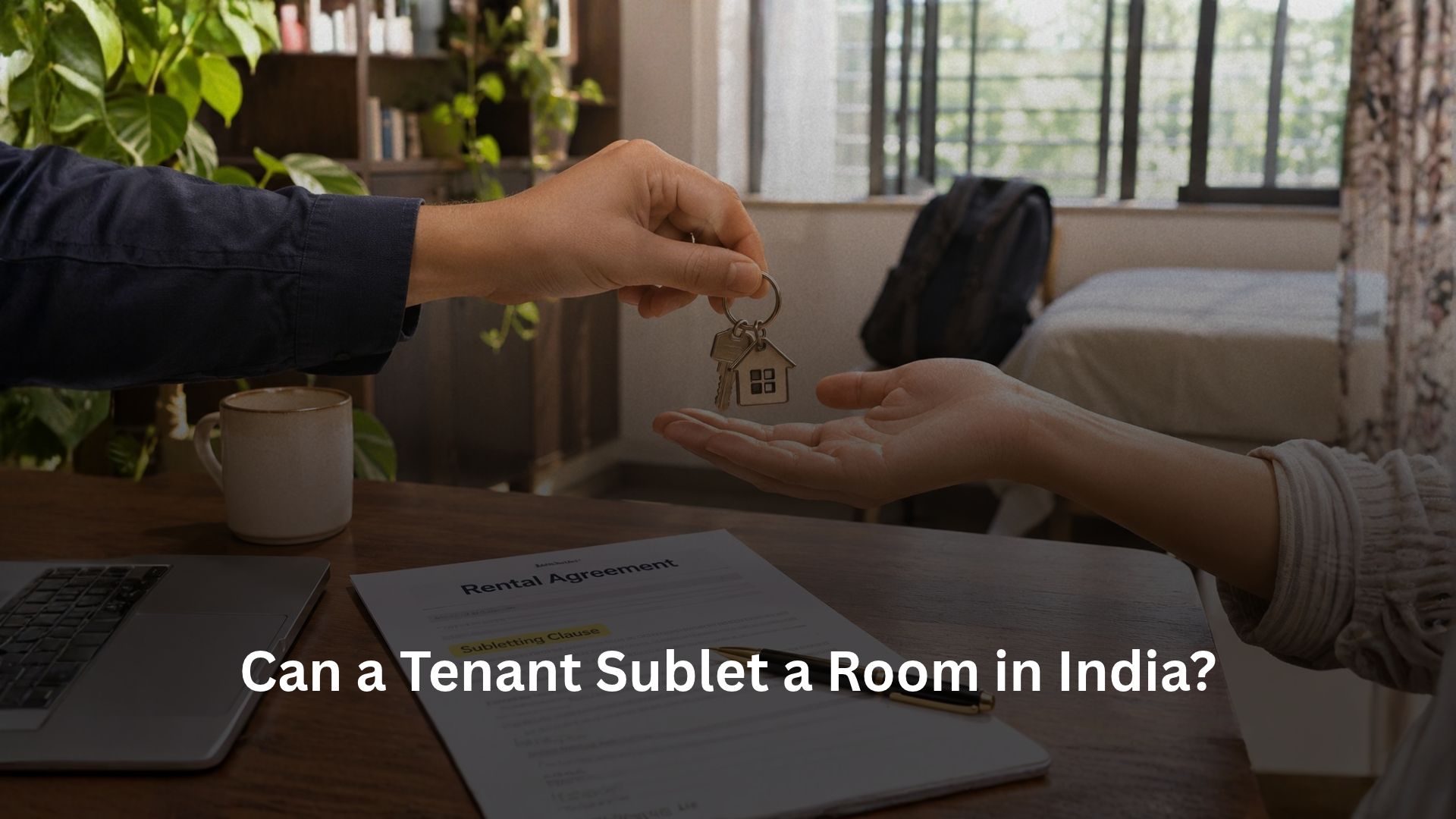
A tenant can sublet a room in India when the applicable law and rental agreement permit it. In many tenancies, that means obtaining the landlord’s written consent before another person moves in. Having a spare room, continuing to pay the full rent or calling the newcomer a flatmate does not settle the legal position.
The practical question is what rights you plan to give the other person and whether you have authority to give them. This guide explains subletting rules in India, the difference between co-tenancy and subtenancy, state-law requirements and the documents to complete before accepting money or handing over keys.
Is subletting legal under Indian law?
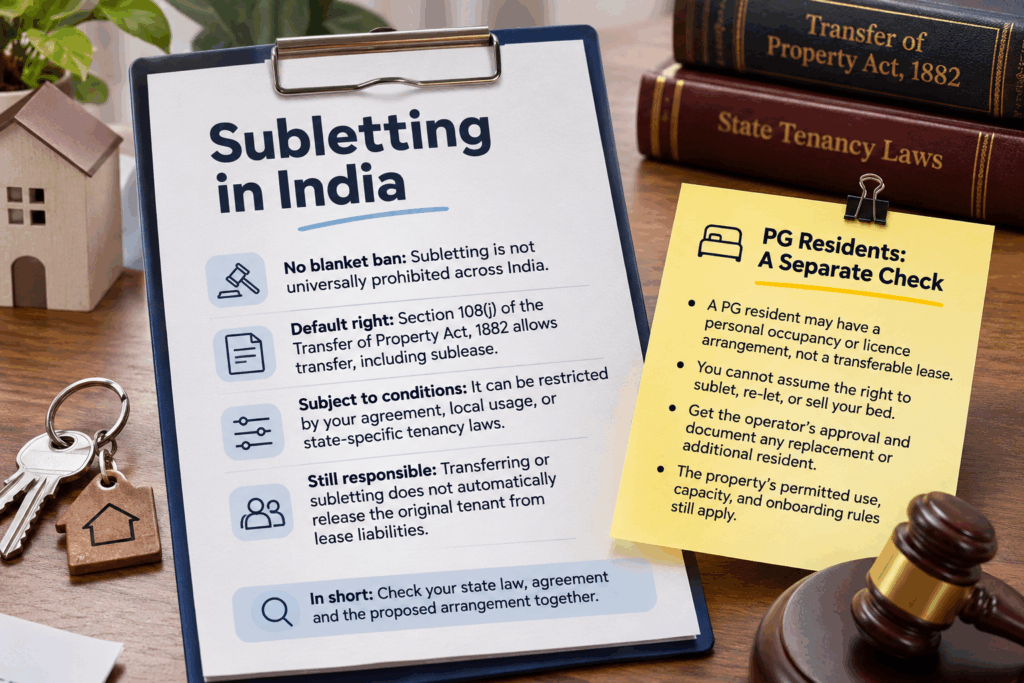
Subletting is not subject to one blanket nationwide ban. Section 108(j) of the Transfer of Property Act, 1882 provides a default ability to transfer a leasehold interest, including through a sublease. However, Section 108 operates subject to a contrary contract or local usage, and applicable special tenancy legislation can restrict that position.
The Transfer of Property Act text also makes clear that a transfer alone does not release the original tenant from lease liabilities. Permission to share possession and release from responsibility are separate questions.
For a practical decision, check the applicable state law, your agreement and the proposed arrangement together. A silent lease does not establish permission where a special law requires consent. Equally, a landlord’s approval cannot override a statutory restriction or an occupancy limit.
PG residents need a separate check
A PG resident may hold a personal occupancy or licence arrangement rather than a transferable lease. Do not assume that renting a bed gives you the right to sell, transfer or re-let it to someone else.
Ask the operator to approve and document a replacement or additional resident. The property’s permitted use, capacity and onboarding requirements still matter even when everyone agrees on the price.
Your agreement sets the permission you need
Look beyond a clause headed “subletting”. Restrictions may also cover assignment, paying guests, additional occupants, sharing possession or parting with possession. A clause can prohibit transferring one room even when you continue living in the rest of the flat.
RentOk’s guide to reading a rent agreement before signing explains why occupancy rules, financial terms and exit conditions deserve attention together.
Check whether your agreement:
- Bans the arrangement outright: Obtain an appropriate written amendment if the landlord agrees to change the restriction; a separate deal with the incoming person cannot amend your main lease.
- Requires prior written consent: Secure it before handing over possession. Identify the person, room, dates and permitted use rather than relying on a general conversation about visitors.
- Allows sharing subject to conditions: Follow the approved occupancy, verification and society requirements. Permission for one named person does not necessarily cover later replacements.
Permission should describe the actual arrangement
Ask whether the landlord wants an additional co-tenant on the main agreement, an approved subtenancy or a new tenancy replacing yours. These choices create different relationships and responsibilities.
If you anticipate a transfer, discuss it before signing. RentOk’s guide to negotiating rent and maintenance terms includes replacement-occupant and early-exit discussions that can prevent later uncertainty. An RWA’s approval or police acknowledgement does not replace the landlord’s required consent.
A flatmate, co-tenant and subtenant have different roles
“Flatmate” describes how people live together; it does not identify their legal rights. The agreement, payment arrangement and actual control of the accommodation determine the position.
| Arrangement | Typical relationship | Point to check |
|---|---|---|
| Co-tenants on the main agreement | Each joins the documented arrangement with the landlord | Who signs, who owes rent and how a person exits |
| Approved subtenant | The main tenant grants an interest in all or part of the rented premises | Authority to sublet, consent, term and required filings |
| Guest or household visitor | Temporary presence without a separate tenancy arrangement | Duration, payment, control and agreed visitor rules |
| Informal paying flatmate | The label leaves the legal relationship unclear | Whether the facts create a subtenancy or breach an occupancy restriction |
Co-tenancy can make the relationship more transparent, but it does not automatically divide each person’s liability into equal shares. Check the agreement’s actual terms.
Does giving someone a separate room make it a sublet?
Giving a person exclusive possession of a room for payment raises a serious subletting question. The Supreme Court has discussed exclusive possession and consideration as key ingredients when examining alleged subletting; the legal test depends on the applicable provision and evidence. See the Court’s discussion of subletting principles.
Ordinary shared living or a visitor’s stay does not automatically establish those ingredients. Other restrictions on additional occupancy or parting with possession may still apply. RentOk’s explanation of guest and visitor restrictions in rented homes helps distinguish visitor management from a resident arrangement.
State laws and the Model Tenancy Act
The Model Tenancy Act, 2021 is a framework for states and Union territories, not a tenancy law that automatically governs every Indian rental. Check the enacted law, commencement notifications and coverage of your particular premises.
Under the Model Act’s Section 7, subletting requires a supplementary agreement to the existing tenancy agreement. The landlord and tenant must jointly inform the Rent Authority within two months of executing that agreement. The official Model Act text supplies the model procedure; state legislation determines the operative requirement.
Delhi and Tamil Nadu show why the location matters
In Delhi, Section 14(1)(b) of the Delhi Rent Control Act identifies unauthorised subletting, assignment or parting with possession of all or part of the premises as an eviction ground. Written landlord consent matters where that Act applies. Its statutory text also contains coverage exclusions, so do not assume every Delhi flat falls within it.
In Tamil Nadu, the 2022 amendment substituted Section 7 with a supplementary-agreement framework and joint intimation to the Rent Authority within two months. The published amendment matters because the original provision described a different consent and notification process.
Do not mix a one-month rule from an older text with the Model Act’s two-month procedure. Verify the current state provision, prescribed form and filing route for your tenancy.

The risks you keep as the original tenant
The incoming person’s promise to pay does not automatically change your obligations to the landlord. If you remain the contracting tenant, a missed contribution can leave you funding the full agreed rent while you pursue the other person separately.
Consider an illustrative arrangement: you owe ₹24,000 monthly, and an approved subtenant agrees to pay you ₹9,000 for one room. Their failure to pay that ₹9,000 does not, by itself, reduce the landlord’s contractual entitlement to ₹24,000.
Other risks include:
- Damage and bills: You may remain responsible under the main agreement for damage, utilities or conduct involving the person you admit.
- Two deposit settlements: Money you collect from a subtenant and money your landlord holds from you belong to separate arrangements. Record each amount and its refund conditions.
- Possession disputes: An incoming person who refuses to leave can complicate your own handover. Match the permitted duration and exit process to the main tenancy.
- Termination proceedings: An unauthorised arrangement can expose the tenancy to eviction proceedings even when the landlord receives rent regularly.
Can the landlord keep your whole deposit?
Not automatically. A breach does not create an unrestricted right to retain every rupee. The landlord needs a legally supportable basis for deductions or compensation under the agreement and applicable law; a forfeiture clause may itself require legal scrutiny.
Request an itemised settlement showing unpaid dues, damage or other claimed liability. RentOk’s guide to how much of a security deposit is refundable explains how to examine deductions and preserve supporting records.
Put an approved subletting arrangement in writing
Before accepting a deposit or handing over keys, confirm the legal structure with the landlord. For a genuine sublease, prepare the consent, supplementary agreement and subtenancy document required for that structure rather than treating a generic roommate template as sufficient.
Record the following clearly:
- People and authority: Identify the landlord, main tenant and incoming resident, together with the consent that permits the arrangement.
- Premises and dates: Specify the room, shared areas, access rights and start and end dates. Do not promise a longer or stronger right than you can grant.
- Payments and responsibilities: State rent, deposit, utilities, due dates, damage responsibility and who issues acknowledgements.
- Exit and changes: Explain notice, early termination, key return, belongings, deposit settlement and what happens if the main tenancy ends.
- Required formalities: Complete applicable stamping, registration and Rent Authority reporting. These are separate tasks; a notarised document does not automatically complete them all.
RentOk’s guide to finding a roommate and documenting the arrangement covers practical discussions about bills, deposits and move-out expectations.
Collect identity and emergency-contact information proportionately, and follow any applicable local police-verification requirement. Keep payment records and obtain advice on reporting any income you earn from subletting; do not assume that passing most of it to the owner removes every tax question.
What can the landlord legally do about an unauthorised occupant?
A landlord can document the facts, review the agreement and applicable law, and pursue the appropriate remedy. Depending on the tenancy, that may involve a legal notice, termination, eviction proceedings or a claim for legally recoverable dues and damage.
There is no universal notice period or single forum for every Indian rental. A Rent Controller, Rent Court or civil court may have jurisdiction, depending on the property and governing law. The landlord should obtain advice before treating a general breach notice as sufficient.
Changing locks, removing belongings or cutting essential services is not a substitute for the lawful possession process. Section 6 of the Specific Relief Act provides a remedy against dispossession otherwise than through due process. A disagreement over an occupant also does not automatically establish a criminal offence.
The subtenant’s rights need individual examination
A subtenant should not assume that permission from the main tenant creates an independent tenancy with the owner. Their position can become vulnerable when the main tenancy ends.
However, saying that every subtenant has “no protection” is too broad. Statutory protections and the way the head lease ends can matter: Section 115 of the Transfer of Property Act, for example, distinguishes surrender from forfeiture. Obtain local advice before promising continued occupation or demanding immediate removal.

How RentOk helps you record approved occupants
An approved shared stay needs records that identify who lives there and which agreement they join. RentOk supports multi-party agreements, helping property managers document approved co-tenants instead of leaving every resident behind one person’s name.
- Add approved co-tenants: In the documented agreement workflow, open Agreement Parties → Add Co-Tenant and enter the additional person’s details.
- Track the parties and signatures: The Agreement Parties view identifies the people on the agreement and their signing status, helping managers follow up on incomplete execution.
- Keep the completed document accessible: After the parties sign, the final agreement PDF becomes available from the tenant’s profile for later reference.
- Understand the account structure: The documented release keeps dues, passbook, payments and app login with the primary tenant. Do not assume that adding a co-tenant automatically creates separate rent or deposit accounts.
Check account enablement and current functionality through RentOk’s multi-party agreement documentation. Adding someone in software does not supply landlord consent, create a lawful sublease or complete statutory reporting.
Conclusion
Subletting rules in India depend on the applicable law, your agreement and the rights you actually give another person. Confirm permission before move-in, choose between co-tenancy and subtenancy, and document the room, payments, duration and exit process. Keep required filings separate from ordinary resident onboarding.
Once the landlord approves the arrangement, add every occupant on RentOk using the appropriate resident and agreement workflow. Clear records help everyone understand who lives in the property and which responsibilities they have accepted.
Frequently Asked Questions
Find answers to common questions about this topic
About the Author
Ishika Pannu
Ishika Pannu brings you the latest insights and easy-to-apply strategies in property management—helping you simplify renting and grow with RentOk.