Tenant Rights
Landlord Not Giving Rent Receipts? How to Still Claim HRA


Written by
Ishika Pannu
Read Time
10 min read
Posted on
November 24, 2026
Overview
Overview
Landlord Not Giving Rent Receipts? How to Still Claim HRA
Your bank statement shows the rent leaving every month, but your employer’s proof-submission deadline brings a problem: the landlord will not issue receipts. If you receive House Rent Allowance (HRA) and qualify under the old tax regime, missing receipts do not automatically settle whether you can claim the exemption. They do make the supporting evidence more important.
Start by requesting a genuine acknowledgement and organising your agreement, completed-payment records and landlord details. If payroll cannot allow the claim, an eligible exemption may still be available through your income-tax return. This guide explains the practical steps without treating a UPI screenshot, an unsigned receipt or a missing PAN as a guaranteed workaround.
Why does your employer ask for rent receipts?
Your employer estimates taxable salary and deducts tax at source (TDS). Before allowing HRA relief in payroll, it needs evidence connecting your claim to accommodation you occupy and rent you actually pay. A receipt helps identify the payer, recipient, property, amount and rental period.
For Tax Year 2026–27, employees use Form 124, which replaces Form 12BB under the newer framework. The department’s Form 124 guidance explains its role in salary-TDS calculations. Earlier income periods continue to require the applicable earlier forms.
The official Form 124 FAQs list a copy of the rent agreement as HRA supporting evidence. Employers may also ask for receipts and payment records. Ask payroll for its checklist and deadline before assuming that one document can replace everything else.
Eligibility comes before paperwork
You need genuine residential rent payments and an HRA component in salary. HRA exemption is unavailable under the new tax regime, as the Income Tax Department’s regime guidance explains.
If your employer does not pay HRA at all, a different rent-deduction framework may apply. RentOk’s guide to rent deduction when you receive no HRA explains that separate route and the forms for different income periods.
Asking your landlord with the details already prepared
A specific request gives the landlord less work to do. Send the rental month, amount, actual payment date and transaction reference together. Explain that you need acknowledgement for your employer’s rent-proof process, and ask whether they prefer to sign a paper receipt or confirm an acceptable digital document.
Keep the conversation polite and written. If the landlord says they do not have a receipt book, offer to prepare the document for review. Ask payroll what digital authentication it accepts before relying only on a message.
A message you can adapt
“Hello [name], I paid ₹[amount] for [month/period] on [payment date] through [mode/reference]. My employer needs rent proof for my HRA submission by [deadline]. Could you please issue a receipt, or review and sign the attached receipt confirming the payment? Please also share the landlord details payroll requires through a private channel. Thank you.”
Keep your request and any reply with the payment record. If the recipient is a PG operator, company or authorised manager, confirm who should acknowledge the rent; do not automatically replace the contracting landlord’s identity with the manager’s personal details.

Turning UPI and bank records into useful rent proof
A completed bank transfer supports the fact that money moved. Your agreement and the recipient’s acknowledgement help explain why it moved. A transfer to an unfamiliar name, without a link to the landlord, can leave that connection unclear.
Build a small monthly record rather than collecting screenshots alone:
- Completed payment evidence: Save the bank statement or successful UPI, NEFT or IMPS record, including the date, amount and reference. A pending payment or mandate approval does not prove completed rent payment.
- The rental arrangement: Keep the agreement, property address, rental period and agreed rent together. Record changes in rent, accommodation or payment recipient.
- Recipient confirmation: If you pay an authorised agent or operator, retain evidence explaining that authority. Ask for written acknowledgement where the bank payee differs from the agreement.
- Correspondence: Save requests for receipts and messages confirming receipt of particular payments. Keep original files available rather than editing screenshots.
RentOk’s guide to rent-payment methods and the records to retain explains why payment authorisation, successful collection and receipts serve different purposes.
Keep the claim consistent with what you paid
If you pay ₹18,000 rent and transfer another ₹2,000 for electricity, do not automatically describe the full ₹20,000 as accommodation rent. Keep deposits, food, utilities and refunds identifiable.
For shared accommodation, document your own rent share. If you pay cash, seek a genuine signed acknowledgement promptly; an ATM withdrawal alone does not show that the landlord received rent. Cash is not automatically disqualified, but proving an unacknowledged cash payment can be harder.
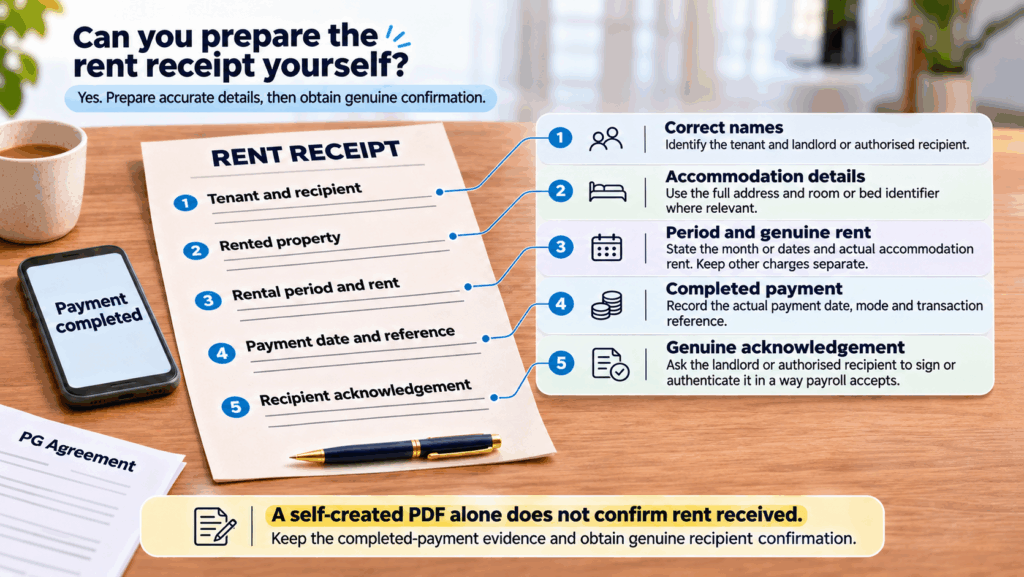
Can you prepare the rent receipt yourself?
Yes, you can prepare an accurate receipt for the landlord or authorised recipient to confirm. Creating the layout is different from acknowledging receipt of money. An unsigned PDF that you produce yourself does not establish that the landlord received the payment.
A generator can make preparation easier. RentOk’s comparison of rent receipt generator apps and tools explains the difference between producing a document and keeping the payment evidence behind it.
Details to include in the draft receipt
| Field | What to record |
|---|---|
| Tenant and recipient | Your full name and the correct landlord or authorised recipient |
| Accommodation | Complete rented-property address and room or bed identifier where relevant |
| Rental period | The month or exact dates the payment covers |
| Rent received | The genuine accommodation amount, with other charges separate |
| Payment record | Actual payment date, mode and transaction reference where available |
| Acknowledgement | Landlord’s signature or authentication that payroll accepts |
Provide PAN where required, whether through the receipt or the employer’s accepted supporting declaration. Check applicable receipt-stamping requirements, particularly for cash, separately from the agreement’s stamping or registration.
For an older payment, preserve the real payment date and state when the landlord issues the acknowledgement. Do not invent a signature, change the amount, or backdate a document to suggest that someone signed it earlier. Preparing accurate paperwork is useful; fabricating evidence creates a different problem.
Landlord refuses PAN: what can you do?
For Form 124, the department requires landlord PAN when annual rent exceeds ₹1,00,000. Exactly ₹1,00,000 does not cross that particular trigger. Use the actual tax-year total rather than an approximate monthly figure.
Explain the requirement and offer a private submission route. Ask payroll whether it needs the PAN number, a signed confirmation or a copy. Avoid circulating identity documents in resident groups.
RentOk’s guide to landlord PAN and current rent-receipt rules explains the documentation and recipient-identity checks.
No PAN and refusal to share are different situations
Older CBDT salary-TDS guidance allowed a declaration when a landlord genuinely had no PAN. That does not justify declaring “no PAN” when the landlord has one but refuses to share it. For a current Form 124 claim, explain the facts and ask payroll or your tax adviser how to proceed; do not assume a declaration guarantees acceptance.
Form 10BA is not an HRA PAN substitute. It belongs to the older Section 80GG rent-deduction framework. The current corresponding declaration is Form 31 under Section 134, as the official Form 31 FAQs explain.
Never insert another person’s PAN or split the same rent artificially to conceal the annual amount. A refusal email records your efforts; it does not supply the missing PAN.
Claiming eligible HRA when payroll does not allow it
An employer’s decision to tax HRA through payroll does not, by itself, decide your final income-tax liability. You may claim an eligible HRA exemption in the appropriate return, subject to the applicable regime, calculation and evidence. Return filing does not erase a documentation gap.
The department’s ITR-2 guidance expressly discusses rent receipts for HRA where an employee has not submitted them to the employer. It does not promise that bank records alone will always replace receipts.
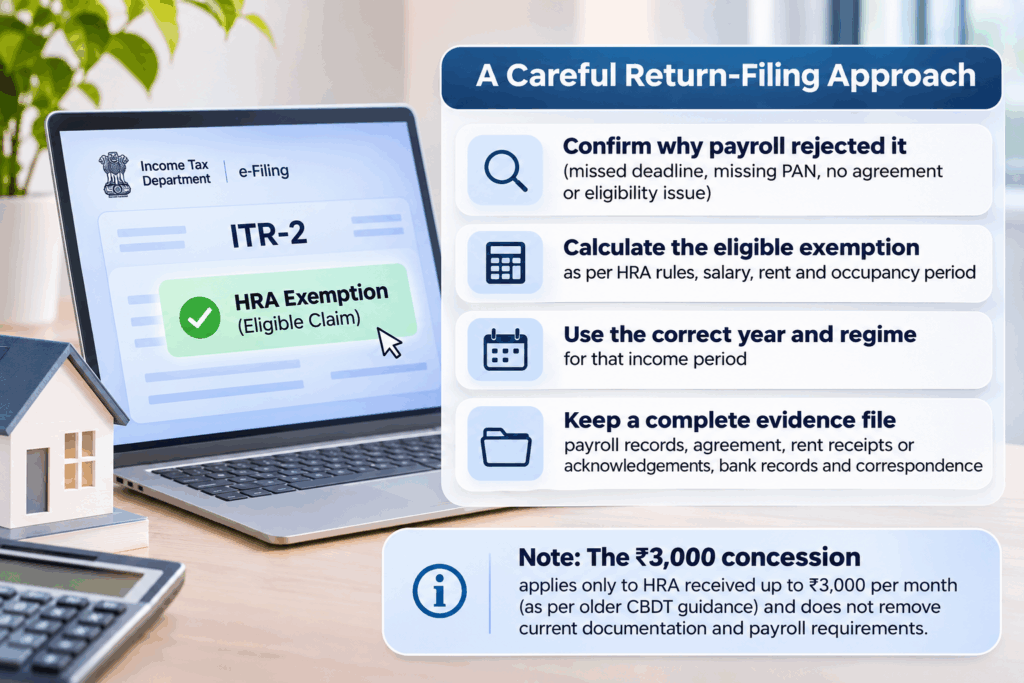
A careful return-filing approach
- Confirm the reason for payroll rejection: Distinguish a missed deadline from missing PAN, an absent agreement or an eligibility issue. Ask whether payroll can still correct the current-year calculation.
- Calculate the eligible exemption: Use the applicable HRA rules, salary details, actual rent and occupancy period. The exemption may be lower than the rent paid or HRA received.
- Use the correct year and regime: Follow the return and regime-election rules for that income period. Do not assume that an employer declaration completes your return-stage election.
- Retain a complete evidence file: Keep payroll records, the agreement, genuine receipts or acknowledgements, bank records and correspondence. If receipts or PAN remain unavailable, obtain advice on the evidence gap before claiming.
A mismatch can lead to questions or disallowance. Fabricated payments or documents can also create interest and penalty exposure, depending on the facts.
The ₹3,000 concession needs context
Older CBDT salary-TDS guidance describes a receipt-production concession for employees drawing HRA up to ₹3,000 per month. It concerns HRA received, not a universal rent threshold.
The guidance preserves the tax officer’s ability to examine actual rent expenditure. Do not treat this older concession as permission to ignore current Form 124, payroll requirements or genuine-payment evidence.
How RentOk helps you keep rent receipts ready
Repeated receipt requests become easier when the payment and its acknowledgement stay connected. For properties using RentOk, tenants can access recorded receipts instead of rebuilding their rent history just before payroll submission.
- Connect supported payments with receipts: RentOk’s payment workflow marks successfully processed bills as paid and makes the corresponding receipt available. Check the payment result rather than treating a pending transfer as complete.
- Find records in one place: The payment page’s Receipts tab shows recorded payments, including supported online payments and cash that the property records. Ask the manager to resolve missing or incorrect entries.
- Reduce repeated monthly follow-ups: With an authorised recurring-payment setup, successful collections can update payment records and generate receipts. RentOk’s guide to AutoPay and e-NACH for rent collection explains the owner and tenant workflow.
- Check details before submission: Match the receipt to your agreement, rental period, accommodation amount and correct recipient. Obtain missing PAN or other required details separately rather than assuming the app supplies them automatically.
The RentOk payment-page guide explains where receipts appear and how to raise a payment query. Receipt automation supports documentation; it does not guarantee HRA eligibility or employer acceptance.
Conclusion
A landlord not giving rent receipts creates an evidence problem that you should address early. Request acknowledgement in writing, offer an accurate receipt for confirmation and keep the agreement, completed payments and landlord details consistent. If payroll cannot allow relief, review the eligible return-stage claim without assuming that filing an ITR cures missing proof.
For a more dependable monthly record, ask your property manager about automatic receipts on RentOk. Keep those receipts with your own supporting documents so your next HRA submission starts with organised evidence.
Frequently Asked Questions
Find answers to common questions about this topic
About the Author
Ishika Pannu
Ishika Pannu brings you the latest insights and easy-to-apply strategies in property management—helping you simplify renting and grow with RentOk.