Tenant Rights
Bad Food in Your PG? Your Rights and How to Complain


Written by
Ishika Pannu
Read Time
12 min read
Posted on
October 31, 2026
Overview
Overview
Bad Food in Your PG? Your Rights and How to Complain
When meals form part of your PG package, food quality is part of the service you pay for. A late breakfast, a repeatedly missing meal and food that appears spoiled create different problems, but each deserves a clear response. You should not have to choose between eating something you distrust and paying again for an alternative without recording what went wrong.
A useful PG food complaint explains the meal, the problem and the remedy you want. It also goes to the right place: the owner can correct service failures, food-safety authorities can investigate unsafe food, and consumer channels can help address an unresolved paid-service dispute. This guide explains those routes, the evidence to keep and the limits of a refund or compensation claim. If someone becomes seriously unwell, seek medical help before working through complaint formalities.
Your PG fee should explain the meal service
Start with the agreement, joining terms, advertised package, menu and payment receipts. Check how many meals the package includes, serving times, vegetarian or other promised options, and whether food carries a separate charge. A single monthly PG payment can still include a paid meal service; it does not make the food a favour from the owner.
Use the written agreement and charge breakdown to establish the promise. The distinction matters when you ask for a replacement meal, a mess-fee adjustment or permission to stop using the meal plan.
| Concern | What to record | Useful starting response |
|---|---|---|
| Taste or variety | Repeated dishes, excessive oil or an agreed dietary preference | Specific menu feedback and a practical change request |
| Service deficiency | Missing meals, short portions or repeated breaches of promised timings | A written correction request and documented fee adjustment proposal |
| Possible food-safety violation | Suspected spoilage, foreign material, pests or unhygienic handling | Stop consuming the affected food and report the concern promptly |
These categories can overlap. An unpleasant taste does not prove contamination, and food can be unsafe without looking unusual. The Food Safety and Standards Act places responsibility for food safety on food-business operators. A low-priced package does not excuse unsafe food.
Raise the issue with the owner in writing
For routine quality or service problems, contact the manager or owner promptly and keep a written record. Describe what happened instead of sending only “the food is bad.” RentOK’s PG menu-planning guide explains why specific feedback about portions, timing and preparation is more useful than a general rating.
- Identify the meal: Record the date, serving time, dish and location. If the problem repeats, list the relevant occasions rather than relying on memory.
- Document the observation: Photograph your meal, foreign material or accessible hygiene concerns without altering the scene. Respect other residents’ privacy and avoid entering restricted kitchen areas.
- Connect it to your payment: Keep the meal plan, receipts, agreement and earlier messages. Save original photos and the owner’s replies together.
- Ask for an action: Request a safe replacement, a hygiene review, a corrected serving schedule or a written fee adjustment. Ask who will follow up and when.
You do not need to finish an internal complaint process before reporting a serious food-safety concern. Suspected contamination or illness should not wait for repeated reminders.
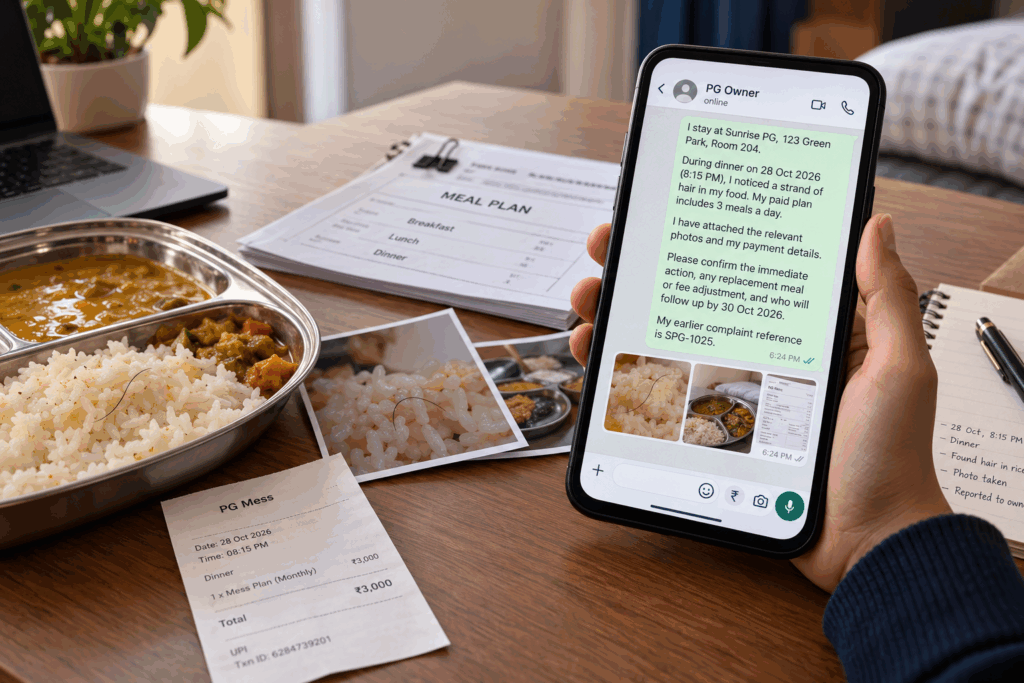
A short complaint message you can adapt
I stay at [PG name, address and room]. During [meal, date and time], I noticed [specific issue]. My paid plan includes [meal service]. I have attached the relevant photos and payment details. Please confirm the immediate action, any replacement meal or fee adjustment, and who will follow up by [appropriate date/time]. My earlier complaint reference is [if applicable].
Keep the description factual. Write “I found a foreign object” or “three residents reported vomiting after dinner,” rather than presenting an unconfirmed cause as a medical finding. A concise record gives the owner something definite to investigate and helps if you later escalate.
Suspected food poisoning needs medical attention first
If you suspect food poisoning in a PG, stop eating the suspected food and seek medical advice. Urgent warning signs include an inability to keep fluids down, bloody diarrhoea or signs of significant dehydration. The NHS food-poisoning guidance identifies these as reasons to obtain urgent medical help. In India, call 112 for a medical emergency.
Tell the clinician what you ate, approximately when, when symptoms began and whether others became unwell. Illness after a meal does not, by itself, establish its cause. Keep consultation records, prescriptions, test reports and bills; they can help a later investigation or compensation claim.
Notify the manager and the appropriate food-safety or local health authority promptly, particularly if several residents report illness. Ask each affected person to preserve their own account and medical records rather than circulating private health information without consent.
Do not taste the food again to test it or conduct your own inspection. Photograph what you can safely observe, retain relevant packaging or purchase details, and ask the authority how to handle any remaining food or samples. Let authorised officers and medical professionals establish the facts.
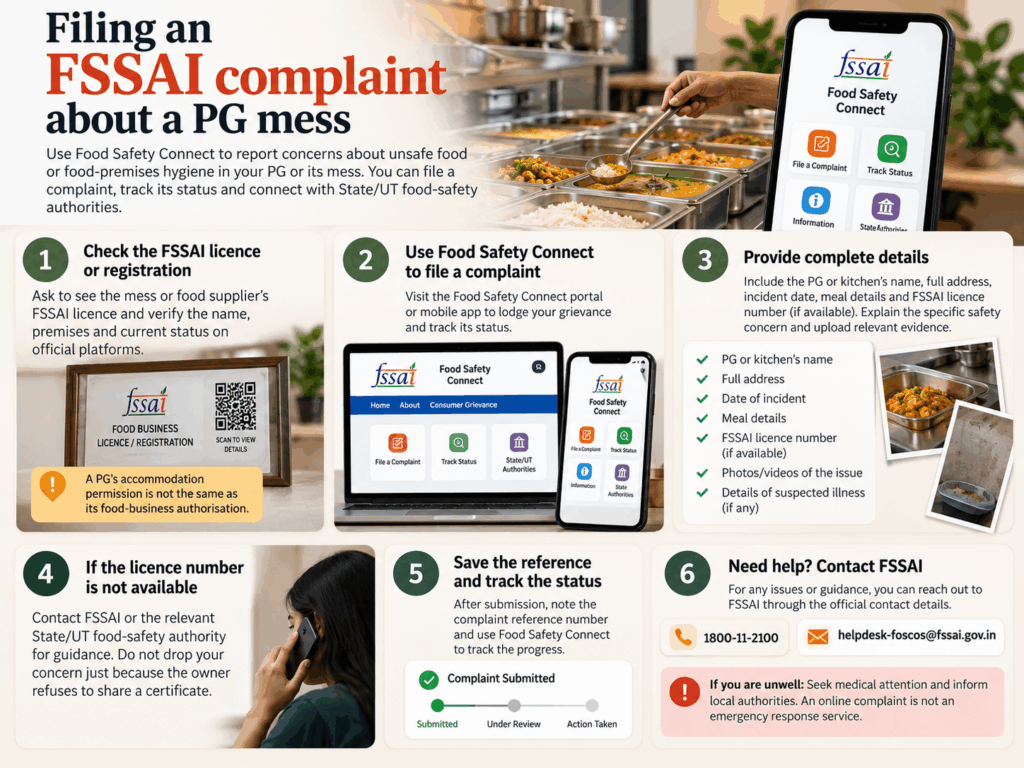
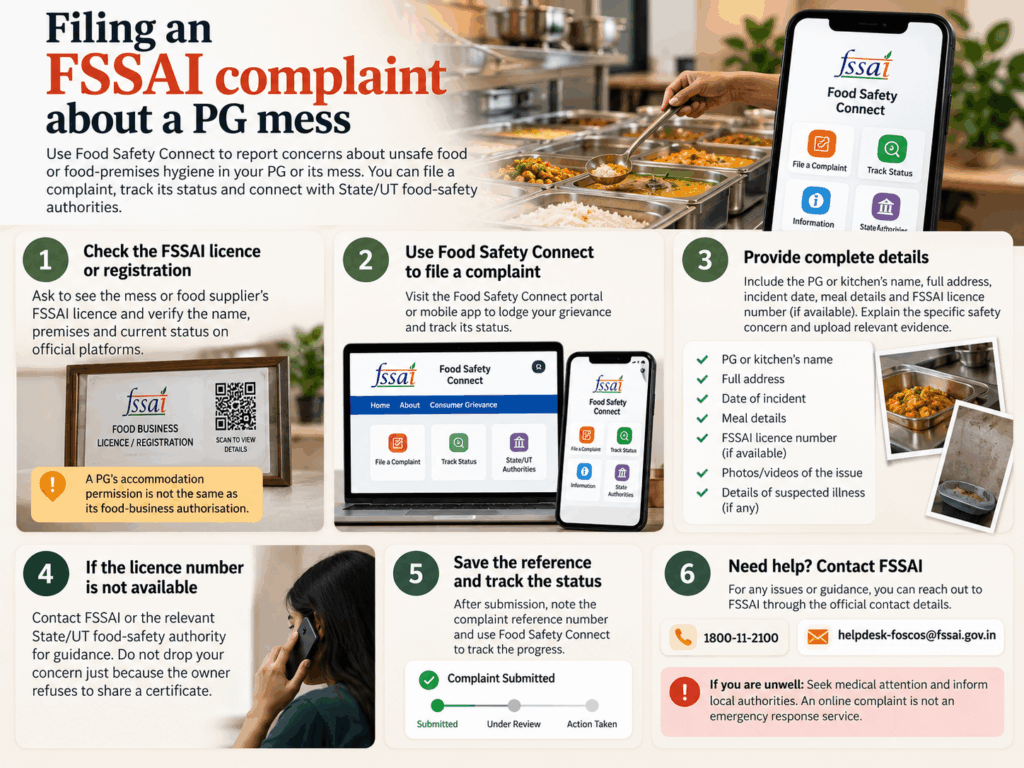
Filing an FSSAI complaint about a PG mess
Use Food Safety Connect for concerns about unsafe food or food-premises hygiene. FSSAI provides a consumer portal and mobile app for lodging and tracking grievances, and it also directs consumers to State and UT food-safety authorities. You do not need to reserve this route only for a large outbreak.
Check the food operator and prepare the complaint
Ask to see the mess or food supplier’s FSSAI licence or registration, and check the name, premises and current status through official facilities. A PG’s accommodation permission is not the same as its food-business authorisation. If catering comes from elsewhere, identify both the supplying kitchen and the PG where the meal was served.
FSSAI’s licence-display guidance calls for customer-visible display of the relevant certificate and Food Safety Connect QR code. A certificate alone does not prove that every meal is safe; the actual handling still matters. RentOK’s mess food-quality guide explains the daily routines behind consistent hygiene.
Submit the facts and retain the reference
Use the official consumer grievance flow and provide the PG or kitchen’s name, full address, incident date, meal details and licence number if available. Explain the specific safety concern, upload relevant evidence and mention suspected illness accurately. FSSAI’s consumer-grievance FAQ explains registration, supporting documents and complaint tracking.
If you cannot identify the licence number or the portal does not fit your situation, contact FSSAI or the state authority for help. Do not abandon a concern merely because the owner refuses to share a certificate.
FSSAI lists 1800-11-2100 and helpdesk-foscos@fssai.gov.in on its food-grievance contact page. Save the complaint reference and follow the status. Urgent illness needs medical and local-authority attention; an online submission is not an emergency response service.
Where do unresolved service and money disputes go?
The National Consumer Helpline, or NCH, provides pre-litigation grievance support. It can help you raise an unresolved paid-service complaint, such as repeated meal failures or a disputed mess-fee adjustment. Its role differs from a food-safety inspection or a Consumer Commission order.
The official NCH contact page lists these options:
| Channel | Contact or route |
|---|---|
| Telephone | 1915 or 1800-11-4000 |
| Online | National Consumer Helpline portal |
| 8800001915 | |
| Apps | NCH app or UMANG |
| nch-ca@gov.in |
Describe the paid meal service, earlier complaints, the operator’s response and the remedy you seek. Attach relevant receipts, terms and evidence. The Department of Consumer Affairs explains that NCH registers grievances with docket numbers for follow-up. Keep yours and add it to later correspondence.
Consumer Commission and legal-aid options
If the dispute remains unresolved, consider a complaint before the appropriate Consumer Commission, including through e-Jagriti. The Department identifies it as the unified consumer-dispute platform. Check the applicable jurisdiction, documents and maintainability of your claim.
A paid meal-service dispute may raise consumer issues, but every PG disagreement does not automatically belong in the same forum. Pure tenancy issues may require a different route. For legal guidance, contact NALSA on 15100 or your local Legal Services Authority; eligibility rules apply to free legal representation. An NCH docket is not a court order or a guaranteed settlement.
Can you ask for a mess-fee refund or compensation?
Yes, you can request a proportionate refund, replacement service or agreed reduction when the paid meal service falls short. Whether you can enforce that demand depends on the terms, established deficiency, evidence and applicable law. Paying a bundled PG fee does not automatically entitle you to a refund of the entire accommodation charge.
The Consumer Protection Act, 2019 allows a Consumer Commission to order remedies, including refund of charges and compensation, where the relevant grounds are proved. That is different from assuming that submitting a complaint automatically creates an award.
An illustrative proportionate refund request
Suppose your documented mess charge is ₹3,000 for a 30-day service period. Assume five full chargeable days had no usable agreed meal service and no acceptable replacement. One way to explain your request is ₹3,000 ÷ 30 × 5 = ₹500.
That is an illustrative negotiating basis, not a statutory refund rate. If only particular meals failed, adjust the calculation to the agreed package rather than automatically treating each incident as a full lost day. If food forms part of one combined fee, ask the operator for the meal component and the basis for any proposed credit.
For suspected illness, you may also seek documented medical expenses and other proven losses, but causation, responsibility and the amount require evidence. Keep bills and medical records rather than demanding an unsupported fixed sum. Avoid deducting the disputed amount from rent unilaterally without checking the agreement and obtaining advice where needed.
When moving out becomes the sensible option
Consider leaving when credible safety concerns continue, serious complaints receive no meaningful response, or the meal service repeatedly fails despite documented attempts to resolve it. Staying solely to avoid a deposit dispute may expose you to a problem that the operator is not addressing. If there is immediate danger, prioritise a safe place and urgent assistance.
For a planned exit, check the notice period, lock-in, mess opt-out and deposit terms. Send written notice stating the reasons, relevant complaint references and proposed move-out date. Ask for a written settlement covering accommodation dues, unused meal charges and the deposit; do not assume that a food complaint automatically cancels every contractual term.
Keep photographs of the room, an inventory check and key-handover acknowledgement. RentOK’s move-out guide explains the value of completing these steps together, while its deposit-record guide helps distinguish deposits from other payments and adjustments.
Preserve your complaint records after leaving. Moving out does not itself resolve a food-safety report or settle a disputed money claim. If the operator threatens you or obstructs a safe exit, seek appropriate legal or emergency help rather than relying on an app ticket alone.
How RentOK helps you raise and track a food complaint
If your PG uses RentOK’s tenant complaint features, record the issue there so the manager can follow a specific request rather than a lost conversation. Include the meal, date, time, observed problem and action you want. Keep original evidence and external complaint references separately, and provide supporting material through the available channel.
- Create a retrievable complaint record: A digital issue gives the tenant and property team a common reference. Use factual details so the team can distinguish a menu preference from an urgent hygiene concern.
- Make responsibility visible: RentOK’s complaint workflow supports assignment and status tracking, helping managers identify who should act and which requests remain unresolved.
- Check for a real resolution: Review the response and tell the manager if the underlying problem continues. A closed ticket should not replace confirmation that the promised action actually happened.
- Help owners identify recurring problems: RentOK’s Issue Analytics covers complaint categories, ageing, response times, reopened issues and feedback. Repeated food concerns can therefore inform the manager’s review rather than disappear into separate messages.
RentOK helps organise reporting and follow-up. It does not inspect food, diagnose illness, submit every regulatory complaint for you or guarantee a refund. Seek medical attention or use the relevant authority directly when the situation requires it.
Conclusion
A strong PG food complaint connects what you paid for with what happened and what you want corrected. Start with clear records and a written request for routine service concerns, report suspected safety violations through the appropriate food-safety route, and use consumer channels when a paid-service or money dispute remains unresolved. Treat suspected food poisoning as a health issue first.
You do not have to accept repeated problems as part of PG life, but accurate evidence is more useful than an unsupported accusation. Raise complaints on RentOK where your property supports it, track the response and preserve the records you may need for further action.
Frequently Asked Questions
Find answers to common questions about this topic
About the Author
Ishika Pannu
Ishika Pannu brings you the latest insights and easy-to-apply strategies in property management—helping you simplify renting and grow with RentOk.