Legal
Do PGs Pay Commercial Electricity Rates? State-wise Rules

Written by
Ishika Pannu
Read Time
10 min read
Posted on
October 29, 2026
Overview
Overview
Do PGs Pay Commercial Electricity Rates? State-wise Rules
An electricity bill can carry a domestic tariff code even after a family house becomes a full-scale PG. That does not necessarily make the category correct. Equally, a PG owner cannot justify a high tenant charge simply by saying, “We pay commercial rates.” The DISCOM’s classification and the operator’s calculation both need evidence.
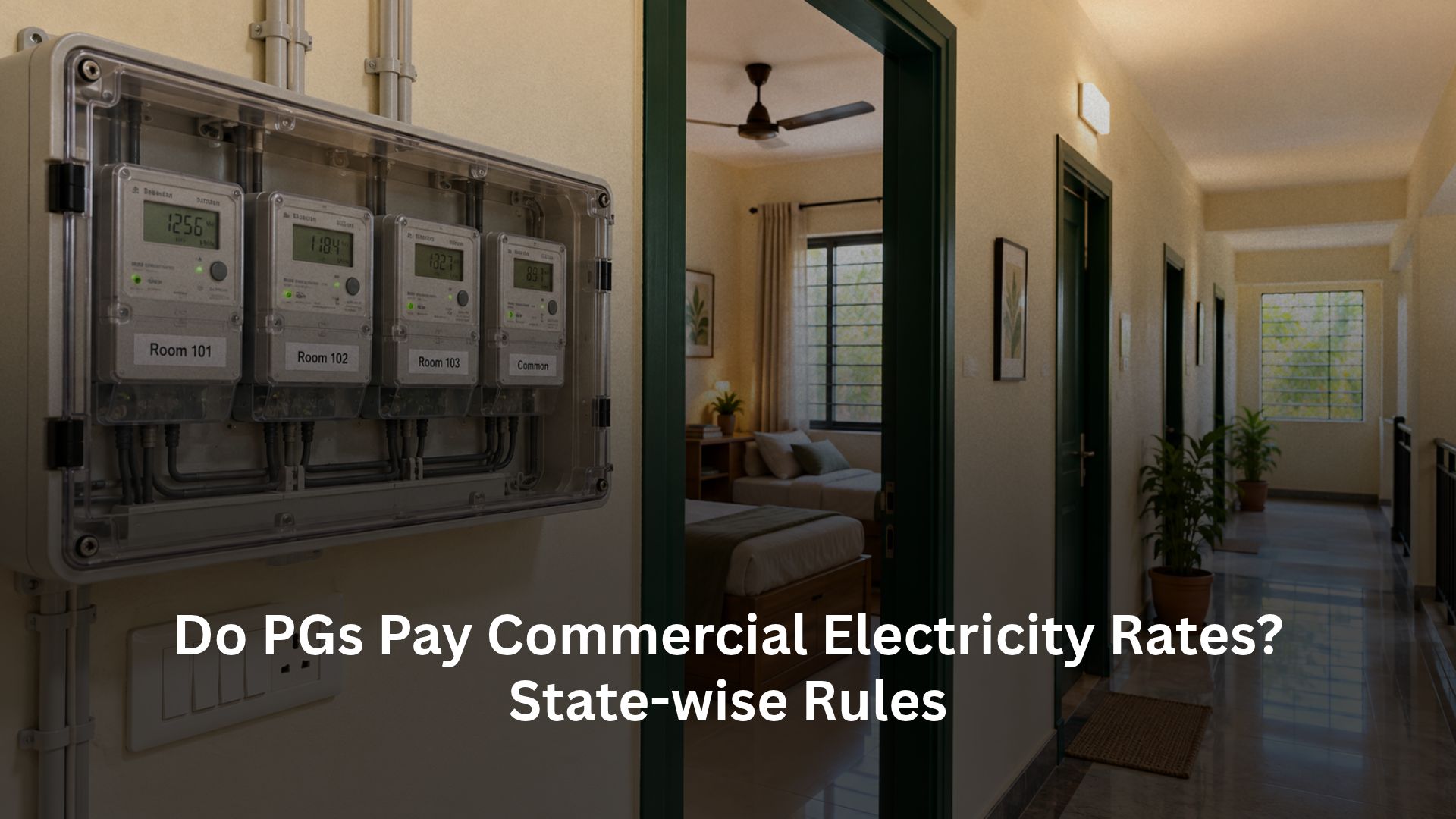
Commercial electricity for PG accommodation depends on the applicable tariff schedule, actual use and conditions such as sanctioned load or the operating model. Business registration alone does not decide the answer. For owners, the priority is to establish the right category before a dispute or inspection. For tenants, it is to understand the master bill, recorded consumption and the method behind their share.
Why would a DISCOM reclassify a PG?
A DISCOM supplies electricity for an authorised purpose under a tariff category. When the actual use changes, the connection may no longer meet that category’s conditions. A hostel-style operation in exclusive premises can raise different questions from paying guests occupying part of someone’s home.
An existing domestic meter is not permanent permission to use domestic tariffs. Nor does high consumption alone establish commercial use: larger households can consume more electricity, while some tariff schedules set specific load or use conditions. Inspectors may examine occupancy, equipment, connected load and the activity at the premises.
Keep these distinctions clear:
- Tariff eligibility: The regulator’s schedule determines which category fits the activity and connection.
- Operating permission: Municipal, building-use and PG approvals answer separate questions. An electricity connection does not legalise the accommodation business.
- Tenant billing: A correctly classified master connection still needs a transparent, lawful method for allocating electricity costs.
RentOK’s city-wise PG registration guide explains why these approvals need separate checks. Subsidies also carry their own eligibility conditions; do not assume every domestic-category PG qualifies for household benefits.
Delhi and Karnataka: two specific PG distinctions
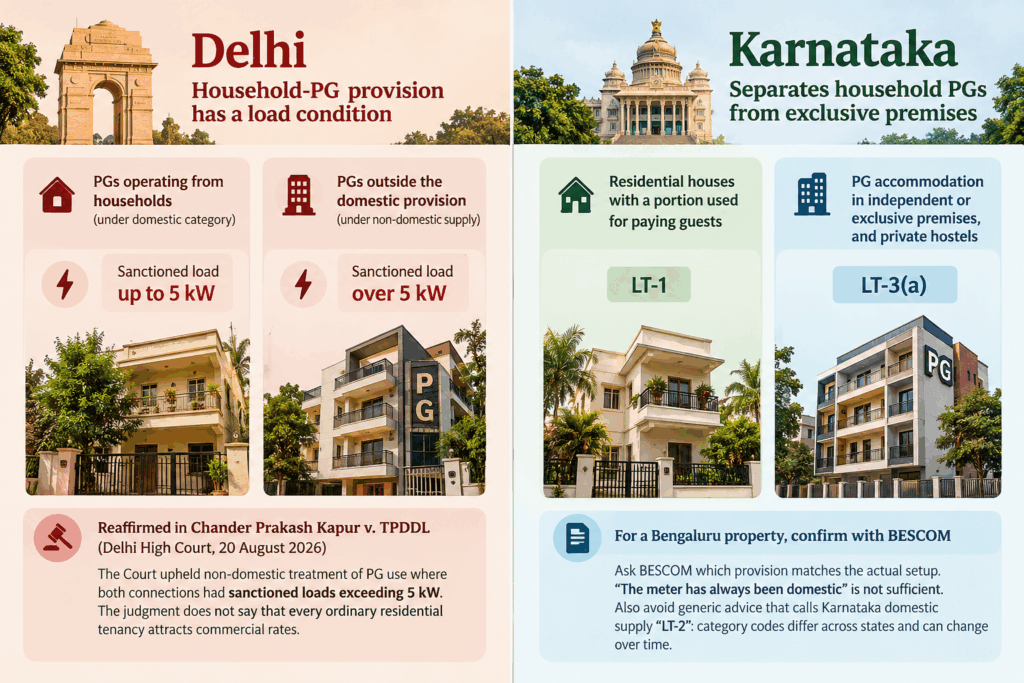
Delhi’s household-PG provision has a load condition
The DERC schedule includes small commercial establishments, including PGs operating from households under the domestic category, with sanctioned load up to 5 kW. It lists PGs outside the domestic provision under non-domestic supply. The threshold concerns sanctioned load, not monthly units. See the DERC tariff schedule.
This distinction remains relevant in recent litigation. In Chander Prakash Kapur v. TPDDL, decided on 20 August 2026, the Delhi High Court upheld non-domestic treatment of PG use where both connections had sanctioned loads exceeding 5 kW. The judgment does not say that every ordinary residential tenancy attracts commercial rates.
Karnataka separates household PGs from exclusive premises
KERC’s tariff framework includes residential houses where the occupant uses a portion for paying guests under LT-1. It places PG accommodation in independent or exclusive premises, and private hostels outside LT-1, under LT-3(a). The KERC tariff schedule shows this distinction.
For a Bengaluru property, ask BESCOM to confirm which provision matches the actual setup. “The meter has always been domestic” is insufficient. Also avoid generic advice that calls Karnataka domestic supply “LT-2”: category codes differ across states and can change over time.
Maharashtra, Telangana and UP follow different schedules
Maharashtra: identify the supplier and accommodation category
Do not treat MSEDCL and BEST as interchangeable. Maharashtra has multiple distribution licensees with separate approved schedules. Residential use, non-residential establishments and specified hostel or public-service categories can involve different applicability provisions.
For an MSEDCL property, read the current tariff documents, including the 25 March 2026 order alongside the underlying schedule. The 2025 MYT schedule places students’ and working men’s/women’s hostels within LT-VII Public Services. Ask whether your actual operation meets that description, residential eligibility or LT-II non-residential provisions. A commercial registration certificate alone does not settle the enquiry.
Avoid a statewide “₹8–₹11 per unit” estimate. Energy charges, wheeling charges, fixed or demand charges, adjustments and electricity duty can materially change the bill. Domestic upper slabs can also be expensive, so a high effective rate does not itself prove commercial classification.
Telangana explicitly lists hostels under non-domestic supply
The FY 2026–27 TGERC order, applicable from 1 April 2026, places domestic dwelling use under LT-I. Its LT-II non-domestic/commercial/others provision expressly includes hostels among the examples. See Chapter 4 of the official tariff order.
A dedicated Hyderabad hostel-style PG should therefore check LT-II applicability with its supplier. Do not assume a residential address guarantees LT-I, or extend a recognised institution’s treatment to an unrelated private operation.
Uttar Pradesh distinguishes domestic PG use from guest houses
UPERC’s FY 2026–27 state-DISCOM schedule includes paying-guest accommodation for domestic purposes under LMV-1, while excluding guest houses from that description. LMV-2 separately lists private guest houses, transit hostels and private student hostels. Read the applicability clauses in the 2 July 2026 order.
For Noida, confirm whether UPPCL’s relevant DISCOM or another licensee supplies the address. Explain the actual arrangement before requesting classification; calling every property a PG hides distinctions that the schedule expressly makes.
Back-billing and assessments can cost more than a tariff change
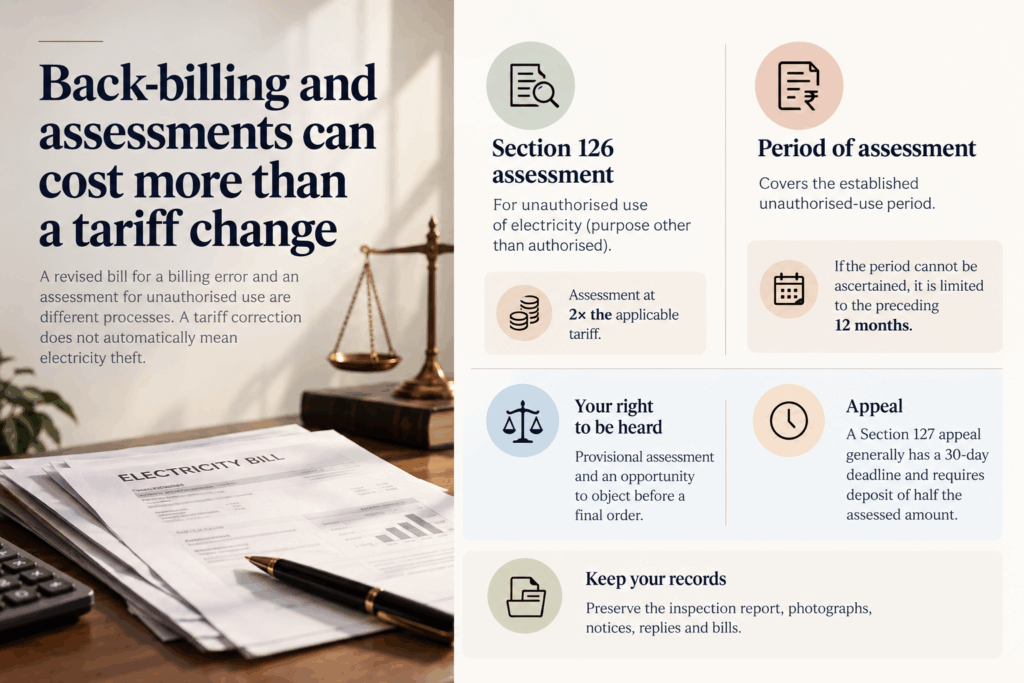
A revised bill for an ordinary billing error and an assessment for unauthorised use are different processes. Ask which provision supports the demand, the period involved and the calculation. A tariff correction does not automatically mean electricity theft.
Under Section 126 of the Electricity Act, 2003, unauthorised use includes using electricity for a purpose other than the authorised purpose. The provision requires provisional assessment and an opportunity to object before a final order. It provides assessment at twice the applicable tariff for the relevant category. The assessment covers the established unauthorised-use period; when the officer cannot ascertain that period, the statute limits it to the preceding twelve months. See the amended Act.
Do not describe twelve months as a universal cap on every electricity recovery. Different demands can involve different rules. A Section 127 appeal against a final Section 126 assessment generally has a 30-day deadline and requires deposit of half the assessed amount.
Preserve the inspection report, photographs, notices, replies and bills. Routine billing grievances may follow the DISCOM, consumer grievance forum and Ombudsman route; a statutory assessment needs its specific remedy. Obtain advice promptly rather than assuming a complaint pauses recovery.
How do you get the correct tariff category?
Start with the latest bill and connection record. Note the supplier, tariff code, sanctioned load, billing period and recorded units. Then compare the actual operation with the schedule’s applicability clause, including exclusions and special categories.
Submit an accurate written description to the DISCOM: owner occupation, resident count, exclusive PG use, services and installed equipment. Ask for written classification and the procedure for changing the category or enhancing load. Keep the application acknowledgement, effective date, revised security-deposit demand and any inspection outcome.
A change may require revised terms or metering arrangements; it does not always mean replacing the physical meter. Use qualified electrical personnel for installation work, and never alter seals or authorised connections yourself.
Keep the tariff decision alongside property approvals. RentOK’s guide to housing-society restrictions on PGs explains another independent layer of permission. Once the position is clear, update tenant-facing electricity terms prospectively and explain how any change affects their bill.
Passing electricity costs to tenants fairly
Does a high per-unit charge prove overbilling?
A quoted ₹15 per unit deserves an explanation, but the number alone does not establish illegality. Check the actual tariff, current-period charges, shared consumption and applicable supply conditions. Do not assume every state permits a markup, or that a signed agreement overrides electricity law.
Show tenants the relevant master bill and their calculation. State-level resale and cost-recovery conditions differ; an unexplained profit surcharge cannot gain legitimacy through the phrase “commercial rate.” RentOK’s guide to rent inclusions and extra charges helps owners disclose costs before move-in.
A transparent sub-meter calculation
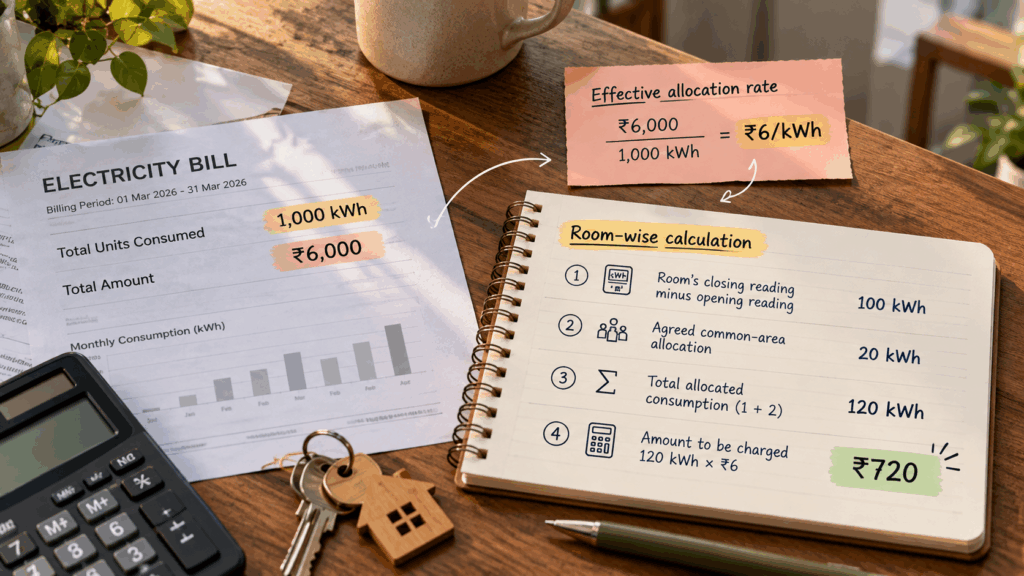
For an illustrative cost-allocation method, assume eligible current-period electricity costs total ₹6,000 for 1,000 kWh. The effective allocation rate is ₹6/kWh, subject to the lawful method for the property.
| Calculation | Illustrative result |
|---|---|
| Room’s closing reading minus opening reading | 100 kWh |
| Agreed common-area allocation | 20 kWh |
| Total allocated consumption | 120 kWh |
| 120 kWh × ₹6 | ₹720 |
Use matching reading dates and explain the common-area split. Reconcile all allocated units and costs against the master bill, without recovering common electricity twice. Exclude deposits, old arrears and owner penalties from routine usage allocation; account for applicable credits separately.
The calculation illustrates transparency, not a statutory nationwide formula. RentOK’s PG electricity-billing guide covers reading records, while its PG agreement format guide explains documenting billing terms. Tenants should dispute unsupported charges in writing and retain readings, invoices and payment proof.
How RentOK helps with unit-wise electricity billing
Once you establish the correct tariff and lawful allocation method, RentOK’s unit-based billing lets you create an electricity package, enter consumed units and automatically calculate the charge for the tenant’s bill. Your team still needs accurate readings and a justified rate.
Set up the Electricity Meter dues package
- Open the package: Tap Money → Dues Package, select Electricity Meter and choose Edit Dues. Enter the package name and select the Electricity category so staff can identify the charge clearly.
- Choose Unit-wise billing: Select Unit-wise and configure the applicable price per kWh. Fixed billing uses a constant amount; variable billing follows its configured usage-dependent settings. Choose the mode that matches your disclosed electricity arrangement.
- Review the schedule: Configure frequency and review Auto-Add by Rent Manager for scheduled dues. Check any minimum bill amount carefully: a configured floor can exceed calculated usage, so it must fit applicable rules and disclosed terms.
- Add supporting details: Use Other Details for a description and available attachments, such as the billing policy or relevant supporting document. Select Save Changes to apply the new settings going forward.
Enter consumption and check the resulting bill
At invoicing, enter the verified units consumed. RentOK multiplies the entered quantity by the configured unit price and adds the total to the bill. For example, 100 room units at an illustrative ₹6/kWh produce ₹600; handle any lawful common-area allocation transparently alongside that charge.
Scheduled dues do not replace meter readings, and this workflow does not imply automatic hardware reading or DISCOM tariff selection. Review the inputs and tenant allocation before issuing the bill. Accurate settings reduce repetitive calculations and give staff a consistent billing process.
Conclusion
PGs do not all pay commercial electricity rates. Delhi’s load condition, Karnataka’s operating-model distinction and UP’s domestic-PG provision show why the actual schedule matters. Telangana’s hostel classification and Maharashtra’s supplier-specific categories also make a blanket answer unreliable. Confirm the category for your premises before a domestic connection becomes an expensive assessment dispute.
Then make tenant billing traceable: preserve readings, justify the rate, explain shared consumption and reconcile collections with the relevant bill. Bill electricity by sub-meter on RentOK using unit-wise dues, so the quantity you verify becomes a clearly calculated charge rather than an unexplained monthly extra.
Frequently Asked Questions
Find answers to common questions about this topic
About the Author
Ishika Pannu
Ishika Pannu brings you the latest insights and easy-to-apply strategies in property management—helping you simplify renting and grow with RentOk.