
Legal
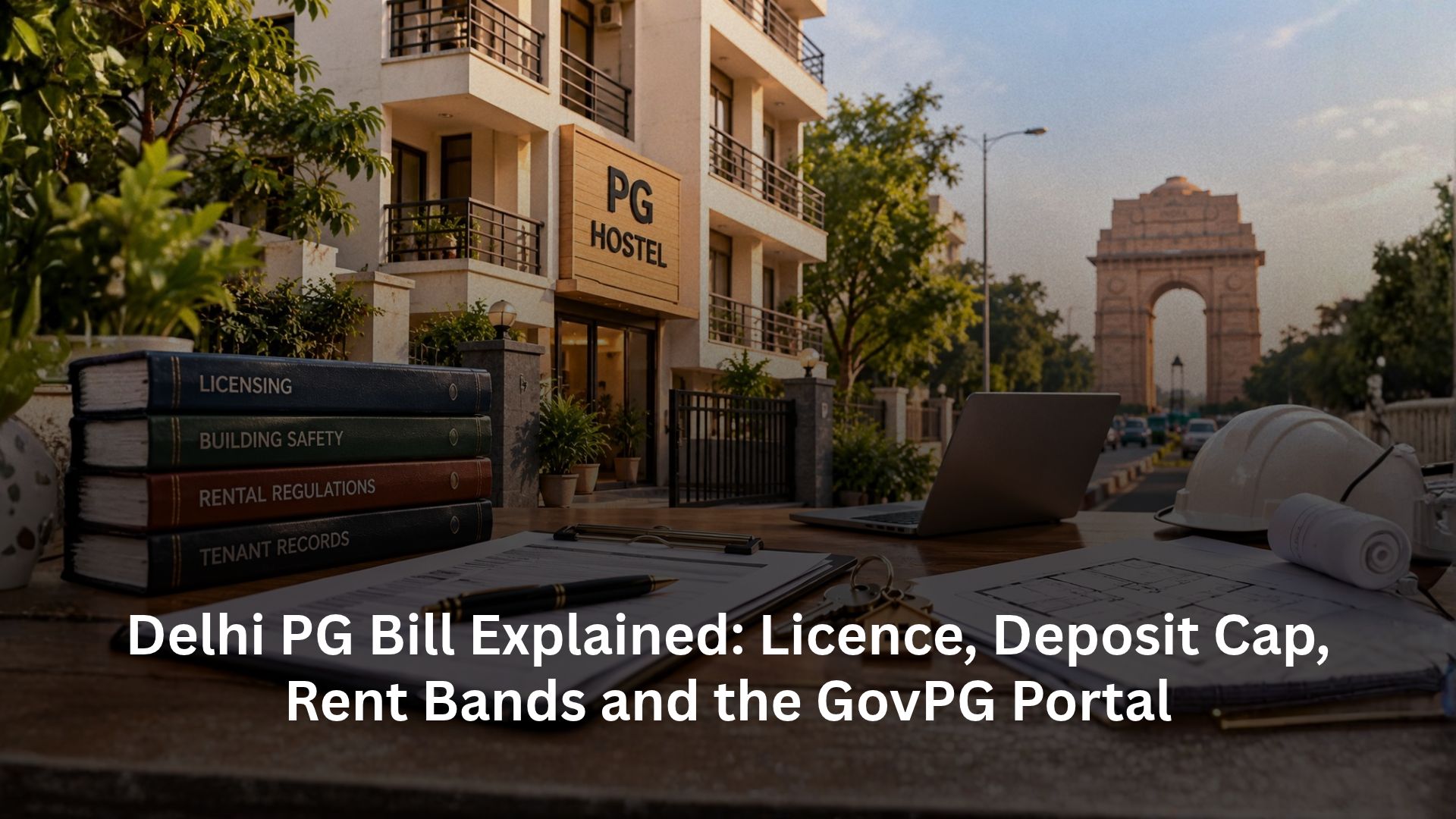
Delhi PG Bill Explained: Licence, Deposit Cap, Rent Bands and the GovPG Portal

Written by
Ishika Pannu
Read Time
12 min read
Posted on
October 20, 2026
Overview
Overview
Delhi PG Bill Explained: Licence, Deposit Cap, Rent Bands and the GovPG Portal
Delhi’s paying guest (PG) accommodation sector is facing significant regulatory changes. Following the Satya Niketan PG building collapse, which claimed seven lives in September 2026, the government began working on a proposed framework to regulate PG accommodation. The proposed Delhi PG Accommodation and Safety Bill aims to address concerns around building safety, property registration, rental practices and accountability.
For PG owners, hostel operators and property managers, the proposals go beyond obtaining a licence. They include a 90-day licensing window, a three-month security deposit cap, 30-day refund timelines, area-wise rent bands and a proposed GovPG portal. The final provisions and implementation process remain subject to official decisions. However, operators can begin reviewing their property documents, tenant records and financial processes before new requirements take effect.
What Triggered the Delhi PG Bill After the Satya Niketan Incident?
The Satya Niketan incident raised serious questions about the safety of buildings being used for student accommodation. Delhi’s student hubs, including Satya Niketan, Mukherjee Nagar and Laxmi Nagar, depend heavily on private PGs and hostels because university accommodation cannot meet every student’s needs.
As demand increases, residential properties may be modified to accommodate more tenants. Problems arise when construction, occupancy and maintenance change without adequate attention to building safety and applicable permissions.
The proposed framework seeks to address these concerns through formal registration, safety clearances and clearer responsibilities for PG operators. It also raises questions about how authorities will verify properties and how residents can report safety concerns.
For owners, the lesson is that filling beds and collecting rent are only parts of running a PG. Building compliance, tenant documentation and safety management also require consistent attention.
For a detailed account of the incident, its investigation and the wider implications for student accommodation, read The Satya Niketan PG Collapse: What It Means for Safety in Delhi PGs.
The 90-Day Licence: What Will PG Owners Need to Arrange?
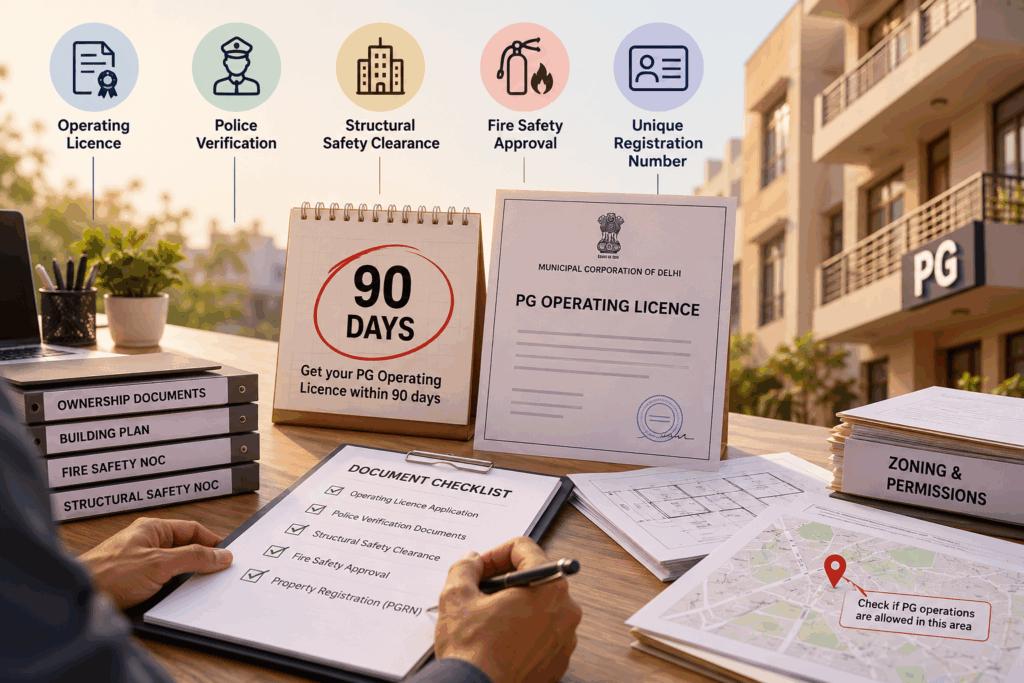
Under the reported draft, PG establishments would need to obtain an operating licence from the relevant municipal zonal authority within 90 days of the law taking effect. The proposed process includes police verification and clearances relating to structural stability and fire safety. Registered properties would also receive a unique registration number.
The reported licensing requirements cover several areas:
- Operating licence: Owners would need to apply to the relevant municipal authority and follow the prescribed registration process.
- Police verification: Operators would need to complete the applicable verification procedure and maintain the required documentation.
- Structural safety: Relevant building documents and clearances would be required to establish compliance with applicable safety standards.
- Fire safety: Operators would need the prescribed fire-safety approvals and supporting records.
- Property registration: Each compliant property would receive a unique identifier under the proposed framework.
The final application process, fees, document checklist and inspection requirements must be confirmed through official notifications. Obtaining one certificate should not be assumed to satisfy every licensing requirement.
Does Your Property’s Location Affect Eligibility?
Zoning and permitted land use deserve attention alongside licensing. A property being used as a residence does not automatically mean every type of commercial PG operation is permitted there.
Before buying another property, adding floors or undertaking major renovations, owners should review the building’s existing permissions and verify the activities allowed at that location. A new licence should not be assumed to regularise unauthorised construction.
Start by organising ownership documents, sanctioned building plans, existing permissions and available structural or fire-safety certificates. Identify gaps and consult the relevant authorities about your property’s requirements.
For a broader checklist, read How to Start a PG Business Legally in India.
What Will You Have to Declare on the GovPG Portal?
The proposed GovPG portal is intended to create a centralised record of registered PG accommodation. Reported features include property registration details, occupancy information, rental structures and a system for residents to submit grievances and track their status.
For operators, the main challenge will be keeping submitted information consistent with actual property records. Consider a PG with 100 beds. If its internal register shows 85 occupied beds but the submitted information shows 95, the discrepancy may require reconciliation before the operator can respond to an official query.
A reliable reporting process should cover:
- Property and capacity: Maintain accurate addresses, room inventories, bed counts and relevant registration documents.
- Occupancy and rent: Record occupied and vacant beds, room categories and applicable rental charges.
- Safety documentation: Keep inspection reports, maintenance records and certificates organised by property.
- Complaints and resolutions: Document the issue, action taken, responsible staff member and resolution date.
The final portal fields, update frequency and reporting deadlines remain subject to official instructions. Until these are confirmed, operators should focus on maintaining accurate records rather than assuming that a specific reporting process is already compulsory.
Tenant information also needs careful handling. Collecting identity documents does not give a landlord unlimited permission to retain or share them. Read What Your Landlord Can and Cannot Store From Your KYC Documents for guidance on document retention, access and privacy.
The Three-Month Deposit Cap and 30-Day Refund Rule
Security deposits are a common source of disagreement between PG operators and residents. Disputes often arise when deductions are unexplained, payment records are incomplete or refund timelines are unclear.
Under the reported draft, security deposits would be capped at three months’ rent, advance rent would also be limited to three months, and deposits would have to be refunded within 30 days of the tenant vacating, subject to applicable conditions. The proposal also addresses formal receipts and arbitrary additional charges.
Consider a PG charging ₹15,000 per month. Under the proposed three-month formula, the maximum security deposit would be ₹45,000. If the tenant later disputes a deduction for room damage or unpaid electricity charges, the operator needs records of the original payment, the agreement terms and the reason for the deduction.
A structured deposit process should cover the entire tenancy:
- At move-in: Record the deposit amount, payment date and any outstanding balance. Issue a receipt and retain a copy for future reference.
- During the stay: Document authorised adjustments separately from rent, with the reason and supporting details.
- At move-out: Reconcile outstanding rent, documented damage and other applicable charges against the deposit.
- At settlement: Calculate the refundable amount, explain deductions and retain confirmation of the refund.
Clear agreements and itemised receipts also help prevent disagreements over electricity, meals and other additional charges.
For a practical breakdown of deposit tracking, tenant ledgers and refund calculations, read How to Track Security Deposits in PG.
Will the Government Decide Your Rent? Rent Bands Explained
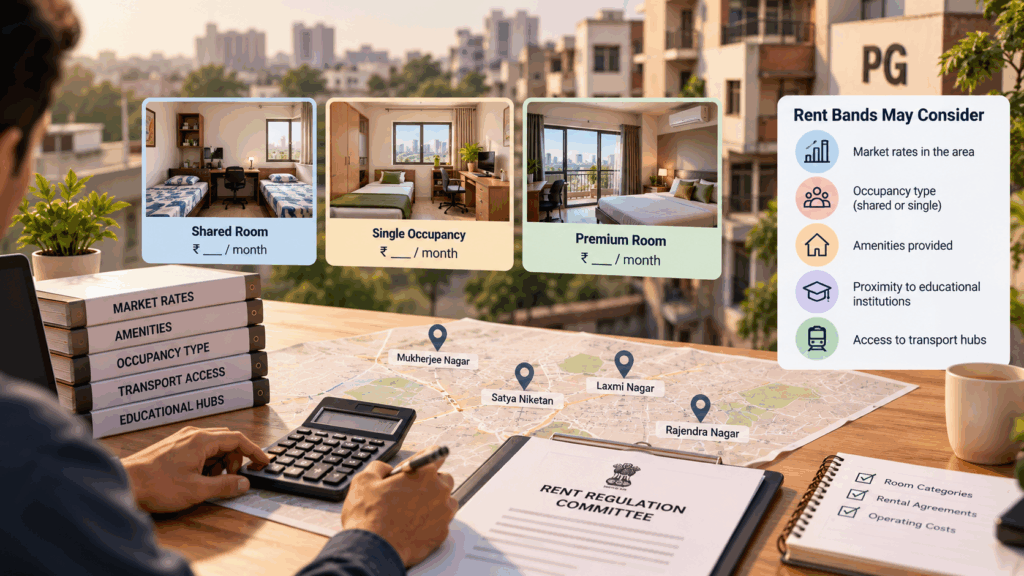
One of the more consequential proposals is the introduction of area-wise rent bands. The reported draft envisages a Rent Regulation Committee that would determine localised bands using factors such as market rates, occupancy type, amenities and proximity to educational institutions or transport hubs.
Charging above a prescribed band would require special permission under the proposal. However, this does not necessarily mean every PG in an area would charge the same amount.
A shared room with basic facilities and a furnished single-occupancy room have different operating costs. The reported criteria suggest that these differences may influence how rent bands are determined.
Before any bands are notified, owners should review three areas:
- Room categories: Maintain clear distinctions between shared and private rooms, occupancy arrangements and included amenities.
- Rental agreements: Clearly document rent, deposits, payment schedules and additional charges. Keep a record of rent revisions rather than relying on verbal communication.
- Operating costs: Review maintenance, staffing, utilities and meal expenses to understand the economics of each property.
The final rent bands, applicable zones and exception process remain subject to official decisions. Owners should not assume that a particular rent ceiling has already been established.
Rental agreements deserve particular attention because they establish expectations for both parties. Explore How to Create a Legally Valid Rent Agreement in India for guidance on documenting rent, deposits, notice periods and other important terms.
CCTV, Night Guards and Fire Safety: What Measures Are Proposed?
The reported draft outlines several security measures, including CCTV cameras at entrances and common areas, footage retention for at least 30 days, licensed night guards for PGs housing 15 or more students, and a designated warden who can respond to emergencies within the prescribed timeframe.
The proposed warden requirement describes a person who resides or maintains an office within 500 metres of the property, remains reachable and can arrive within 15 minutes of an emergency call.
These measures need to be considered alongside structural and fire safety. Cameras cannot compensate for unsafe construction, and a security guard cannot replace functioning fire equipment or a workable evacuation plan.
PG owners can start by reviewing the following:
- Surveillance: Check whether cameras cover relevant areas, function properly and allow footage to be retrieved when needed.
- Emergency readiness: Verify emergency contacts, evacuation routes and staff familiarity with fire and electrical emergencies.
- Staff responsibilities: Establish who handles night-time security, resident assistance and escalation when a manager is unavailable.
- Maintenance records: Document equipment checks, repairs and safety concerns, including the action taken to resolve them.
The final rules will determine which measures are mandatory and how compliance will be inspected. A documented safety process remains useful even before those requirements are finalised.
How to Get Your PG Ready Before the Bill Becomes Law
Preparing for regulation does not require guessing the final wording of the Bill. It requires identifying where operations depend on incomplete records, informal communication or a single staff member’s memory.
Start by auditing each property separately. Permissions and safety arrangements available at one location should not be assumed to cover another. Record what is available, identify gaps and assign someone to follow up on outstanding items.
Next, review tenant and payment information. KYC documents, rental agreements, deposits, outstanding dues and move-in or move-out dates should be traceable to the correct resident and property.
A few practical steps can establish a more reliable system:
- Create a property-wise document register: List permissions, safety certificates, agreements and inspection records for each building, along with missing documents.
- Reconcile tenant and deposit records: Check whether recorded deposits, rent payments, pending dues and refunds match actual transactions.
- Assign compliance responsibilities: Designate someone to track document updates, maintenance checks and official announcements.
- Monitor official notifications: Confirm licensing windows, application procedures and reporting requirements through government announcements rather than unverified summaries.
Operators should also distinguish police verification from basic identity collection. Collecting an identity document alone does not mean that they have completed every applicable verification procedure. For more information, read The PG Owner’s Guide to Tenant Background Verification in 2026.
As your property portfolio grows, digital records can also reduce the time spent searching for documents. Digital KYC and Police Verification: State-wise Compliance in India explains why verification requirements and documentation practices need to be considered together.

How RentOk Helps You Track Deposits and KYC
As regulatory requirements become more documentation-intensive, PG operators need a reliable way to organise tenant information and financial records. RentOk helps operators manage tenant records, KYC documentation, rent payments and dues through a connected property management platform.
Instead of searching through separate registers, spreadsheets and WhatsApp conversations, teams can maintain clearer visibility into day-to-day operations.
RentOk can help operators:
- Organise tenant information: Maintain structured tenant records and KYC documentation for easier reference.
- Track payments and dues: Review payment activity and outstanding balances without relying entirely on manual reconciliation.
- Coordinate move-outs: Refer to tenant and payment records when reviewing outstanding dues and deposit settlements.
- Improve operational visibility: Give teams a clearer view of relevant information across their properties.
RentOk does not replace statutory licences, government approvals or legal advice. It can, however, help operators organise the operational information that supports better recordkeeping and compliance preparation.
Conclusion
The proposed Delhi PG Bill could change how accommodation businesses approach licensing, safety, deposits and rental transparency. Although the final requirements are still under development, operators can take practical steps today. For example, they can review property documents, organise tenant records and maintain accurate payment records to prepare for potential regulatory changes.
Track deposits and KYC in RentOk to organise tenant records, improve payment visibility and prepare your PG operations for evolving compliance requirements.
Editorial note: This article reflects publicly reported proposals available as of October 20, 2026. The final provisions, effective date and implementation procedures should be verified through official government notifications. This article is for informational purposes and does not constitute legal advice.
Frequently Asked Questions
Find answers to common questions about this topic
About the Author
Ishika Pannu
Ishika Pannu brings you the latest insights and easy-to-apply strategies in property management—helping you simplify renting and grow with RentOk.
You may also like these
Related Articles

1 min read
Fire NOC for PGs and Hostels: Process, Documents and Fees State by State
Written by
Posted on
Ishika Pannu
Oct 19, 2026
1 min read
MCD Structural Safety Certificate for PGs: 15-Day Guide
Written by
Posted on
Ishika Pannu
Oct 19, 2026
1 min read
What Can I Ask a Prospective Tenant Before Renting My Property?
Written by
Posted on
Ishika Pannu
Oct 14, 2026
1 min read
Is a Notarised Rent Agreement Enough, or Do I Need to Register It?
Written by
Posted on
Ishika Pannu
Oct 5, 2026
1 min read
Which Indian Cities Still Fall Under Old Rent Control Laws?
Written by
Posted on
Ishika Pannu
Oct 3, 2026

1 min read
Managing Rental Property in India as an NRI Landlord
Written by
Posted on
Ishika Pannu
Oct 1, 2026
1 min read
What Documents Do I Actually Need Before Handing Over My Rental Property?
Written by
Posted on
Ishika Pannu
Sep 30, 2026
1 min read
Is a Verbal Rental Agreement Legally Valid in India?
Written by
Posted on
Ishika Pannu
Sep 24, 2026
1 min read
What Can I Do If My Tenant Stops Paying Rent?
Written by
Posted on
Ishika Pannu
Sep 23, 2026
1 min read
How to Check If Your PG or Hostel is Legally Registered in India
Written by
Posted on
Ishika Pannu
Sep 20, 2026
Stay ahead in property management with expert insights
Join thousands of property managers receiving exclusive tips delivered straight to your inbox.
Browse posts by category
Case Study
Cost of Living
Growth
Legal
Market Trends
News
Pg owner app
Property Management
Property Tax
Tech
RentOk
The easiest way to rent and manage your PGs and hostels.
Grievance Officer
Get the app


Contact us
hello@eazyapp.tech
HQ Office
COGROW, BASEMENT F-12/8A
BESIDE HOUSE OF STYLE SALON, SECTOR 28, DLF PHASE 1
GURUGRAM, HARYANA - 122002
South India Office
LUMIODESK COWORKING, 2ND FLOOR, 40, 14TH MAIN RD
BESIDE MC DONALD, 7TH SECTOR, HSR LAYOUT
BENGALURU, KARNATAKA - 560102
©️ 2026 EazyApp Tech Pvt Ltd. All rights reserved


