
Legal
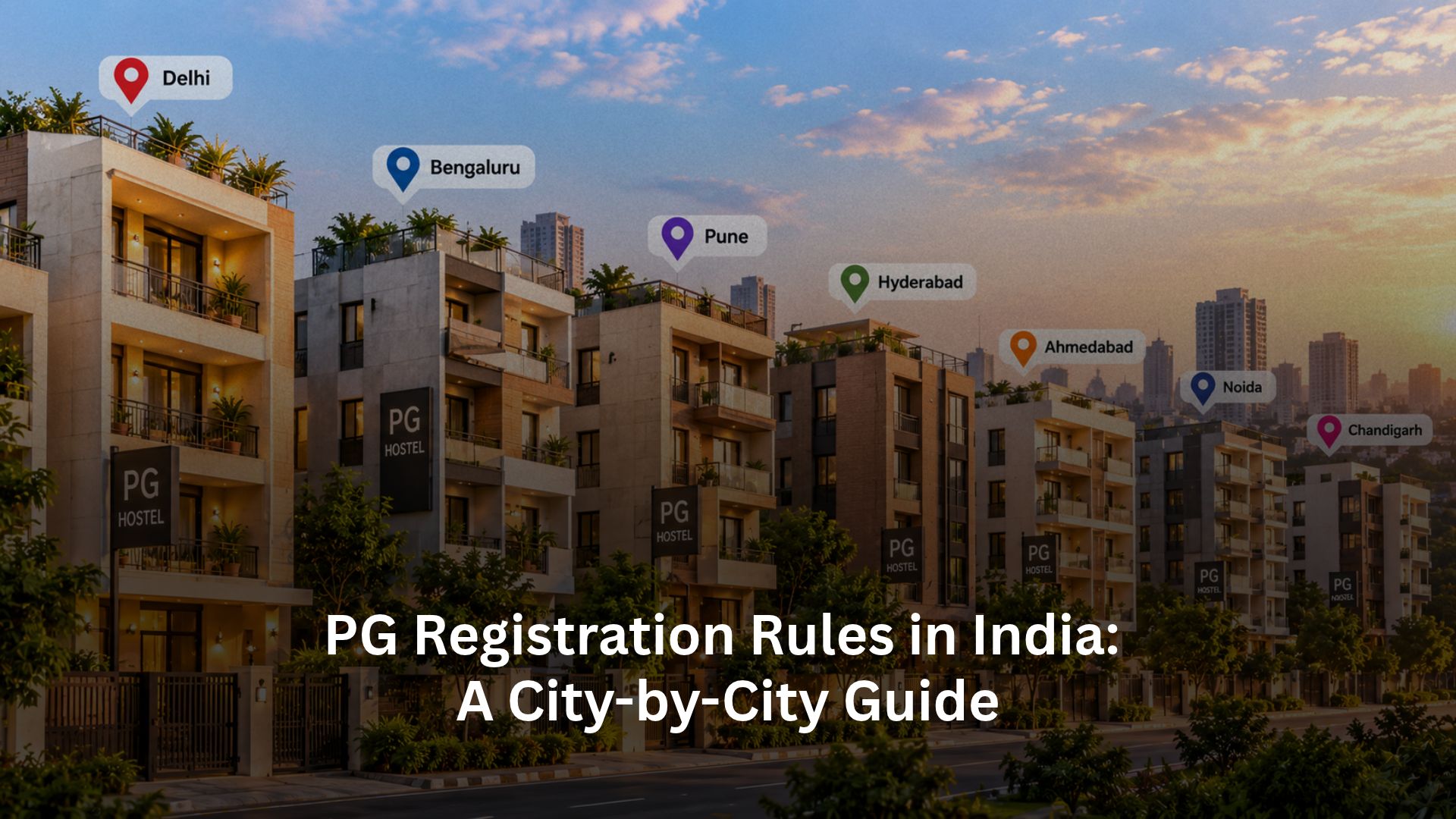
PG Registration Rules in India: A City-by-City Guide

Written by
Ishika Pannu
Read Time
10 min read
Posted on
October 21, 2026
Overview
Overview
PG Registration Rules in India: A City-by-City Guide
Before you furnish a PG, check whether the building can legally support the business. A residential address, an owner’s consent and signed agreements may still leave gaps in operating permissions, fire safety or resident verification. Discovering those gaps after accepting deposits can disrupt your opening and put your investment at risk.
PG registration rules differ across cities because several authorities oversee different parts of the operation. This guide explains how PGs differ from ordinary rentals, compares seven cities, identifies recent enforcement concerns and gives operators a practical checklist. It also separates Delhi’s reported proposals from existing requirements, so you can plan without treating draft provisions as current law.
Start with the property you actually intend to operate: its address, approved use, bed count and meal arrangements. Those details help each authority answer your question accurately and reduce the risk of applying under the wrong category.
Why every city treats PGs differently
An ordinary rental usually gives a household possession of a home. A PG may accommodate unrelated residents, supply meals, employ staff and manage frequent move-ins. Those activities raise additional questions about occupancy, sanitation, security and emergency evacuation. Authorities consider the actual operation, not simply the “PG” label.
State laws, municipal rules, development plans and police directions create different local requirements. Even neighbouring properties can fall under different authorities. Identify your municipal body, planning authority and police jurisdiction before applying.
Keep agreement registration, operating permission, police verification, fire clearance and food registration separate. Each serves a different purpose. RentOK’s rent agreement checklist helps you document resident terms, but an agreement cannot replace permission to operate.
City-by-city table: authority, licence, police verification, fire NOC and FSSAI
Use this comparison to identify your starting points. Where requirements depend on building use or local orders, confirm applicability for the exact address. “Check” does not mean optional.
| City | Main authority | Licence or permission | Police verification | Fire NOC | FSSAI |
|---|---|---|---|---|---|
| Delhi | Municipal body and planning authority | Confirm accommodation category; distinguish GovPG proposals | Follow Delhi Police requirements | Check building/category | Check food-business activity |
| Bengaluru | Jurisdictional city corporation | PG trade licence and conditions | Confirm local procedure | PG guidelines require clearance | Check mass-kitchen requirements |
| Pune | PMC, PCMC or relevant authority | Confirm residential, hostel or lodging classification | Follow jurisdictional directions | Check building/use | Check food-business activity |
| Hyderabad | GHMC or applicable local body | Confirm trade category and building use | Check commissionerate | Check building/use | Check kitchen/mess activity |
| Ahmedabad | AMC and building-use authority | Check use, permissions and society NOC | Confirm local requirement | Check premises | Check food-business activity |
| Noida | NOIDA Authority and relevant departments | Check sanctioned use and lease conditions | UP Police tenant/PG service | Check applicable rules | Check food-business activity |
| Chandigarh | Estate Office or CHB | Applicable PG-policy registration | Maintain records and police intimation | CHB policy requires UT fire NOC | Check food-business activity |
An in-house mess can create food-business obligations even when rent includes meals. Use FoSCoS to check the current registration or licence category; avoid copying outdated turnover thresholds.

Delhi: separate existing checks from GovPG proposals
Start with the property’s approved use. The DDA Master Plan sets conditions for specified activities in residential areas. Do not convert guest-house plot-size, road-width or colony restrictions into a blanket rule for every PG.
A September 2026 report described an unfinished draft proposing a GovPG portal, licensing and clearances within 90 days, 30-day CCTV storage and night security for accommodation housing at least 15 students. These remain reported proposals unless a later notification establishes their implementation. Do not advertise draft deposit caps as existing legal limits.
Delhi Police requires owners to inform local police when taking tenants. Check current electricity classification separately: historical DERC orders included a household-PG provision up to 5 kW, but operators should confirm today’s tariff with their supplier.
Before signing a building lease, ask the relevant authority which accommodation category fits your proposed capacity and services. Record that answer alongside the sanctioned plan. A general assurance that “other PGs operate nearby” does not answer the question for your property.
Ask the owner for the documents that support the proposed use, and compare them with the actual building. Resolve any mismatch before agreeing who will fund alterations or carry the risk of an unsuccessful application.
Bengaluru: check capacity before adding beds
The 2024 BBMP guidelines, reproduced in 2026 court reporting, included 70 square feet per occupant, CCTV at entrances, exits and corridors with 90-day storage, hygienic toilets, drinking water, security, first aid, waste segregation and fire clearance. They also addressed FSSAI licensing for mass kitchens.
Check the current conditions before opening or renewing. Extra beds may exceed permitted capacity even when they fit physically. The Greater Bengaluru Authority now identifies five city corporations and links trade-licence services; locate the corporation responsible for your property.
Maintain accurate resident records alongside licensing. RentOK’s guide to what tenant police verification means explains why collecting an ID alone does not complete that process. Treat advertised deposits and notice periods as contract terms, not automatic citywide legal limits.
Check equipment in practice: cameras need adequate storage, exits need clear access and staff need emergency instructions. Keep maintenance records so your safety arrangements remain usable after the initial inspection.
Build your income estimate around the capacity that the applicable rules allow. If an owner promises room for extra beds, verify that claim before setting rent targets or paying for additional furniture.
Pune: register the right agreement and follow police directions
Confirm whether PMC, PCMC or another authority covers the address, then establish the accommodation category. Your lease should expressly allow the intended activity and your arrangement with residents.
Section 55 of the Maharashtra Rent Control Act requires written, registered agreements for covered lettings and leave-and-licence arrangements, with responsibility on the landlord. The Act’s definitions and exclusions matter, so check how it applies to your arrangement.
Follow the jurisdictional police process separately. Prepare the relevant tenant verification documents, check current submission requirements and retain acknowledgements. For apartments, examine society bye-laws and actual consent requirements rather than assuming every letting needs the same NOC. Confirm fire and food requirements for the operation too.
Hyderabad and Ahmedabad: resolve permissions before committing
Hyderabad
Ask GHMC or the relevant local body which trade category covers your operation. The GHMC service lists identity and legal-occupancy documents among its requirements. Read the certificate’s conditions and approval status; payment alone does not settle every building permission.
Confirm whether Hyderabad City, Cyberabad or Rachakonda police covers the premises. Review fire safety, water, sanitation and waste arrangements, and clarify food-compliance responsibilities when you run a mess or appoint a caterer.
For outsourced meals, identify who prepares, transports, stores and serves the food. Keep the supplier’s relevant documents with your kitchen records rather than assuming outsourcing removes every responsibility.
Ahmedabad
Check sanctioned use, AMC permissions and any society-NOC requirement before renting a society flat. Owner consent does not settle those questions. A January 2026 report described sealing action against three Memnagar properties operating without required permissions.
Distinguish commercial-PG restrictions from disputes about bachelors sharing a home. A society resolution or an interim order in one case does not establish the answer for every property.
Noida and Chandigarh: establish property eligibility first
Noida
Check NOIDA Authority’s sanctioned-use and allotment/lease conditions before converting a residential property into a PG business. Do not treat UP-RERA registration as the routine operating licence or assume model bye-laws automatically govern your address.
UP Police lists tenant/PG verification services. Confirm the current channel, preserve acknowledgements and check fire, utility and food requirements separately.
Chandigarh
CHB’s published policy specifies independent houses of at least 7½ marla, owner occupation of part of the house, sanctioned construction without unauthorised additions, 50 square feet per guest and one WC per five people. It also requires a UT Chief Fire Officer NOC and PG registration.
February 2026 reporting describes an amendment making completion certificates mandatory and ending conditional registration. Obtain the current policy and confirm the required completion/occupation documents with CHB or the Estate Office.
Inspect the property against its paperwork before applying. An additional room, enclosed balcony or altered floor can raise approval questions even when the owner holds an older registration.
Where crackdowns are happening right now
Recent dated actions show what authorities examine. They do not prove that an earlier drive continues today:
- Bengaluru: June 2026 reporting described concerns involving fire safety, trade licences, sanctioned plans and residential-zone use.
- Ahmedabad: February 2026 reporting covered enforcement and protests involving permissions and society NOCs.
- Delhi and Chandigarh: Distinguish Delhi’s reported draft framework from Chandigarh’s reported registration-policy amendment. They create different planning considerations.
If you receive a notice, follow its specific legal basis and deadline. Review extra floors, additional beds and changed kitchens against your approvals rather than relying on an old certificate.
The one checklist that works in every city
Use the same filing structure everywhere, then adapt the requirements locally:
- Property: Confirm jurisdiction, approved use, ownership/lease documents, sanctioned plans and applicable completion/occupation records.
- Permissions: List operating approvals, owner/society requirements, capacity, conditions and renewal dates.
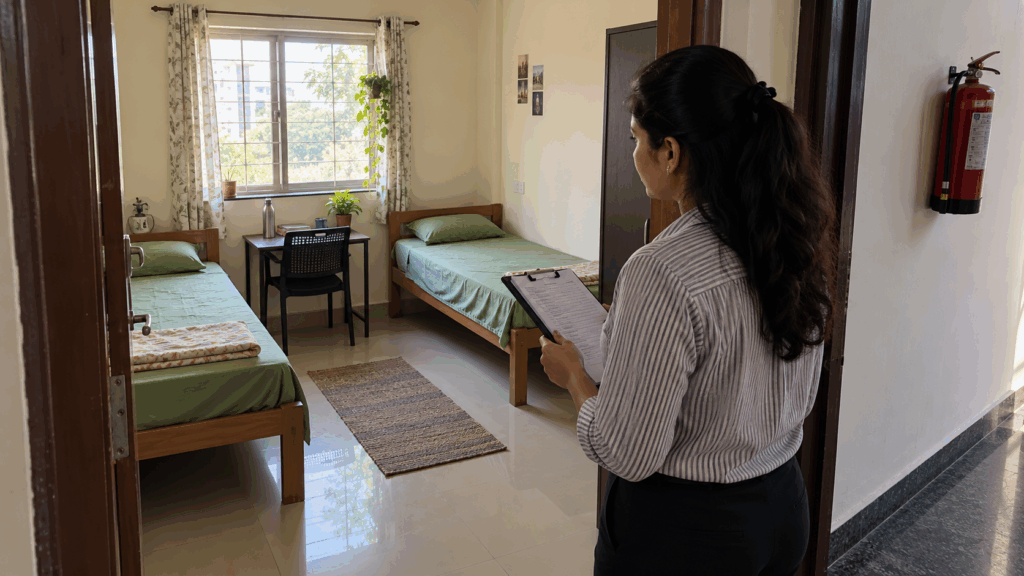
- Safety and food: Check fire clearance, equipment, exits, drinking water, waste arrangements and applicable FSSAI registration.
- Residents: Record identity, address, contact details, move-in date, bed allocation and police submission status. Update departures promptly.
- Agreements: Document charges, deposits, refunds, notice and house rules; check stamp and registration requirements.
For paying guest registration online, identify each document and issuing authority first. Use official channels, respond to inspection queries and distinguish application receipts from final approvals.
Assign one person to maintain the file and schedule renewal reminders. Review it whenever you add beds, change the kitchen or alter the building. This catches gaps while you can still address them before the next move-in or renewal.
Restrict access to resident documents and explain why you collect them. RentOK’s guide to handling personal data during verification helps you organise this responsibility without collecting unnecessary information.

How RentOK helps with tenant police verification
RentOK offers tenant KYC, agreement and police-verification services alongside rental-management tools. Confirm availability and the applicable procedure for your location. Its tenant police verification guide explains the documentation workflow.
Track ID collection, submission and acknowledgement as separate stages for each resident. Keep municipal permissions, fire clearance and food registration with their respective authorities; resident verification supports one part of your compliance work.
Conclusion
Running a compliant PG starts before the first resident moves in. Choose a property that supports your intended use, confirm the local permissions and check that the building matches its approvals. Then keep those arrangements current as you add beds, change services or renew licences. A clear compliance file helps you identify gaps early and respond to questions with the right records.
Resident onboarding deserves the same attention. Collect the required details, follow the applicable police process and retain the acknowledgement for each move-in. Start tenant police verification with RentOK and confirm the procedure for your city, so your growing PG business has an organised resident documentation trail.
Frequently Asked Questions
Find answers to common questions about this topic
About the Author
Ishika Pannu
Ishika Pannu brings you the latest insights and easy-to-apply strategies in property management—helping you simplify renting and grow with RentOk.
You may also like these
Related Articles
1 min read
Delhi PG Bill Explained: Licence, Deposit Cap, Rent Bands and the GovPG Portal
Written by
Posted on
Ishika Pannu
Oct 20, 2026
1 min read
Fire NOC for PGs and Hostels: Process, Documents and Fees State by State
Written by
Posted on
Ishika Pannu
Oct 19, 2026
1 min read
MCD Structural Safety Certificate for PGs: 15-Day Guide
Written by
Posted on
Ishika Pannu
Oct 19, 2026
1 min read
What Can I Ask a Prospective Tenant Before Renting My Property?
Written by
Posted on
Ishika Pannu
Oct 14, 2026
1 min read
Is a Notarised Rent Agreement Enough, or Do I Need to Register It?
Written by
Posted on
Ishika Pannu
Oct 5, 2026
1 min read
Which Indian Cities Still Fall Under Old Rent Control Laws?
Written by
Posted on
Ishika Pannu
Oct 3, 2026
1 min read
Managing Rental Property in India as an NRI Landlord
Written by
Posted on
Ishika Pannu
Oct 1, 2026
1 min read
What Documents Do I Actually Need Before Handing Over My Rental Property?
Written by
Posted on
Ishika Pannu
Sep 30, 2026
1 min read
Is a Verbal Rental Agreement Legally Valid in India?
Written by
Posted on
Ishika Pannu
Sep 24, 2026
1 min read
What Can I Do If My Tenant Stops Paying Rent?
Written by
Posted on
Ishika Pannu
Sep 23, 2026
Stay ahead in property management with expert insights
Join thousands of property managers receiving exclusive tips delivered straight to your inbox.
Browse posts by category
Case Study
Cost of Living
Growth
Legal
Market Trends
News
Pg owner app
Property Management
Property Tax
Tech
RentOk
The easiest way to rent and manage your PGs and hostels.
Grievance Officer
Get the app


Contact us
hello@eazyapp.tech
HQ Office
COGROW, BASEMENT F-12/8A
BESIDE HOUSE OF STYLE SALON, SECTOR 28, DLF PHASE 1
GURUGRAM, HARYANA - 122002
South India Office
LUMIODESK COWORKING, 2ND FLOOR, 40, 14TH MAIN RD
BESIDE MC DONALD, 7TH SECTOR, HSR LAYOUT
BENGALURU, KARNATAKA - 560102
©️ 2026 EazyApp Tech Pvt Ltd. All rights reserved


