Legal
Can Your Housing Society Stop You From Running a PG?


Written by
Ishika Pannu
Read Time
10 min read
Posted on
October 28, 2026
Overview
Overview
Can Your Housing Society Stop You From Running a PG?
You own an apartment, see demand for shared accommodation and decide to offer rooms to paying guests. Then the society objects: more visitors, extra lift use, unfamiliar faces at the gate. Before buying beds or accepting deposits, you need to establish whether the objection concerns an enforceable restriction, a permission requirement or a problem you can resolve through better management.
Running a PG in a residential society does not have one nationwide yes-or-no answer. The outcome depends on the property’s permitted use, the operating model, applicable state law and the society’s governing documents. A society can challenge an unauthorised or disruptive operation, but a committee member’s verbal objection does not settle every legal question. This guide explains the distinctions, relevant court orders and practical steps owners should take before opening.
Is a PG automatically a commercial activity?
The label “PG” does not decide the legal classification. A homeowner accommodating a few long-term residents can present different issues from an operator filling an entire flat with beds, providing meals and housekeeping, and accepting frequent short stays. Authorities and courts examine the actual arrangement alongside the applicable rules.
Consider these distinctions before asking, “Is PG in an apartment legal?”:
| Arrangement | Main questions to examine |
|---|---|
| Ordinary residential letting | Does the letting comply with the agreement, society procedure and residential-use rules? |
| Owner-occupied paying-guest arrangement | Does the local framework permit this model, and what conditions apply? |
| Managed PG or hostel-style operation | Does the building permit the activity, occupancy and services, and which approvals apply? |
| Short-stay accommodation through booking platforms | Do the society restrictions and local lodging or accommodation rules permit the activity? |
These categories guide your checks; they do not create automatic exemptions. Charging rent alone does not answer every land-use question, while describing a hostel-style business as “residential sharing” cannot override a restriction that actually applies.
For example, a proposal for three long-term occupants needs a different factual description from twelve beds with frequent changeovers and an on-site kitchen. Neither number establishes legality by itself. Give the society and the relevant authority the same accurate description, so an approval for one arrangement does not become the basis for a materially different operation later.
RentOK’s guide to starting a PG business legally provides a useful planning framework. Confirm the position for your premises before relying on an advertisement, an agent’s assurance or another building’s practice.
Society bye-laws, resolutions and their limits
Start by identifying the body involved. A co-operative housing society, an apartment owners’ association and an RWA may operate under different state laws and governing documents. “RWA rules for PG” therefore cannot describe one uniform set of powers across India.
Ask for the registered bye-laws, the relevant use restriction, any amendment and the resolution the committee relies on. A resolution may implement an existing provision or attempt to introduce a new restriction; those situations raise different questions. Neither a WhatsApp message nor a majority vote automatically overrides the governing statute.
Maharashtra’s two-thirds rule needs context
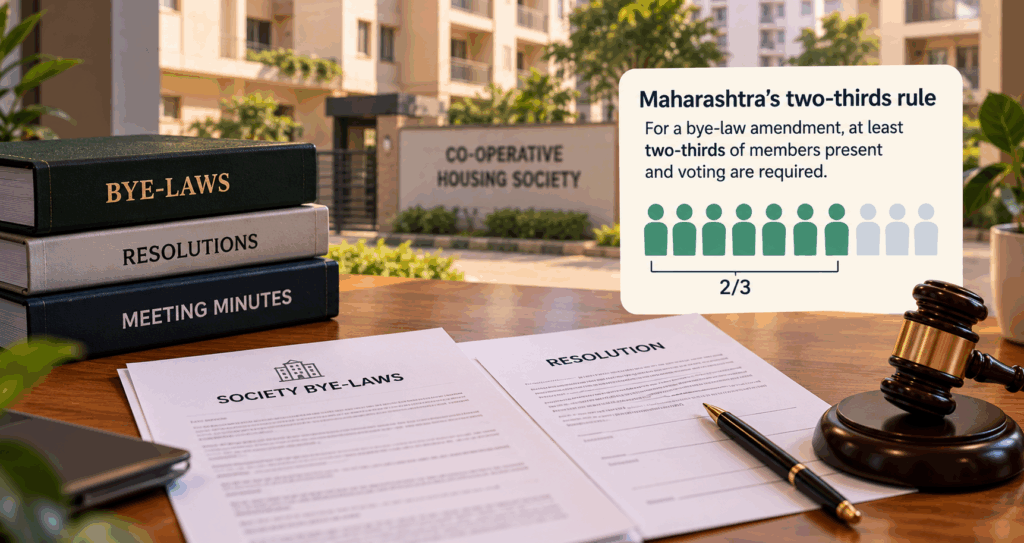
For a bye-law amendment under Rule 12 of the Maharashtra Co-operative Societies Rules, 1961, the prescribed general-body process includes notice and support from at least two-thirds of members present and voting. It does not mean two-thirds of every member on the society’s rolls. Section 13 addresses registration of amendments through the statutory process. See the Rule 12 text and Maharashtra Act.
Do not turn this into “every PG objection requires a new AGM amendment.” Existing registered provisions or resolutions may already matter. Equally, the voting threshold does not validate a restriction that conflicts with applicable law. Review the actual documents and procedure before deciding whether to comply, seek clarification or challenge the restriction.
What have courts actually said about PG restrictions?
Court headlines often collapse a narrow dispute into a blanket rule. Read the operating model, relief requested and outcome before applying a case to your own flat.
In Mahesh K. Mehta v. Bharatiya Friend’s Co-operative Housing Society, the Bombay High Court’s 19 December 2025 order concerned paid guests through agencies and platforms including Airbnb. The society had existing restrictive resolutions, and the owner already challenged them before the Co-operative Court. The High Court declined the writ route and left him to pursue that proceeding; it did not finally decide the resolutions’ legality. The actual order supports taking an existing restriction seriously while contesting it through the proper forum.
In Mukesh Bhanwarlal Bhandari v. State of Gujarat, the Gujarat High Court’s 17 June 2025 order addressed premises that the corporation treated as an unauthorised PG/hostel operation. The court continued temporary unsealing for one week to allow guests to arrange alternatives. The court order illustrates the consequences of missing applicable permission; it does not establish a national PG ban.
Disputes about bachelor or tenant bans also require care. A challenge to a blanket exclusion does not automatically establish a right to operate a managed hostel. Likewise, a society cannot treat every disagreement about a visitor as proof of unlawful commercial use. The relevant facts and legal basis remain essential.
Do you need a society NOC for paying guests?
There is no single all-India society NOC requirement covering every PG arrangement. Check whether your registered documents require prior consent, written intimation, occupant details or a particular application. These procedures serve different purposes; submitting information does not necessarily amount to receiving permission.
Describe the proposal accurately: resident count, expected stay duration, meals, staff, visitor arrangements and whether you or a third-party operator will manage it. If you rent the flat yourself, check the owner’s written permission and any restriction on subletting or operating a PG.
Keep three checks separate:
- Society procedure: Establish the applicable consent or intimation requirement and obtain a written response through the proper channel.
- Building and civic approvals: Confirm permitted use, sanctioned capacity and applicable municipal, trade or lodging requirements. A society NOC cannot legalise unauthorised construction or prohibited use.
- Safety and occupant records: Check fire-clearance requirements and local police verification or tenant-information procedures. Applicability depends on the jurisdiction and property.
RentOK’s society-permission guide explains the difference between routine letting and other accommodation models. Its city-by-city PG registration guide helps you identify the separate local checks. Keep acknowledgements and approval conditions together, and do not assume that silence from one authority resolves another authority’s requirements.

Lifts, parking and visitors: the everyday flashpoints
Even where the accommodation model is permissible, shared-space conduct can generate legitimate complaints. Address the specific impact rather than treating every objection as hostility towards tenants.
For lifts, agree reasonable move-in arrangements and prevent occupants or delivery staff from leaving luggage in corridors. Keep stairs and escape routes clear. RentOK’s PG fire-safety guide explains why access routes need attention alongside equipment and approvals.
For parking, document the spaces actually available to the flat. Do not promise every resident a vehicle slot when the property has none. Explain visitor parking, two-wheeler placement and the process for reporting an obstruction.
For visitors, give residents and guards the same instructions: whom to contact, how to confirm a visit and what arrival or departure details to record. Collect only information needed for the legitimate security purpose, restrict access and avoid circulating identity documents in informal resident groups. Clear procedures work better than guards improvising different rules each evening.
Societies may also raise non-occupancy charges. Ask for the legal basis, calculation and applicable state directions; do not assume one state’s cap applies everywhere. Distinguish these charges from maintenance, damage recovery and disputed fines. Paying a non-occupancy charge does not itself grant permission to run a PG.
A workable agreement with the committee
Approach the society before accepting residents or non-refundable commitments. Submit a short operating note explaining the accommodation model, resident count, responsible contact and arrangements for waste, staff, visitors and emergencies. Ask the committee to identify any objection against a specific provision or practical concern.
Translate agreed conduct rules into the residents’ written terms. Cover noise, deliveries, parking, shared facilities, visitors and complaint escalation. RentOK’s rent-agreement checklist can help you organise these provisions. Keep them consistent with applicable law and the permissions for the property.
If the society still refuses permission
Request the written decision, cited provisions, relevant minutes and available review procedure. Preserve correspondence, permission records and evidence of how the premises actually operate. Separate a disagreement over legal authority from a nuisance complaint you can resolve immediately.
An owner may approach the Registrar, Co-operative Court or another competent forum, depending on the state, association structure and relief sought. The Mumbai case shows why choosing the forum matters. A society may separately complain to municipal or police authorities about unlawful use or nuisance; those authorities must assess the matter under their powers.
Do not assume that filing a challenge suspends an existing restriction or closure notice. Obtain advice on deadlines and interim relief, and make arrangements for residents if enforcement threatens their stay. A documented objection is far easier to assess than an escalating argument at the gate.

How RentOK helps manage house rules and visitor records
Once you establish the permitted arrangement, your team needs consistent daily records. RentOK supports resident administration and communication, helping you connect agreed house rules with the people who actually live at the property.
- Resident records and KYC: Organise resident information and stay details so managers can identify occupants and keep records current. Complete any separate local police procedure and retain its acknowledgement where required.
- Agreements and renting rules: Use RentOK’s agreement workflow and supported renting-rule settings to communicate the property’s terms. Check that those terms reflect the society’s lawful requirements and the accommodation you actually offer.
- Entry-exit and guest workflows: RentOK describes entry-exit logs, guest invitations and leave information in its tenant-app offering. Confirm the available setup, then align it with the guard’s verification process and your visitor policy.
- Complaint follow-up: Use complaint management to track reported issues and the team’s response. A record of follow-up helps managers address repeated noise, cleanliness or maintenance concerns before discussions become personal.
RentOK’s published product offering describes these operational tools. They support administration; the society, competent authorities and applicable law determine the permissions your PG needs.
Conclusion
A housing society can raise a serious challenge when a PG breaches applicable restrictions, operates without required permissions or disrupts other residents. However, the answer must come from the property’s actual use, governing documents and local law. Neither ownership of the flat nor a committee’s verbal refusal provides the complete legal position.
Before opening, establish the permission route, document the operating model and agree workable rules for shared spaces. If a dispute remains, seek a written decision and pursue the appropriate remedy instead of relying on informal assurances. Set house rules and visitor logs on RentOK to support consistent daily management once you establish the lawful basis for your operation.
Frequently Asked Questions
Find answers to common questions about this topic
About the Author
Ishika Pannu
Ishika Pannu brings you the latest insights and easy-to-apply strategies in property management—helping you simplify renting and grow with RentOk.